
4 Days in Sigri Lesvos: Where the Journey Quietened
At the far western edge of my next destination revealed itself slowly. Over four unexpectedly peaceful nights, Sigri Lesvos offered striking volcanic landscapes, interesting Petrified Forests, and enabled me to settle into the quiet rhythms of village life. It became a place of stillness rather than spectacle — a reminder that not all memorable travel moments announce themselves loudly.
Whilst waiting for Stelios, the taxi driver to take me to Sigri, I sat on my balcony at Eleftheria’s place, eating bougatsa and drinking tea. Around me, others were departing too — many heading for the airport, some eighty(ish) kilometres away. When Stelios arrived, I said my goodbyes, thanked Eleftheria for a wonderful stay, and set off.
As we left Skala Eresou behind, the landscape began to reveal the low, rolling volcanic hills in shades of ochre to burnt umber, scrubby and stark. It’s such a contrast to the rich and verdant landscape of the north and east. Stelios told me that while the petrified forest in Sigri was famous, there were petrified forests scattered across the island, though Sigri holds the greatest concentration. I remembered seeing a solitary petrified stump near the marina in Mytilene, almost ninety kilometres away — a reminder of how far-reaching this geological story really is.
Accommodation options in Sigri were limited, likely because the season was drawing to a close. Reviews described Marianthia’s place as basic but clean, which would do for my short stay. As we rolled into the village, Stelios gave her a call to locate the place exactly. Several minutes later, she was waiting for us at the gate. After introductions, she called for Tammy, who came running down the stairs and instinctively picked up my case. Tammy must have been all of four feet ten, so there was no way I could let her carry it alone. Together, we negotiated the two flights of stairs to my little abode at Ioannides – Sigri Studios.
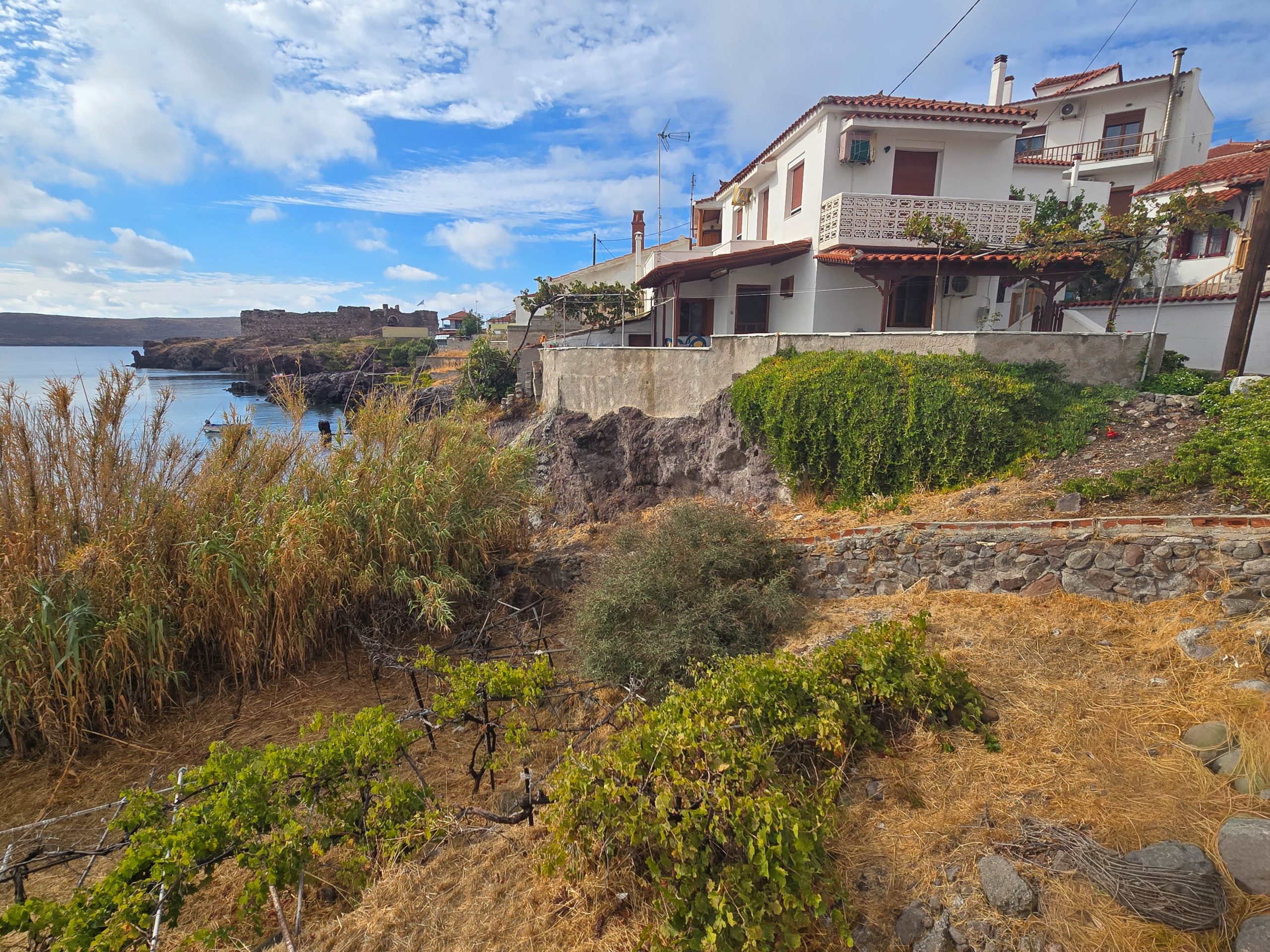
The room was simple, the bathroom compact, but the balcony looked out across the bay towards the castle. Location is everything. Down below, Marianthia’s garden, her pride and joy, was clearly a place for family get-togethers.
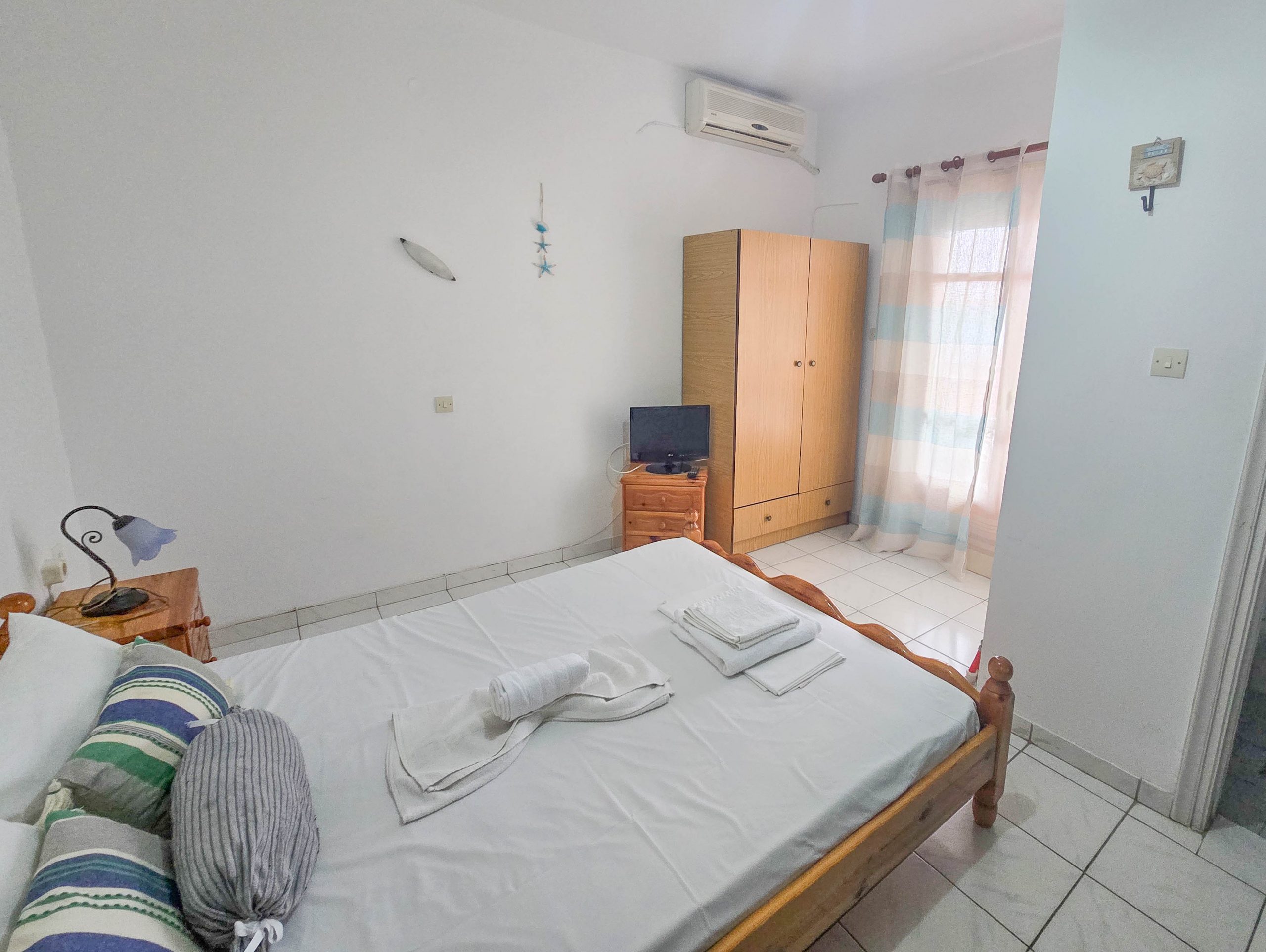
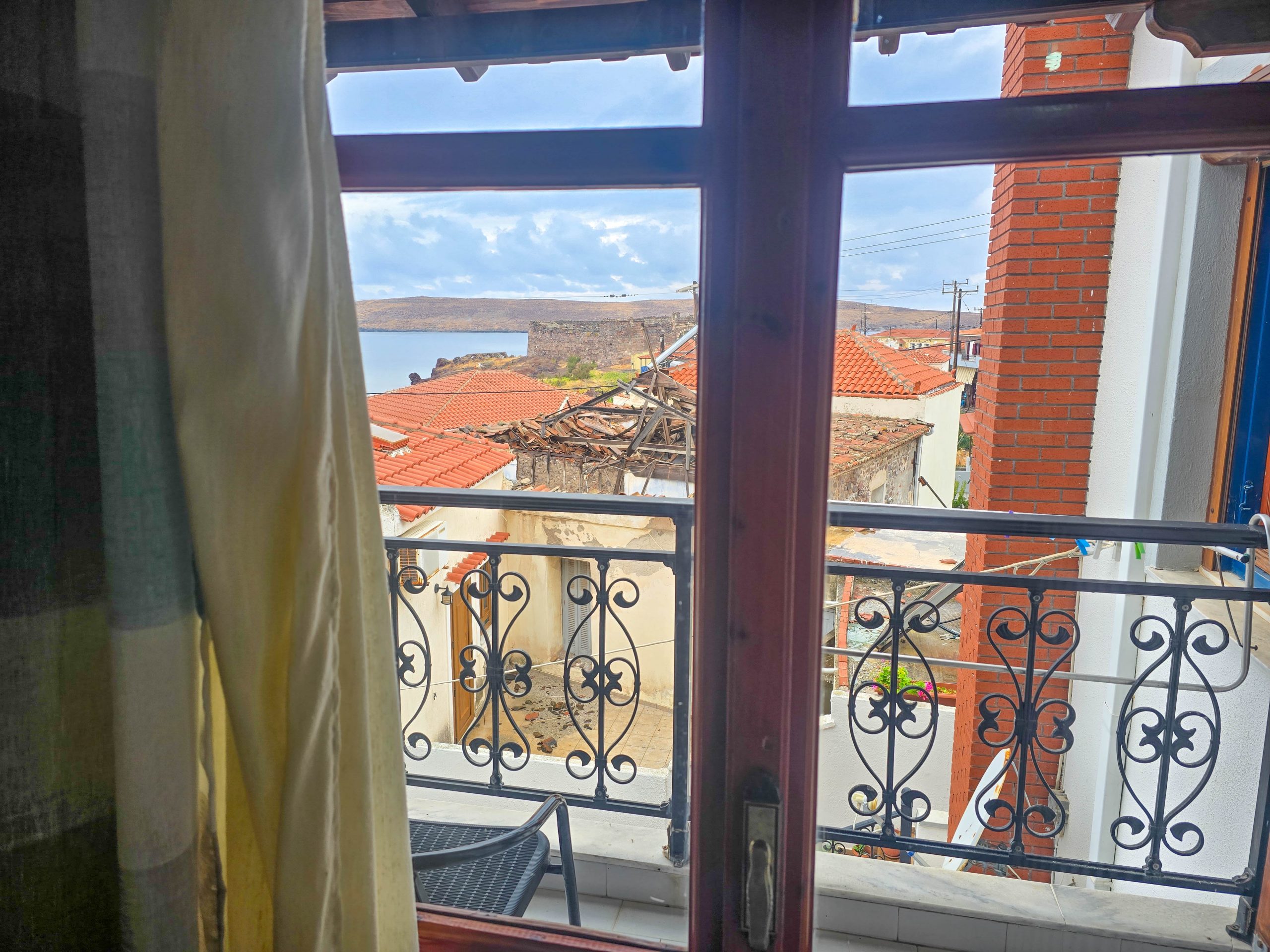
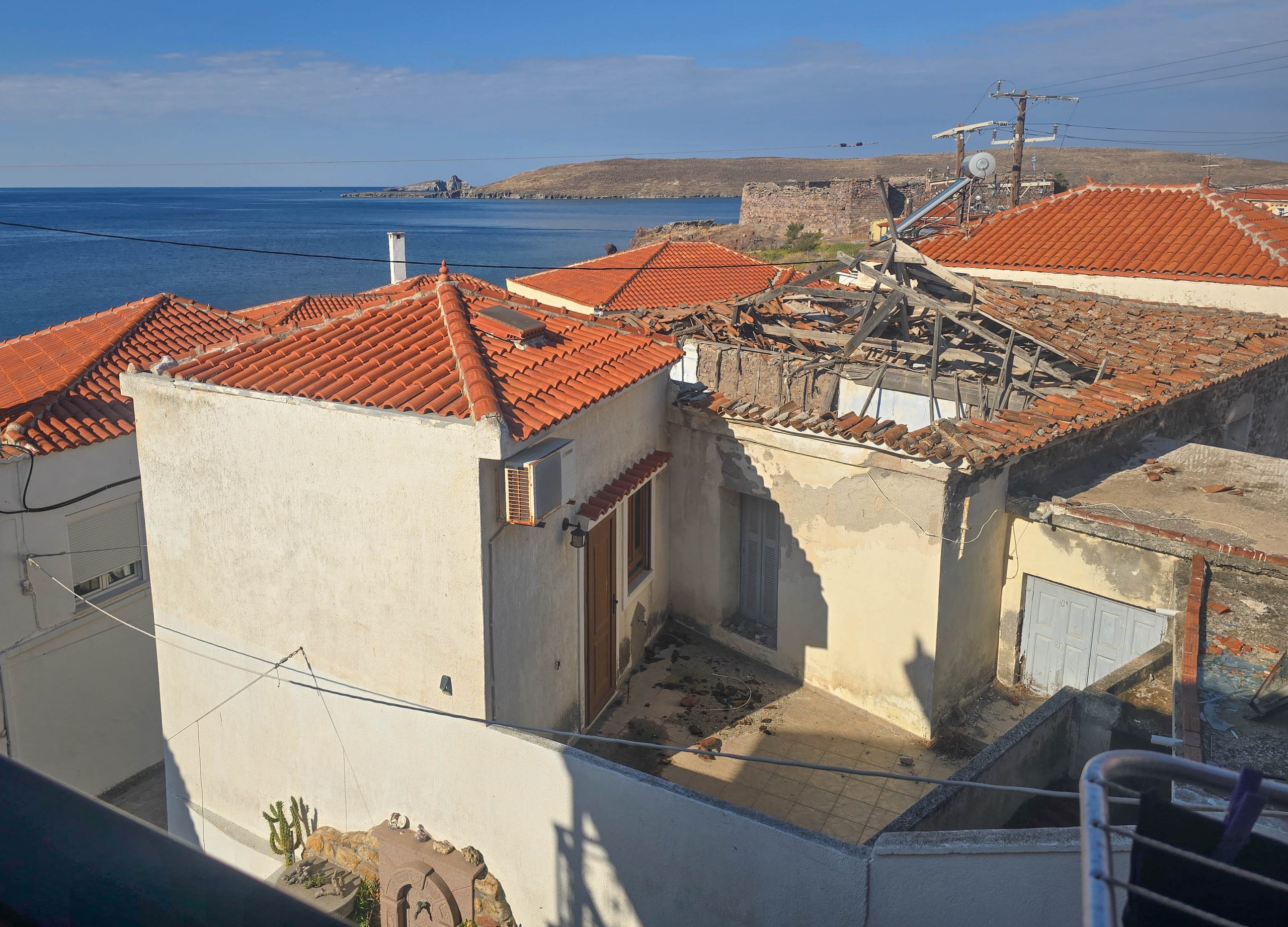
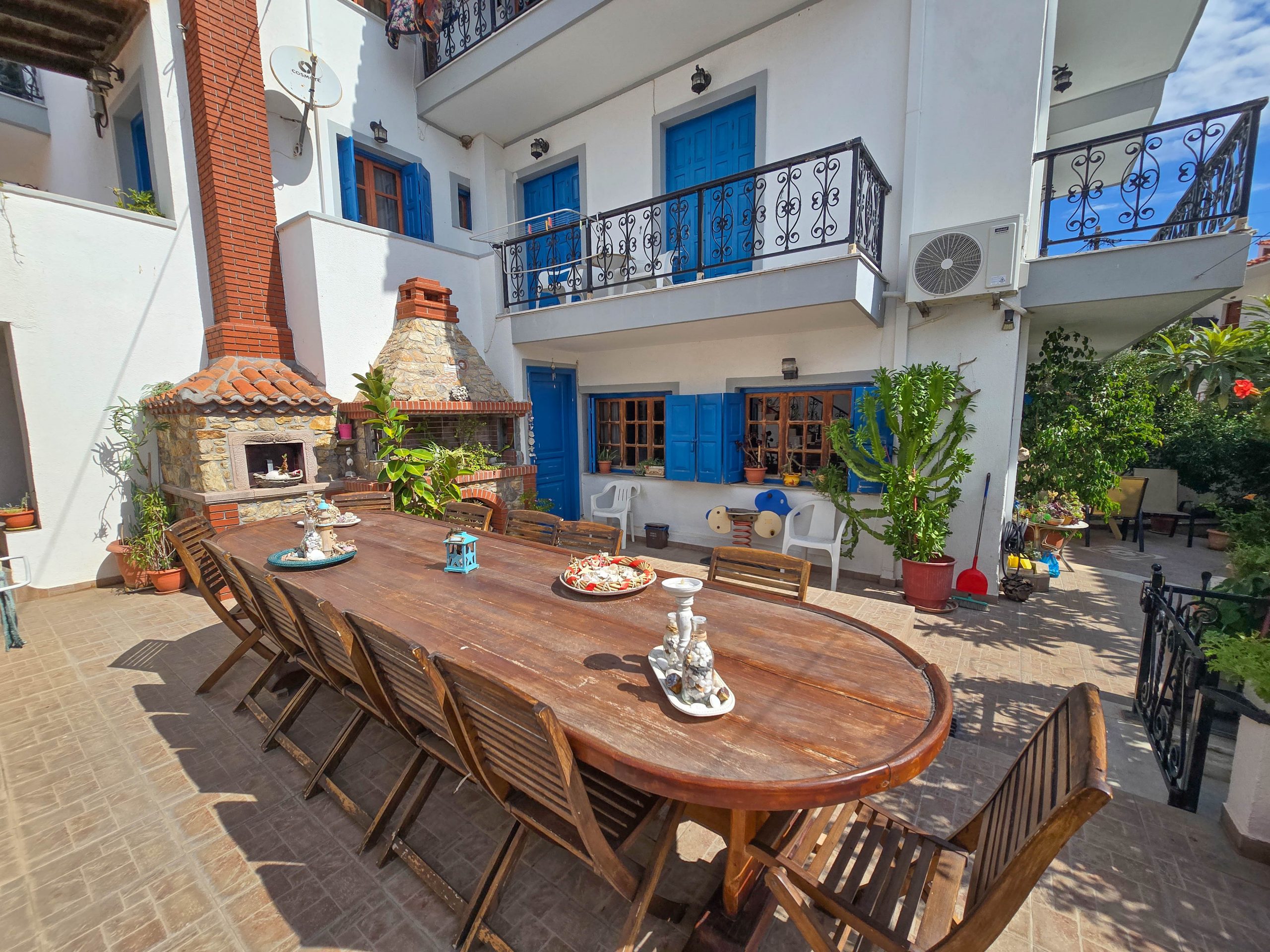
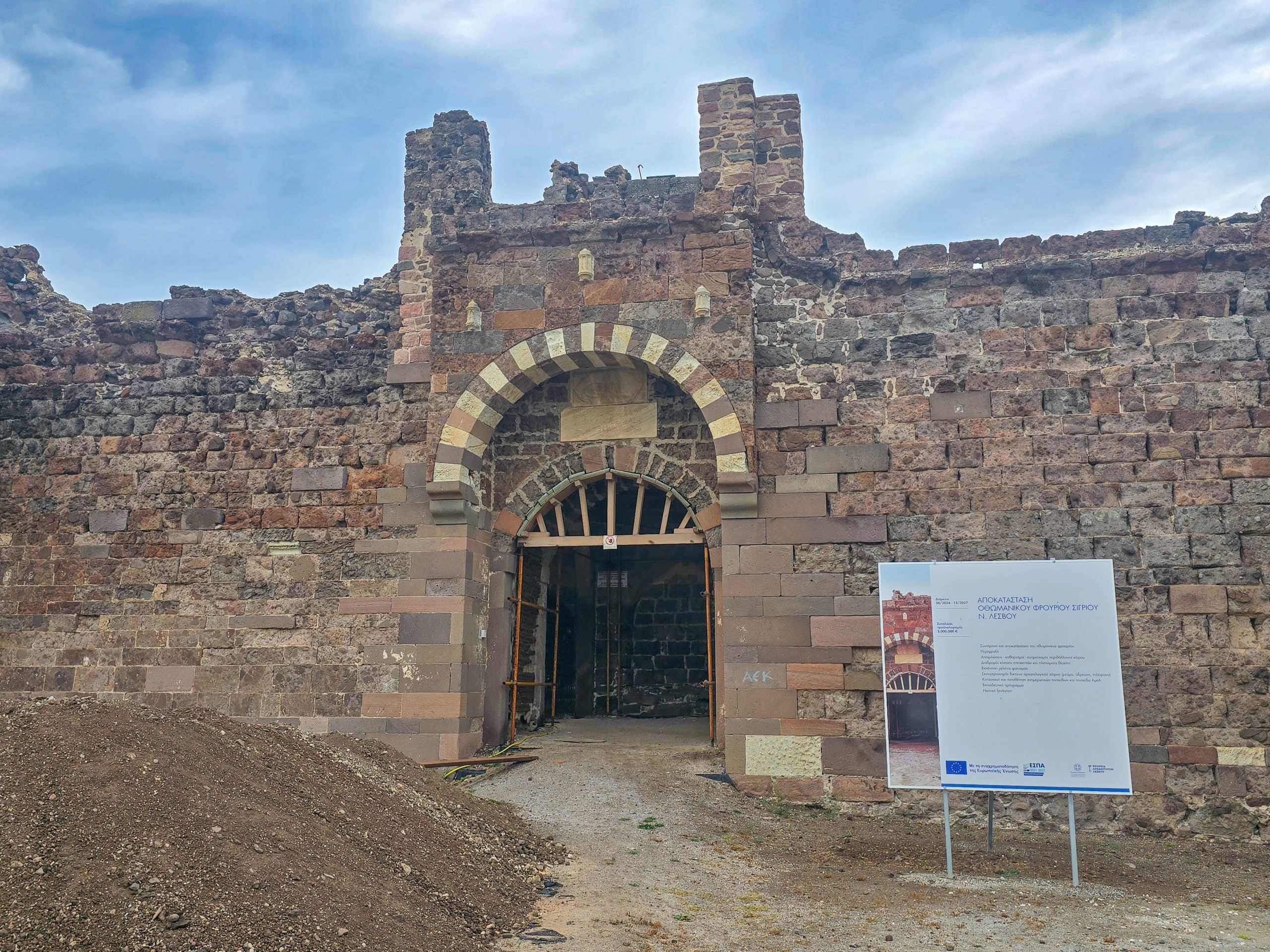
Sigri is best discovered on foot. The castle, unfortunately, was cordoned off for refurbishment. I learned later that it had become unsafe, but after restorative work, it would open to the public again. Nonetheless, I was happy to see this small fortification from the perimeter fence.
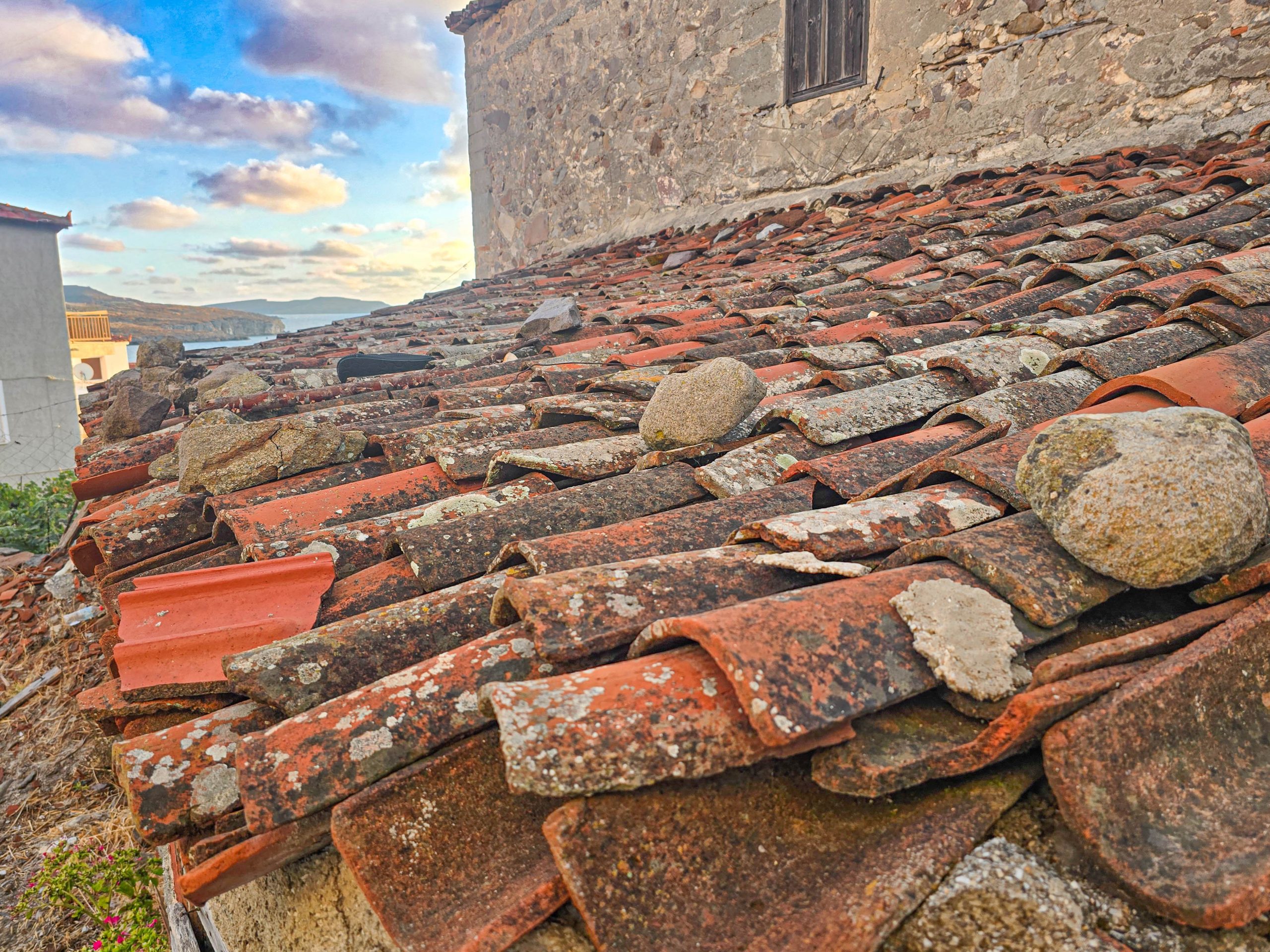
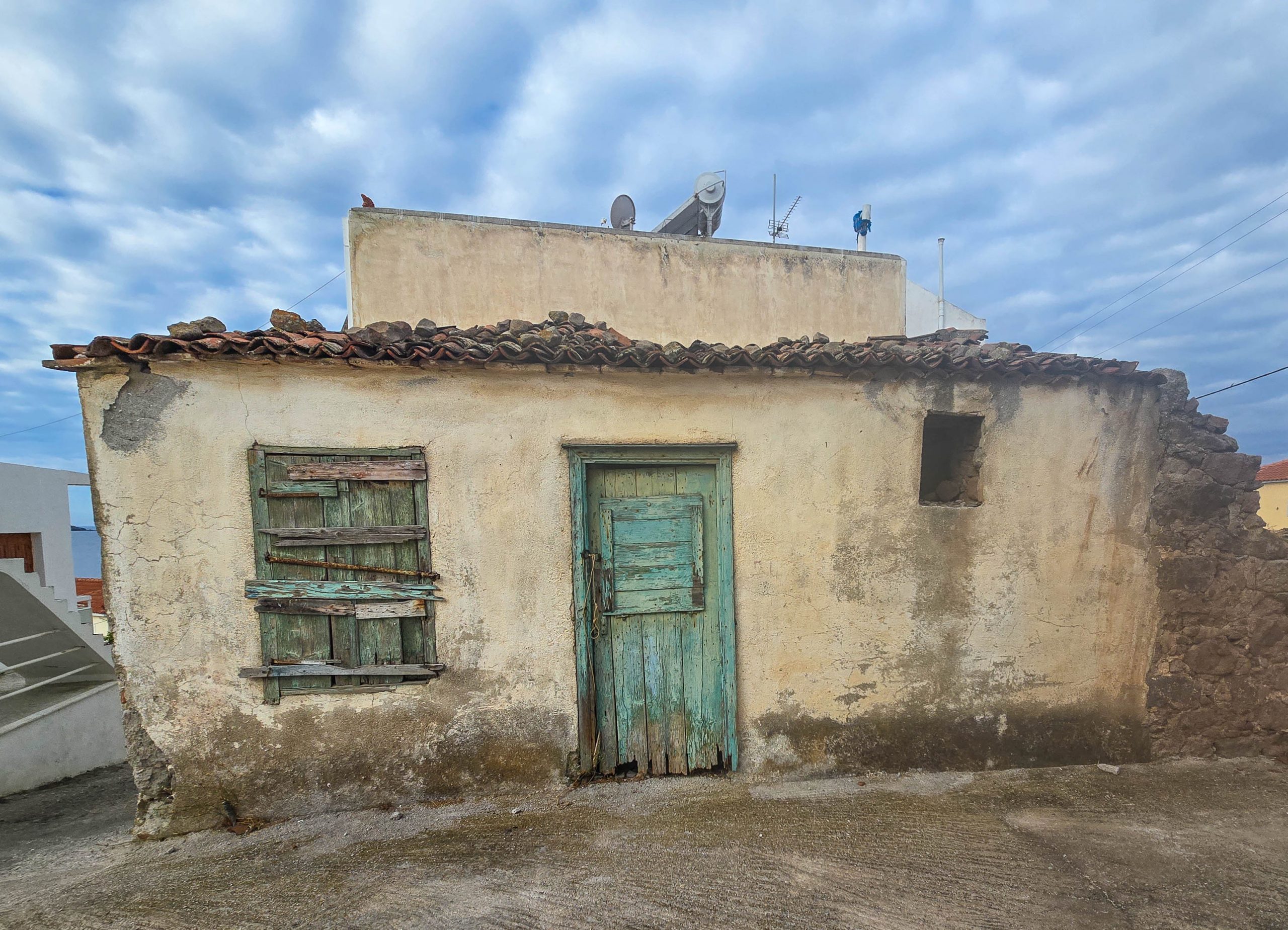
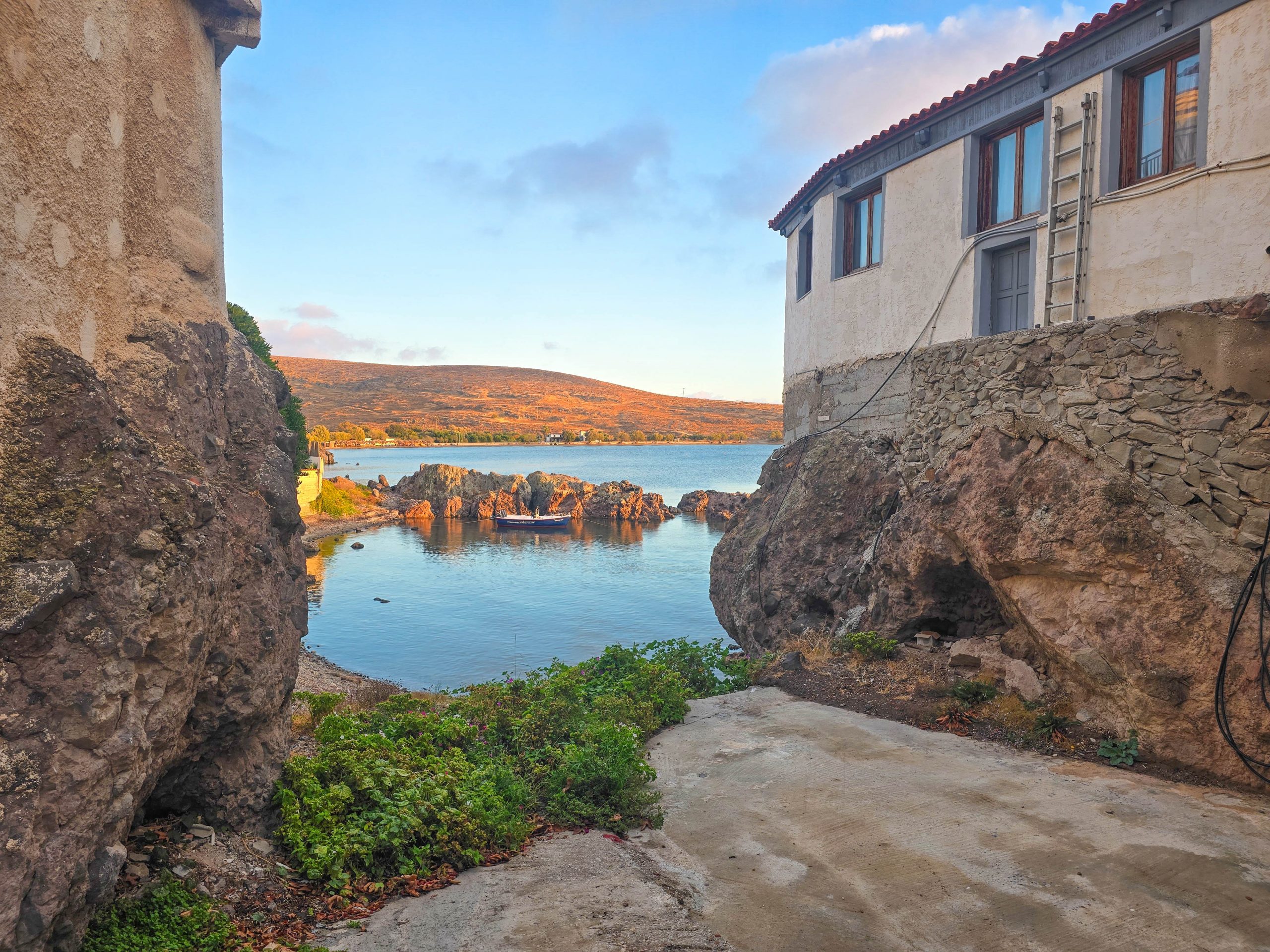
Climbing up into the village proper were reminders of Sigri’s layered past. Narrow cobbled streets lined with traditional homes constructed from volcanic stone, some built directly onto volcanic rock as a foundation. Some older houses were in a state of tumble down, where only the exterior walls remained. Amongst the patina and charm, were examples of some very contemporary adornment in the form of some interesting street art. I liked the juxtaposition of both.
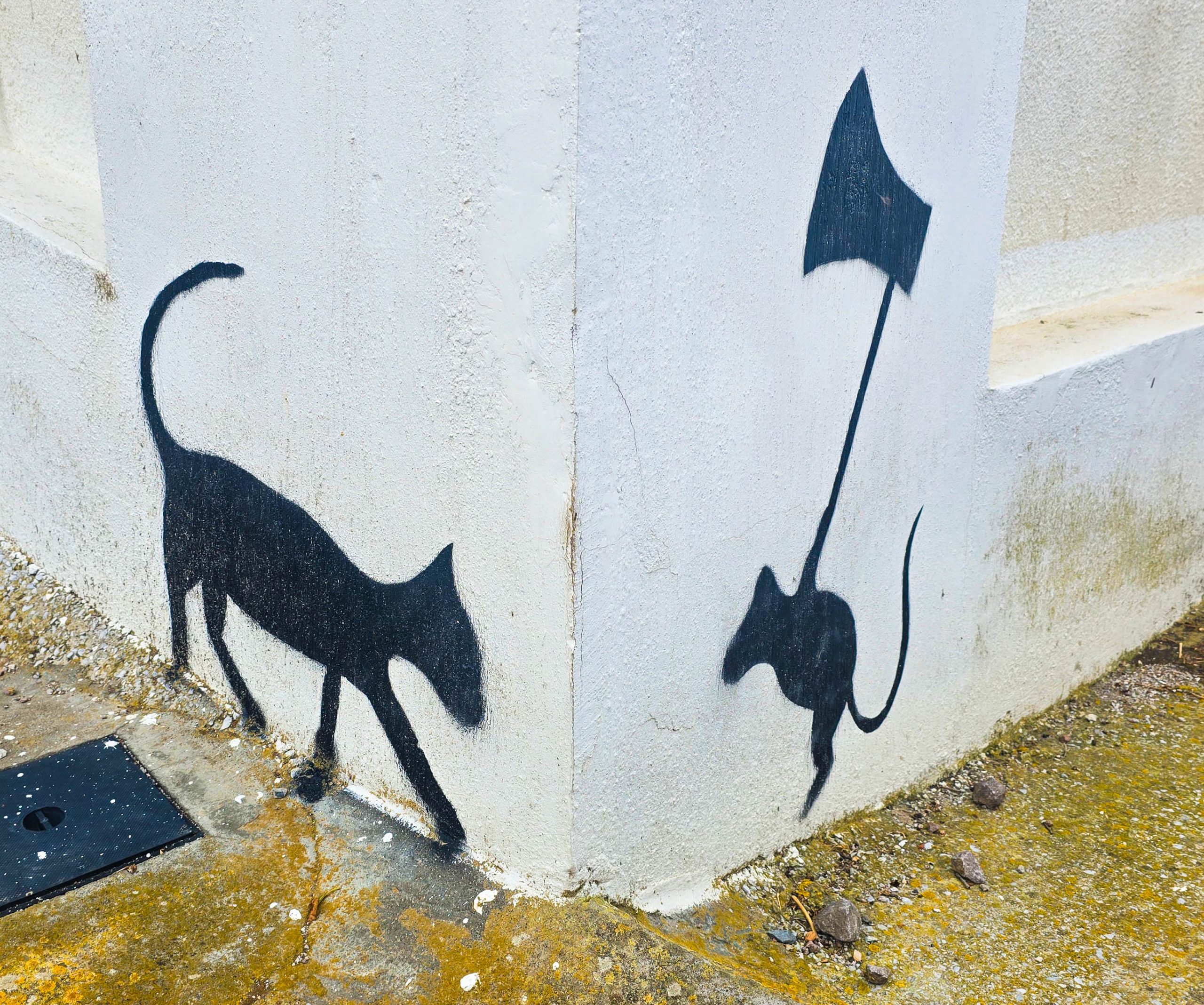
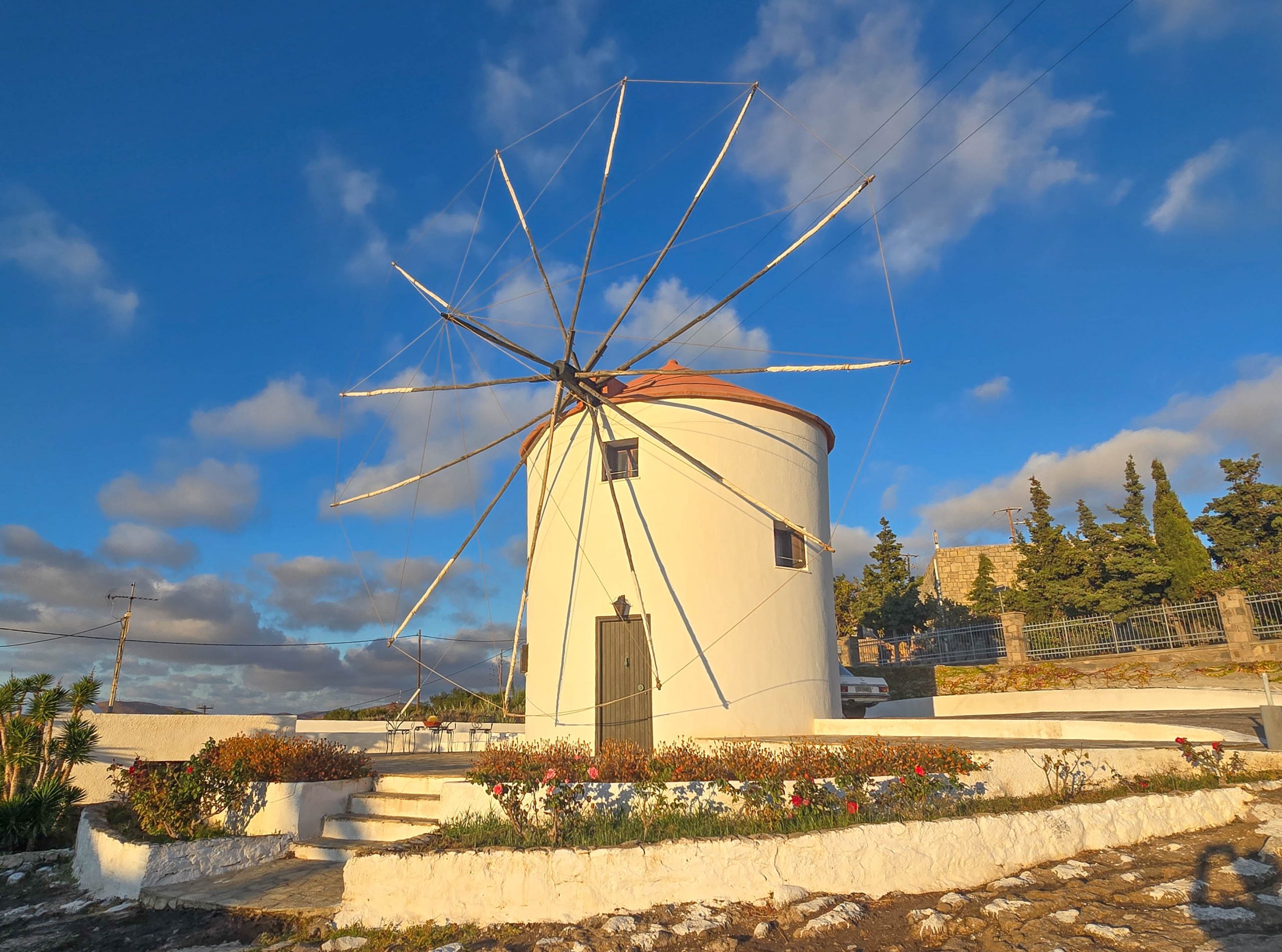
Right at the top of the village, the first thing that draws attention is the Sigri Windmill, built in a prime position to take advantage of the wind, a remnant of the days of domestic grain milling. The windmill, with its small rose garden, has become one of Sigri’s popular landmarks.
Adjacent is the Natural History Museum of the Lesvos Petrified Forest (to give it its full title). It provides an essential key to understanding the strange volcanic landscape surrounding Sigri. Photography isn’t permitted inside, which encourages you to slow down and absorb the story rather than collect images. The exhibits explain how a once-subtropical forest, buried under volcanic ash millions of years ago, was gradually transformed into stone, preserving trunks, roots, and branches in remarkable detail. What might otherwise feel abstract out in the open landscape suddenly becomes tangible.
The museum also invites you to imagine the wider ecosystem that once existed here. Alongside the dense subtropical forest were ancient animals very different from those we associate with Greece today — early species of elephants, primitive horses, deer, and other mammals that roamed the region long before the Ice Age reshaped the world.
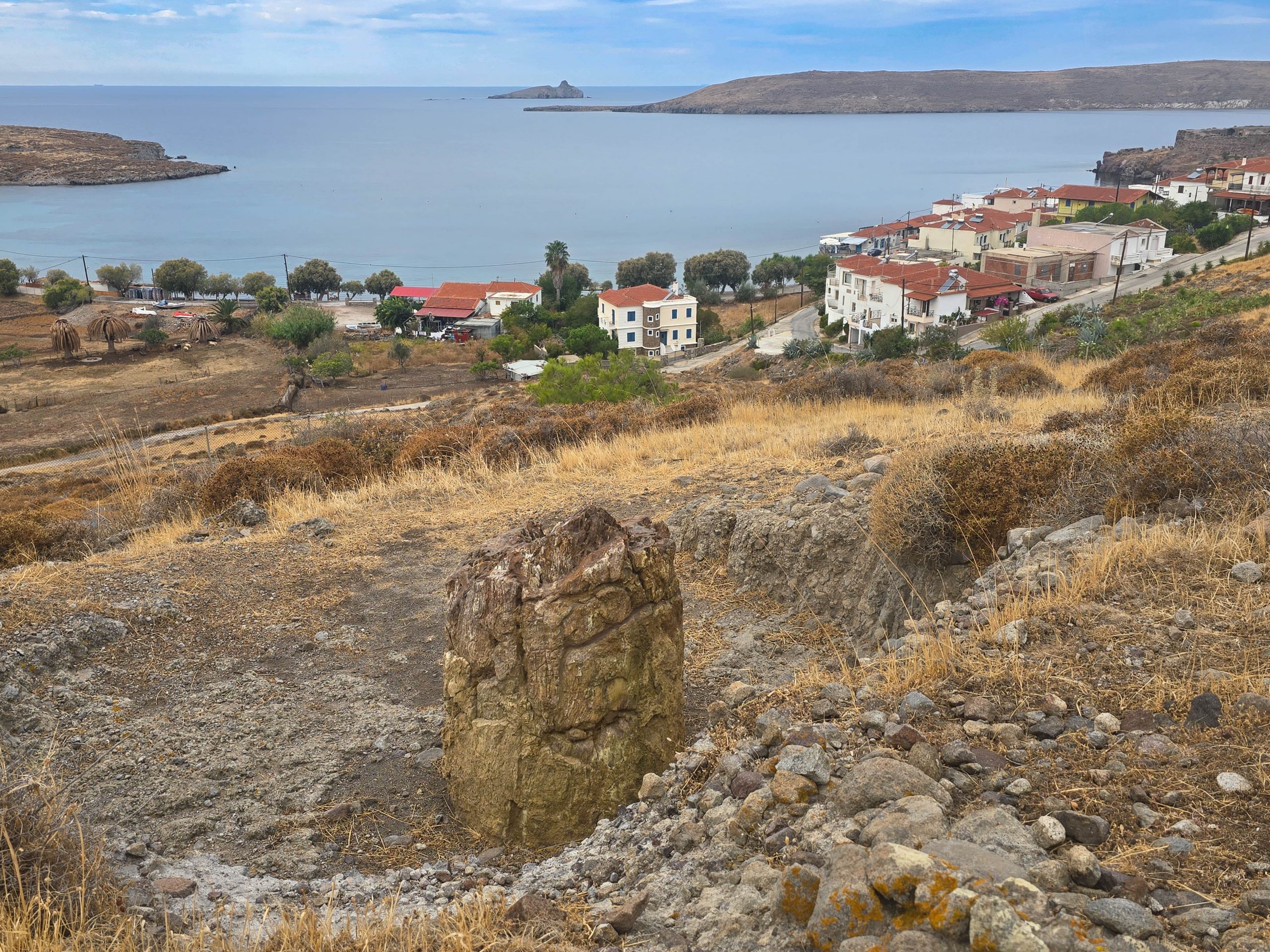
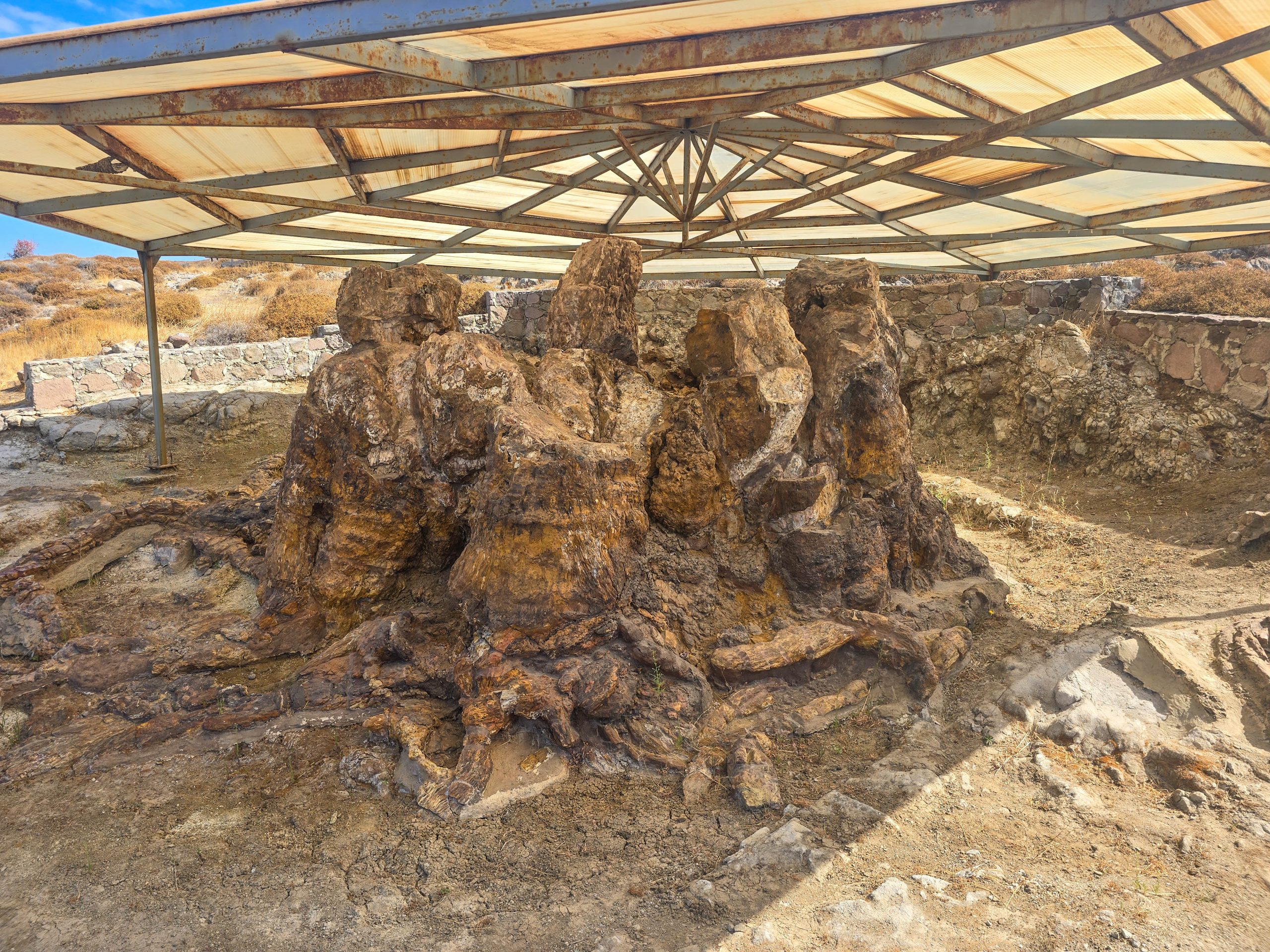
In the exterior part of the complex, among the petrified trees themselves, some roots sprawled like octopus tentacles across the ground. Colours varied — creams, reds, greys — almost marble-like in places. The word ‘forest’ conjures a certain image, and it’s possible to feel underwhelmed when faced with scattered stumps. Once you let your imagination wander, the real scale of what survived begins to reveal itself – life as it was in this little part of Lesvos millions of years ago — dense with towering trees, before volcanic ash buried and preserved it. The awe lies not in spectacle, but in imagining what was.
Natural History Museum of the Lesvos Petrified Forest
Before I left the museum, I enquired about the possibility of visiting the little islet of Nisiope, where there is another small petrified forest. The museum does run boat trips out there, but it depends on numbers. So far, I was the only enquirer. I was asked to call in again, which I did the following day, but despite there being a coach party of visitors, nobody was interested. One of the curators must have sensed my disappointment and pressed a book about Nisiopi into my hands instead — a small kindness that I appreciated (but would have preferred the boat trip).
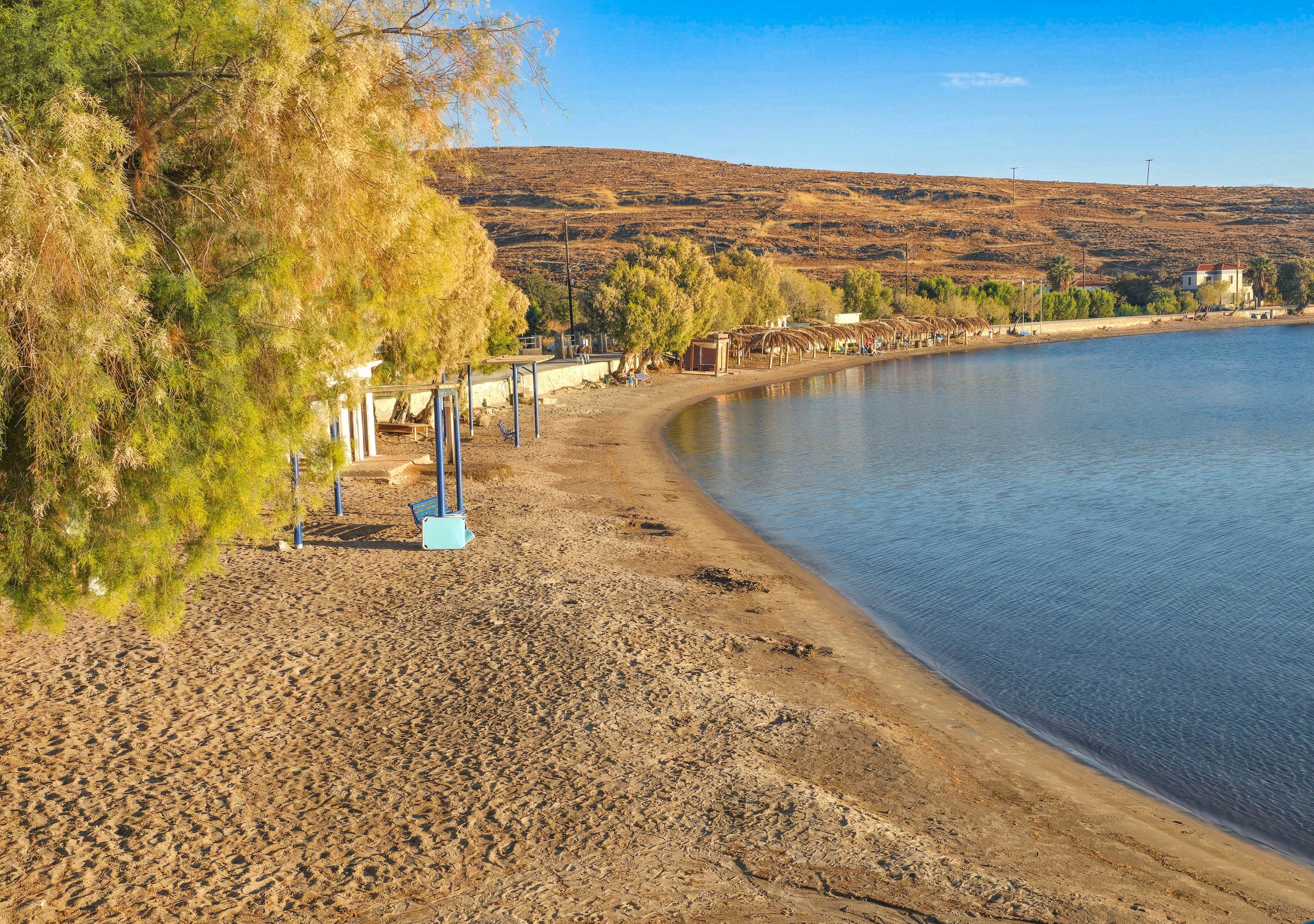
There is another part of the Petrified Forest which you access by walking along the back of the Blue Flag Sigri Beach, now in the process of closing down, signified by the municipality deconstructing the palm leaf shelters. Continuing along, the road begins to climb, bringing you onto the Sigri – Eresos Trekking Trail. On either side of the road here, there is a gated section of petrified forest. The museum ticket will give you access to both. When I arrived, the guardian was busy at work, drilling and hammering away at something and was surprised to see me, but was warm and welcoming nonetheless. He directed me towards the site where I was free to wander.
Shelters protected the most precious specimens, but elsewhere the landscape seemed littered with petrified jewels, each carefully numbered — though without a reference, the numbers meant little to me. It didn’t matter. Walking in this unusual landscape with exceptional views over to the kastro, village, and Nisiope Islet was enough.
I lost track of time and only realised how long I’d been gone when I eventually made my way back down. At first, I couldn’t see the guardian, then he appeared from the trees, arms raised as if to say, ‘there you are’. I explained that I wouldn’t have left without letting him know, in case he thought there was a body somewhere up on the hillside. He said he wanted to check I was OK, and he even offered to open the other site across the road. I admit that by then I was quite happily petrified-forested out, and politely declined.
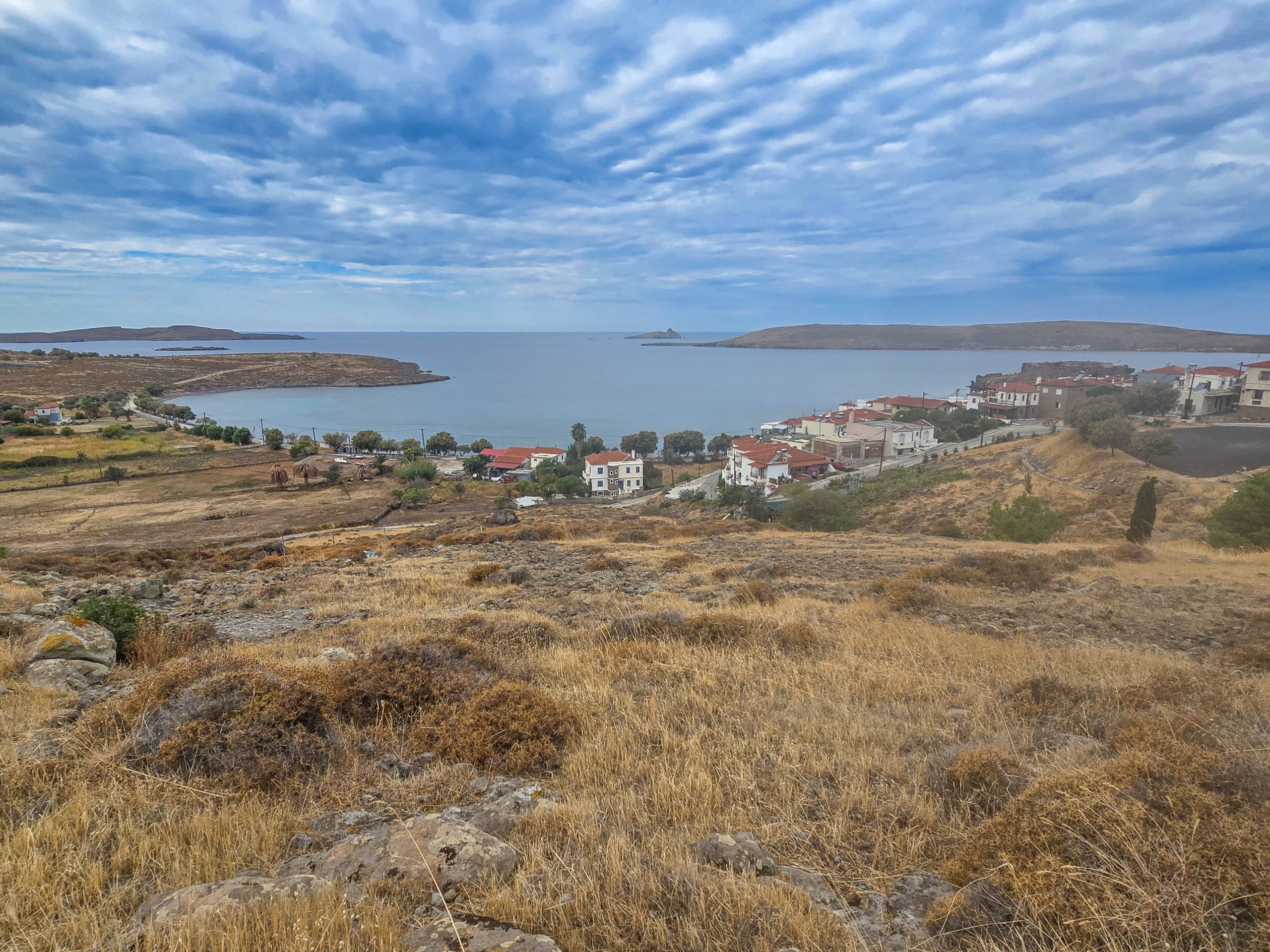
Sigri is a place made for walking. Once I’d exhausted the cobbled streets and narrow alleyways of the village, I turned towards the coast. Sigri has a small port, though no passenger services currently operate. Marianthia told me there are hopes for a route to begin in 2026, though she wasn’t entirely convinced it would happen. To the left of the harbour lies a military zone — something I already knew, having watched a naval ship come in to refuel while I was high above, walking through the Petrified Forest.
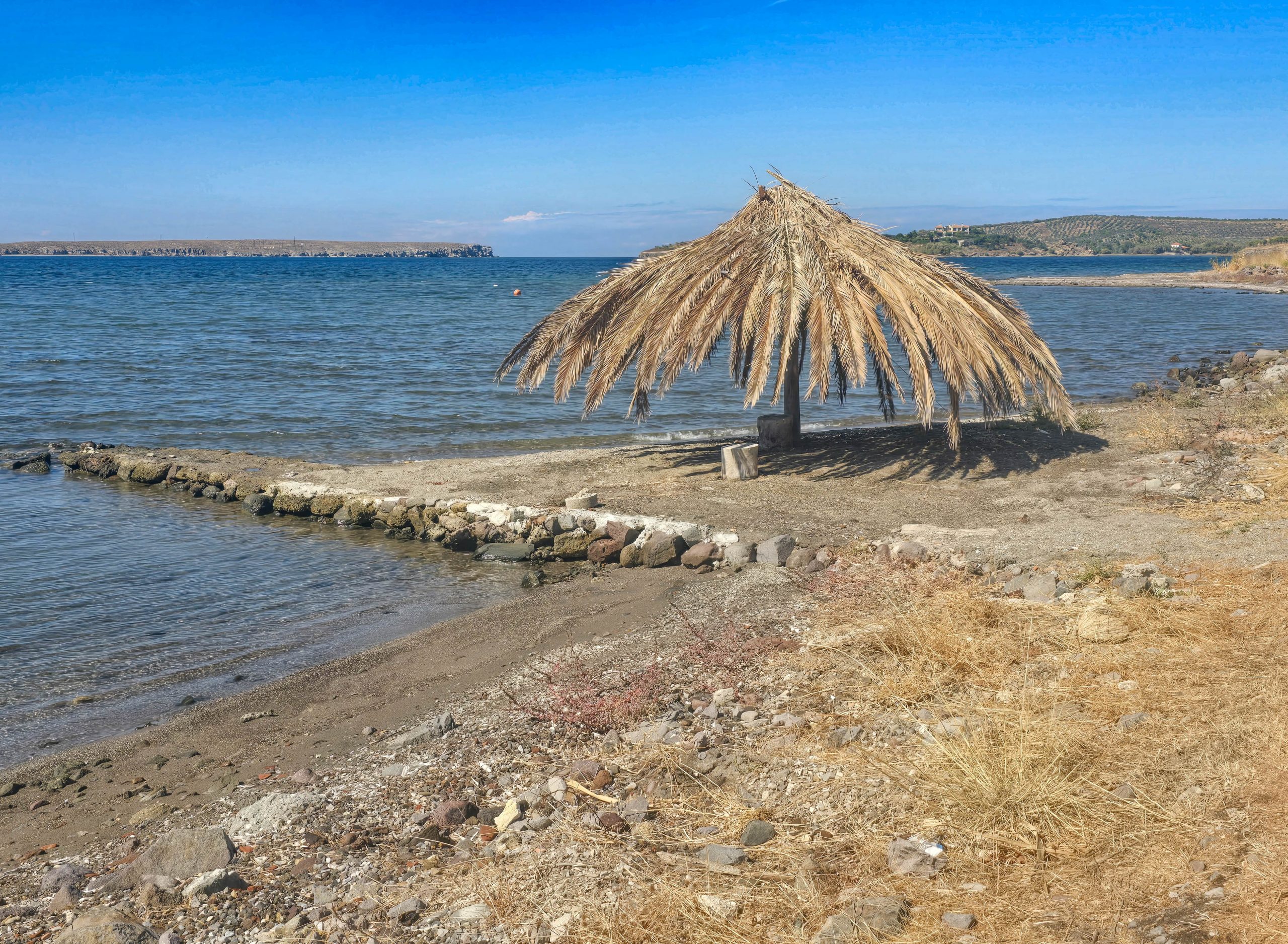
That left the road north: a quiet coastal track where I was able to walk in complete solitude, except for the local wildlife that kept me company along the way. A flock of blackbirds rose each time I drew close, lifting like a dark cloud before settling again further down the road. Small jetties with fishing boats appeared and disappeared; tamarisk trees offered shade on stretches of empty beach; and smallholdings grew vivid red and green peppers, their colour standing out sharply against the muted volcanic hills.
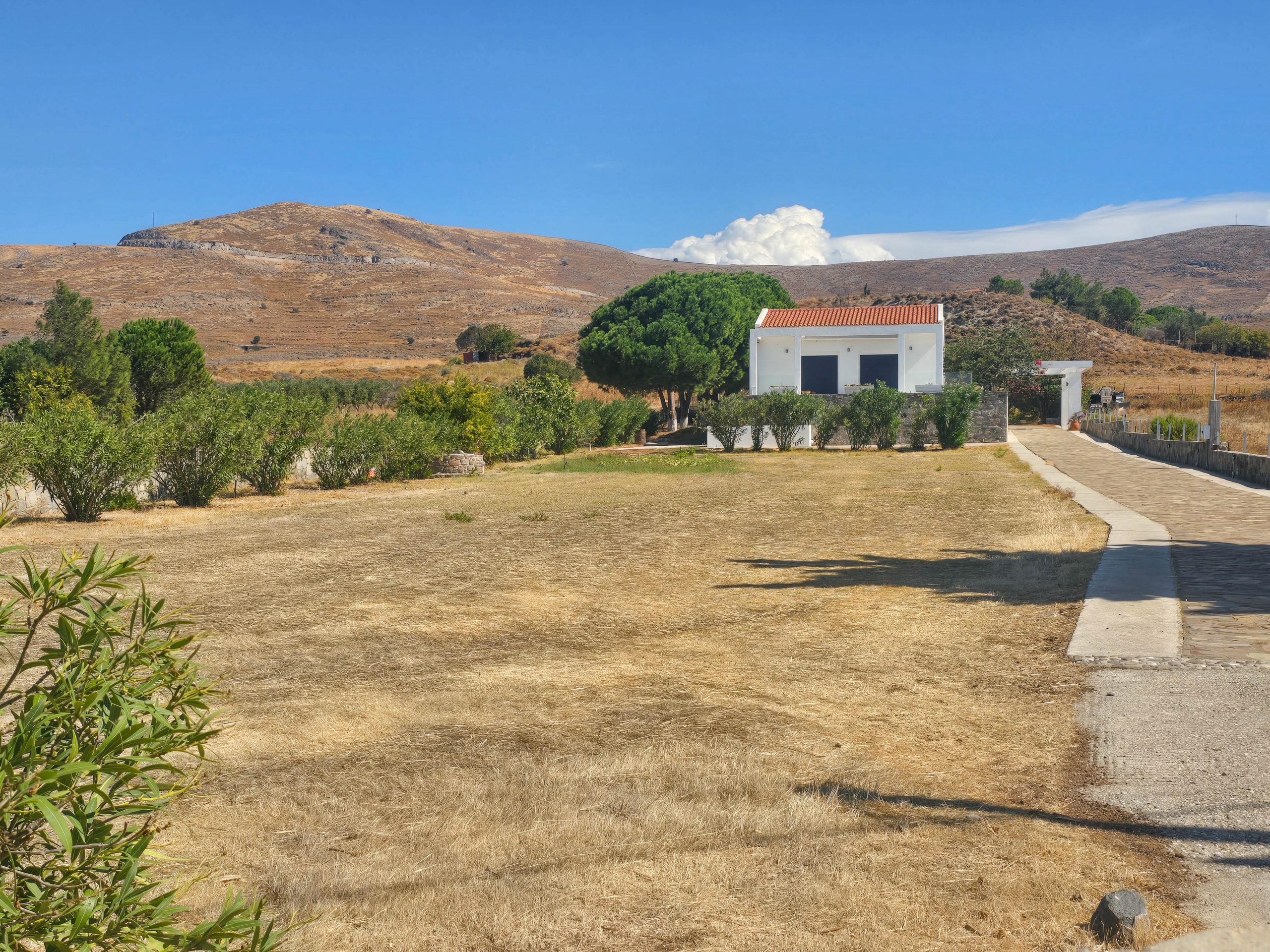
The walks that gave me most pleasure, however, were those clambering up through the characterful streets of the village, where the mix of architectural styles quietly tells the story of Sigri’s history — from its Ottoman beginnings through to more contemporary additions — a reminder that this is, by Lesvos standards, a relatively young settlement.
When the Ottomans built the castle at Sigri in the mid-18th century, it functioned primarily as a military garrison with a small service settlement attached. Muslim soldiers, their families and supporting workers lived within the fortified area, while Christian Greeks were not permitted to settle inside the walls for security reasons. Instead, fishermen, farmers and traders established themselves just beyond the gates, forming a small hamlet that supplied the garrison and made use of the sheltered harbour. This pattern remained largely unchanged until the early 20th century. Following the Balkan Wars in 1912 and the population exchange of 1923, the Ottoman military presence withdrew, and Muslim families left, allowing the village to expand. Greek families — both local and Asia Minor refugees — moved closer to, and in some cases into, the former fortress zone. What we see today as Sigri is essentially the gradual growth of that original community outside the walls, absorbing the castle area once those restrictions fell away and shaping the village’s distinctly Greek identity in the 20th century.
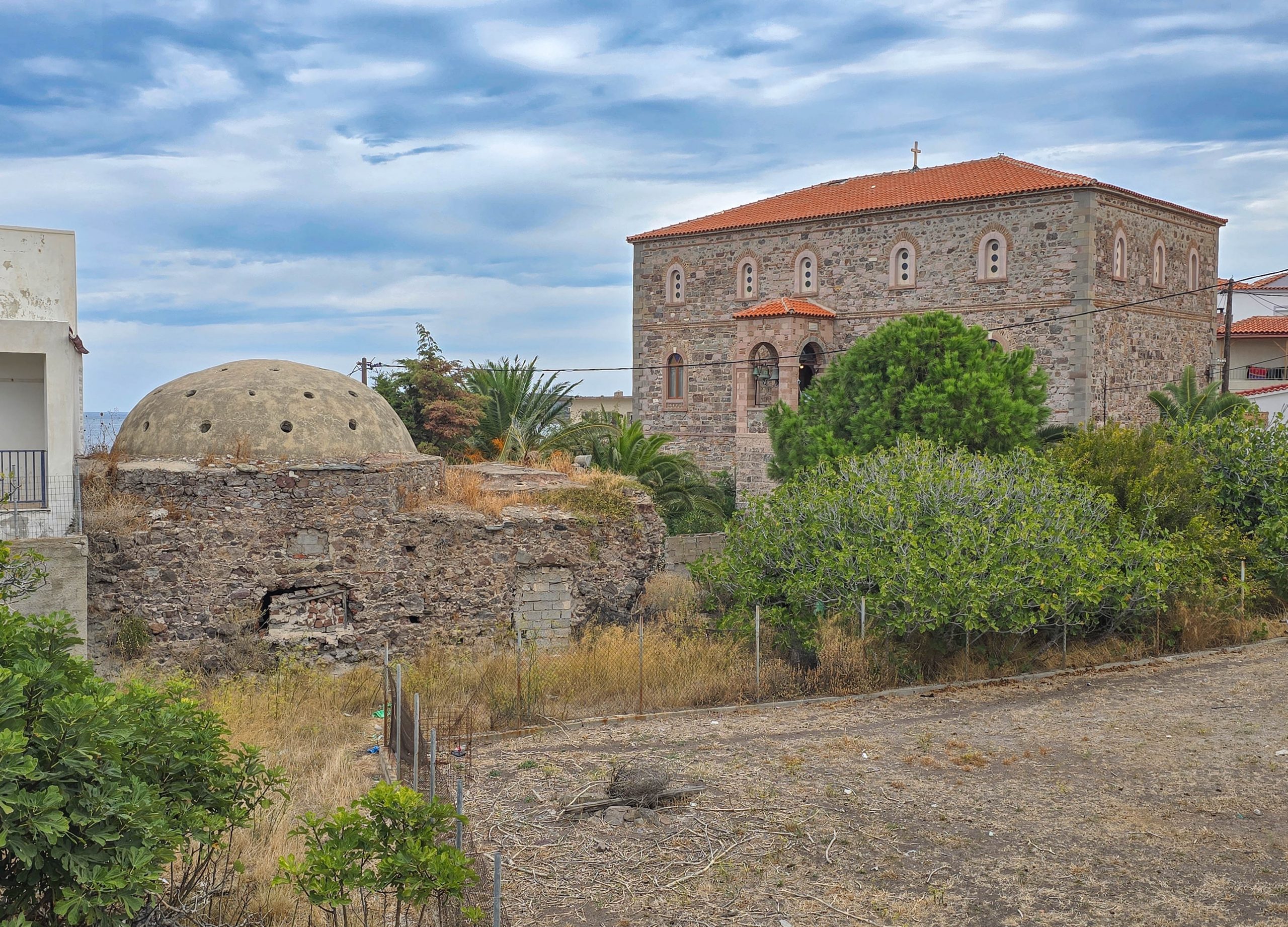
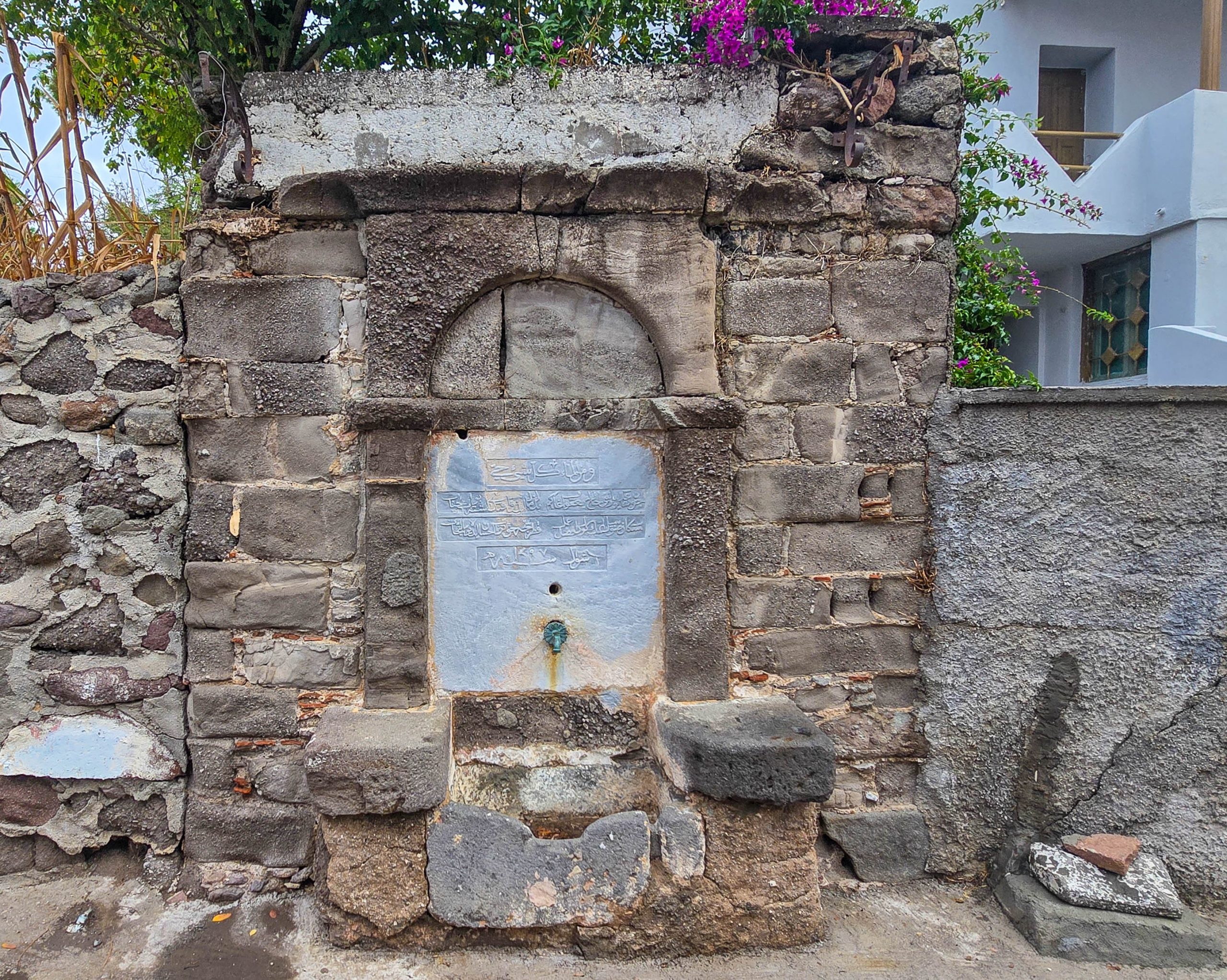
Part of that story is told in the Agia Triada Church that sits just above the port. Although today it functions as the village’s Orthodox church, it began life as a mosque serving the Ottoman garrison within the castle walls. Nearby, the crumbling remains of a Turkish hamam and a water fountain anchor Sigri firmly to this period.
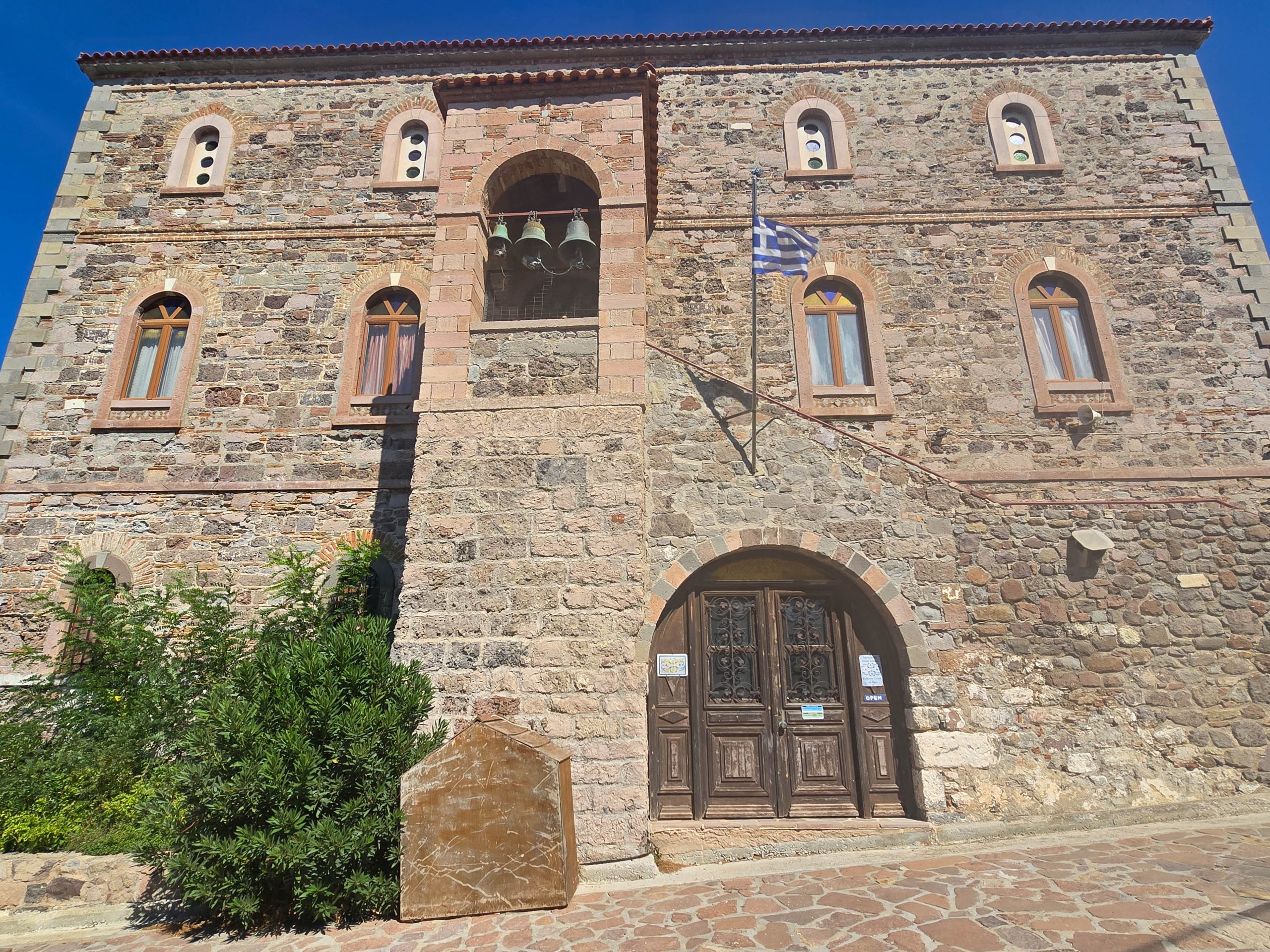
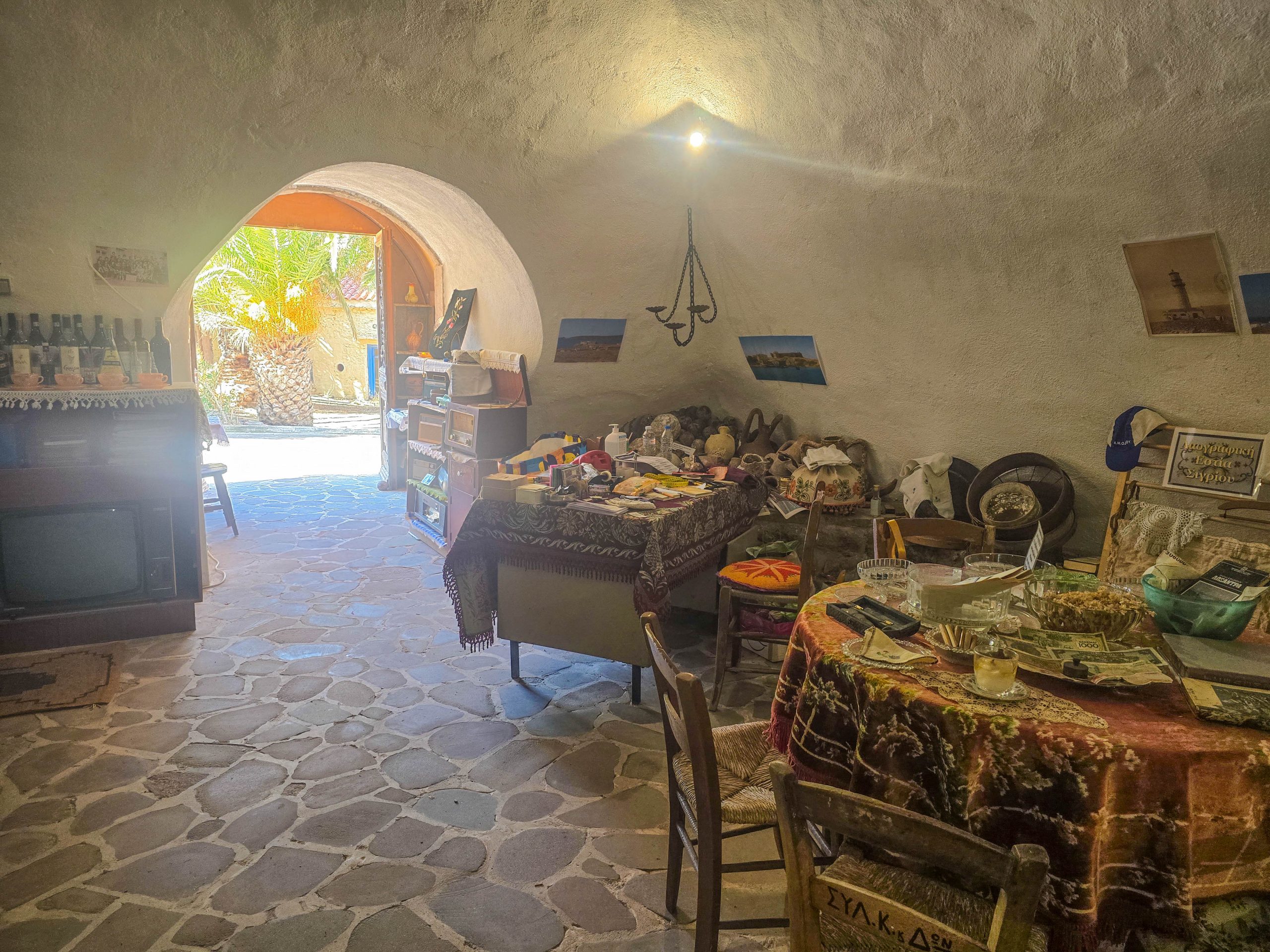
On the ground floor of Agia Triada Church, the Sigri Folklore Museum proved to be a fascinating visit. The museum’s guardian, Andonis, explained that we were standing in what had once been the cistern beneath the mosque, fed by clay pipes running several kilometres from inland springs. This water system supplied both the castle population and the hamam. Only after Lesvos came under Greek control in the early 20th century, and following the population exchange of 1923, did these divisions dissolve, allowing the village to expand and absorb the former fortress area into the Sigri we see today.
Before exploring the museum’s exhibits, I asked Andonis to tell me more about the museum itself and how it came about. He explained that it had first opened around ten years ago, with locals donating enough objects to form a thoughtfully curated collection. What they couldn’t agree on, however, was who should hold the keys. The museum eventually closed, only reopening recently with Andonis taking on the role of guardian.
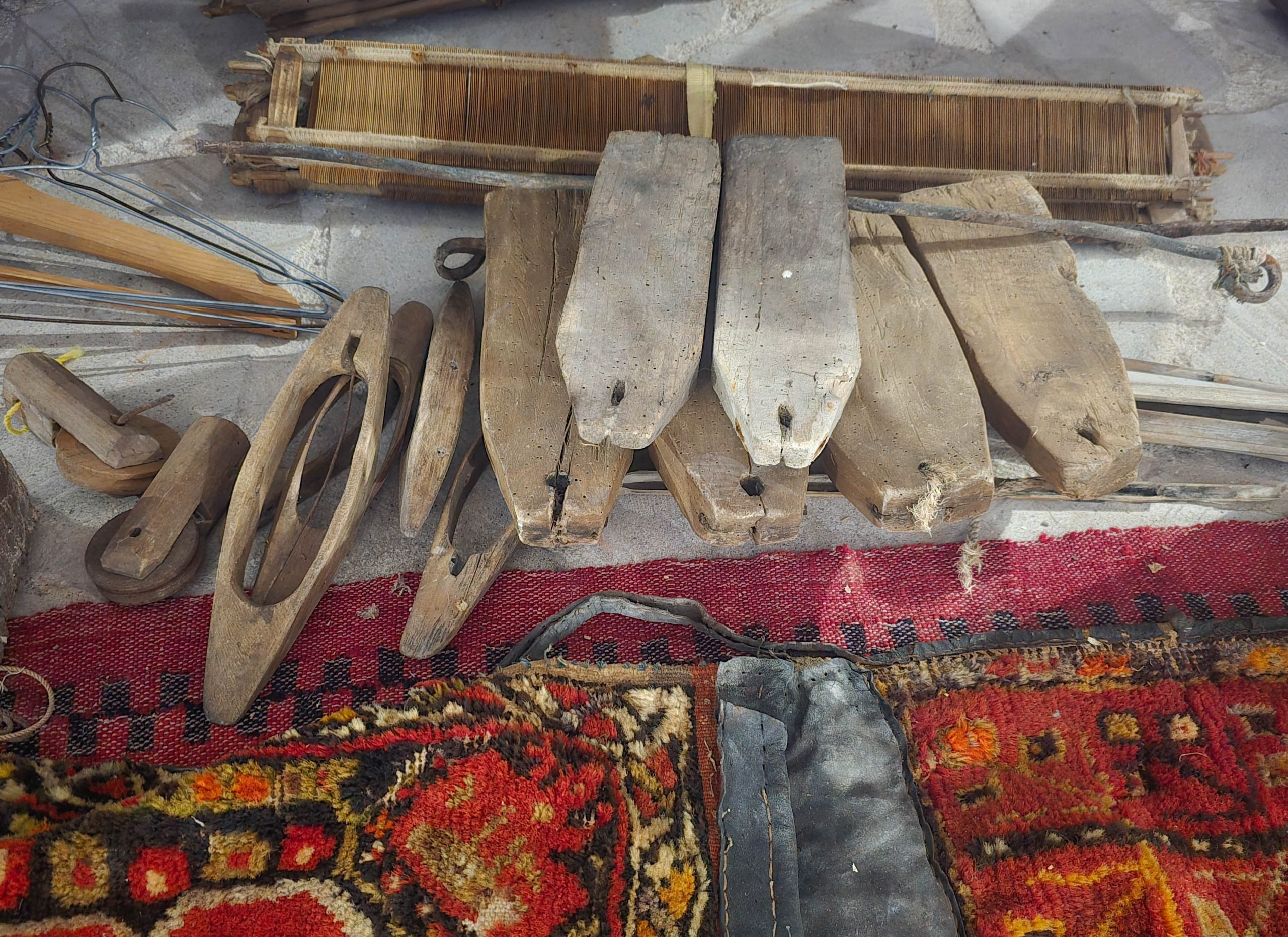
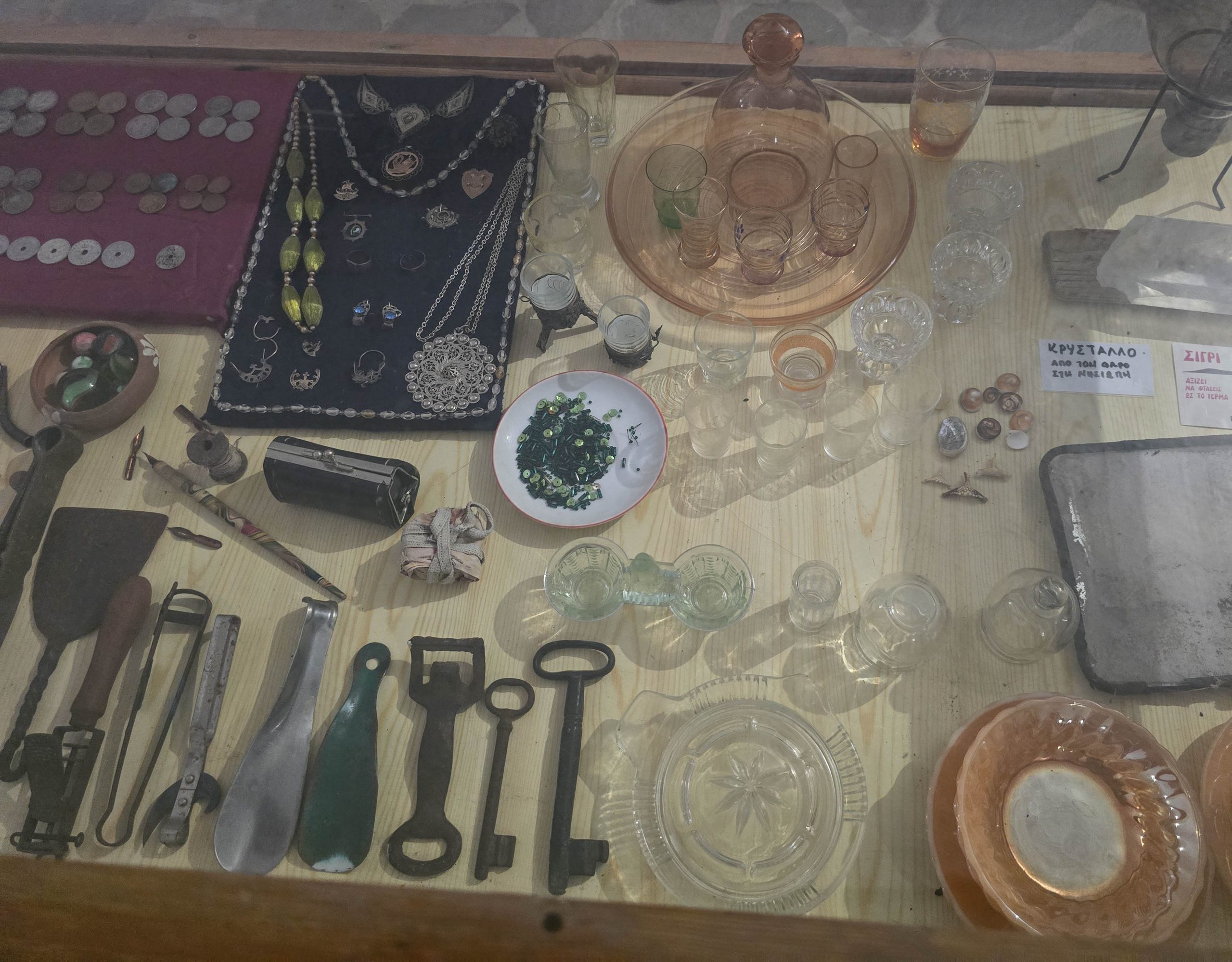
On the face of it, the museum is typical of many folklore collections, yet filled with distinctly local and personal curiosities: weaving looms, farm implements, a colossal film projector, religious items, and a scattering of knick-knacks and everyday objects. One display case in particular caught my eye, its contents oddly familiar- large metal door keys, photographs, jewellery and religious items. Andonis confirmed my suspicion — these were items brought from Asia Minor by people fleeing the catastrophe, either in the years leading up to, or following, the population exchange.
As he spoke, it became clear that Sigri’s story is deeply entwined with the wider history of Asia Minor — a thread I’d been following since Istanbul. To compound the connection, Andonis produced a map and pointed to Pasalimeni, an island I’d initially planned to visit but instead skirted to nearby Marmara Adası. Before the population exchange, he explained, many Greeks had already begun to leave Asia Minor as tensions rose. People from Pasalimeni were seafarers and recognised that Sigri — itself a small maritime hamlet — could offer them a livelihood. Crucially, they were able to leave in their own time, unlike those ethnic Greeks who were abruptly expelled later during the population exchange, often under far more treacherous and harrowing circumstances.
Andonis’s own family was among those who came from Asia Minor, and his stories carried the weight of lived memory rather than abstraction. He spoke quietly of loss during the transition, and of his grandfather, a soldier during the troubles, who was shot and left for dead — only to be saved by a Turkish man. It was a reminder that history is rarely clean or binary, and that kindness can endure even when politics fails.
Standing there in the cool stone space of the old cistern, I realised how neatly this moment squared the circle of my journey. From Istanbul to Lesvos, from geology to human memory, Sigri had become the place where disparate threads quietly converged.
Heading into October, several tavernas had closed for the season, but I was never at a loss for anywhere to eat. Breakfasts were usually at Calma Café or Veranta, with Calma becoming a favourite. It doubled as a meeting place for locals and a small expat community — understated, unshowy, and always welcoming.
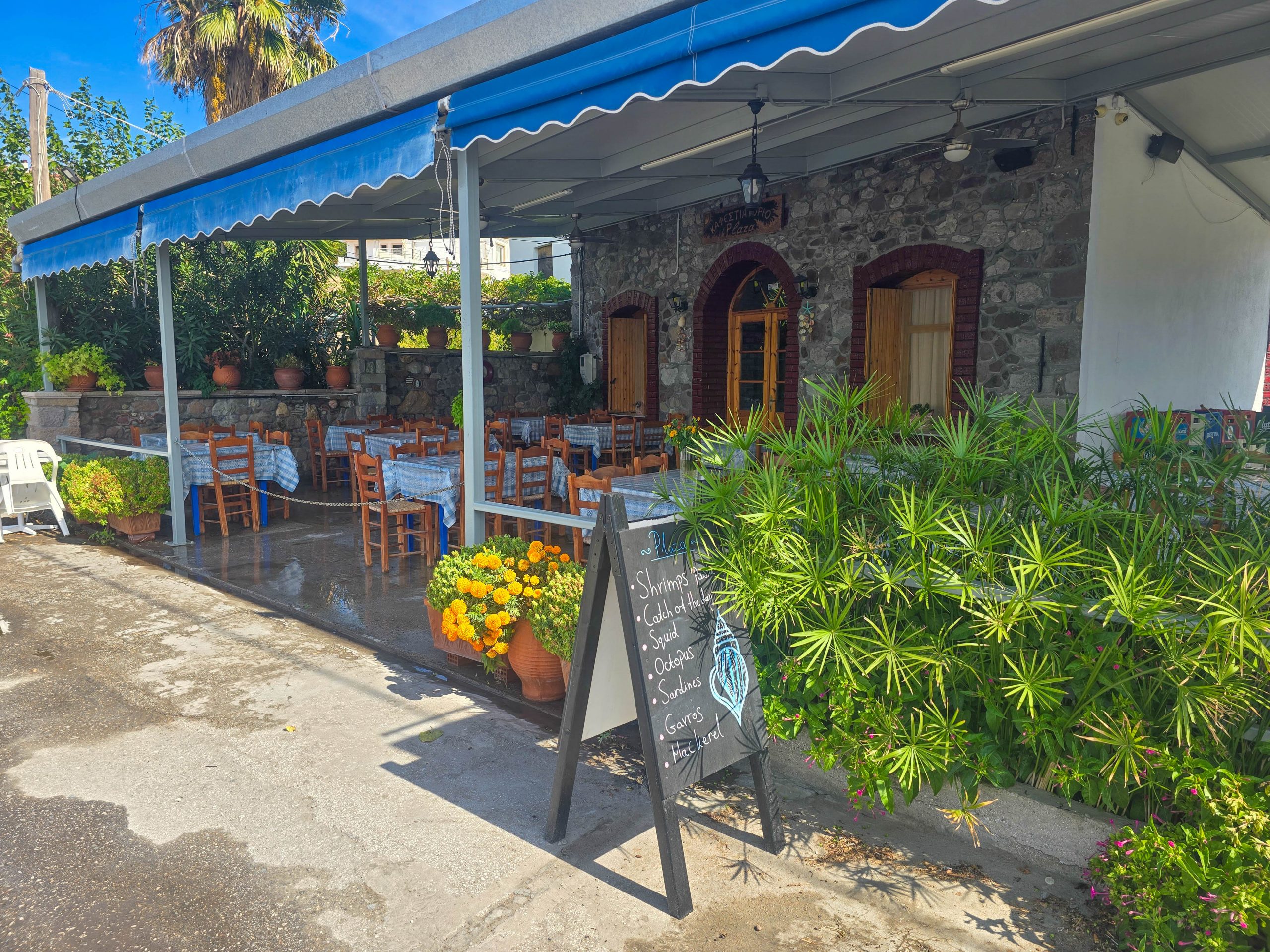
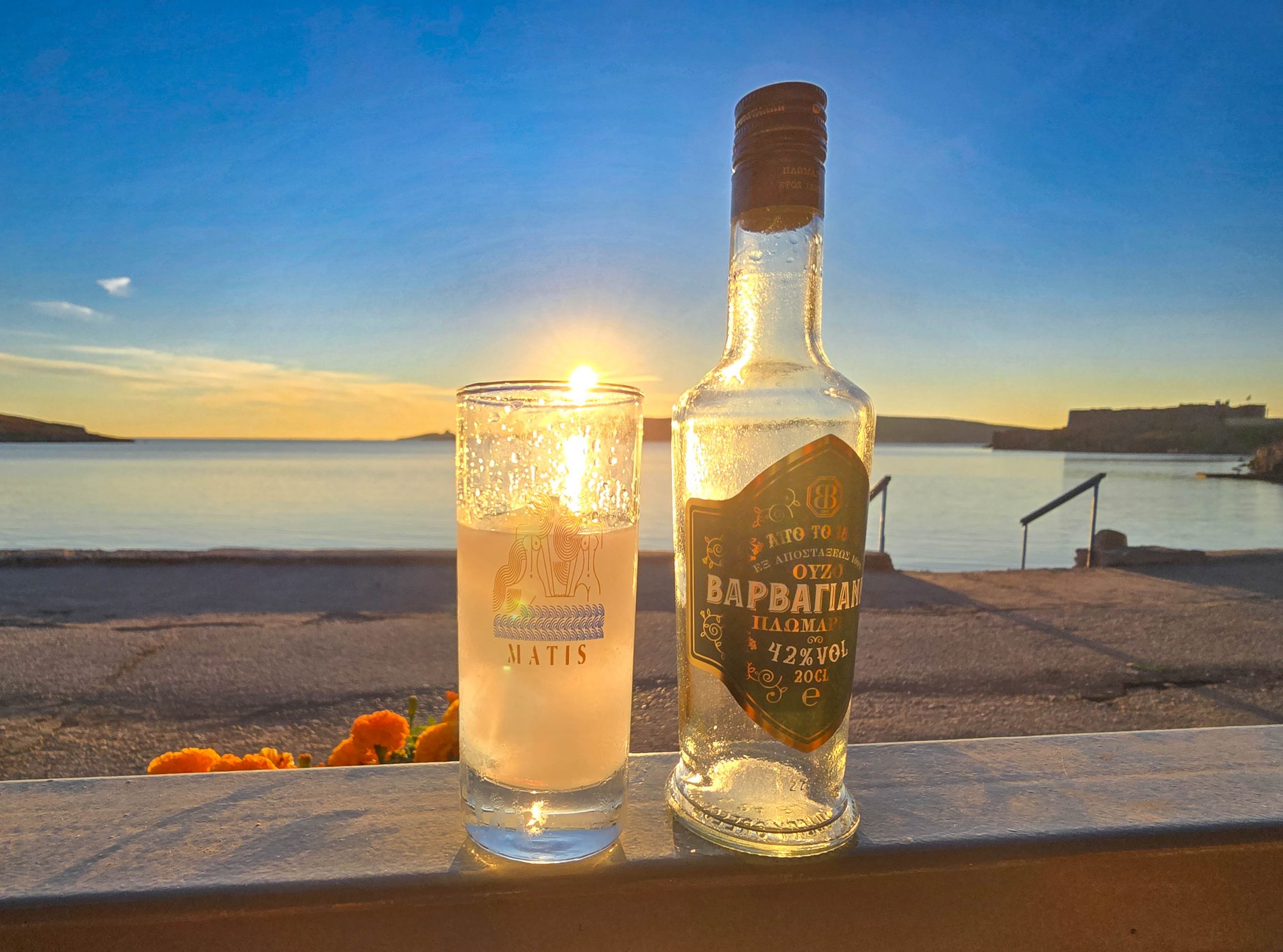
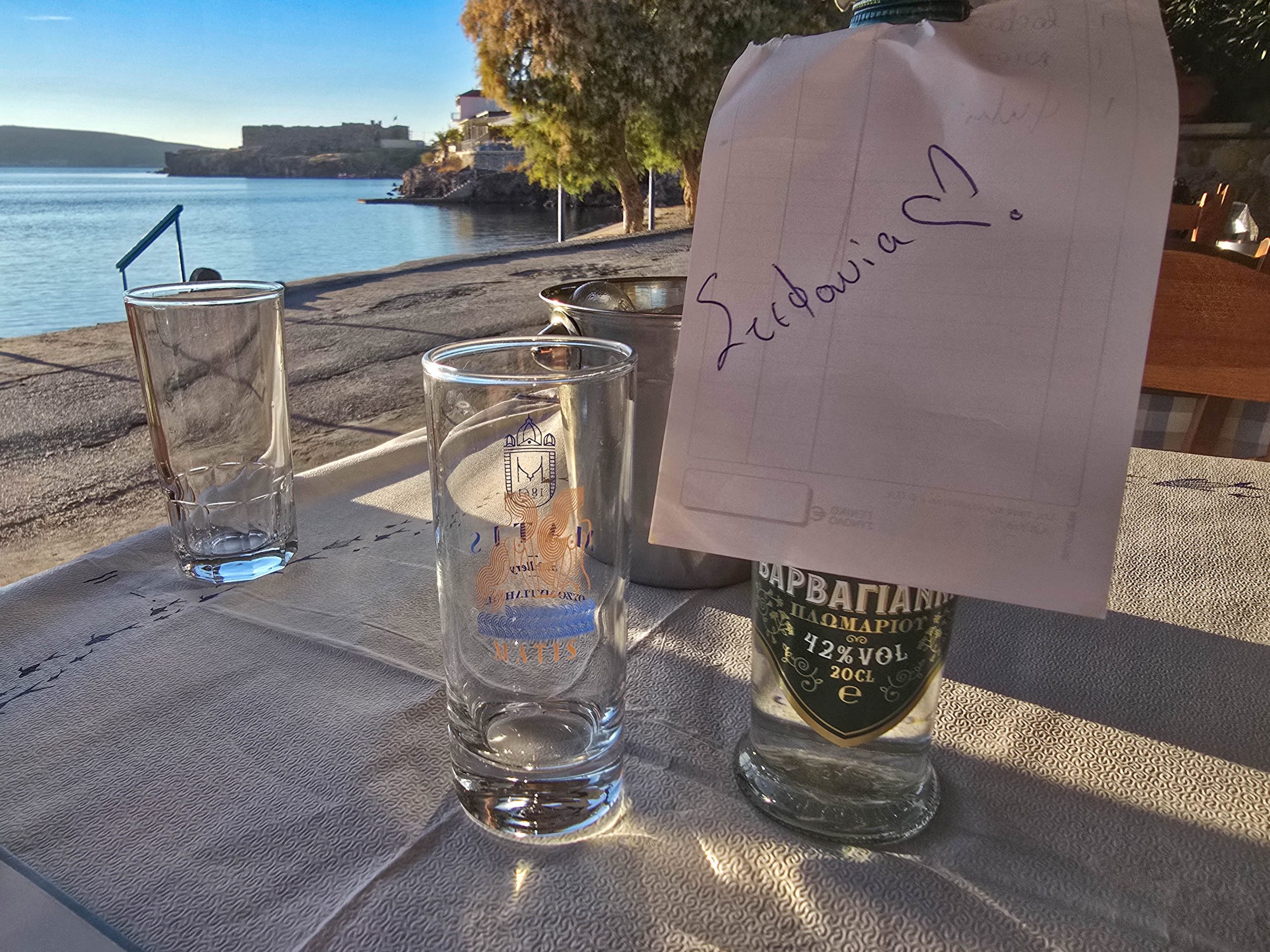
Evenings always ended at Plaza, a traditional taverna behind Sigri beach. Giota and her mother, Helen, made it feel like a home from home. Helen cooked meals daily, and although still working from a menu of sorts, Giota would tell us what Helen had cooked that day instead. If I couldn’t finish my ouzo in one sitting – no problem. It would be waiting for me the following day.
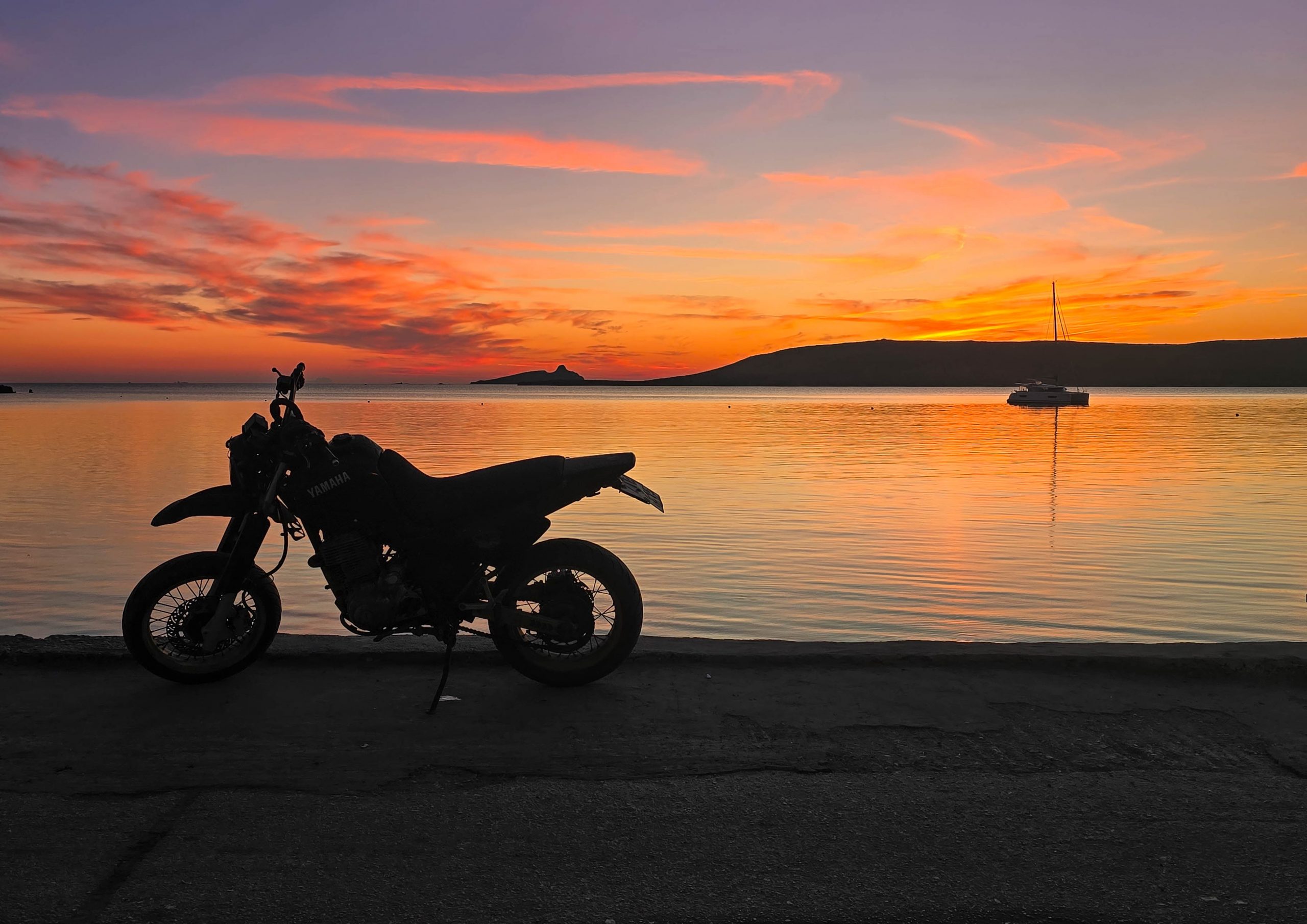
Apart from the truly wonderful hospitality at Plaza, the outward-looking view from the taverna gave front row seats to the most stunning of sunsets. Some sunsets were so captivating that Helen and Giota would stop working just to watch — which said everything.
On my final evening, the atmosphere in the air felt strange — flat, silent, ominous. No sunset. A strange flurry of small beetles began dive bombing the restaurant, seeking refuge under napkins and bread baskets. A weather warning for Lesvos had been escalated to code red. This was the calm before the proverbial, but the local insects were already feeling it and were taking cover.
I had already had to extend my stay from three days to four after misreading the bus timetable. (Monday AND Friday, not Monday TO Friday!). Although I had no definite travel plans for where to head next, I would have to wait another 5 days until the next bus departure. A bus was to leave at 6 AM in the morning and the storm was forecast to stay until mid-morning. Discussing this with Giota, she said I should get a taxi after the storm had finished. This would cost around 100€. In case I decided to brave the storm, she gave me a couple of bin bags to put over my case.
Later that evening, lightning out on the horizon began to silently light up my room. No thunder yet, and just a gentle patter of rain. I stayed awake until past midnight, trying to gauge what shape this storm would take. The sheet lightning became more intense, and a slight rumble here and there, but nothing dramatic. Thinking that it may have changed course, I went to bed, setting my alarm for 05:15, which was ample time to make my way to the bus stop down by the port.
I had spoken too soon. No sooner had I gone to bed, the lightning was now accompanied by loud cracks and rumbles of thunder that sent vibrations throughout the house. As time went on, the more violent it became, with relentless sheets one after the other. But the worst was yet to come. Torrential rain began to hit the roof, feeling more like a torrent of bullets than splodges of water. Then came the sound of rushing water as it surged along the gutters and hit the concrete paving below. Sleep was fractured, and my imagination vivid. I didn’t know exactly what was going on outside, but I imagined the streets to be like rivers and half expected the village to be washed into the sea. My biggest worry was that the bus would be washed off the road by a landslide. By dawn, with the rain still pounding on the roof above me, I made the call to abandon the bus and wait out the worst of it. Fear does sharpen with age — but so does judgement.
Morning revealed Sigri intact. Marianthia’s garden had survived, seaweed lay strewn across the beach, and life resumed quietly. Over tea and yoghurt at Calma, I sat with old men fingering komboloi and talking through the morning. ‘Ah, you didn’t catch the bus this morning?’ I was asked. ‘No, I’ll catch a taxi later, ‘ I said, not going into any further detail than that.
Marianthia had called a taxi for me, and I made my exit from Sigri and headed the 85 kilometres back to Mytilene.
Sigri, in its autumnal simplicity, offered me the peace, authenticity, and connection that I’d missed. It’s a place where wandering was enough, and where it’s easy, even briefly, to feel part of something quietly enduring.
🏩 Book accommodation in Sigri here
Discover more from A Greek Oddity
Subscribe to get the latest posts sent to your email.
Fifteen years of writing about Greece. Thirty plus years of travelling it. Now condensed into a travel planning toolkit.
Take a look


