
Spetses: Museums, Maritime History and a Weekend in Tweed
Spetses has a way of revealing itself in layers. Beyond the harbour and its polished façade, there is a deeper story shaped by a wealthy benefactor, maritime power, revolution and, as it turns out, the occasional appearance of vintage bicycles and tweed. This post brings together two of the island’s museums and an annual event that I hadn’t quite expected to find here.
The Man Behind the Mansion
Most mornings on my way out to explore the island, I’d pass the old Anargyros Mansion, former home of tobacco merchant and wealthy benefactor, Sotirios Anargyros. You can’t miss the building. Although devoid of any signage giving clues to its history, it’s a head turner. It was my host Aggeliki that told me what the building was and its significance. Although now looking somewhat forlorn and neglected, it still has a type of grandeur that manages to hold its own despite the slow decay.
In my previous post, I briefly mentioned Anargyros in relation to the Anargyrios and Korgialenios College, but there is far more to the man and his legacy than the college alone.
Spetses-born Sotirios Anargyros left his home island as a young man with little money but considerable ambition. After working his way through Istanbul, Alexandria, Romania, Marseille and London, he eventually landed in New York, where he built a tobacco empire from scratch, most famously producing the hand-rolled Egyptian Deities cigarette – marketed to “people of culture, refinement and education.” When the American Tobacco Company bought him out in 1900 for the then-staggering sum of $650,000, he had more money than he knew what to do with.
He decided to spend it on Spetses.
What followed was an extraordinary one-man transformation of his home island. He funded the road that circumnavigates Spetses, built the island’s first water supply system, planted the pine forests that visitors fall in love with today – having bought up more than half the island and handed it back on the condition it remain free of construction – and built both the grand Poseidonion Hotel and the boarding school modelled on Eton and Harrow. John Fowles, author of The Magus, taught at the school, which later immortalised Spetses as the island of the Magus.
As for the mansion, it was built in 1904 at a cost of 100,000 golden drachmas. It reflected both the man and his money. Anargyros was fascinated by Egyptology, and Egypt was quite literally his brand, so he built himself an Egyptian palace in the middle of a Greek island. Complete with sphinxes, two of which flank the entrance. The Egyptian references didn’t end there. He named the house Neith after the Egyptian goddess of war and hunting.
The building was the first on Spetses to use reinforced concrete, and it hosted kings, queens and dignitaries until Anargyros died in 1928.
Since then, it has served as the island’s town hall, a German interrogation centre during the occupation, and, for the better part of a century, a very atmospheric ruin, home mainly to pigeons and lizards. Restoration funds have been secured, but bureaucracy, as ever in Greece, has other ideas.

The Bouboulina Museum, Spetses
You can’t come to Spetses without encountering Laskarina Bouboulina. Her statue stands prominently along the harbour front, a reminder that this otherwise elegant island played a significant role in the Greek War of Independence.
The Bouboulina Museum is housed in what was once her family home, reached via a set of stone steps that somehow didn’t feel quite grand enough for a person of her heroic magnitude.
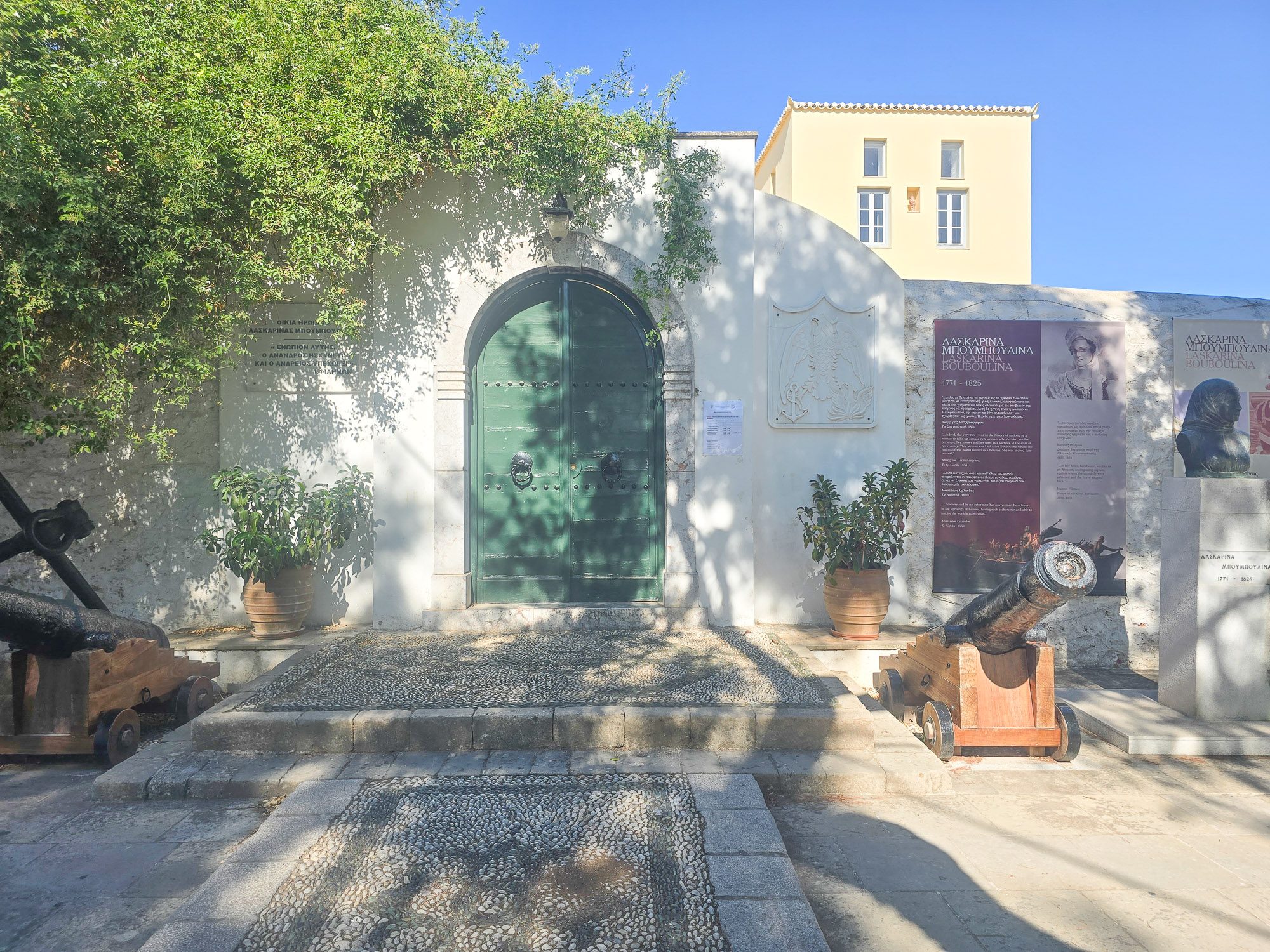
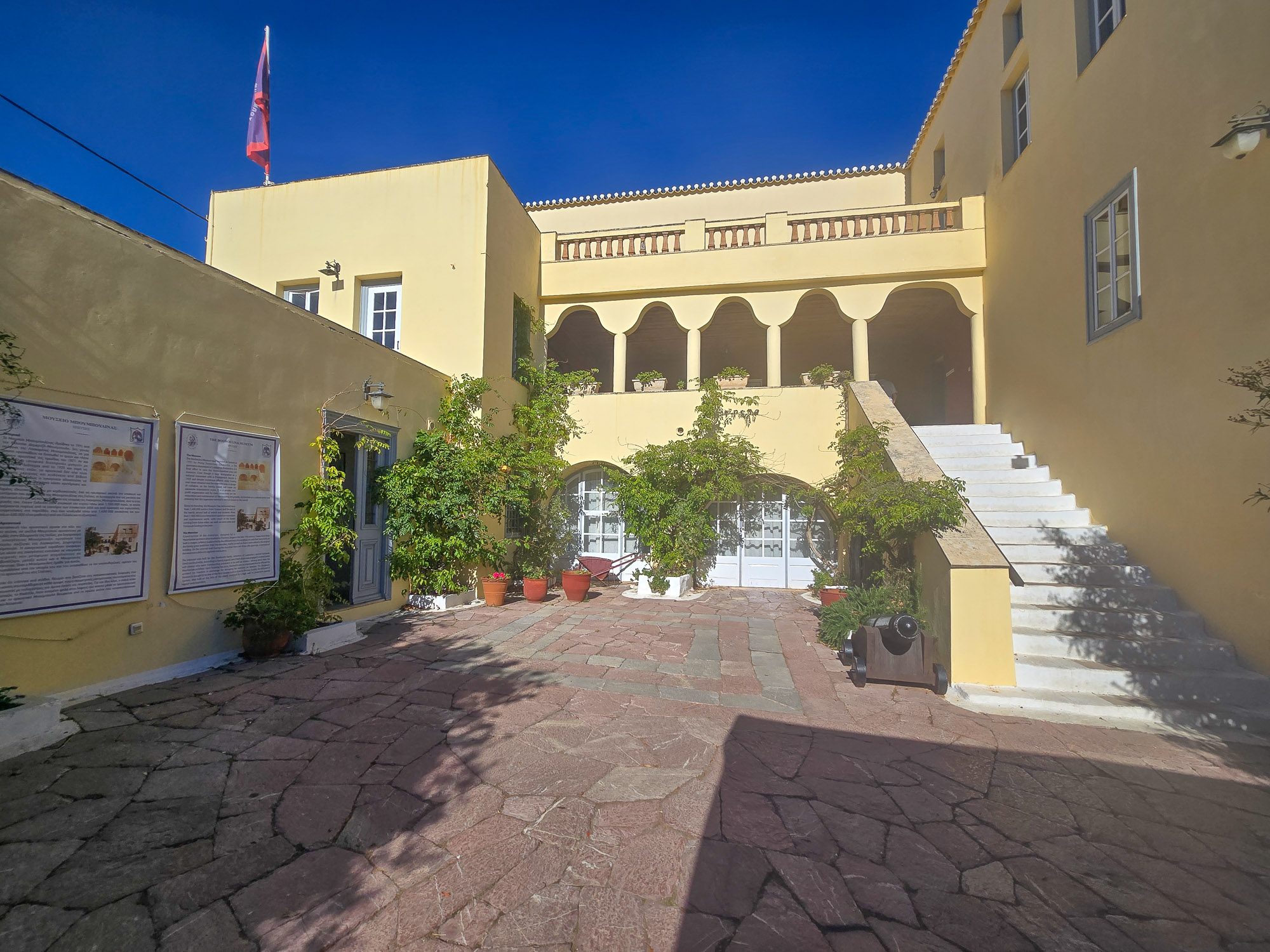
Laskarina Bouboulina was born in an Ottoman prison in 1771 – her father, a Greek sea captain, had been imprisoned for his part in a failed rebellion against Ottoman rule, and her mother was visiting him when she went into labour. It was, in retrospect, a fittingly defiant beginning to a life that would end with her commanding her own fleet against the same empire that had imprisoned her father.
Her life reads almost like fiction – except fiction would probably tone it down for credibility. Twice widowed by naval conflict, and a mother of seven by the age of forty, she had inherited considerable wealth from both husbands – ships, trading businesses and fortune – and had built on it shrewdly enough to become one of the most prosperous shipowners on Spetses. She had already lived several lives before the revolution even began.
When the Ottomans tried to seize her inherited wealth, they had their reasons. Her second husband had fought on the Russian side in the Russo-Turkish war, and they considered his assets forfeit. Bouboulina travelled to Constantinople and argued her case in person, enlisting the help of the Russian ambassador and the Valide Sultan herself. She won. She then joined the Filiki Etaireia, the secret society organising the revolution, and set about building ships in deliberate defiance of Ottoman regulations on Greek vessel sizes. When an Ottoman admiral arrived to investigate, she bribed him. The Agamemnon armed with 18 cannons and the first warship of modern Greece was the result.
When the revolution broke out in 1821, she raised her own version of the Greek flag on its mast. It was she who first raised the flag of revolution on Spetses and sailed immediately to Nafplion to impose a naval blockade. Her fleet of eight ships took part in the sieges of Nafplion, Monemvasia and Pylos. She rode on horseback to Argos to deliver money and ammunition to rebels, and she financed an army unit from her own fortune. Her fellow revolutionaries called her Kapetanissa – Lady Captain. After her death, the Russian Tsar Alexander I awarded her the honorary rank of Admiral of the Imperial Russian Navy, making her the first woman in history to hold that title.
And then, rather unexpectedly, her story ends not in battle but in what can only really be described as a family altercation. A dispute over her son’s elopement escalated, and she was shot. By whom, remains a mystery. Well, there are theories, but no concrete evidence. A strikingly domestic end to an otherwise formidable life.
Her former home and now museum is still owned and run by her descendants. Inside, the grand salon holds items from the family collection – not presented in a slick or overly curated way, but in a manner that feels closer to stepping into a lived-in house. The details are what stay with you. A hand-carved ceiling made in Florence and shipped in sections, an 18th-century Ottoman carpet from Uşak, and furniture with Arabic and Turkish influences all speak of a life shaped by trade and travel.

In one room sits a model of the Agamemnon, Bouboulina’s flagship. Nearby, an Ottoman firman — a sultan’s decree — grants passage through the Bosphorus into the Black Sea, complete with the tughra, the sultan’s distinctive calligraphic seal.
After her death, the Agamemnon passed into the hands of the Greek state and was later commanded by Konstantinos Kanaris — a figure who had already woven himself repeatedly through my travels in the eastern Aegean, surfacing in Chios and Psara like a golden thread binding each destination together.

The Spetses Museum (Chatzigiannis Mexis Mansion)
The Spetses Museum is another impressive building, approached by two sweeping staircases that give it a certain presence.

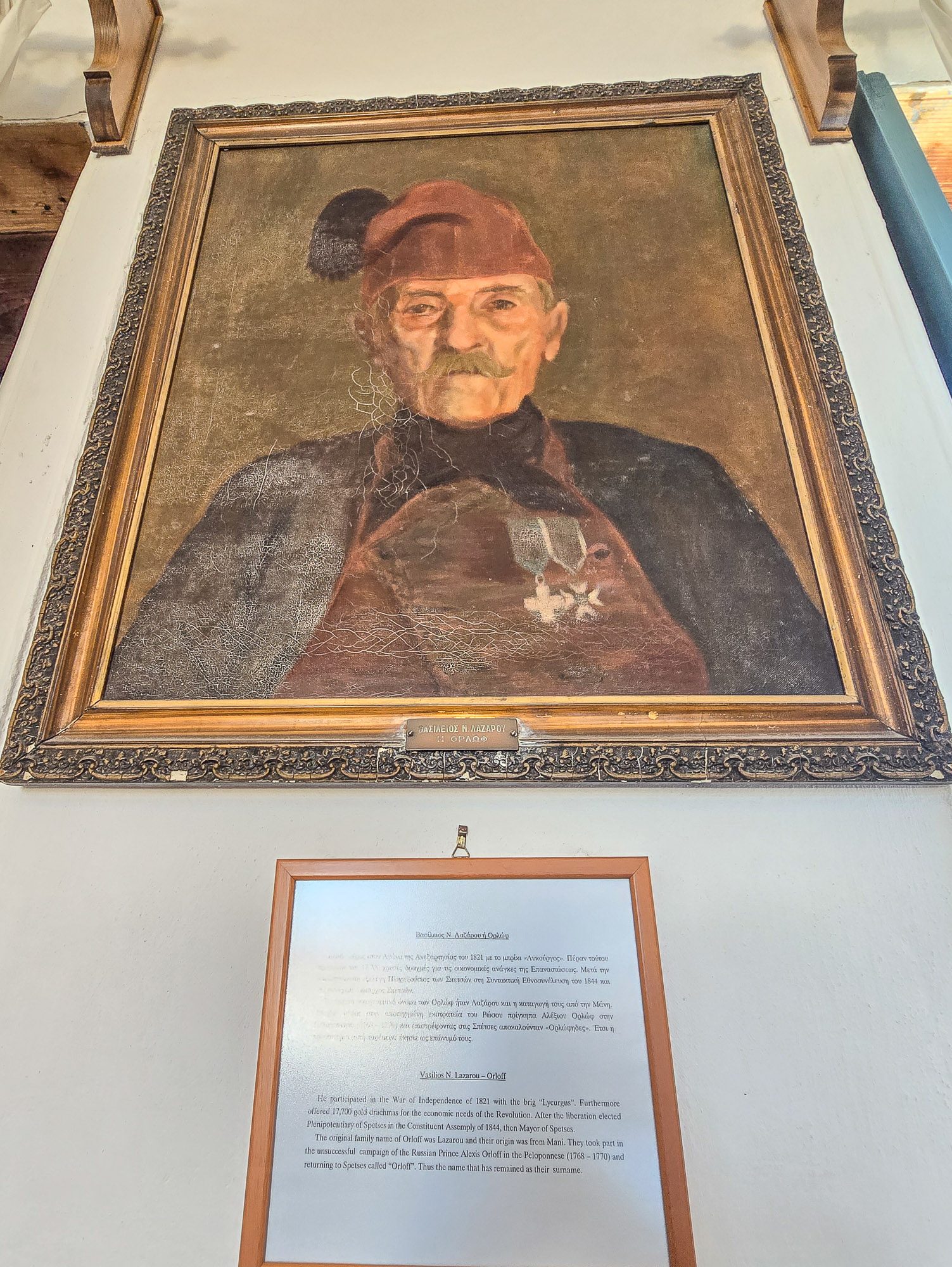
Inside, I was left to wander through the rooms at my own pace. There was an icon room filled with religious hagiography which included post-Byzantine icons from old churches on the island. Some of the icons had been brought back from countries like Russia by ship owners. A room dedicated to the revolutionary period houses a gallery of Spetsiot naval battle fighters – familiar faces of the heroes gallery running through the town. Weapons of the period were also on show.
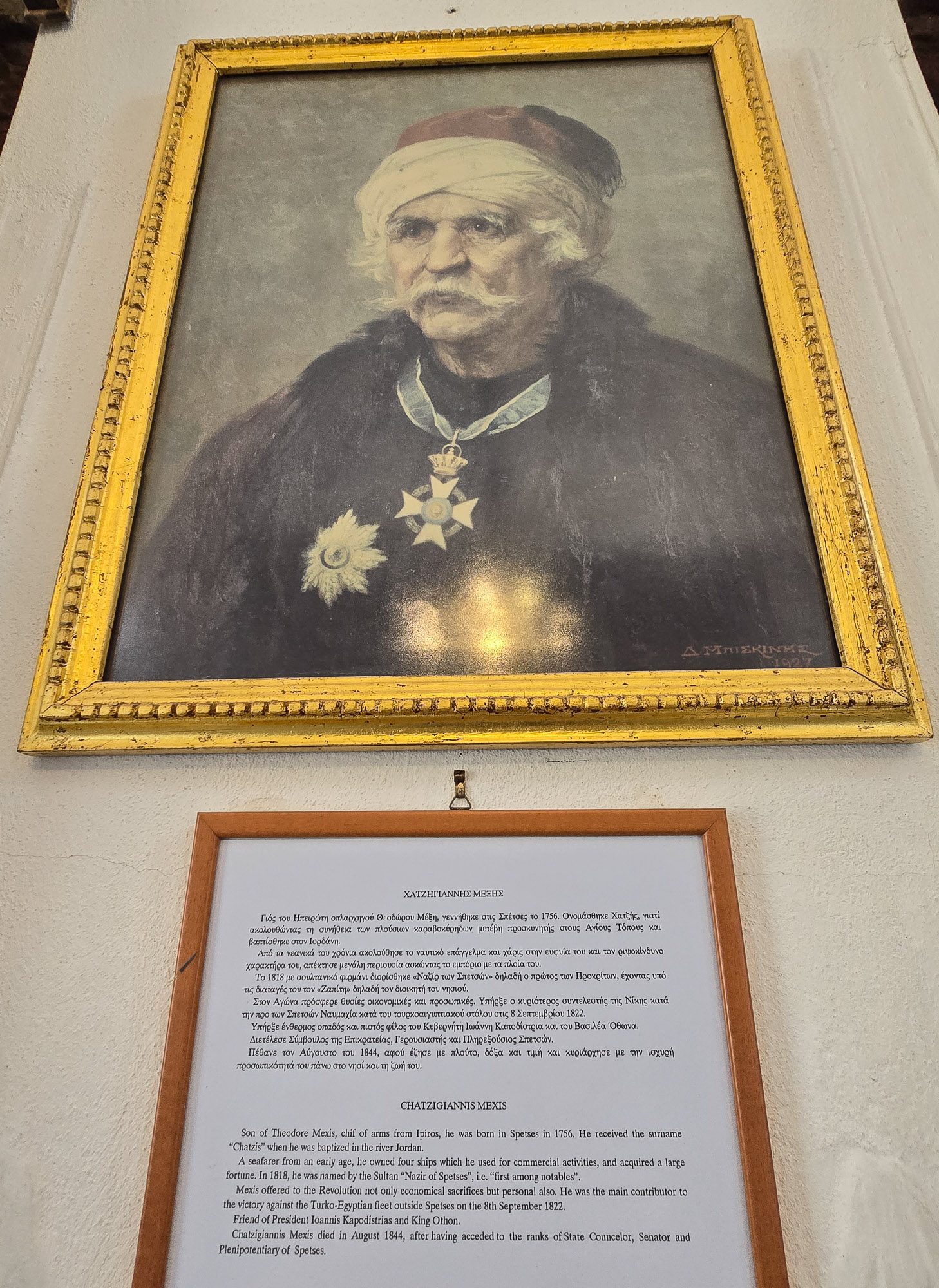
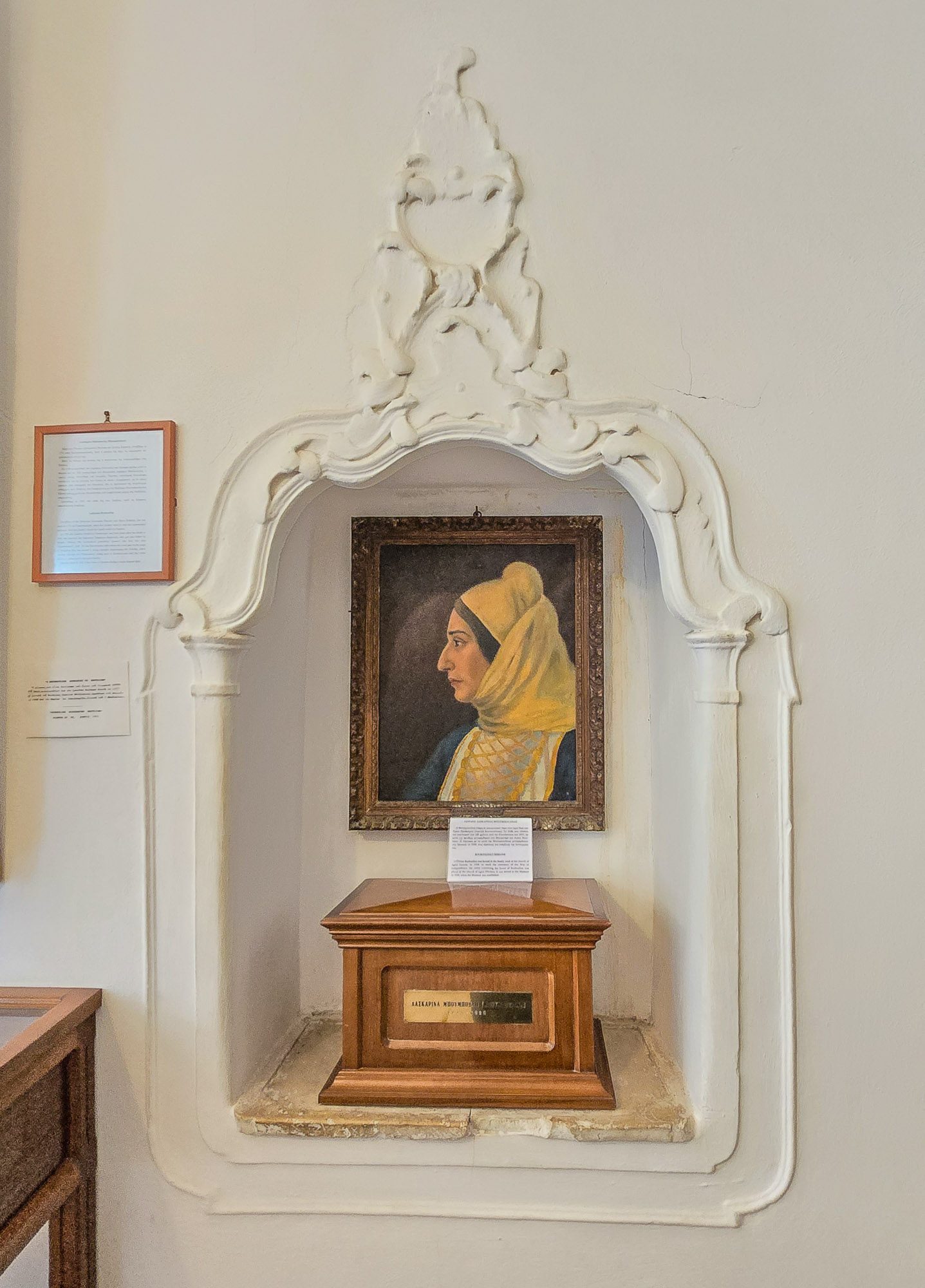
I found the costume room most interesting having always had an interest in sewing and clothes design (a previous life). It’s a nice detail that the Spetsiot women’s dress is known simply as Bouboulina’s – because she wore it. The ensemble consists of a white silk long-sleeved shirt, a dress called a kavadi, a brocade jerkin, fine white stockings and black pumps, finished with a colourful multi-pleated kerchief called a tsemberi. The men’s costume, the toumani, is named after the marine knot that was its most distinctive feature.

My visit was short as the museum is small, but it did provide useful context for understanding the island’s history. There is also something to be said for exploring a museum in complete silence.
Weekend in Tweed, Spetses
Then came the Weekend in Tweed.
An annual event organised by the Poseidonion Grand Hotel, it initially sounded to me like something dreamt up by a group of enthusiastic British expats. The words ‘tweed’, ‘picnics’ and ‘vintage bicycles’ conjured up something from the pages of P.G. Wodehouse — Bertie Wooster cycling through the Cotswolds, possibly being chased by an aunt. So very English.
As it turns out, the participants were predominantly Greek.

At Villa Christina, several guests from Thessaloniki were preparing to take part. By breakfast, half of them had appeared in full costume — striped tops, berets, and one slightly unfortunate baguette that had clearly not survived the journey intact but had been carefully taped back together. It is all about the visuals!
Vintage bicycles began to appear in the courtyard, some adorned with small French flags, hinting at their theme for this year. And then they left to gather at the Poseidonion Hotel.
Rather than watching the departure from outside the Poseidonion, I decided to position myself at the Anargyrios School, the first stopping point along the route. When I arrived, a single woman stood there with her bicycle, dressed to the nines (vintage Laura Ashley she told me) and holding a camera with a lens that suggested she meant business. She told me her son was taking part and that she’d just had a call that they were on their way.
Ten minutes later, they began to arrive.
It began with a trickle followed by a steady stream. Singles and in small groups, they cycled under the dappled shade of the avenue of pine trees lining Kaiki Beach.
Most of them had really pushed the boat out with their costumes and the smiles on their faces really gave the impression they were enjoying it. Although I’d had my doubts when I first heard about this event, the slightly eccentric idea of it all grew on me.
Despite my resistance to visiting Spetses after all these years, it surprised me. Not just the unexpected ‘tweed’ event, but almost everything about it. It took me long enough, but Spetses was a revelation. So much so, I extended my stay.
Final round up of my stay on Spetses in the next post.
Discover more from A Greek Oddity
Subscribe to get the latest posts sent to your email.


I had to google Spetses – no idea where it even was ! What a quirky day with the bicycles!
Thank you Liz! I always appreciate your comments on my posts! ❤️ Spetses – you should go. Very close to Athens. Also film location for Knives Out film starring Daniel Craig! ❤️