
First Impressions of Spetses – Along the Southern Shore
Spetses is often described as elegant, refined, even a little aloof — but walking its southern shoreline tells a far richer story. From the working boatyards of Baltiza and the Armata monuments of Cape Fanari to quiet monasteries hidden among pine and cypress, this first exploration reveals an island shaped as much by labour, faith and seafaring resilience as by grand hotels and polished harbours. Arriving without expectations, I began to see how Spetses slowly dismantles its own reputation — one walk at a time.
The flight from Lesvos to Athens was an easy one – short, no turbulence – just as I like it. It still makes me smile when the cabin crew don aprons to serve a biscuit and a cup of juice! At the airport, I hesitated between my usual choice — the Metro — and the bus to Piraeus. It had been a while since I’d taken the latter, so I left the decision to chance. Heads it was. The bus stop sits directly outside arrivals, tickets can be bought at the booth or paid contactlessly on board, and the journey into the port takes around ninety minutes — a slow, practical transition back into ferry mode.
At Piraeus, the electronic departure boards held my attention longer than expected. The next sailings were all heading back in the direction I’d just come from. A twelve-hour return to Lesvos wasn’t especially tempting. Instead, my thoughts turned to destinations with reliable year-round connections with late afternoon departures. And this is where Spetses edged into focus.
Spetses had long occupied an awkward corner of my imagination. Years ago, I’d formed the view that it was a little pretentious — a judgement shaped by hearsay rather than experience. Yet I’ve always believed you should never take anyone’s word for a place. Beauty is subjective, and some of the places I’ve loved most are those others would walk away from without a second glance. Ticket purchased, decision made. I made use of the waiting time and booked accommodation at Villa Christina. As my arrival was imminent, I booked directly with the accommodation rather than leave it to a booking platform.
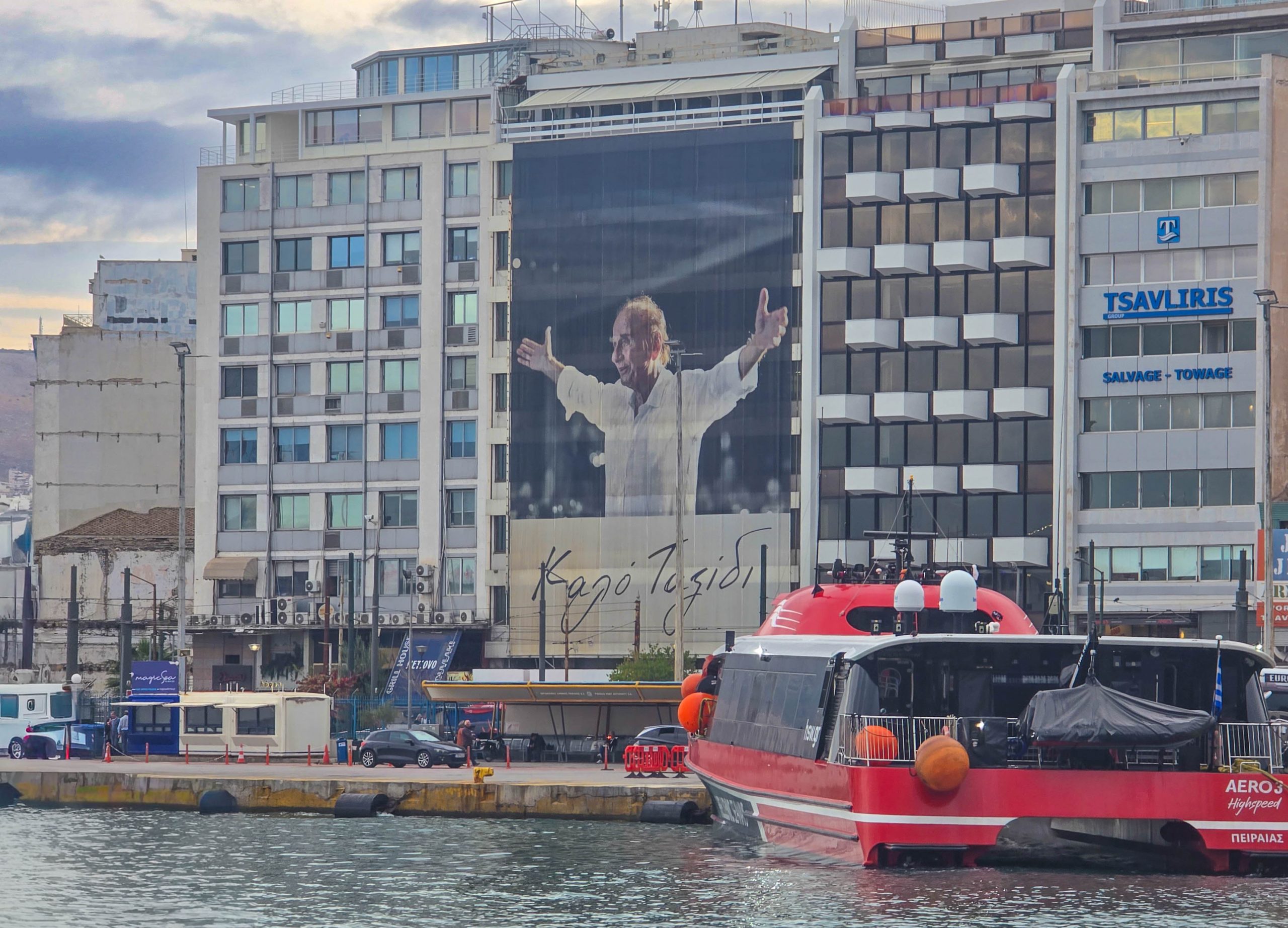
The final boat of the day made an additional stop at Ermioni, stretching the journey into darkness. I’m not especially fond of high-speed ferries. Not because I get seasick, but because I dislike being pinned to one seat, staring through salt-streaked windows. Still, the boat was almost empty, and I was able to move from seat to seat as the boat pulled into each port. By the time we passed Poros and Hydra, the latter briefly illuminated by a full moon, it was too dark to recognise anything from my visit back in 1993 – over thirty years ago now. Even through the blurred glass, Hydra looked very atmospheric. Enough to spark curiosity. Maybe I’ll have to pop over to refresh my memory.
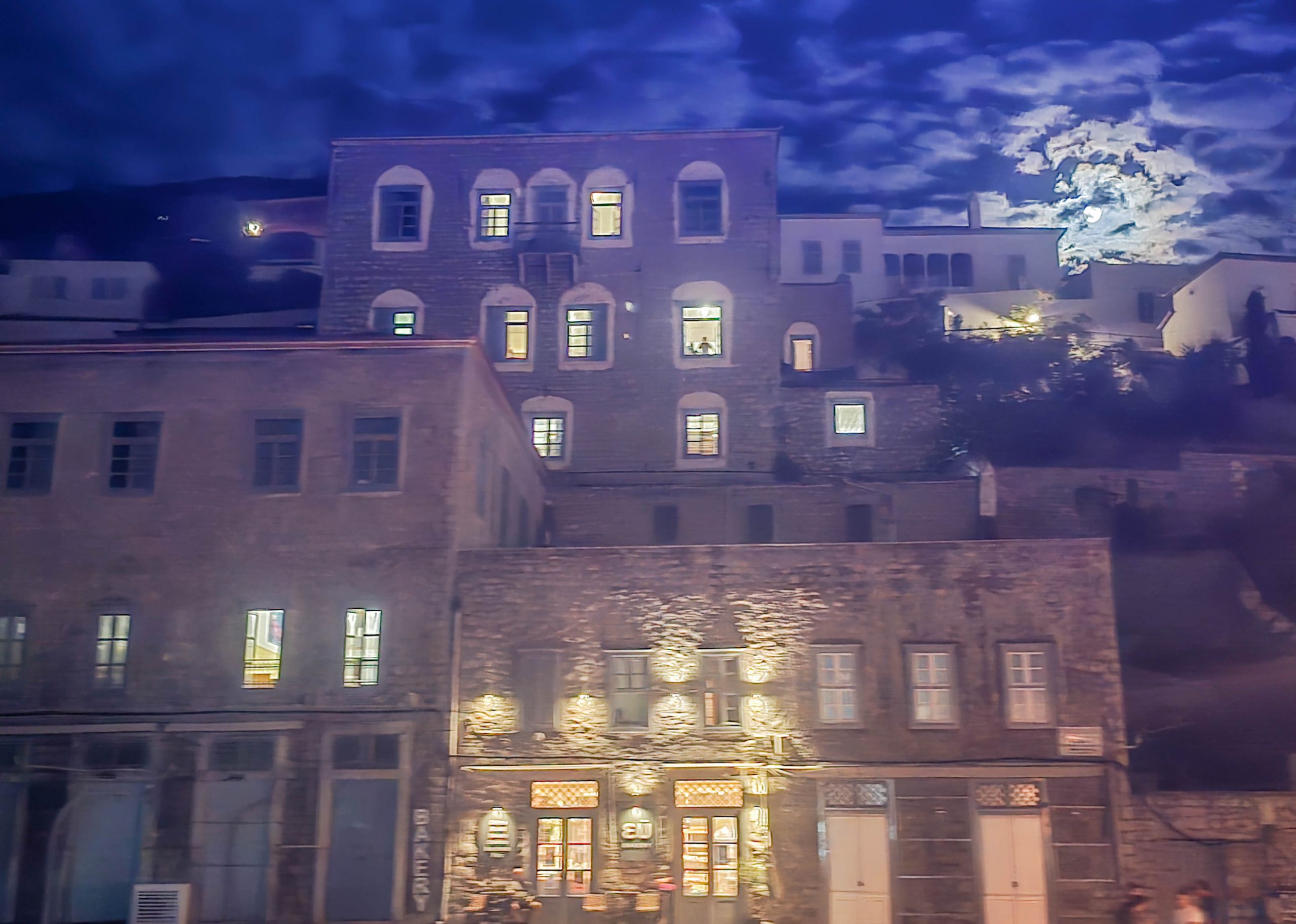
Once at Dapia port, I climbed uphill along a cobbled street until I reached the entrance of Villa Christina – a wooden door set into a high stone wall. Aggeliki emerged from a hidden courtyard, unfazed by the late hour. ‘The last boat is always late’, she smiled. My room was simple, on the ground floor, and quiet. Breakfast, she said, would be waiting in the morning.
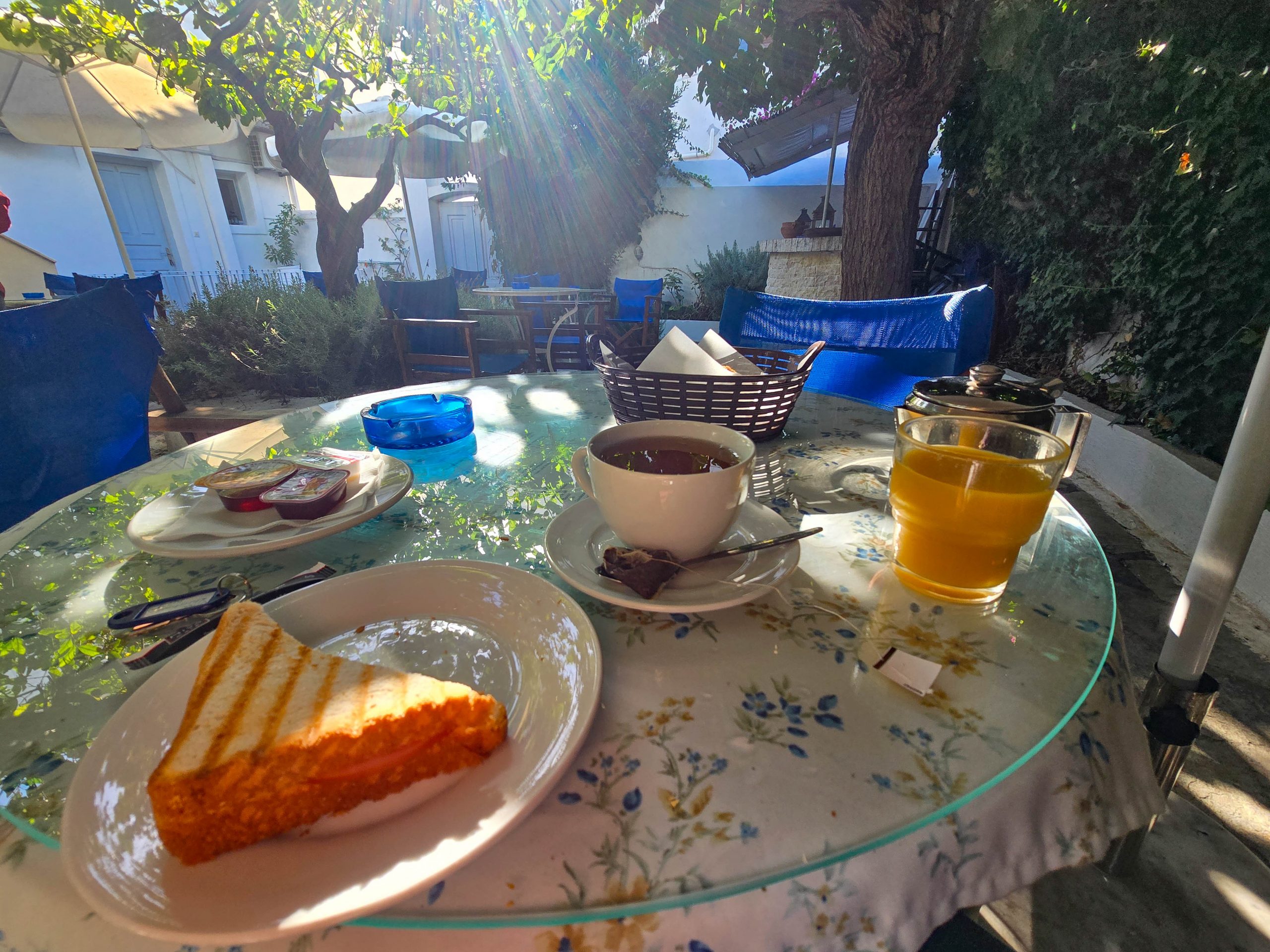
Breakfast was optional, uncomplicated, and lovely. A toasted cheese and ham sandwich, a slice of cake, bread and jam, orange juice and tea. There’s something deeply satisfying about simplicity — it taps into childhood picnic memories, unembellished and content. The orange trees filtered the dappled light into the courtyard which always had sun spots or shade – whatever you preferred.
Aggeliki soon revealed herself to be a most welcoming and informed host. A native of Grevena with excellent English, her knowledge of the island was encyclopaedic, having married a native of the island. Honestly, my morning chats with Aggeliki were some of the highlights of my stay. We talked about life, love, family and all manner of topics. Two strangers with a shared outlook on the world. Well, I guess that comes with age and experience and motherhood.
I had planned to stay on Spetses for 5 days, and Aggeliki advised that many of the facilities on the other side of the island would now be closed. However, she assured me that there would be plenty to see and do during my stay.
Let’s explore the southern shore from Dapia to Baltiza first.
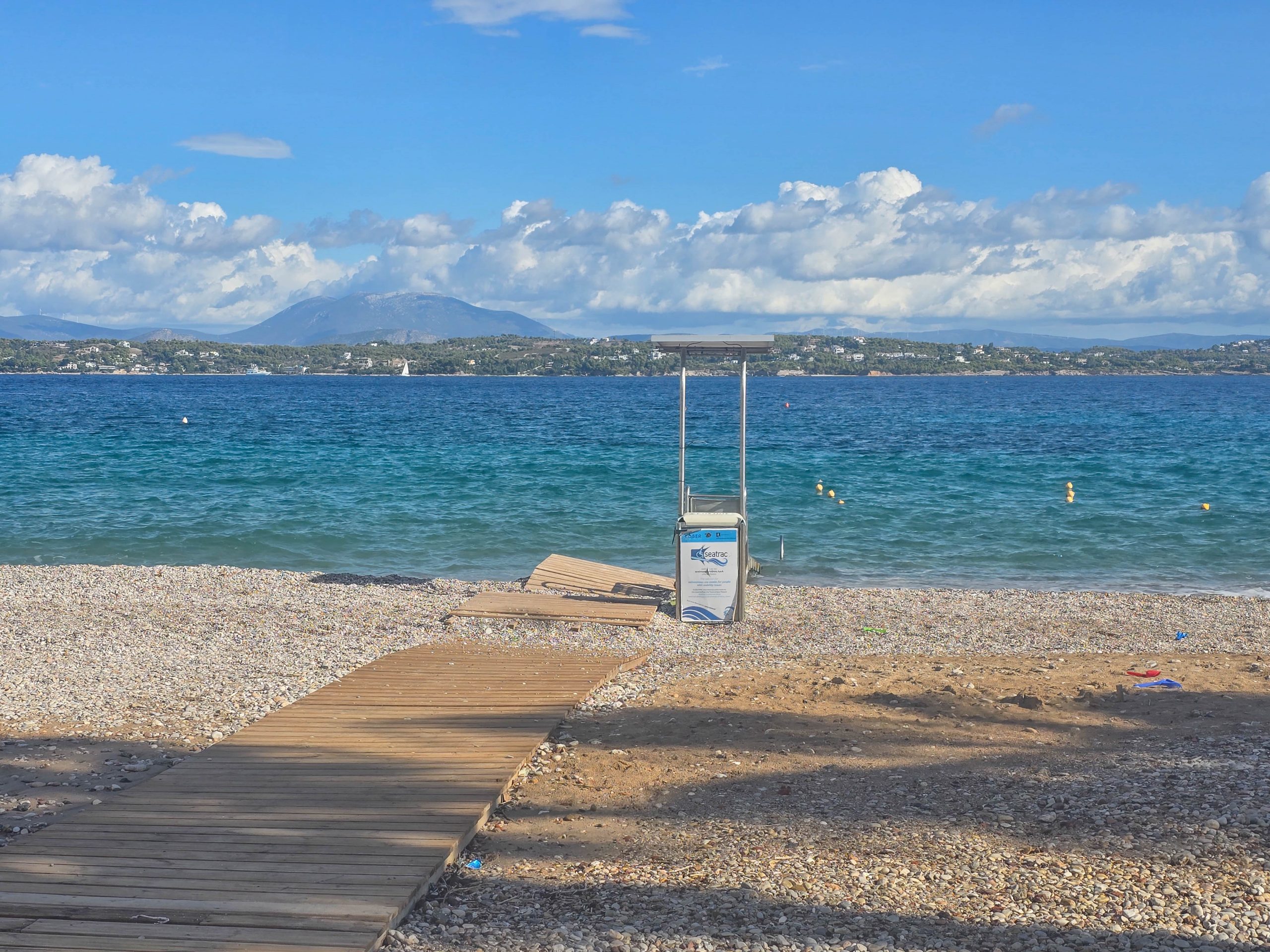
Leaving Dapia, the island’s main port, the initial impressions are familiar enough: smart cafés, boutiques, polished harbourfront living. There is the small beach of Paralia Agios Mamas, complete with SeaTrack accessibility for visitors with mobility impairments — a facility I always make a mental note of for when I have my professional hat on. The thing that really caught my attention was how close we were to the mainland of the Peloponnese – I mean, I knew it was just a 10-minute boat ride away, but it felt almost within touching distance.
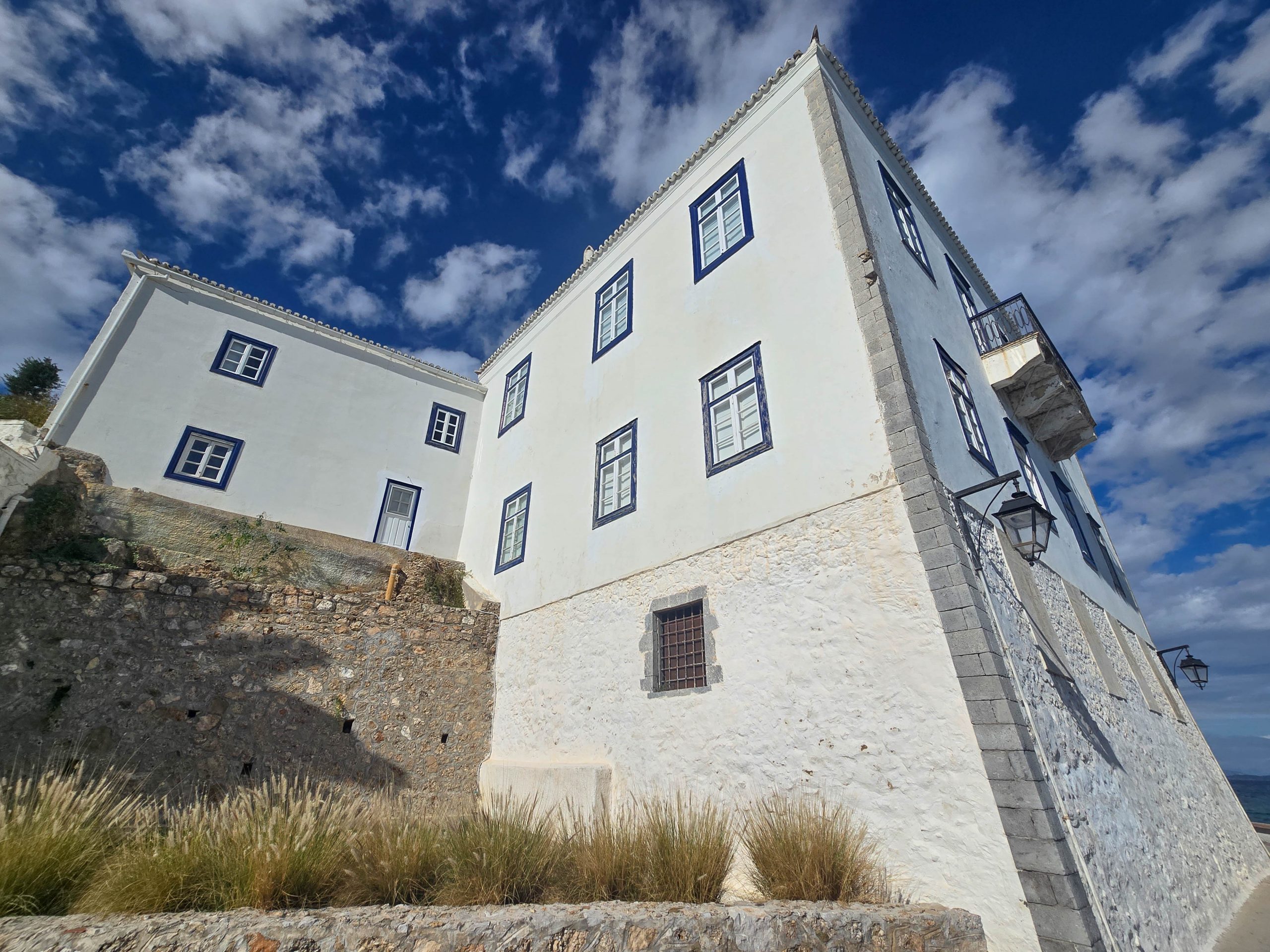
Walk a little further, and Spetses begins to reveal its older, more defensive character. Tall houses with thick walls appear, whitewashed and almost blindingly reflective in the bright morning sun — architecture shaped by centuries of maritime exposure and threat.
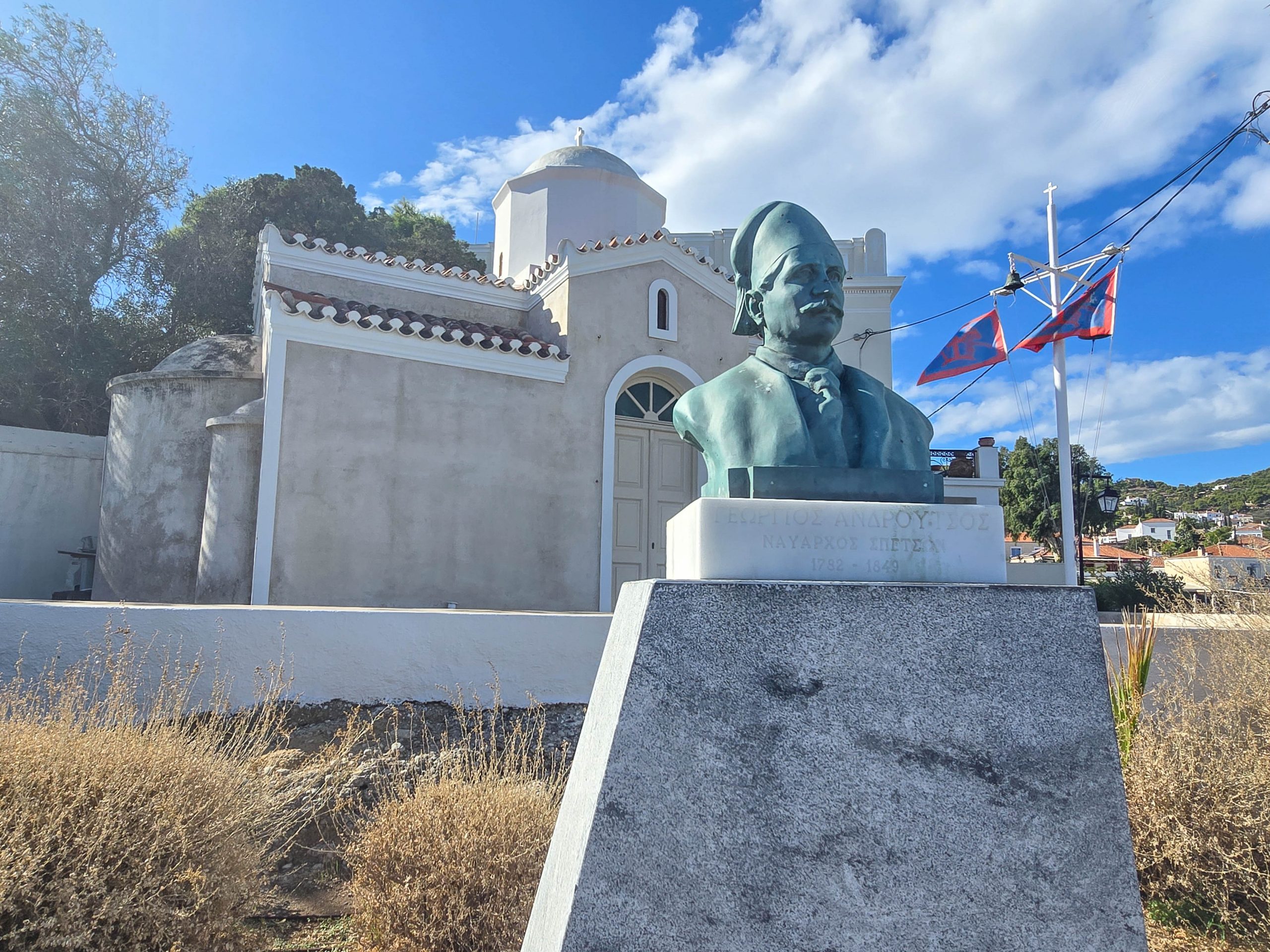
Beyond it, the Heroes Gallery begins — a line of busts honouring figures from the Greek War of Independence. One bust in particular, or rather the name, caught my attention. That of Vasilis Lazarou.
Locally, he was known by the nickname ‘Orloff’, which hardly sounds Greek at all. He earned it through his and his brothers’ involvement in the Russo–Turkish campaigns, and it speaks to an earlier generation of Spetsiot seafarers whose experience helped shape the island’s later role in the War of Independence.
What isn’t immediately obvious as you walk along the Heroes Gallery is that these busts were never intended as a single, fixed outdoor monument. The original eight Spetsiot heroes were modelled as gypsum casts in the early 1930s and displayed for many years in the courtyard of the Museum of Spetses, before being removed for preservation. Their return to the island has been gradual, with new castings installed along the waterfront as part of recent municipal heritage projects.
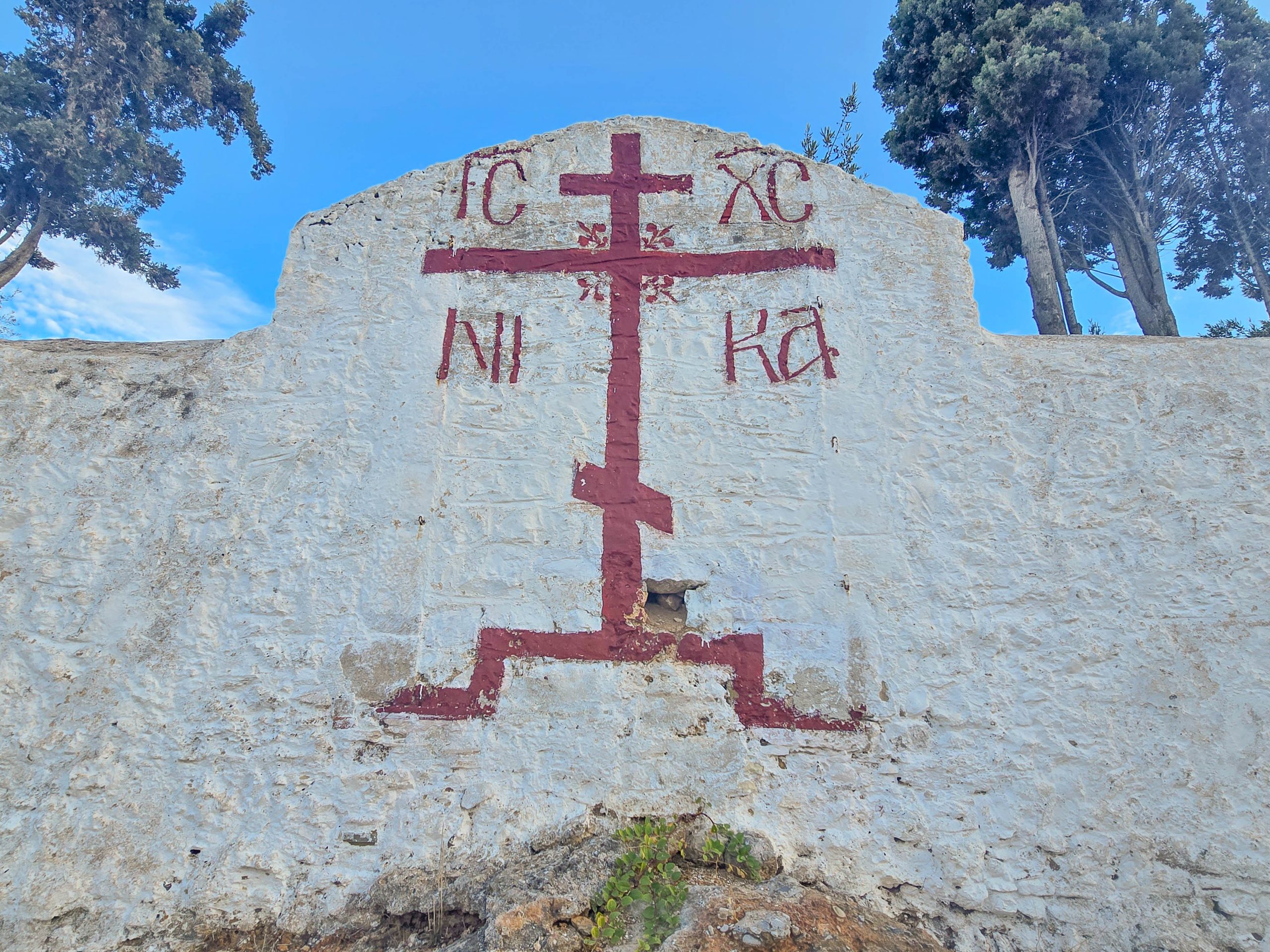
Nearby stands the modest Agios Mamas Church, long associated with protection and everyday devotion rather than ceremony. Painted onto a neighbouring wall is the familiar Orthodox inscription IC XC NIKA — Jesus Christ conquers.
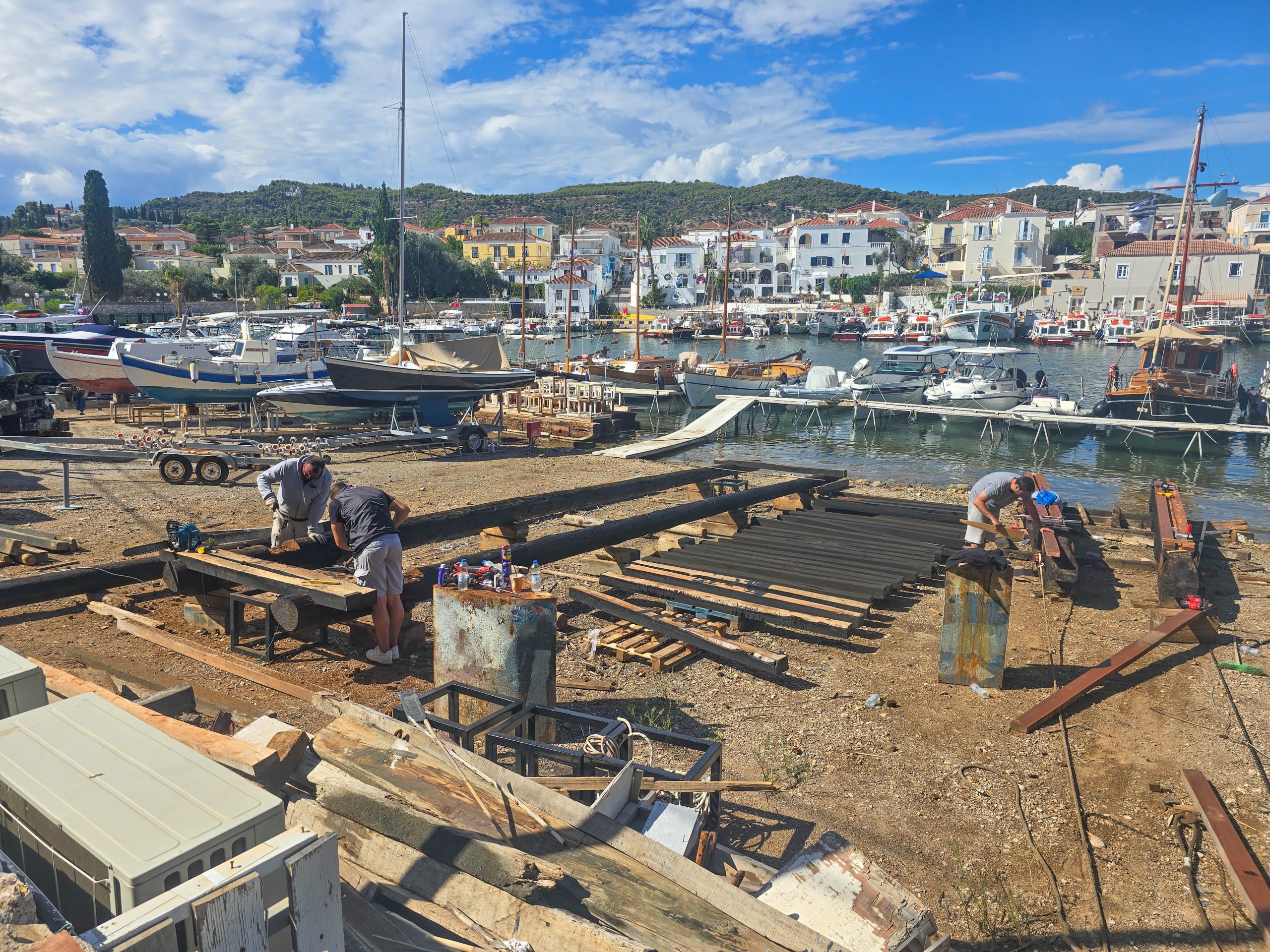
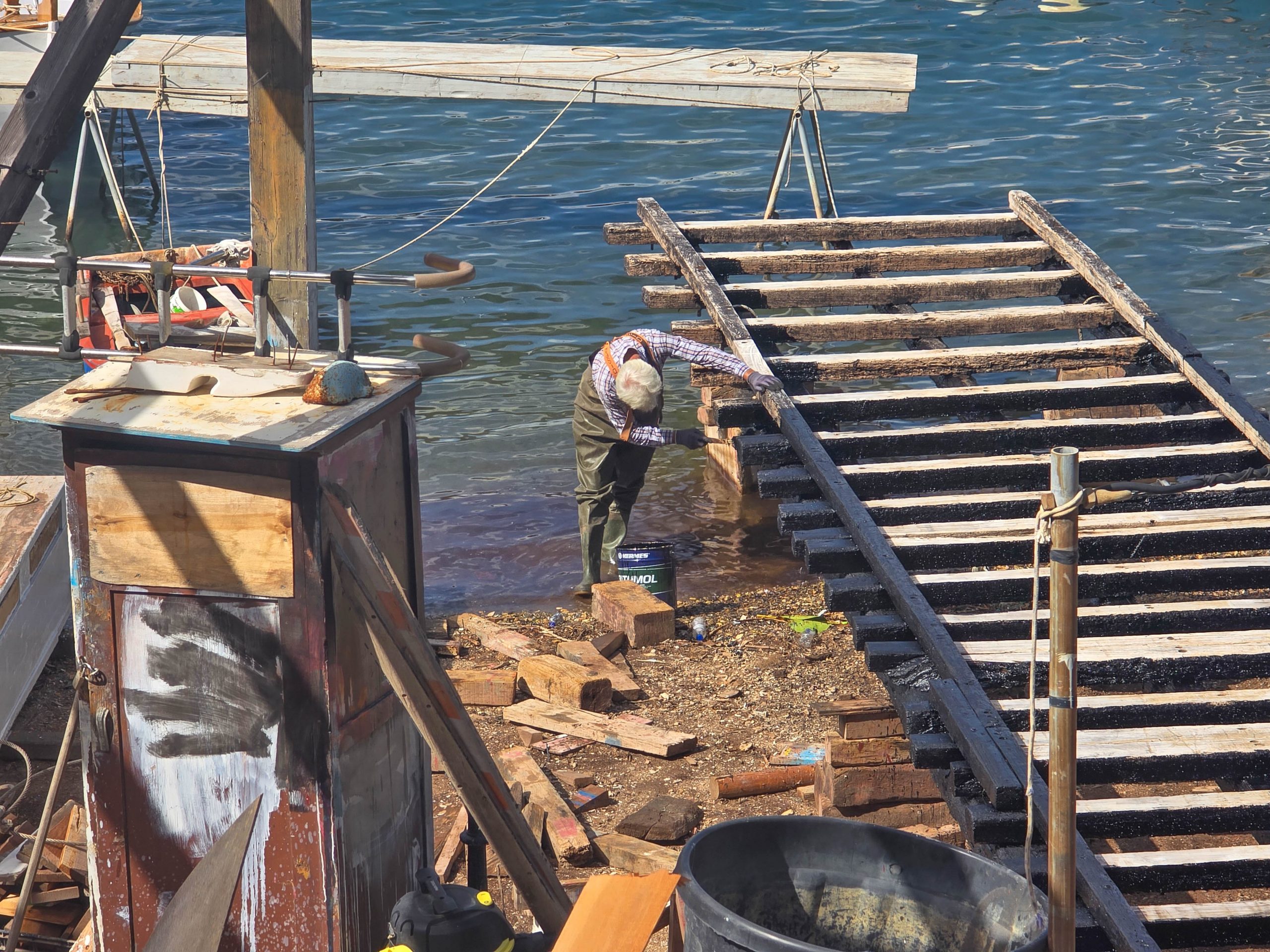
Turning the corner, the atmosphere shifts again. Palio Limani, the Old Harbour, lies around 1.5 kilometres from Dapia and remains a working boatyard. I watched craftsmen constructing new skaria — wooden runners, or skids, used to slide boats between land and sea. Winches, pulleys and all manner of boatyard accoutrement lay scattered about, seemingly cast aside, but I don’t doubt every single tool had a role to play in boat maintenance and construction.
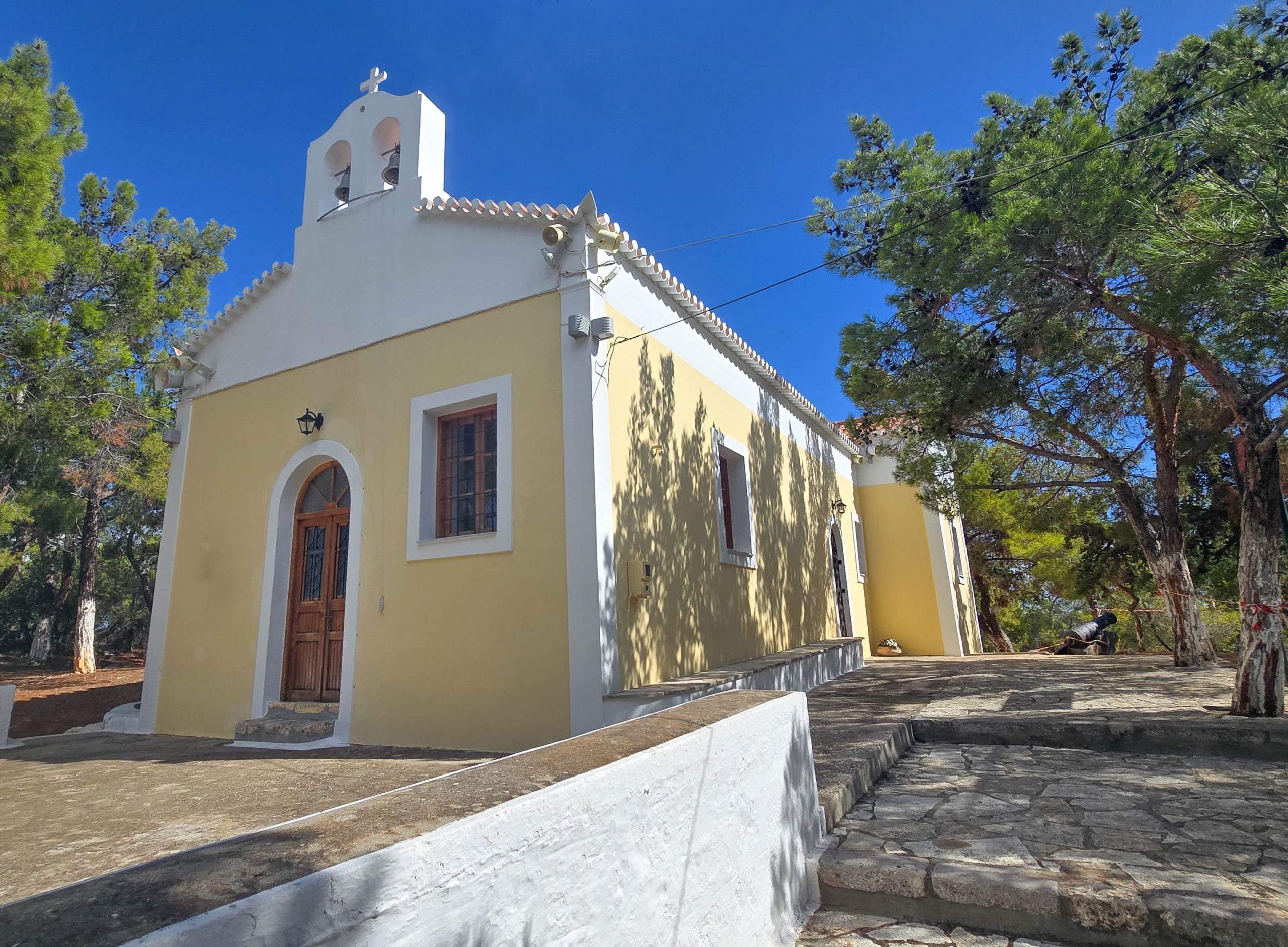
Beyond the boatyard, the road begins to climb along a shaded avenue of pine trees. Tucked into the greenery is Panagia Armata, an unassuming little chapel surrounded by pines, their bases ringed with a carpet of fuchsia-pink cyclamen. Just as the flowers of summer seem to be calling it a day, the message from the cyclamen is ‘bring it on’!
Agios Mamas was built in the 1820s in thanksgiving to the Virgin Mary following the decisive naval clash of 8 September 1822. Each September, the island still commemorates that victory with the Armata celebrations — candlelit processions, a symbolic sea battle and fireworks.
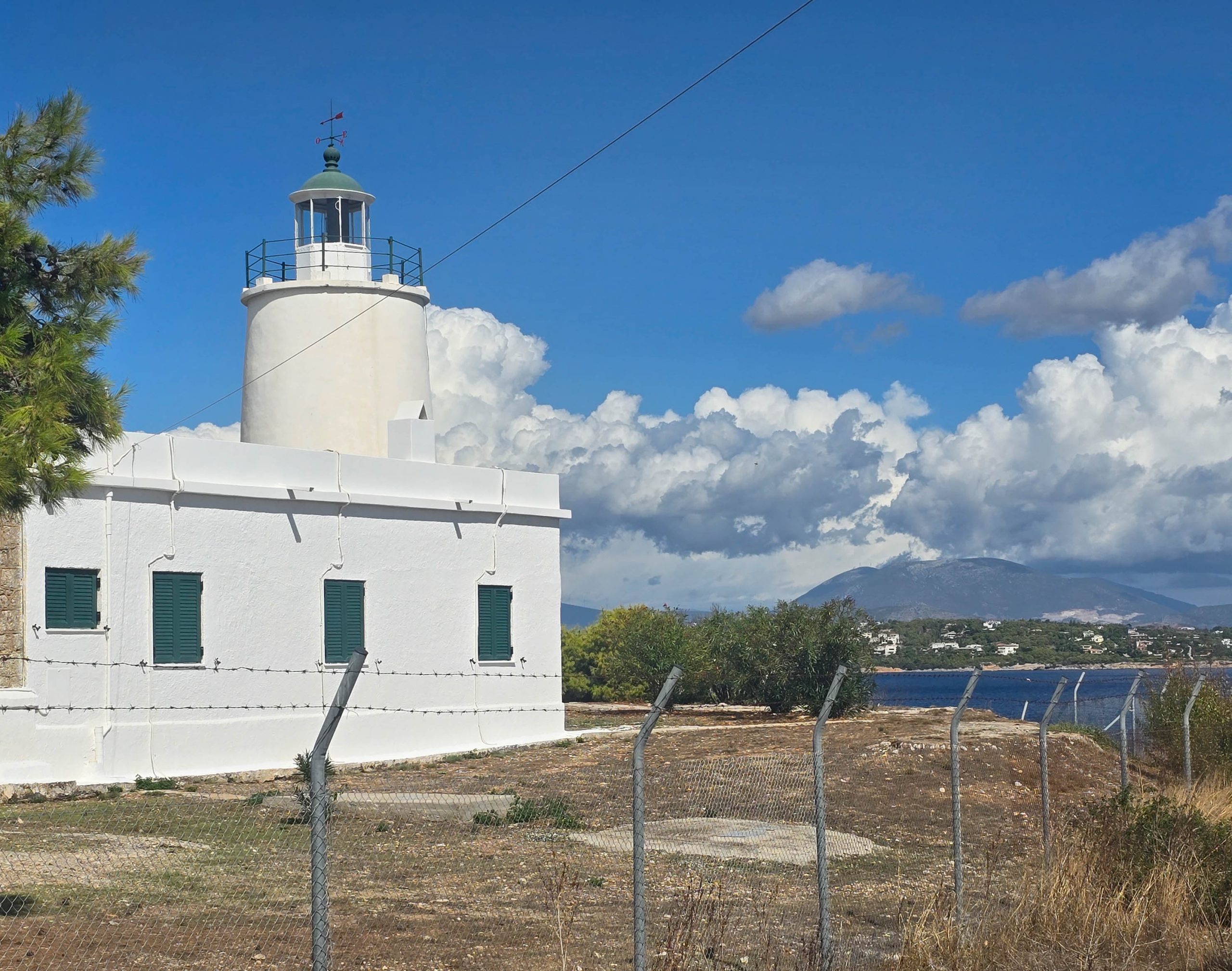
At the tip of Cape Fanari, the lighthouse rises quietly. Built in 1831 and still operating, it is among the earliest lighthouses in Greece. With Armata cannons below and Panagia Armata close by, it feels like another part of Spetses’ connection with the sea.
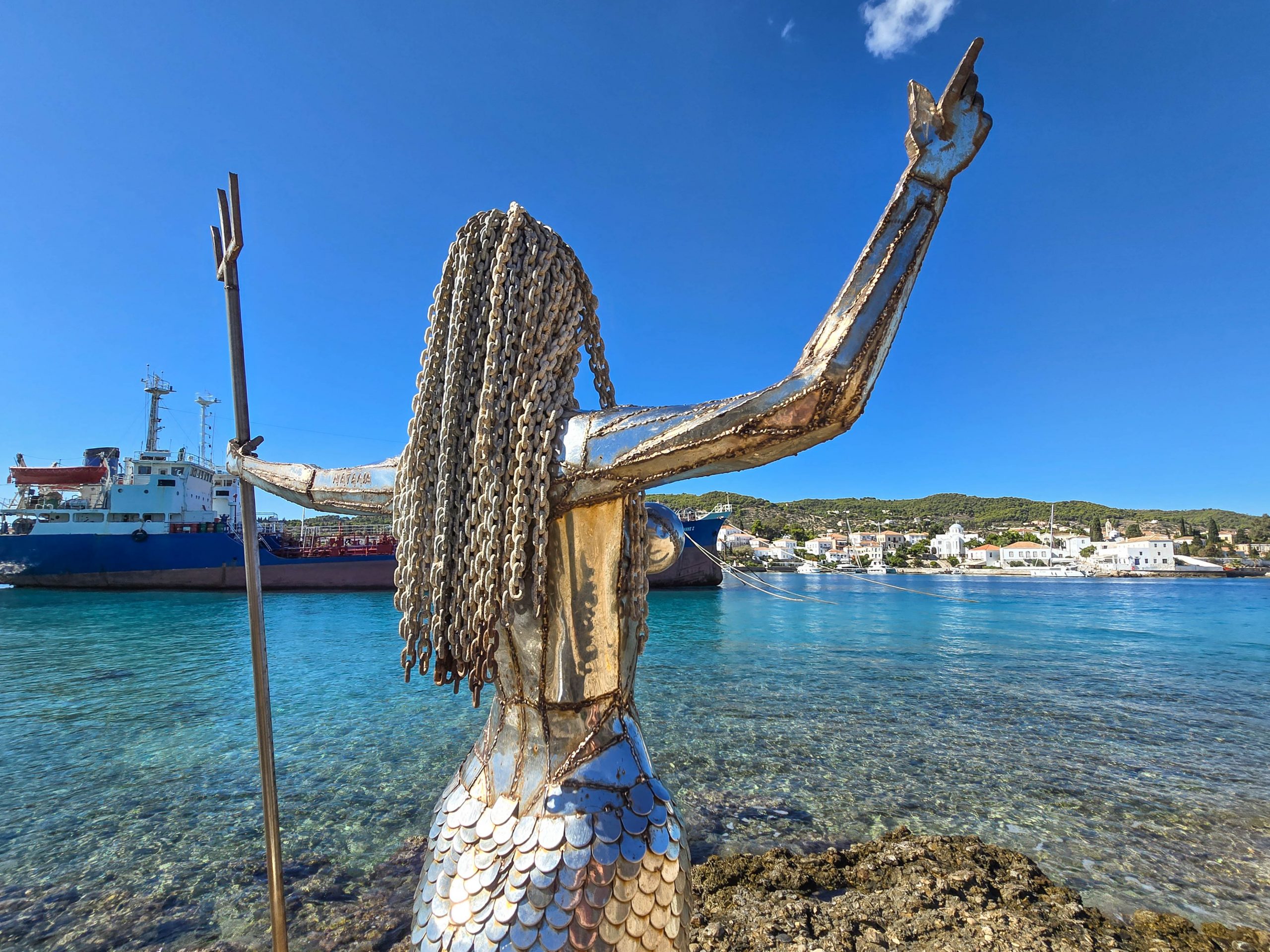
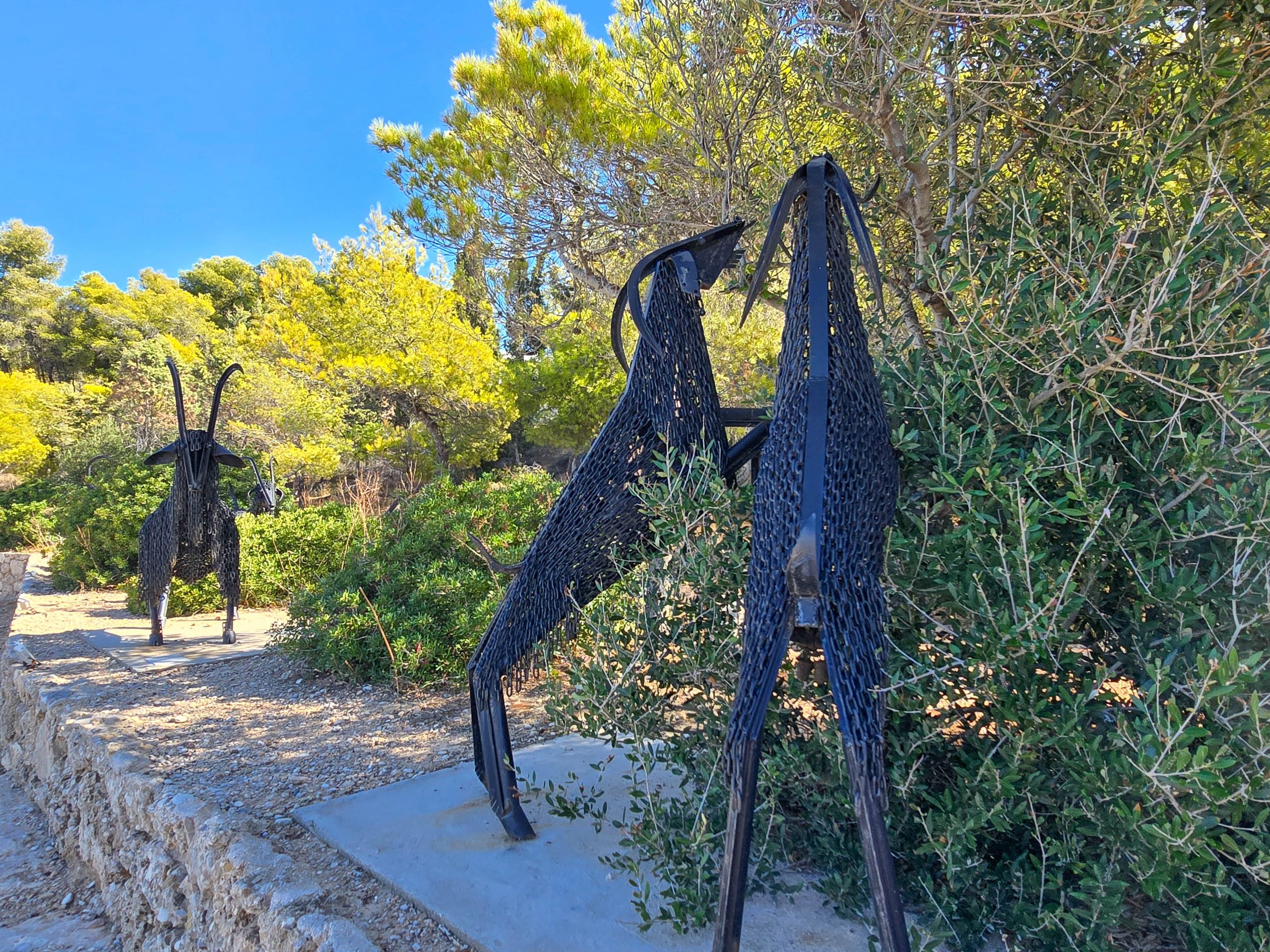
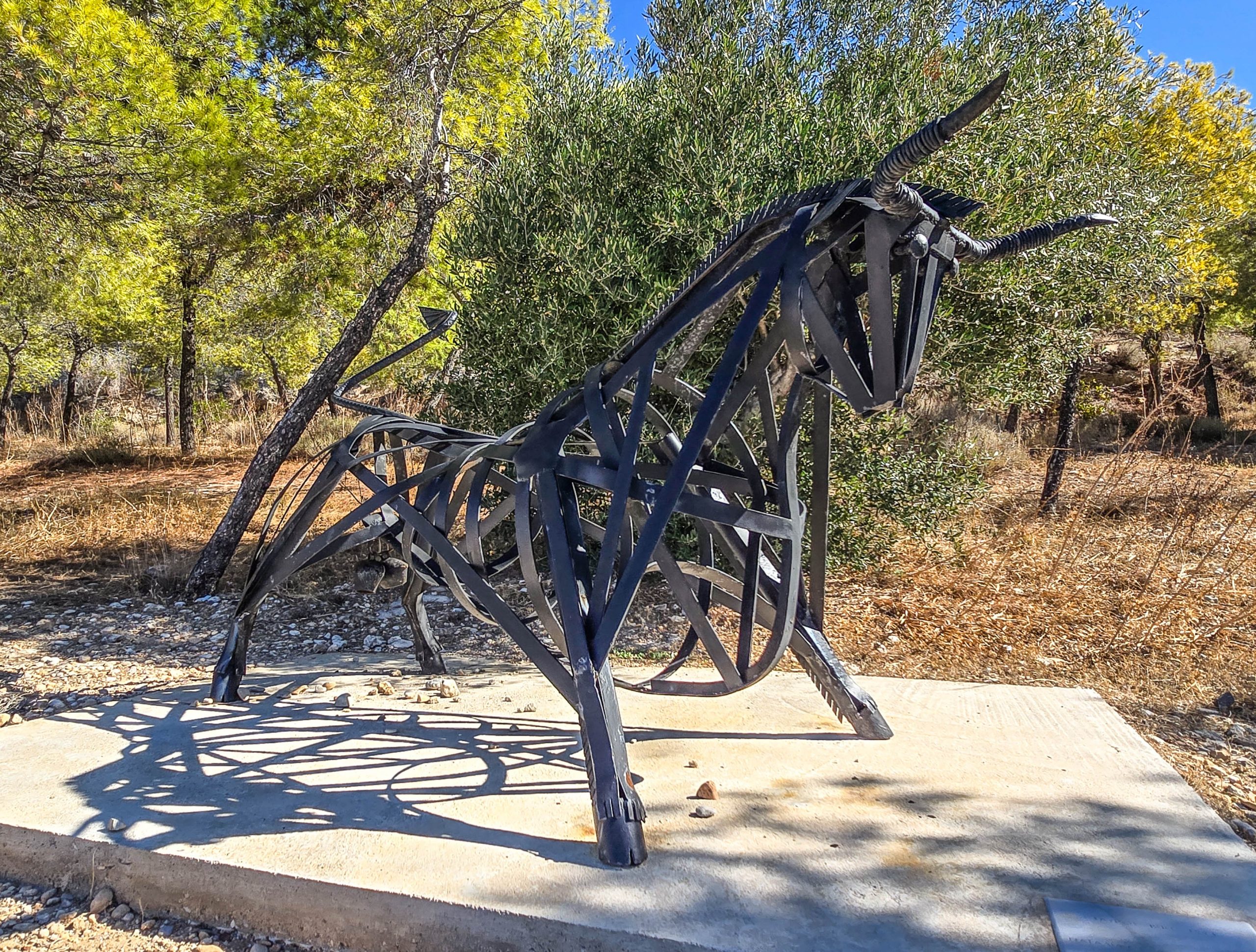
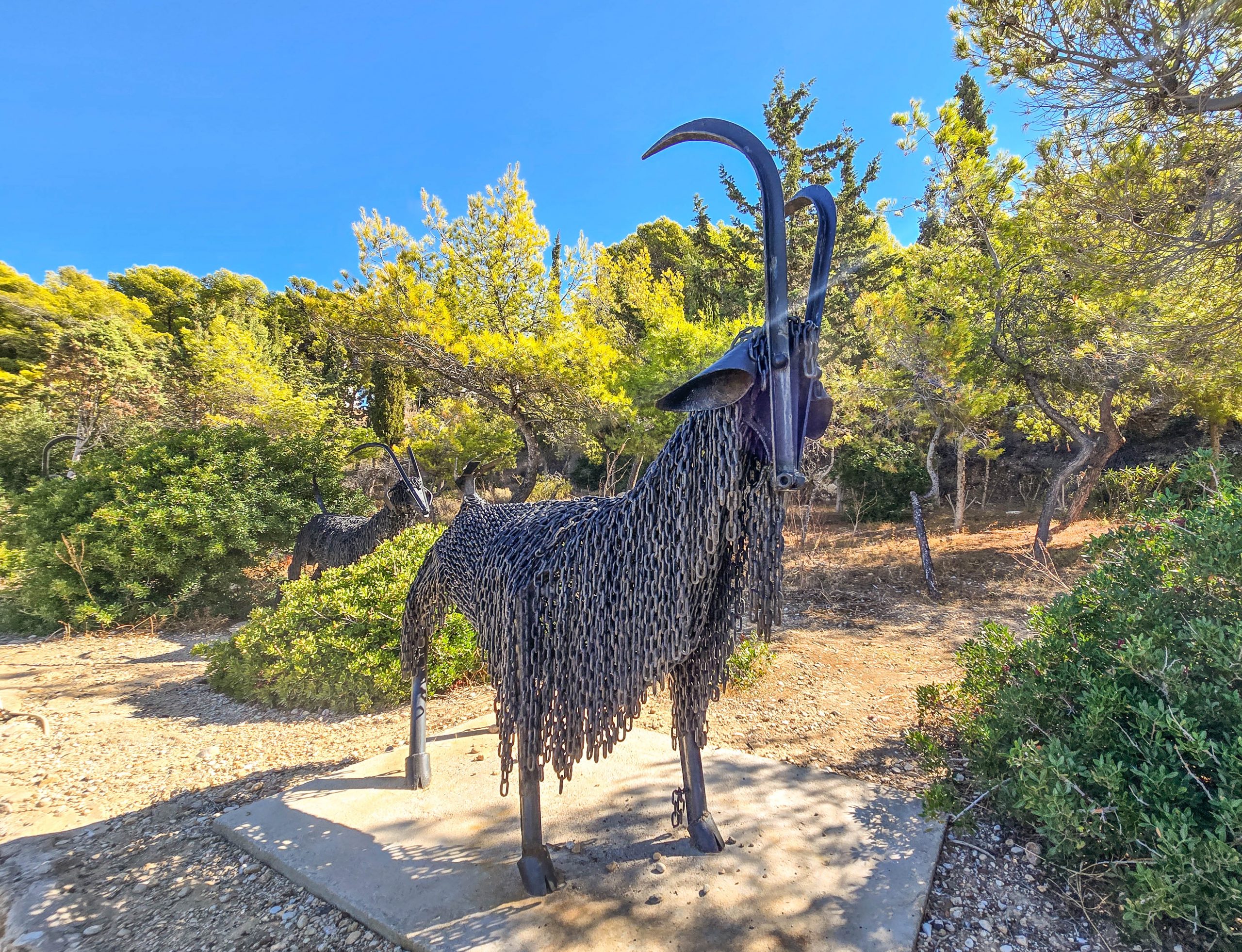
From the lighthouse, a track leads into the Municipal Park of Historical Monuments, where sculptures by Natalia Meller punctuate the landscape. A cluster of goat sculptures appears to gnaw at the greenery. Below, a striking silver mermaid gazes across the harbour, spear in hand, as though calling ships home.
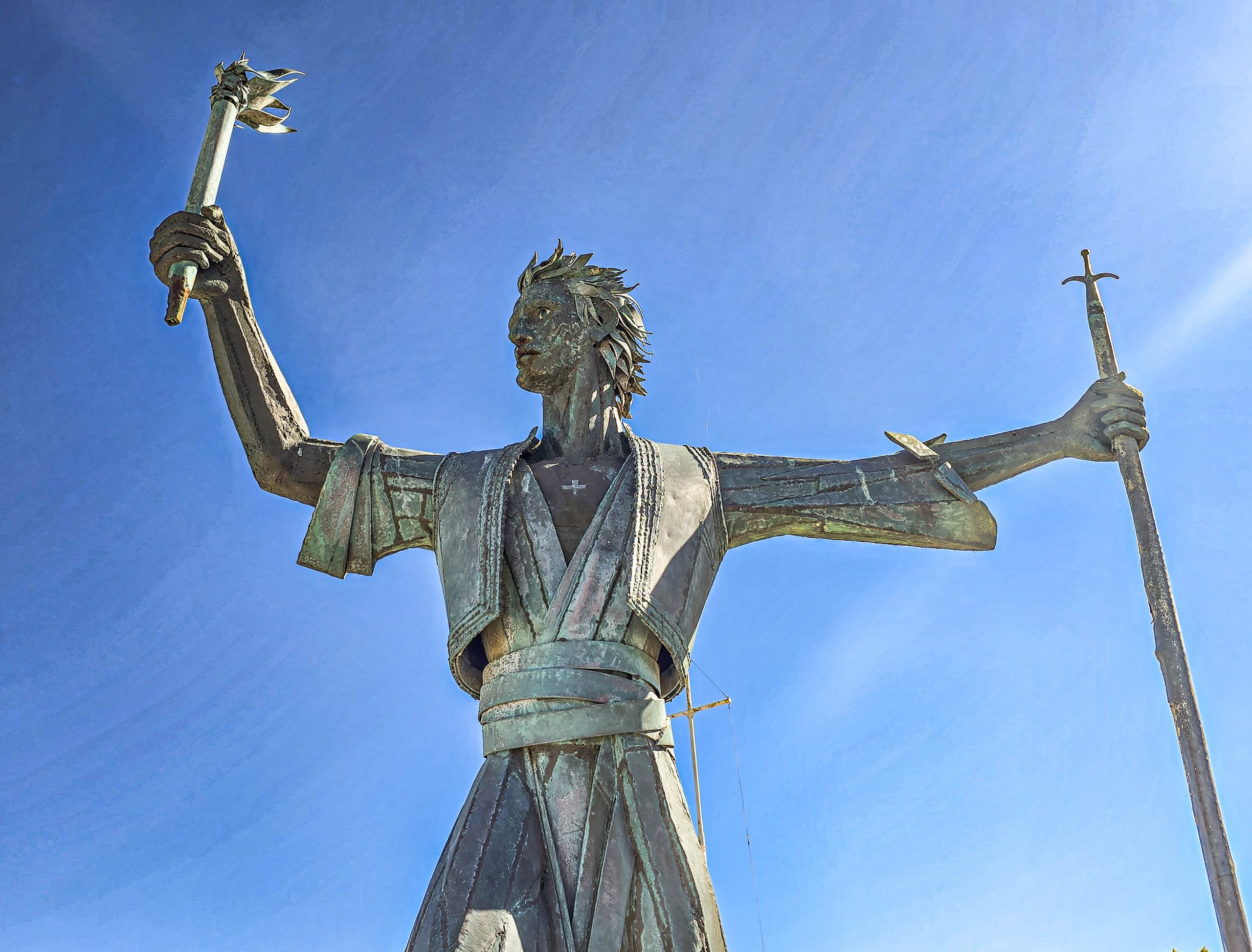
At the promontory’s tip stands the statue of Kosmas Barbatsis, commemorating the moment he set his fire ship against the Ottoman flagship in 1822. Meller’s work cannot show smoke or flame, but it captures something else — the defiant forward step of a man creating legend.
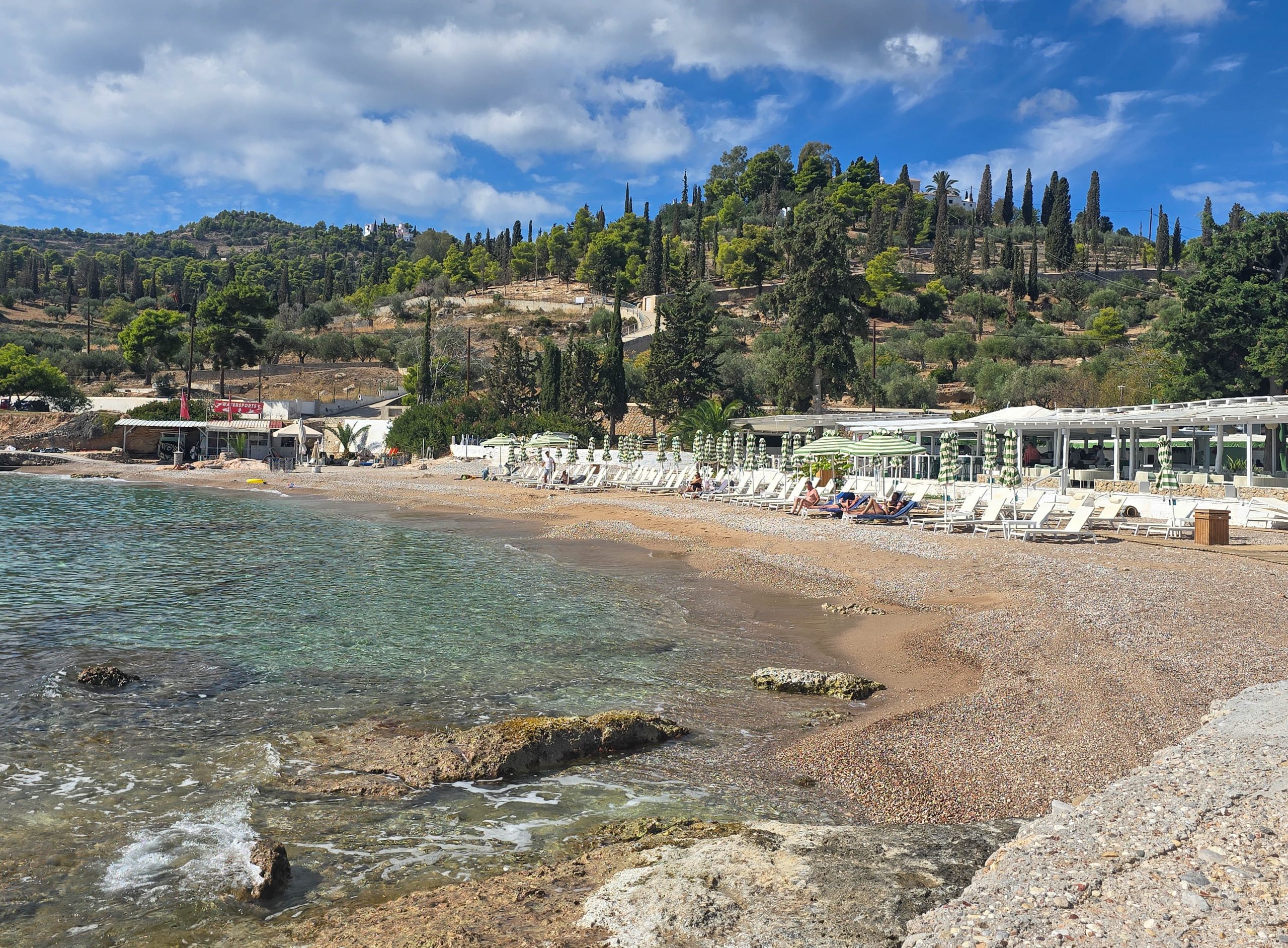
Beyond the Old Harbour, an inland path brings you back onto the coast at Agia Marina and its Beach. Here, there is an organised stretch of sand and pebble with sunbeds, a café-taverna called Paradise Beach and nearby a seasonal watersports hire facility. In early October, it was blissfully quiet. Cypress and pine crowned the hills behind; turquoise water met gold and green under a clear blue sky. It was a nice place to linger on a lounger for a while.
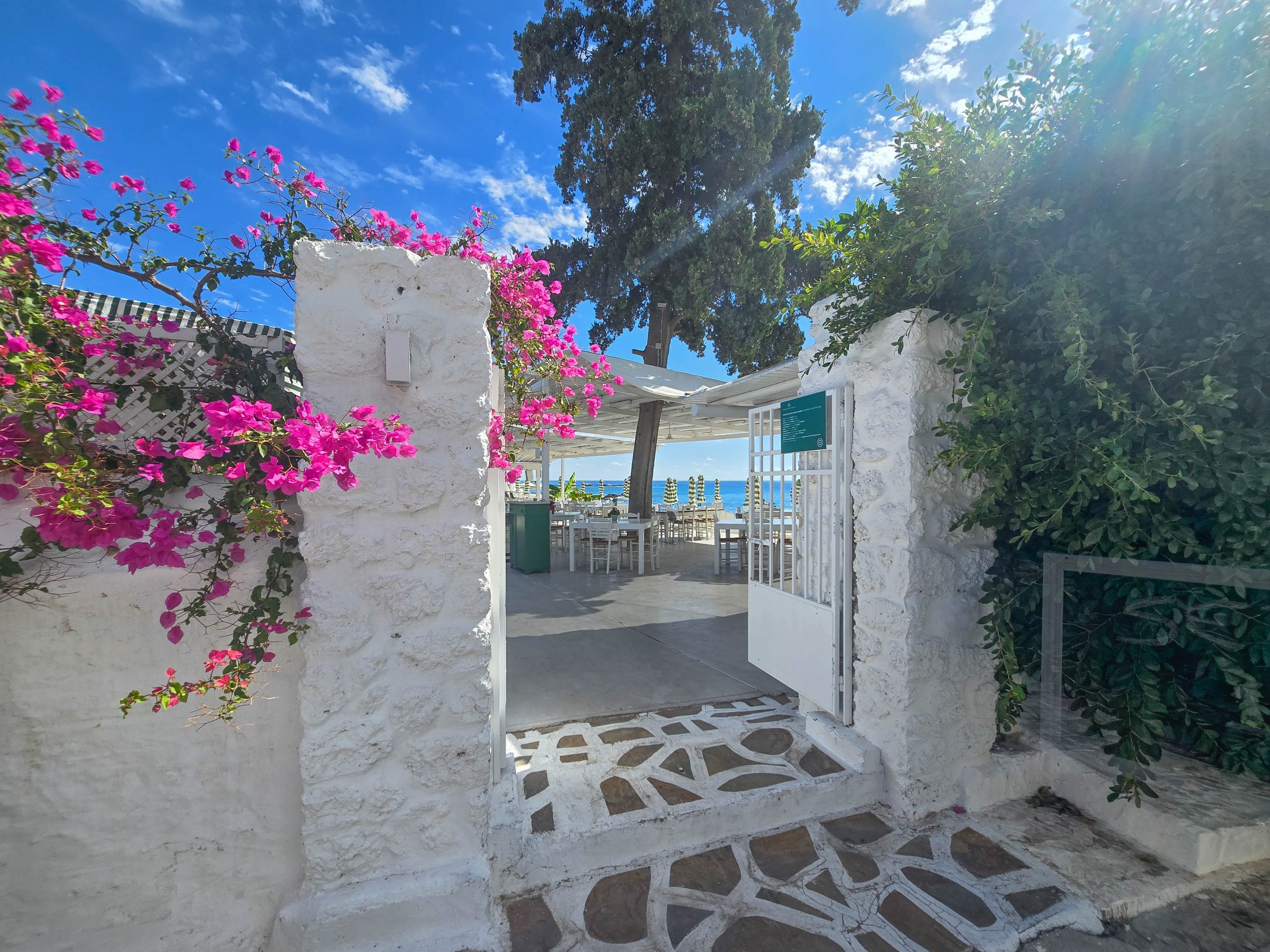
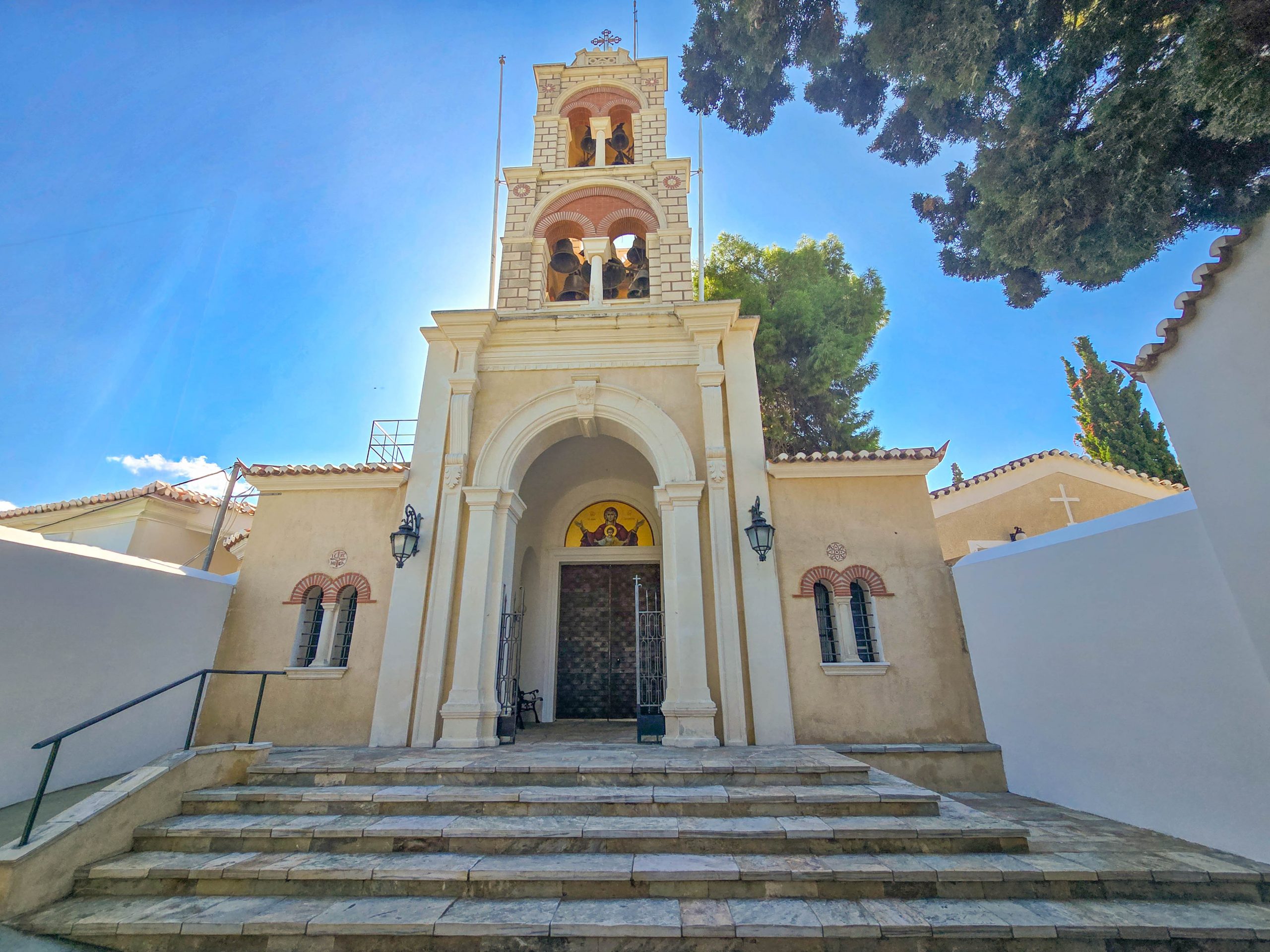
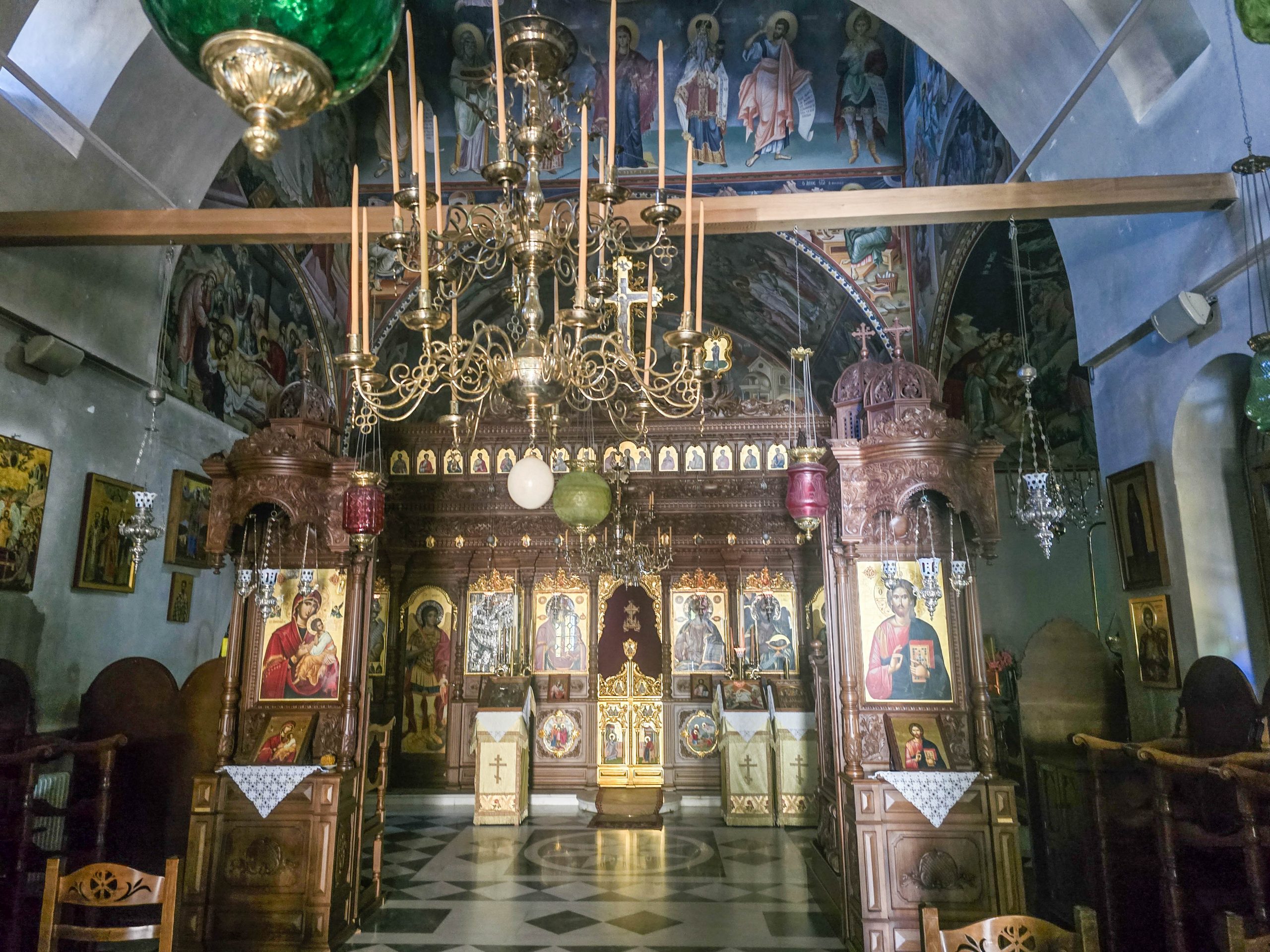
Set slightly back from the waterfront, the Church of the Three New Martyrs of Spetses occupies a prominent position along the road between Dapia and the Old Harbour. The church commemorates three Spetsiot sailors — Nikolaos Tsion and his nephews Yianni and Stamatios.

They were arrested in Chios in early 1822 during a commercial voyage, tortured, and ultimately martyred for refusing to renounce their Christian faith and revolutionary allegiance. Their story resonated deeply on Spetses, where they are remembered not only as religious martyrs but also as symbols of the island’s collective sacrifice during the War of Independence. The church itself is relatively modern, its construction beginning in 1975 through donations from both named and anonymous benefactors, yet its emotional weight firmly anchors it in the revolutionary era.
The site carries an additional layer of meaning. Before the church was built, this land was occupied by the commercial and industrial enterprises of Hadjigiannis Mexis, one of Spetses’ great benefactors. Here stood his warehouses, olive mill, blacksmith’s workshop and, directly in front, the shipyard where his vessels were constructed — a reminder that faith, trade and seafaring life were never separated on the island. Just a little higher up the slope to the right stands the Agios Nikolaos Church, distinguished by its beautifully crafted hohlakia pebble-mosaic courtyard. Together, the two churches form a quiet dialogue between sacrifice and continuity: one rooted in martyrdom and memory, the other in enduring everyday devotion.

One Sunday morning, I made my way up the hill to the Holy Monastery of All Saints (Moni Agion Panton), having been advised by Aggeliki that this is usually the only day it opens to visitors. Fir trees and Italian cypress lined the approach, the air cooler and resin-scented as the sounds of the harbour faded away.
When I arrived, the large wooden doors were firmly shut. The monastery was silent, its high enclosing walls revealing nothing. I lingered, invisible to anyone inside, then wandered through a side gate into a small cemetery — clearly not the main entrance. Returning to the doors, just as I was about to leave, a Greek couple arrived on a motorbike. The woman dismounted, marched straight up and knocked loudly. She said she could hear movement inside.
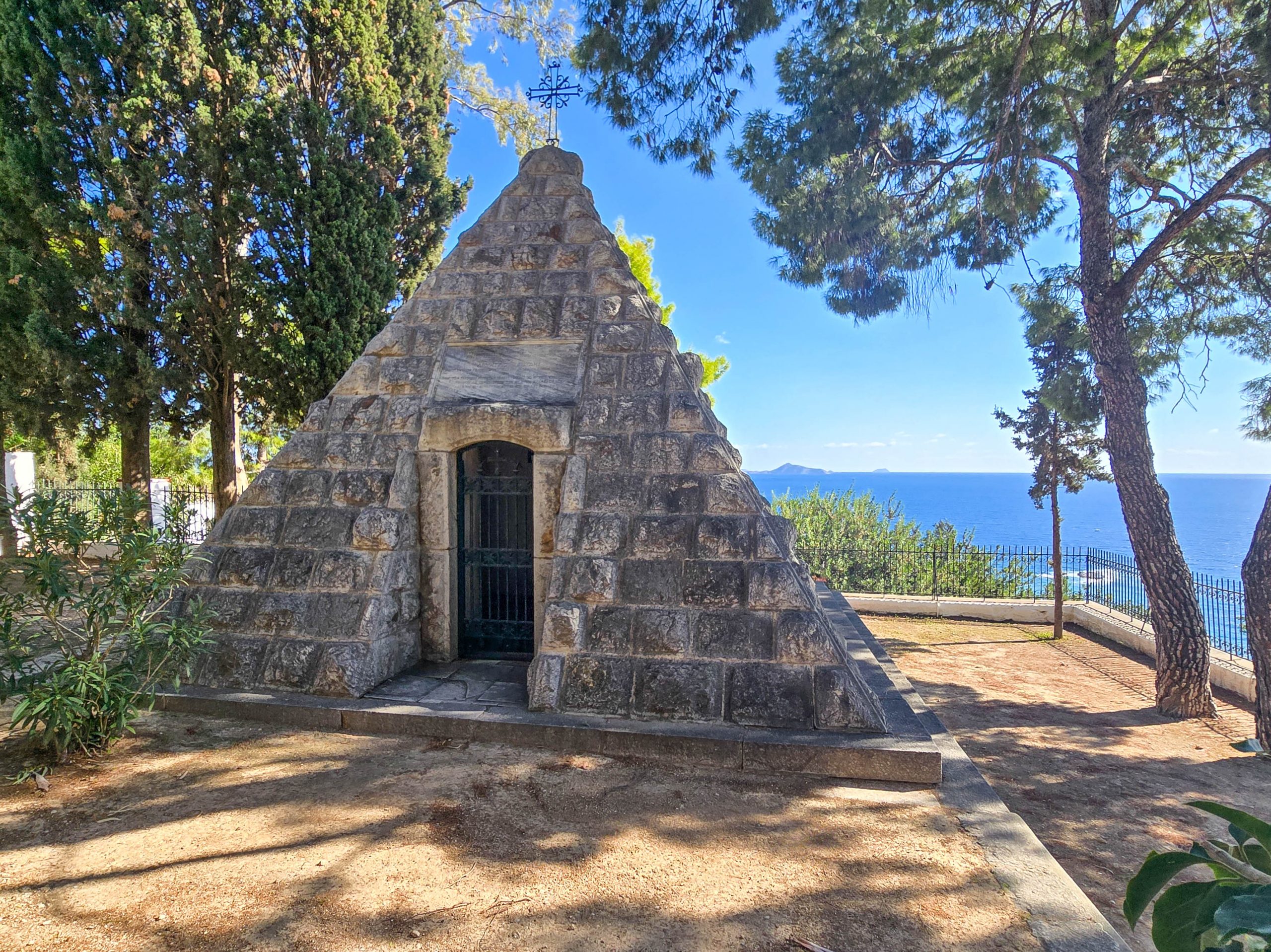
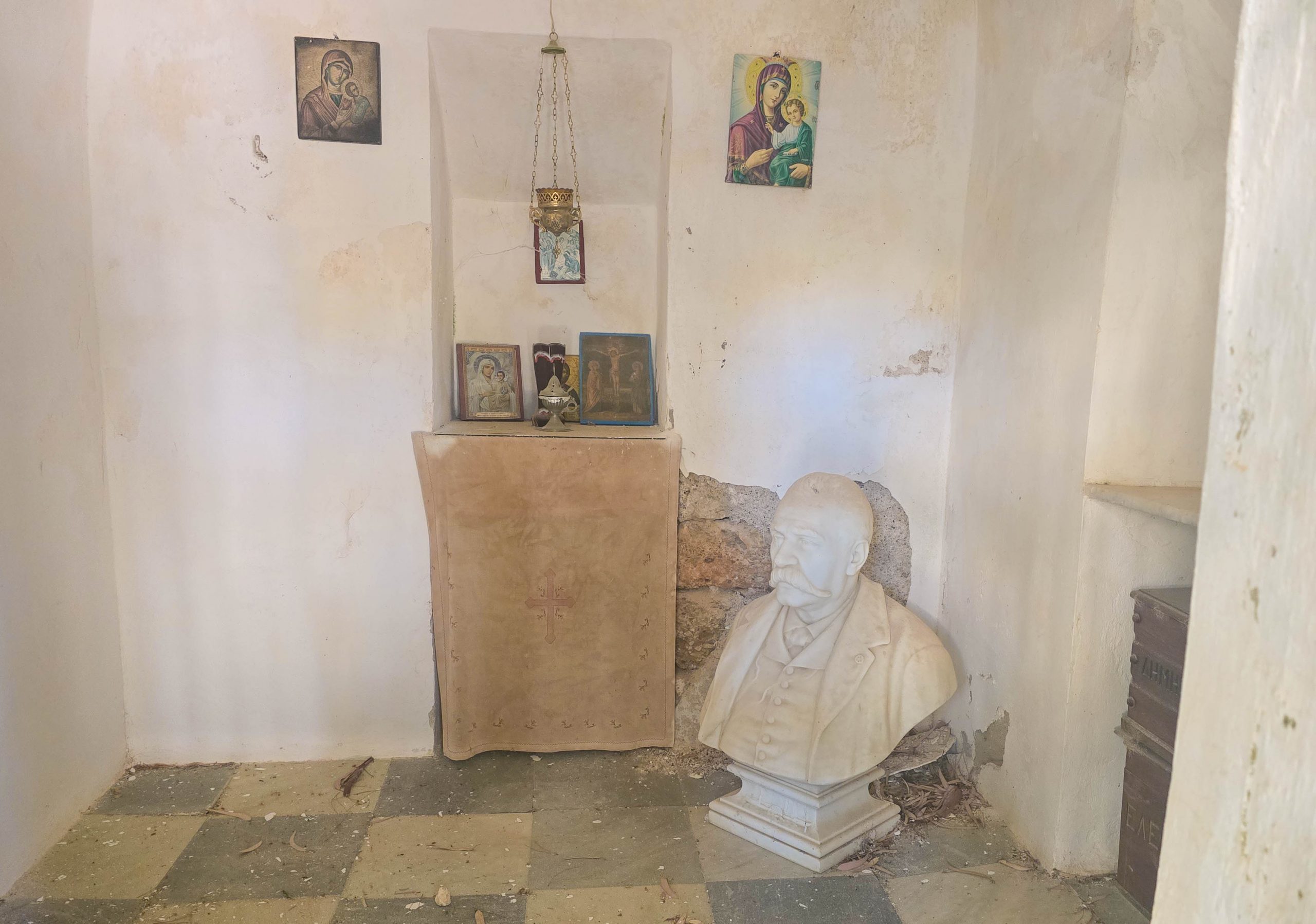
A few minutes later, a nun, visibly surprised to see visitors, opened the doors and ushered us in, directing us towards aprons, which we dutifully put on. In the courtyard stood a striking triangular pyramid, which serves as the tomb of Dimitrios P. Goudis (1824–1891), a prominent benefactor and landowner closely connected with the monastery. The views from the monastery down to the coast were breathtaking. Before we left, the nuns offered us water and loukoumi, and invited us to light candles — a small gesture of hospitality.
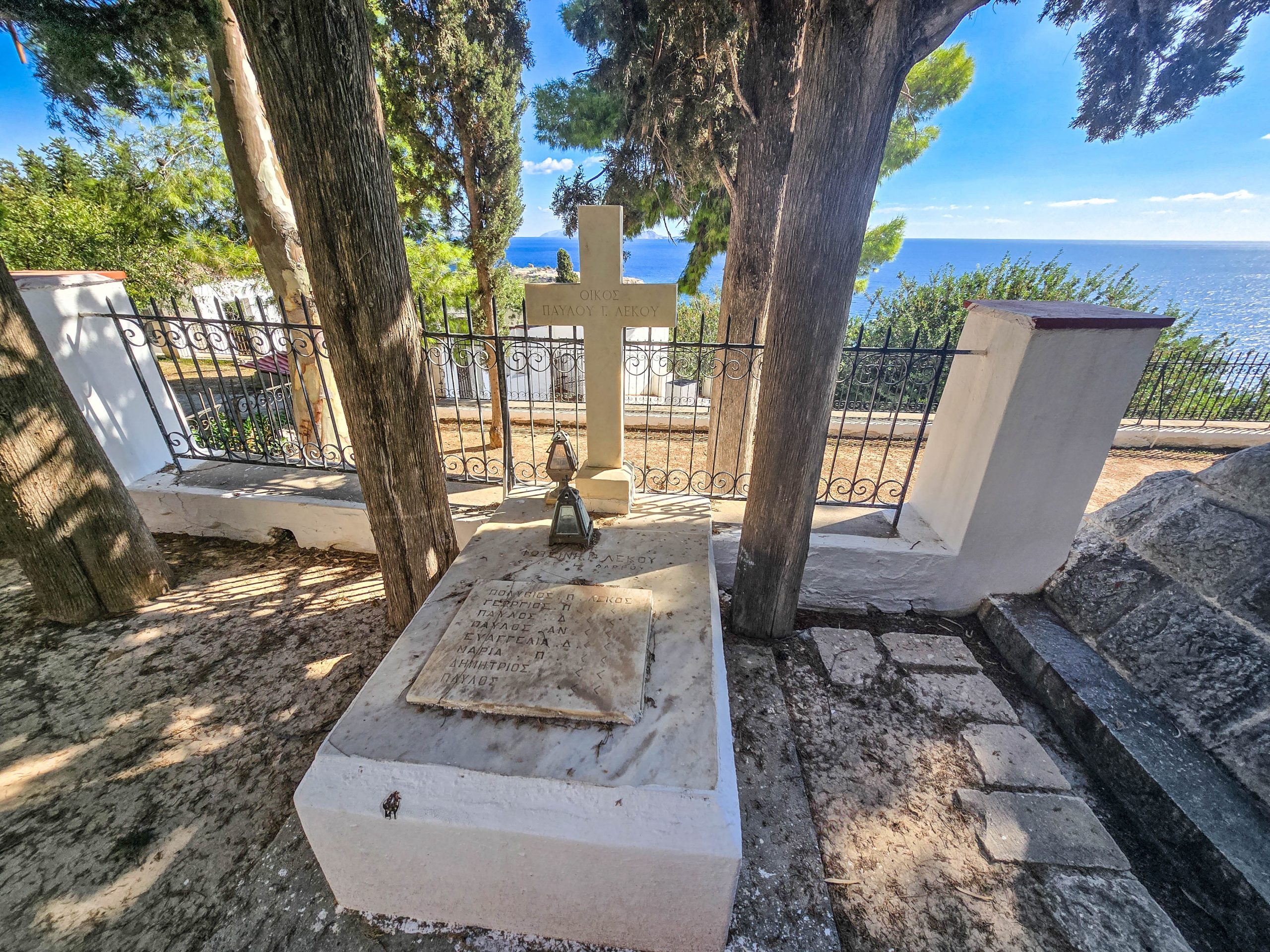
Back in Dapia, life revolved around the harbour. Although cars are heavily restricted on Spetses, they’ve largely been replaced by scooters and motorbikes. Turning a corner requires alertness, and while I’m not convinced it’s always preferable to cars, the narrow streets certainly suit two wheels better — if only they weren’t sometimes ridden like a race track.
Between the two harbour arms stands the Poseidon Grand Hotel, built in 1914 by Sotirios Anargyros as part of his vision for Spetses as a refined resort destination. It’s important to mention him as his influence on the island was far-reaching.
Sotirios Anargyros was a Spetsiot-born industrialist and philanthropist whose influence still shapes the island today. Born in 1849, he made his fortune abroad — primarily in Romania and Egypt — through trade, shipping and tobacco, at a time when many islanders were seeking opportunities beyond Greece. Unlike many of his contemporaries, Anargyros did not simply accumulate wealth and move on; instead, he returned to Spetses with a clear vision for its future at a moment when the island’s traditional sailing economy was in decline.
That vision was ambitious but carefully considered. Anargyros believed Spetses could reinvent itself as a refined, cultured resort without losing its identity. His most visible legacy is the Poseidon Grand Hotel, built in 1914 as a statement of intent rather than mere accommodation. Alongside this, he invested heavily in education, founding the Anargyros & Korgialenios School (more of that in the next post), and supported infrastructure and public institutions across the island. Much of Spetses’ restrained elegance — its low-rise development, discreet confidence and enduring appeal to a largely Greek clientele — can be traced back to Anargyros’ belief that progress need not come at the expense of character.
The Poseidon Grand Hotel is also known for hosting events that draw crowds from across the world. During my stay, it was hosting its annual ‘A Weekend in Tweed’ with vintage bicycles, picnics and Edwardian-inspired dress. My initial reaction was sceptical, until Aggeliki told me that most participants were Greek, many returning year after year, including a group from Thessaloniki who regularly stay at Villa Christina. Again – more of that in another post.
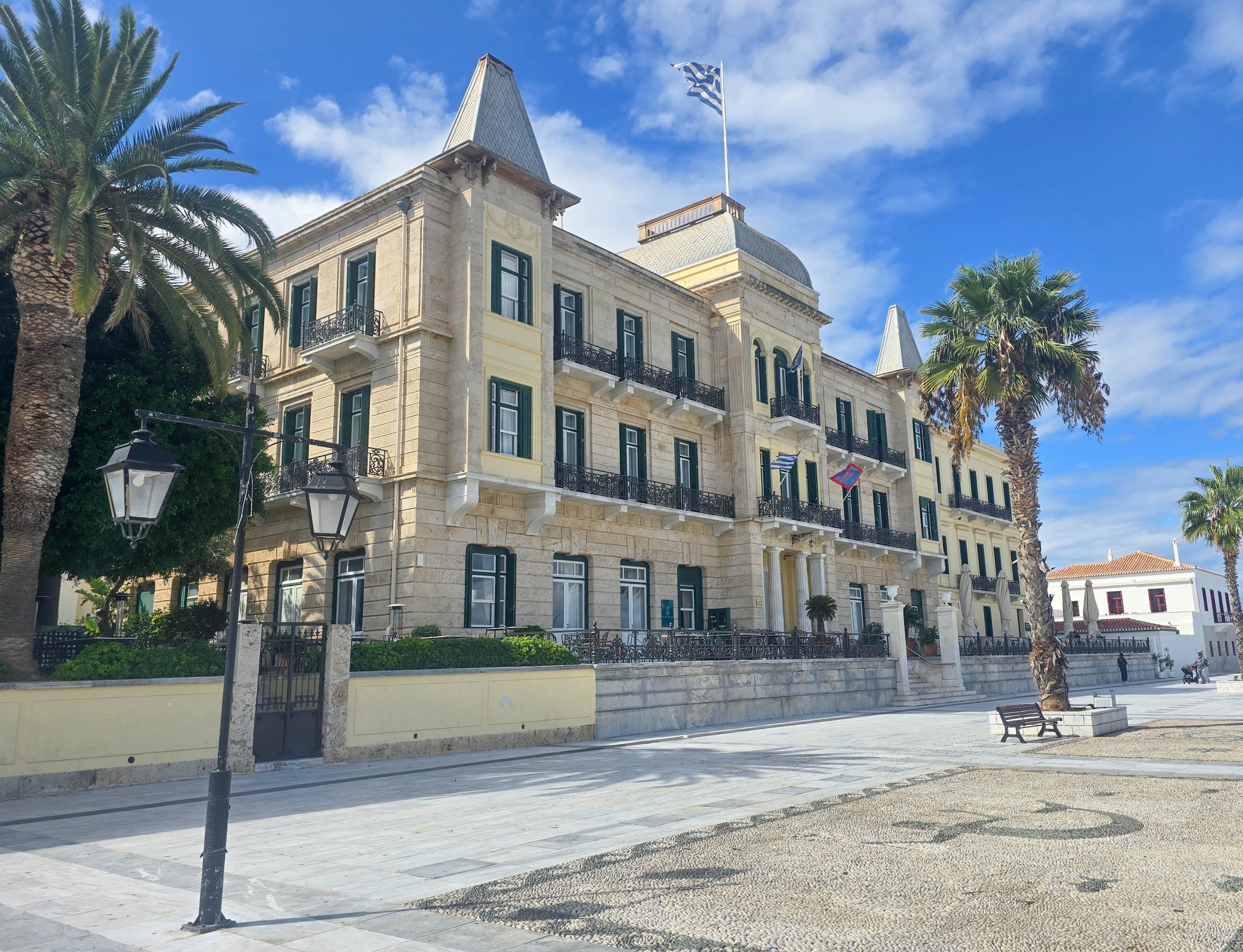
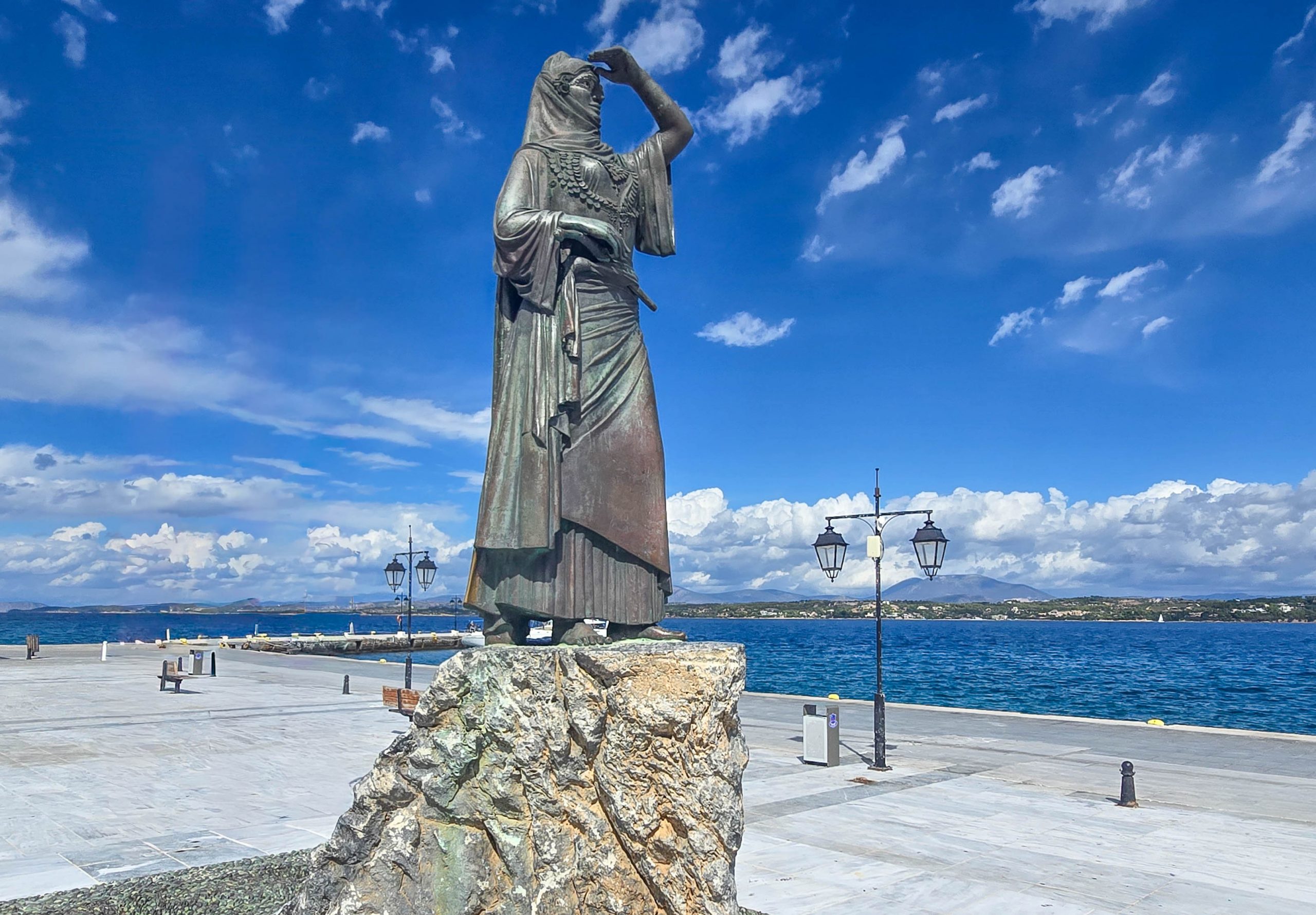
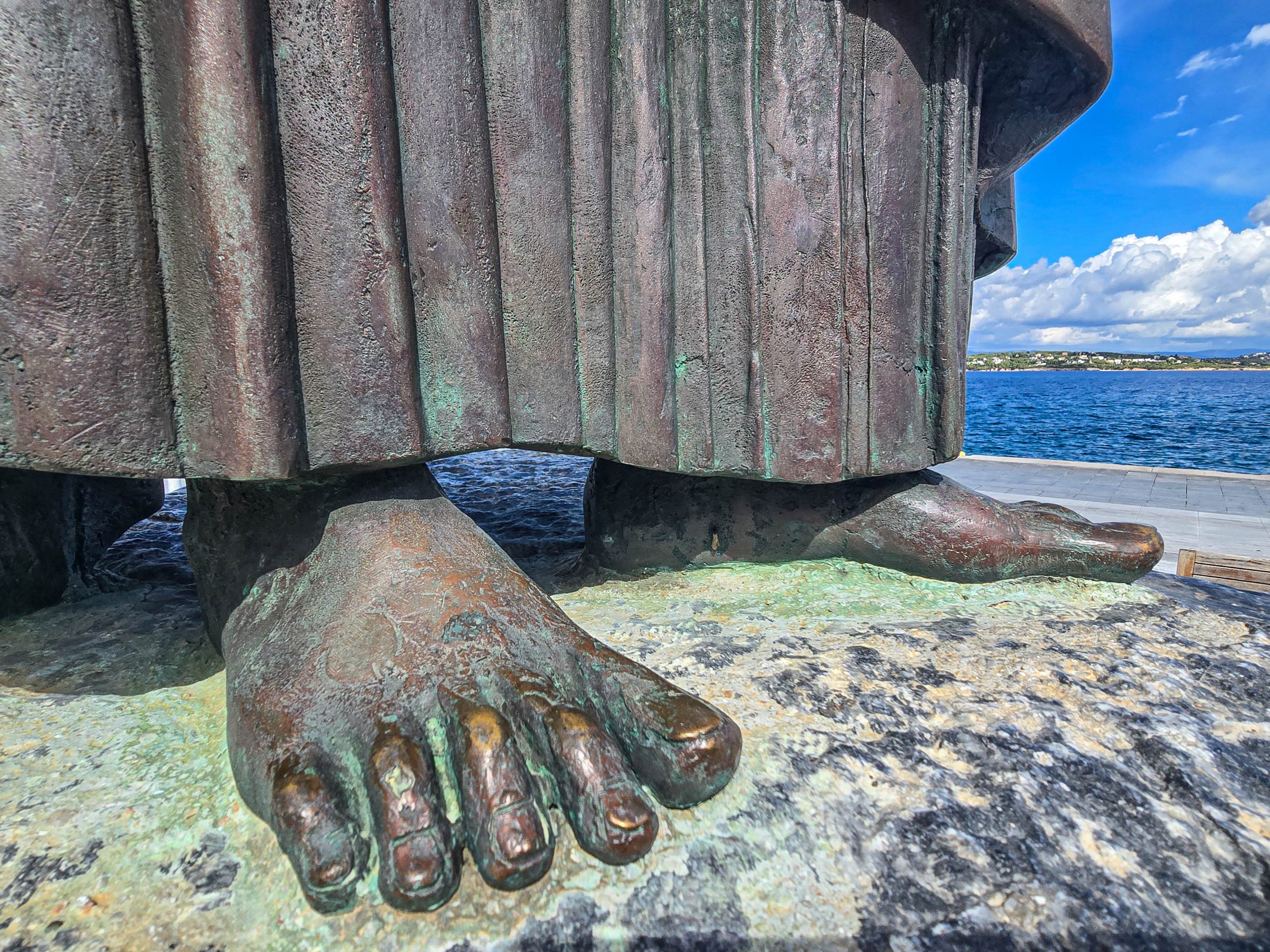
In front of the hotel stands the statue of Laskarina Bouboulina, whom I’ll return to in more depth when I visit her museum. But this is probably one of the most iconic landmarks of the island, and she, the most symbolic figure of the Greek War of Independence and Spetses.
Down by the harbour, a small marina hosts a cluster of orange-red water taxis. These run regularly to Kosta on the mainland, the main road connection to Porto Heli, and also operate services to Porto Heli itself, another upmarket destination. Alongside them, high-speed ferries arrive from Piraeus, while the Katarina Star provides a vital local link, ferrying both passengers and supplies between Spetses and the mainland just ten minutes across the strait.
As the days progressed, something unexpected had already happened. An island I’d avoided for years had begun to grow on me. Not a little, but a lot. I was more surprised than any to discover that this island I’d had preconceived ideas about actually turned out to be a little gem! My initial 5 days became 9, and even then, it was hard to pull myself away.
More of Spetses in the next post.
Discover more from A Greek Oddity
Subscribe to get the latest posts sent to your email.
Fifteen years of writing about Greece. Thirty plus years of travelling it. Now condensed into a travel planning toolkit.
Take a look


I enjoyed reading this, my husband’s home island is Spetses! I met him there in the late 70’s and lived there a few years. We have many friends and family there and love visiting, such a pretty island.
That’s incredible Gail. It’s a very special island indeed and I can’t believe I left it so long before I visited. Thank you for your kind words. ❤️