
Car Hire in Greece – Not the Only Solution. Not Always the Best One Either.
Ask anyone how to get from A to B in Greece and “Hire a car” is likely to be the automatic response. Ask in a Facebook group, and you’ll have seventeen suggestions before you’ve finished your coffee, all saying the same thing. Ask a Greek, and they’ll give you that look (you know the look) if you suggest there’s an alternative. Ask an American, and they’ll wonder why you’re even asking.
Greece is a car-centric country, as are many others too. And yes, sometimes hiring a car is the right answer. There are mountainous interiors, villages clinging to hillsides with infrequent bus services, and islands where the distances make other options impractical. I’m not here to pretend otherwise.
But I am a passionate supporter of Greece’s public transport systems. And “hire a car” has become such a default response that it’s reached for automatically, regardless of the island, the itinerary, or the traveller. So before you book that Suzuki Celerio, hear me out.
There is nothing more authentic
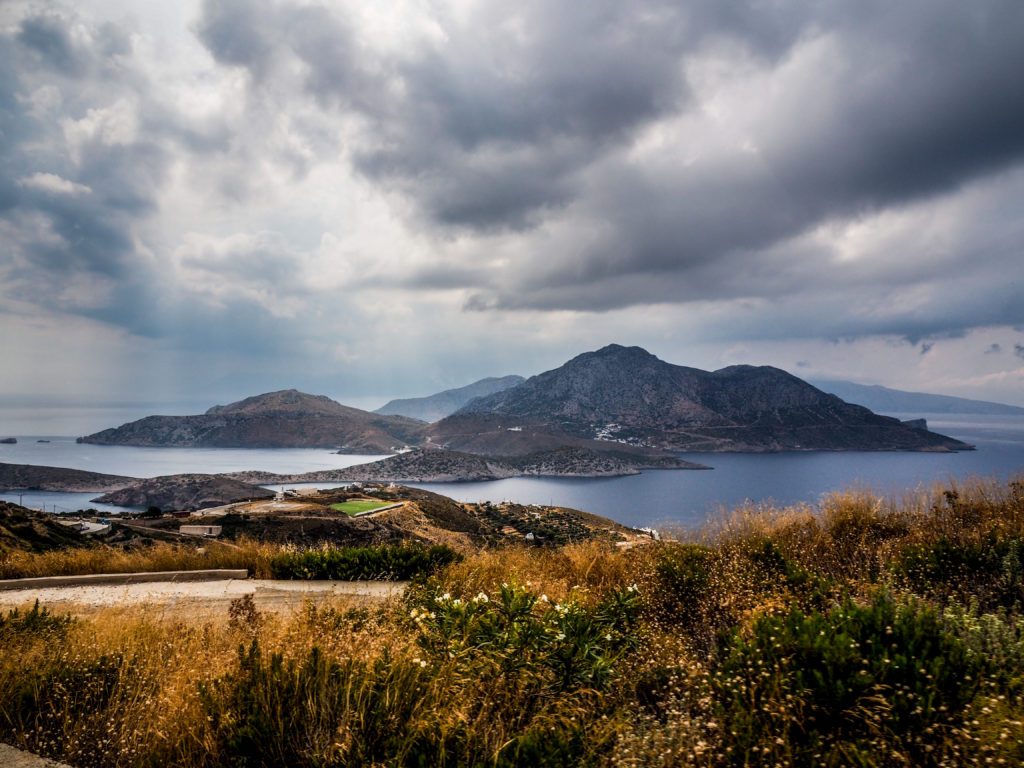
Travelling independently by bus, ferry, train, and what my grandmother used to call Shanks’s Pony, is utterly liberating. Walking is where you get up close and personal with a landscape. There really is nothing like the smell of wild thyme on a hillside, the sight of spring flowers swaying gently in the breeze, and the low hum of bees busy at work. Public transport forces you out on foot, and that’s a good thing. It grounds you in a place.
I love travelling on local ferries. You know – the old Captain Pugwash style boats where you sit side by side with locals heading to a larger island or the mainland to collect supplies or carry out business. There is something special about sitting next to fellow yiayiás on a bus to a mountain village. It can be what makes a journey truly memorable, and it’s fascinating to watch everyday life unfold around you.
None of that happens through a hire car windscreen.
It isn’t without its challenges
Despite the romanticism of travelling by public transport in Greece, it isn’t without its challenges. And the biggest source of confusion for most independent travellers is KTEL.
KTEL is Greece’s intercity bus network made up of sixty-two independent bus cooperatives, each operating within its own prefecture or region. They share a name, but little else. Each company is separately owned. Each sets its own schedules, prices, and routes. Some have modern websites and online booking systems. Others appear to be held together by optimism and a fax machine.
Working out how they all connect (and sometimes don’t) takes time, local knowledge, and a fairly high tolerance for ambiguity. This is precisely why I designed and built the app Plan Your Greece (available for Android on Google Play Store) and wrote the companion book How Greece Moves (available on Amazon).
Plan Your Greece is an Android app (£11.99, one-off purchase, no subscription) for independent travellers planning a trip to Greece. It has five tools:
Seek — Rate 22 preferences across four themes and get your top 10 matches from 101 curated Greek destinations. No algorithm, no sponsored results.
Route — Every public transport connection in Greece on one interactive map: airports, ferry ports, KTEL bus stations, train stations, metro stops, each with a direct link to the operator’s timetable.
Tools — A curated directory for booking flights, ferries, accommodation, transfers, tours and activities, all in one place.
Plan — Build a day-by-day itinerary, track your budget, export the complete plan, and work through a Before You Go checklist covering Greece-specific preparation (not a packing list).
Ticked — A personal tracker for 133 Greek islands, log where you’ve been and mark where you want to go.
You can find it at Plan Your Greece for Android at Google Play Store
For the record – I’m not anti-car hire
I should be clear: I’m not anti-car hire. I’ve done it myself several times when it made sense. Kythira and Samothrace, for example, where no other alternatives existed.
The thing is, it usually ends in disaster.
A few years ago, during an unexpected heatwave on Lipsi. The heat was so immense that it rendered us practically immobile and I’m a snowflake in the heat. We wanted to visit the monastery and a couple of hidden beaches, which in normal circumstances would be walkable. So we hired a car. We tootled around quite happily with me at the wheel. I truly believe I’m the better driver – but don’t tell Peter!
We then decided to drive down to the bay of Kamares. Getting down the gravel track was fine. Getting back up was not. The little Suzuki Celerio wheel-spun into a rut, threw clouds of dust in through the windows until we nearly choked. I attempted a kind of retreat and zigzag motion – something I’d seen on The World’s Most Dangerous Roads, but to no avail. A man on a nearby digger machine watched us with the calm of someone who had seen this before, whilst he drew slowly on his cigarette. With nothing else around in sight, he was our only hope.
Peter went to plead for help. I watched the animated conversation through the windscreen, and ten minutes later Peter returned to the car. “So, what’s happening?” I asked. “I’m not sure” Peter said. Peter, you had one job!
We sat and pondered if there was a Greek version of the AA on Lipsi, and cast that thought aside immediately. I also thought about phoning Voula, who we’d hired the car from, but the car wasn’t looking pretty, once black, now a shade of grey.
Just as we were about to abandon all hope, out in the distance across the other side of the field came three men, striding into view like a scene from Desperado, the one with Antonio Banderas surrounded by flames.
I was ordered out of the driving seat, and Mr Digger Man took control. The three men and Peter pushed, and they pushed. This was a messy job. Eventually, they managed to get some traction on the stone and dust surface, and the car made it up to the top.
This is one of those many instances where it’s not the planets that align in your favour, but the Greek spirit of filotimo, and kindness. We couldn’t thank them enough.
It took four men, a digger driver, and what felt like an eternity to get us back to the top of the track. The digger man’s parting words, relayed via Peter, were that he’d seen us the night before at his son’s restaurant. “Your name is going to be mud all over the island by tonight,” Peter told me.
It probably was.
This story, along with rather more bus-related misadventures than I care to admit, can be found in How Greece Moves — my guide to getting around Greece by public transport.
How Greece Moves – A Guide to Public Transport on Amazon.
If you’ve ever stared at a Greek ferry timetable wondering how it all connects, it was built for exactly that.
Discover more from
Subscribe to get the latest posts sent to your email.
MY BIG FAT GREEK TRAVEL SURVEY
How do you really plan your Greek adventures? I'd love to hear from you.
TAKE THE SURVEY →