Astakos, Greece: The Small Ionian Town Built on Acorns
Astakos, Greece: a small Ionian port with a folklore museum, pebble beaches, grand old houses and local lemonade.
When I arrived in Astakos, I’d already been travelling for over a month on what had been quite an action-packed itinerary. Astakos came at exactly the right time. Six days here was just what I needed to rest and recalibrate.
Something about the place made me feel immediately comfortable, like Cinderella’s foot in the glass slipper, metaphorically speaking, that is. Signs showed this small seaside town was already nearing the end of its summer season. However, tavernas and cafes were still open, serving a small contingent of yachters who’d stay a day before moving on. And me. Visitors from neighbouring towns came, but tourists like me were few and far between. I had no urge to see beyond the village boundaries, though with only two daily buses and a mountain backing it, there really wasn’t anywhere to go. That suited me fine.
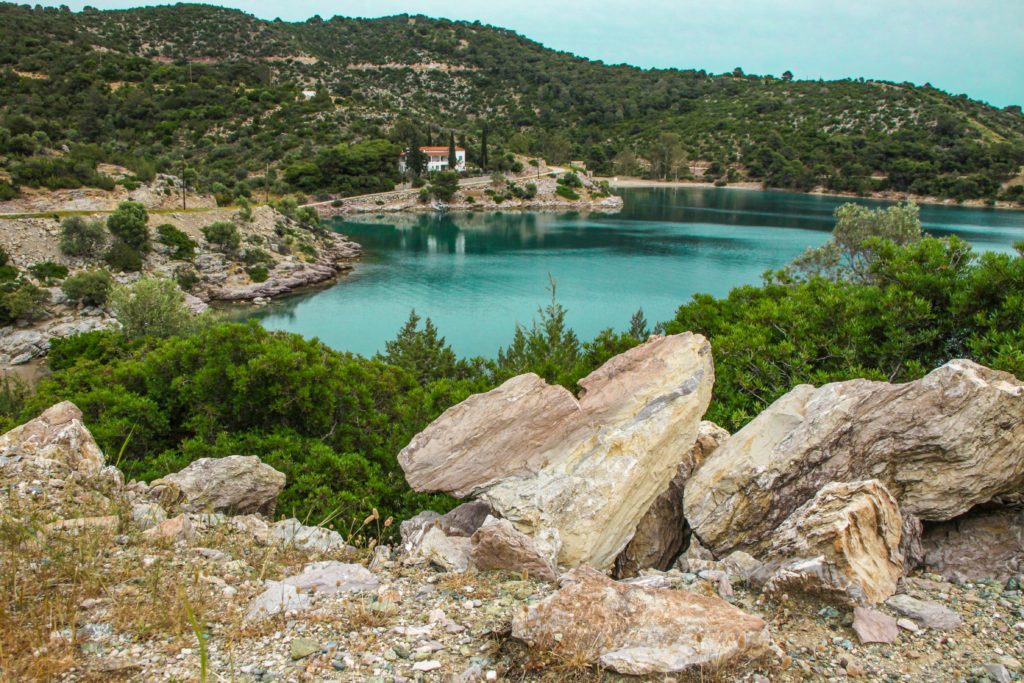
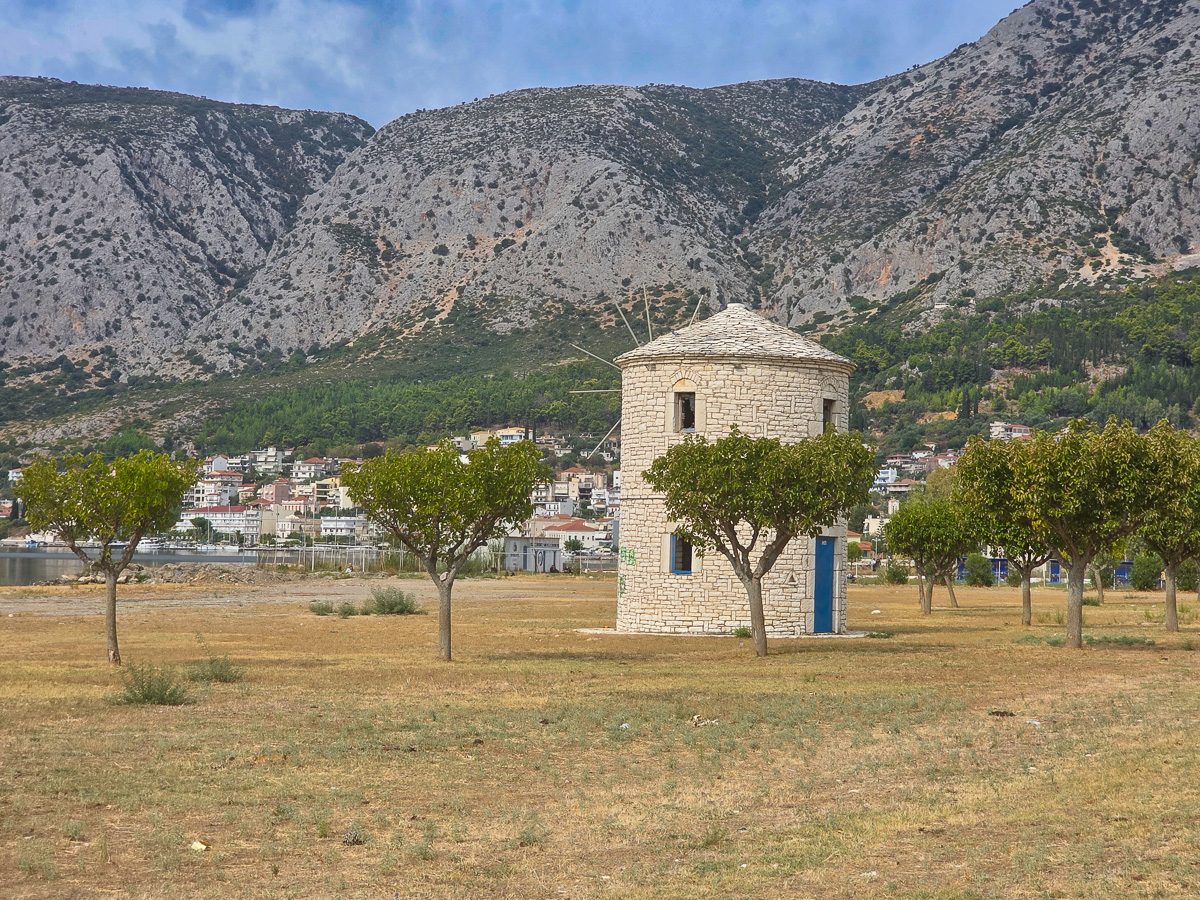
Astakos feels protected, and the geography explains why. It sits in the foothills of Mount Veloutsa, which sprawls back toward the Acarnanian mountain range. It rises behind the village before plunging to the western shore, where it stops short at the deep, narrow bay. At the mouth of the bay lies the Echinades, a cluster of small islets, only a few of which are visible from land. You feel completely wrapped in the landscape’s arms.
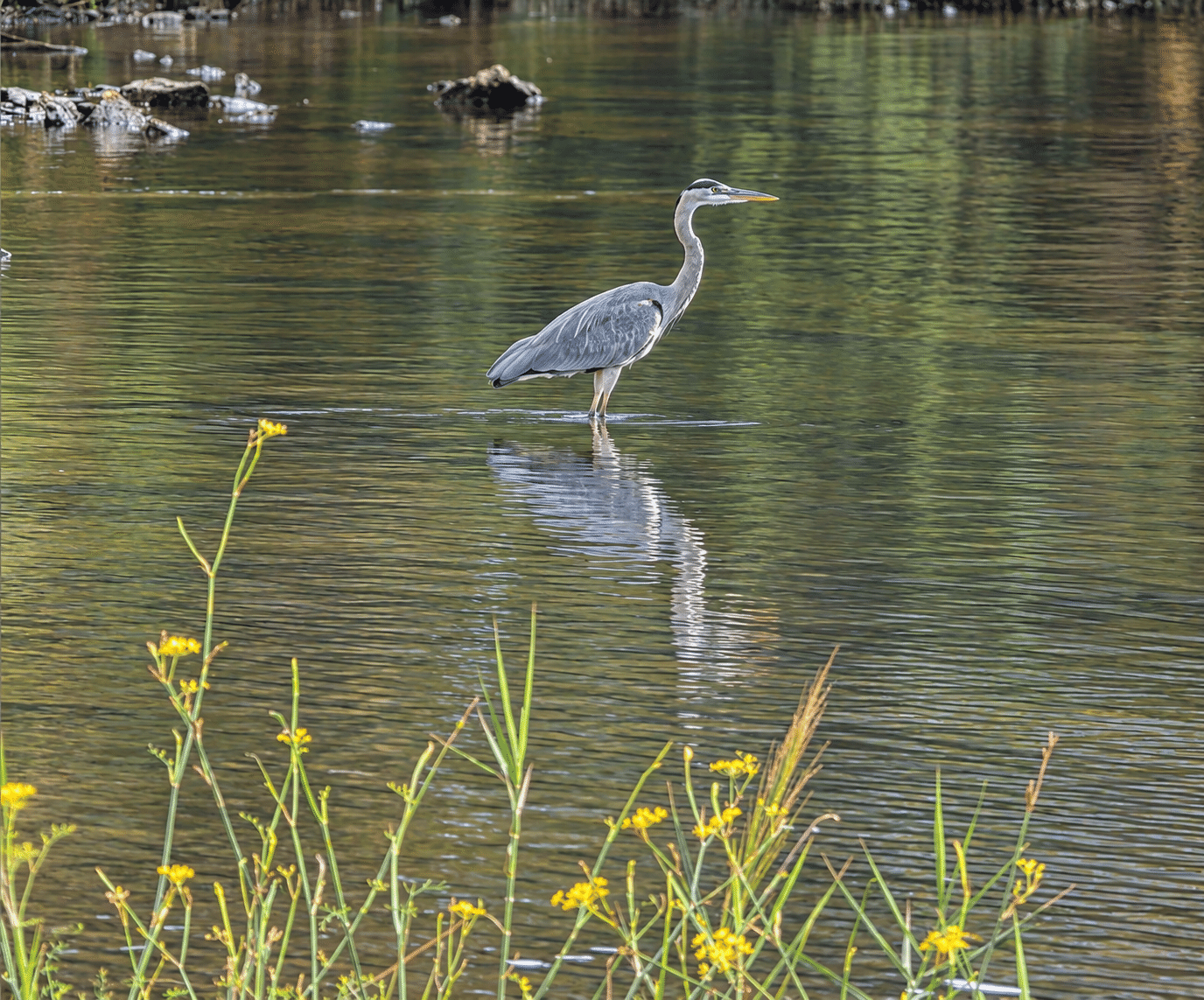
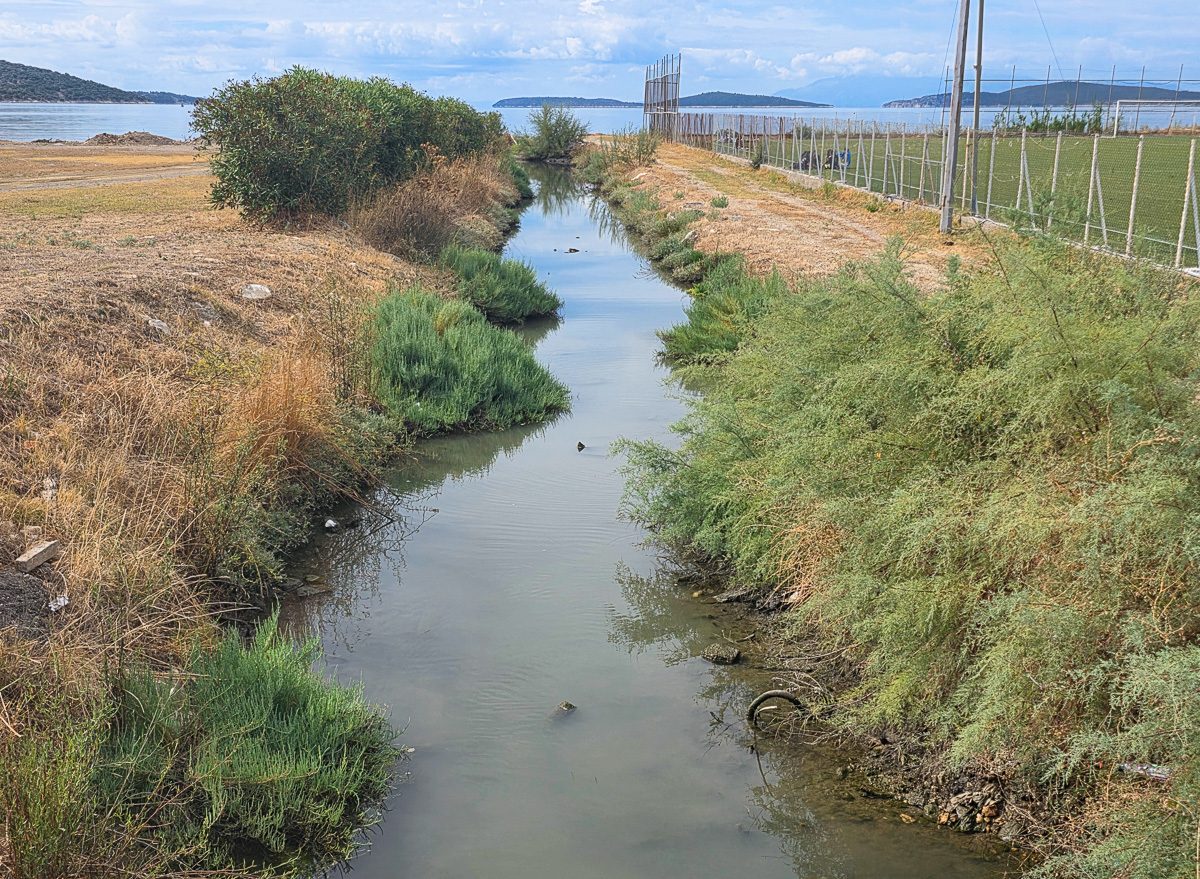
The best place to get a real sense of this is from the head of the bay, looking back towards the town. Behind me, the Xiropotamos (dry stream) cuts through the valley and empties at the eastern curve of Astakos Bay. At the shoreline, the mixing of fresh and marine waters creates a small, tranquil brackish wetland filled with coastal reeds and a small wildlife habitat.
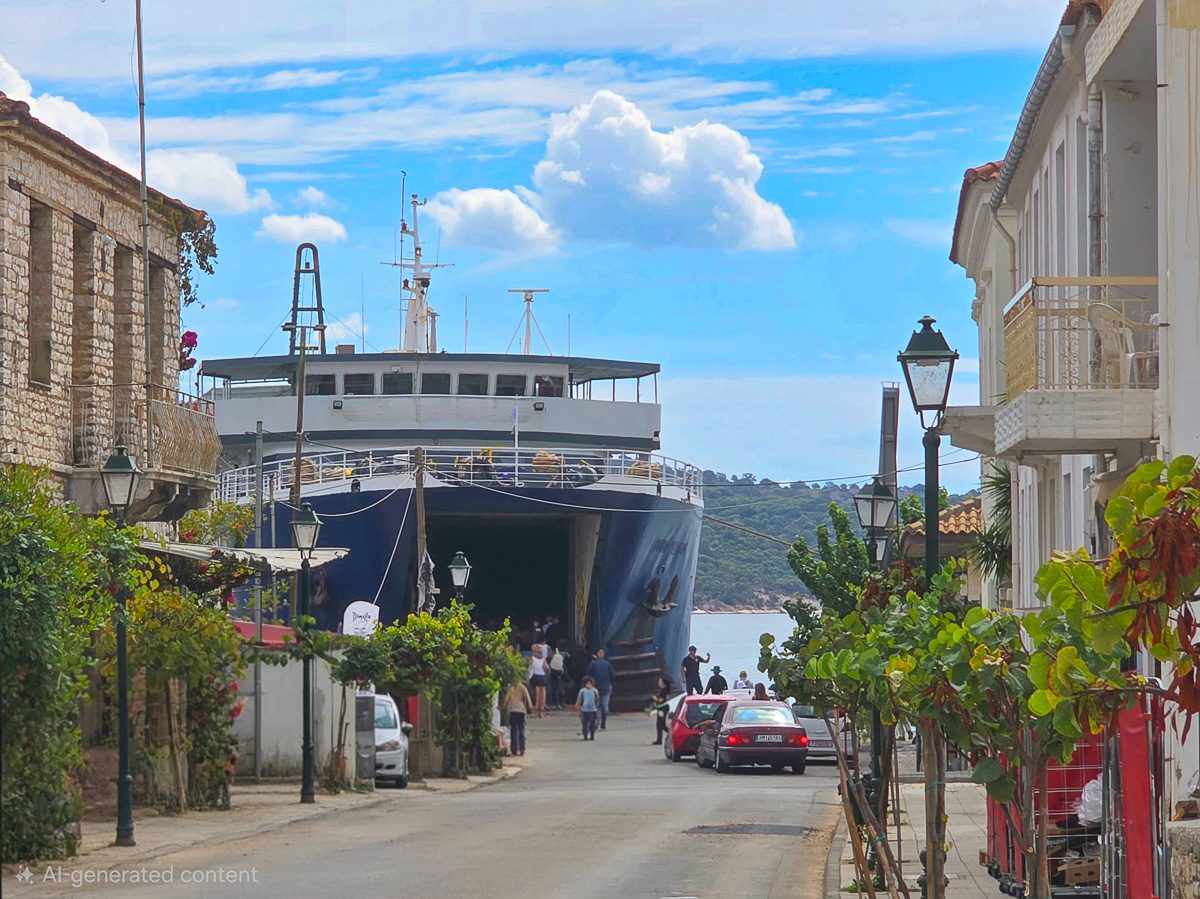
Astakos holds the title of official administrative capital for Xiromero, but the coastal town feels far more like a hidden seaside escape than a bureaucratic hub. With a permanent population of 2608, you get the sense of a close-knit community where everyone knows the daily pulse of activity (and non-activity). A familiar scene: old men swinging kolomboi, watching life go by in cafes. The streets behind serve everyday life: barbers, supermarkets, dress shops, and cafes. Regular fixtures were the taxi drivers I’d see sitting in the shade of a tree, drinking frappe and waiting for the ship to arrive. This unassuming town is not only a fishing village but also a port for an almost daily ferry that shuttles between Kefalonia (Sami) and Ithaca (Pisaetos). Each arrival of the Ithaki or Ionio Pelagos propels the town into a hive of activity – for a while anyway. The ferries serve not only the islands, but also the rural hinterland of the mainland and beyond. Goods pass through in both directions.
Astakos Folklore Museum
You can read as much as you like about a place, but I always think a folklore museum can offer good insight into the past and present. Astakos Folklore Museum was closed for the season during my stay. Still, my host Vassiliki at Nostalgia Suites contacted Mrs Gianna, president of the Astakos Women’s Association, who kindly agreed to open it so I could visit.
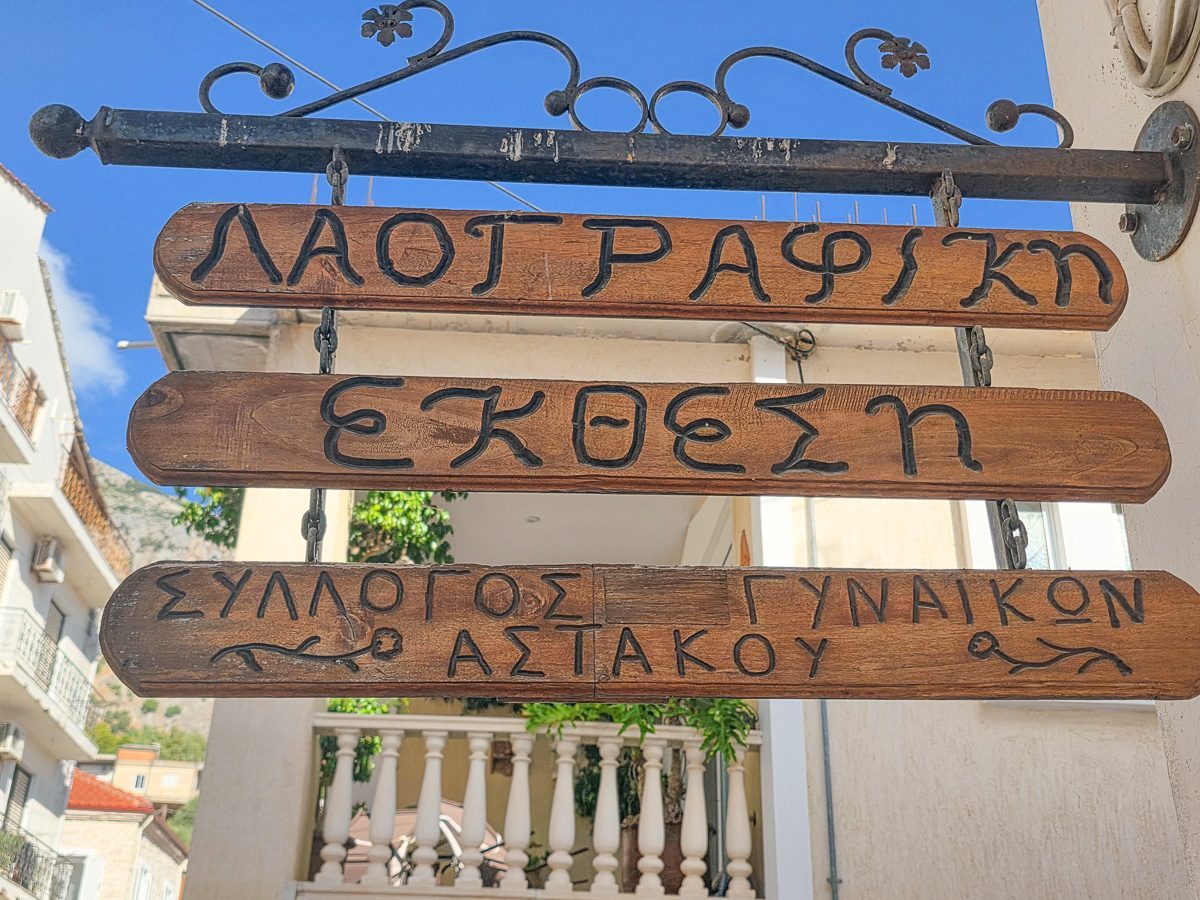
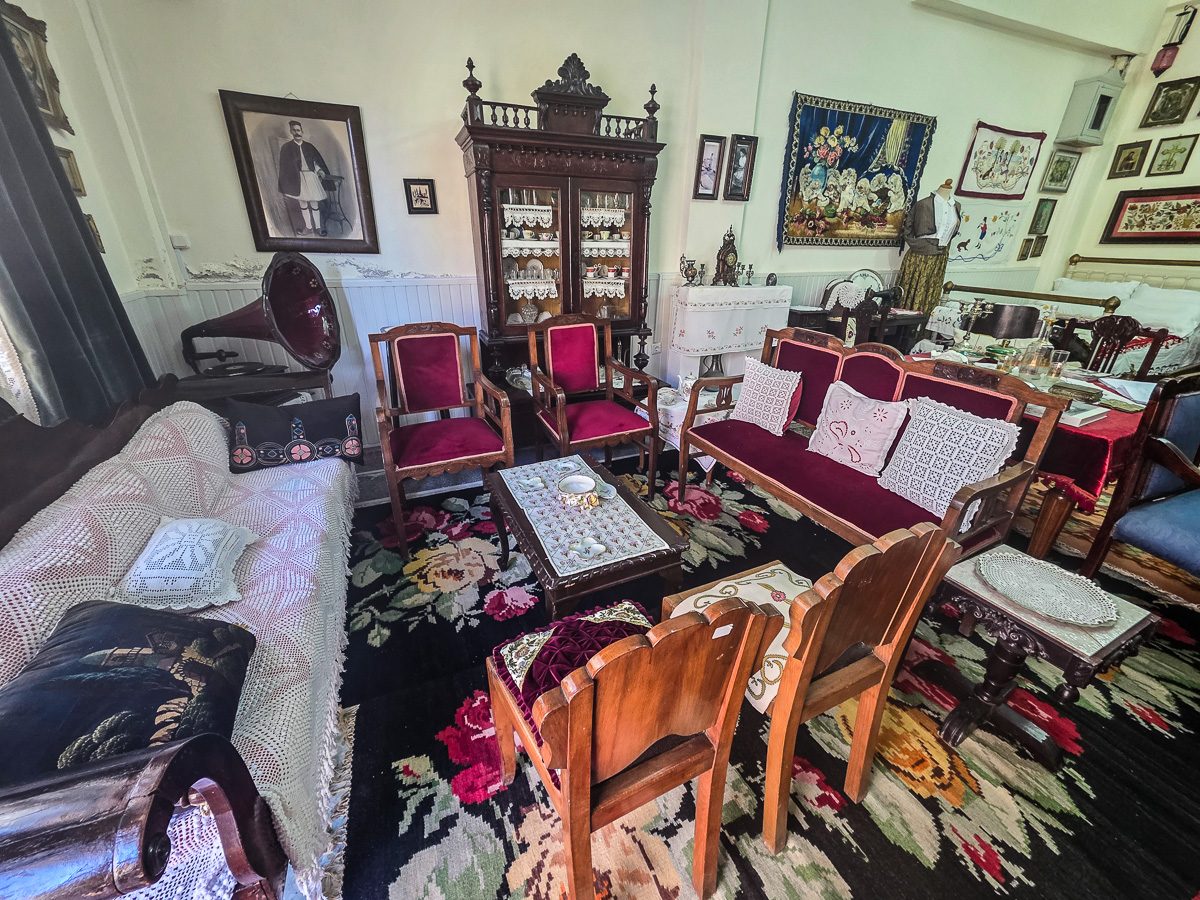
We met outside the museum, a small, unassuming building next door to the police station. Stepping through the door felt like being welcomed into someone’s home. It occupies the ground floor of an old house, in a space provided by the church, and has been open since 2016.
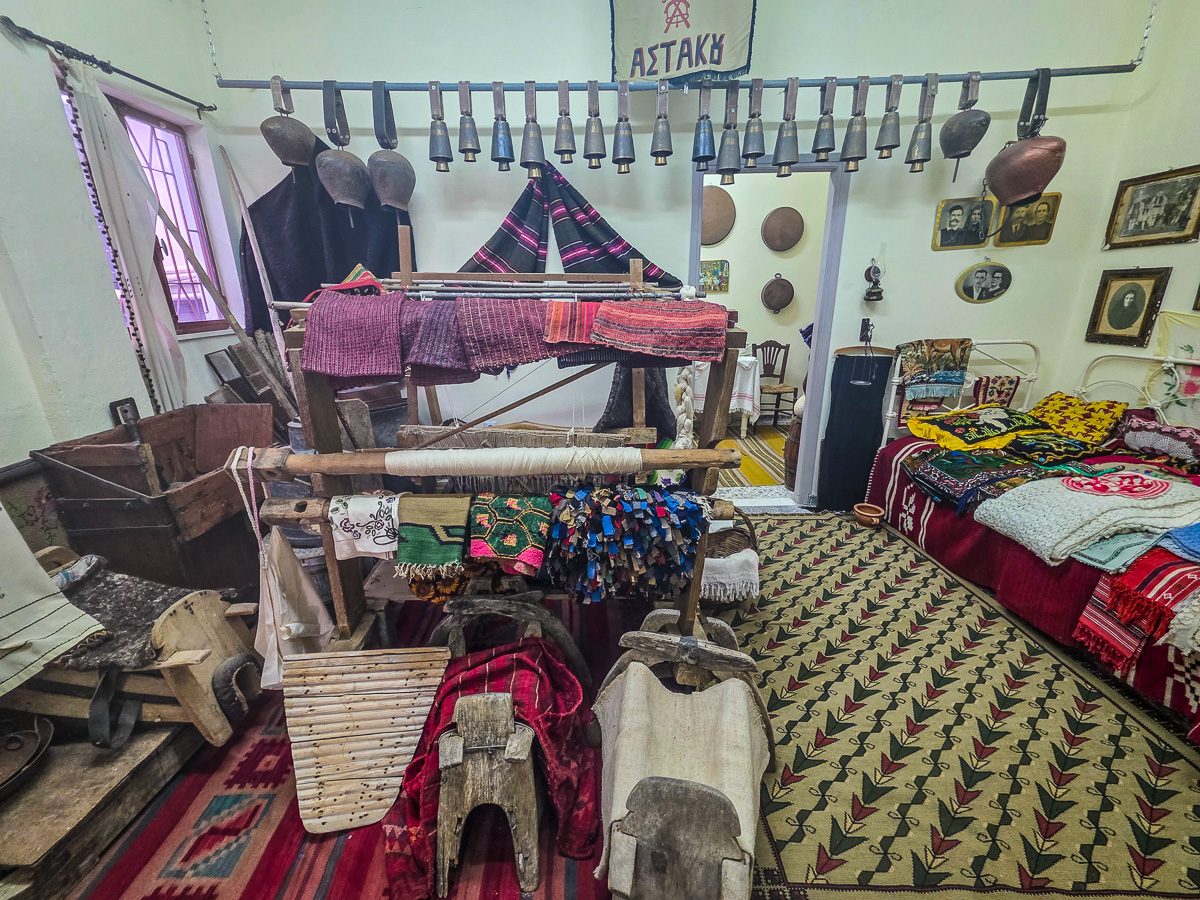
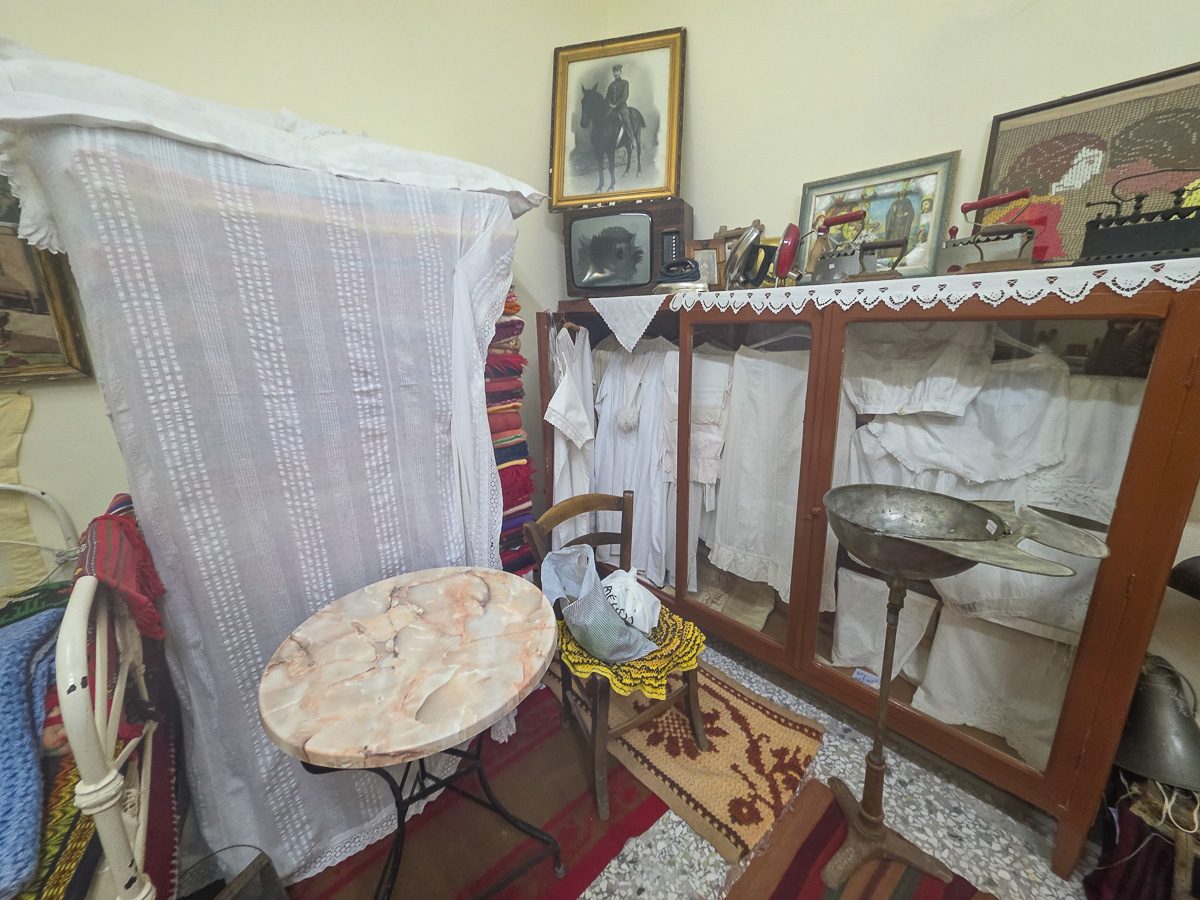
At first sight, it looks like many of the other folklore museums I’ve visited. It’s laid out as a traditional home, with everything that you’d expect to see. A living room with a fireplace, family photographs, religious icons, and, in pride of place, the first television ever owned in Astakos. An ornately carved oak display cabinet once held someone’s best china and diamond-cut glassware. Somehow, a huge iron safe once belonging to the Agricultural Bank of Greece also had a space here. In one corner, a marital bed made up with exquisitely embroidered cotton sheets and a glass case displaying women’s undergarments just as delicately decorated. In the parlour, a weaving loom stood as a mainstay of every home in the rural outlands. Examples of woollen capes worn by shepherds in winter and a display of cow and goat bells of every possible size. Some local farmers still hold a small ceremony every spring when the new ones go on.
Young women once made every decorative piece and woollen blanket themselves before marriage, to show their new family how worthy they were. Once married, they kept their wedding crowns, or ‘stefana’, in frames above the bed among images of the saints to keep the family safe. Space was short, so they stacked bedding into a ‘yioukos’, a tall pile of handmade woollen blankets and mattresses kept in a corner and hidden behind a piece of fabric during the day.
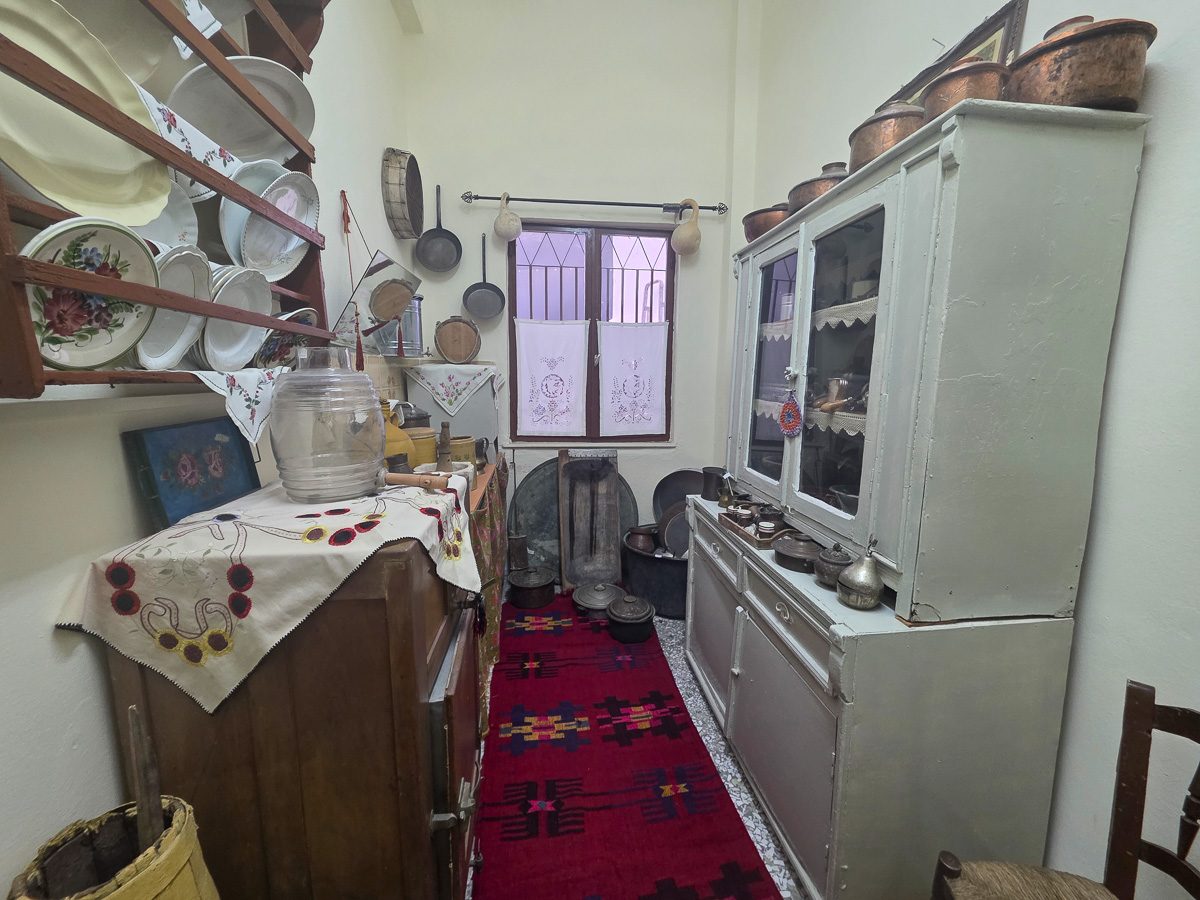
It’s always the conversations that make the visit. In the kitchen, I learned that many of the objects there had been used (or possibly made) by political prisoners during the time of the junta. Between the language barrier and my memory, I can’t confirm which. A tobacco press hidden in a corner also surprised me. Until the 1980s or 1990s, everyone around here grew it, Mrs Gianna told me. A few older people were still at it in the late 1990s, until imported tobacco arrived and everyone stopped. “A bit sad if you think about it,” was the verdict. The machine was a nifty little invention that pressed the dried leaves into packages, making transportation easier.
The conclusion was that two industries had made Astakos its money: tobacco, and the acorns from its oak forests, used in leather tanning. Mrs Gianna confirmed that the oak forests still exist, but they no longer harvest acorns. I asked whether anyone produces oak honey from them, my favourite and one I can never find. Not here, they said. Honey is flower and thyme these days. Now that’s what I think is a bit sad.
Behind every folklore museum is a community of people passionate about keeping their heritage alive, and for visitors like myself, an opportunity to be immersed in a bygone era. It was a privilege to visit the museum, and I even left with a gift of an Astakos china mug, which I’ll keep safe for the onward journey.
The Beaches of Astakos
Although we were firmly on the shores of the Ionian Sea here in Astakos, I hadn’t quite reached the turquoise waters we tend to associate with this part of Greece. Those impossibly clear, blue-green seas that feature so heavily in photographs of Kefalonia, Lefkada, and Zakynthos were conspicuously absent.
Geography explains this. The coastline and seabed around Astakos differ from the exposed western shores of the Ionian islands. The pale limestone and white pebble seabeds that help create those dazzling turquoise shades are less prevalent here, while the more sheltered waters and coastal sediments tend to produce darker shades of blue and green. So, technically speaking, I was most definitely in the Ionian, just not quite the postcard version of it.
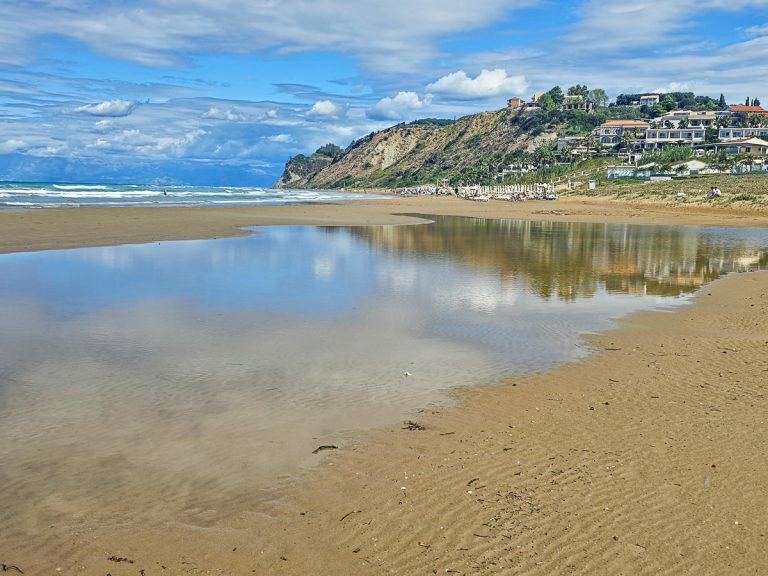
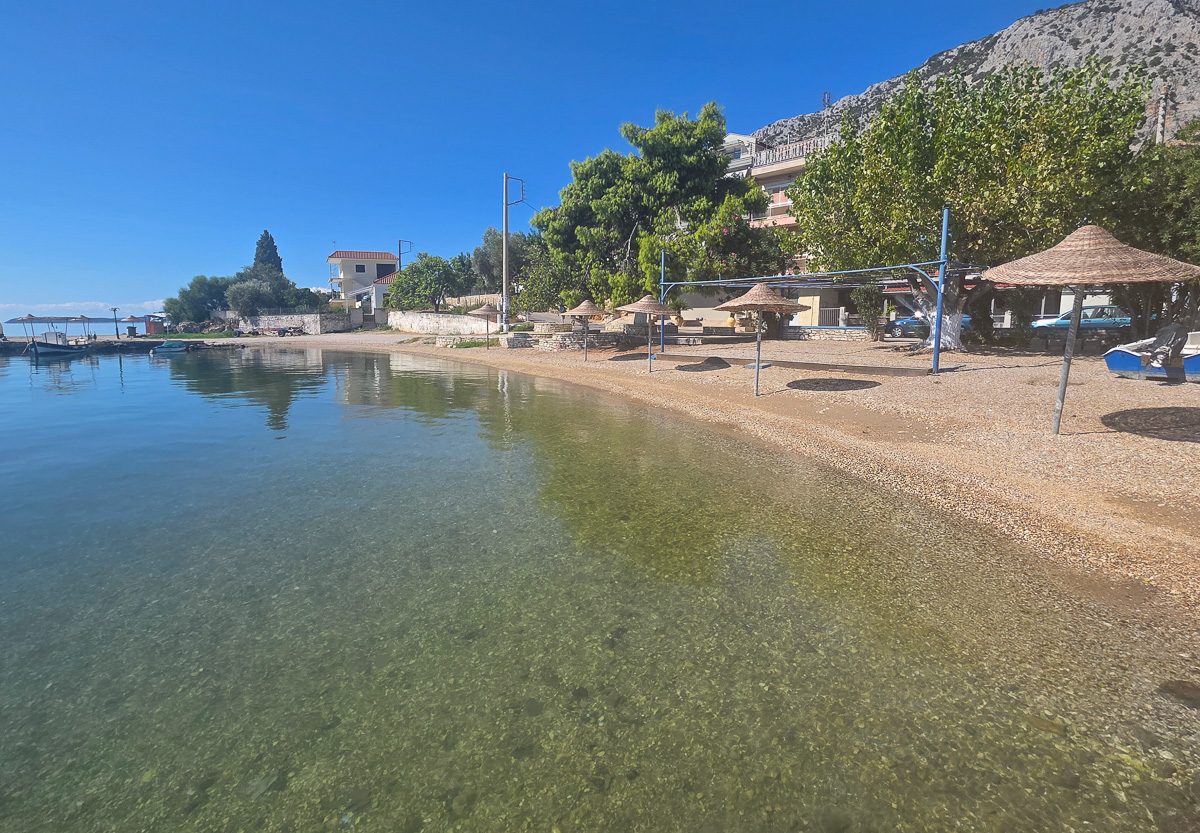
That isn’t to say Astakos lacks good places to swim. Follow the seafront beyond the last taverna, and the built-up waterfront gives way to a succession of small pebble beaches tucked into the curve of the coastline. They are simple, unpretentious places, with the shoreline gently shelving into the water and municipal straw parasols providing welcome shade. There is no grand sweep of white sand or beach-club scene here, just a series of little spots where you can spread out your towel, settle under an umbrella and enjoy a swim.
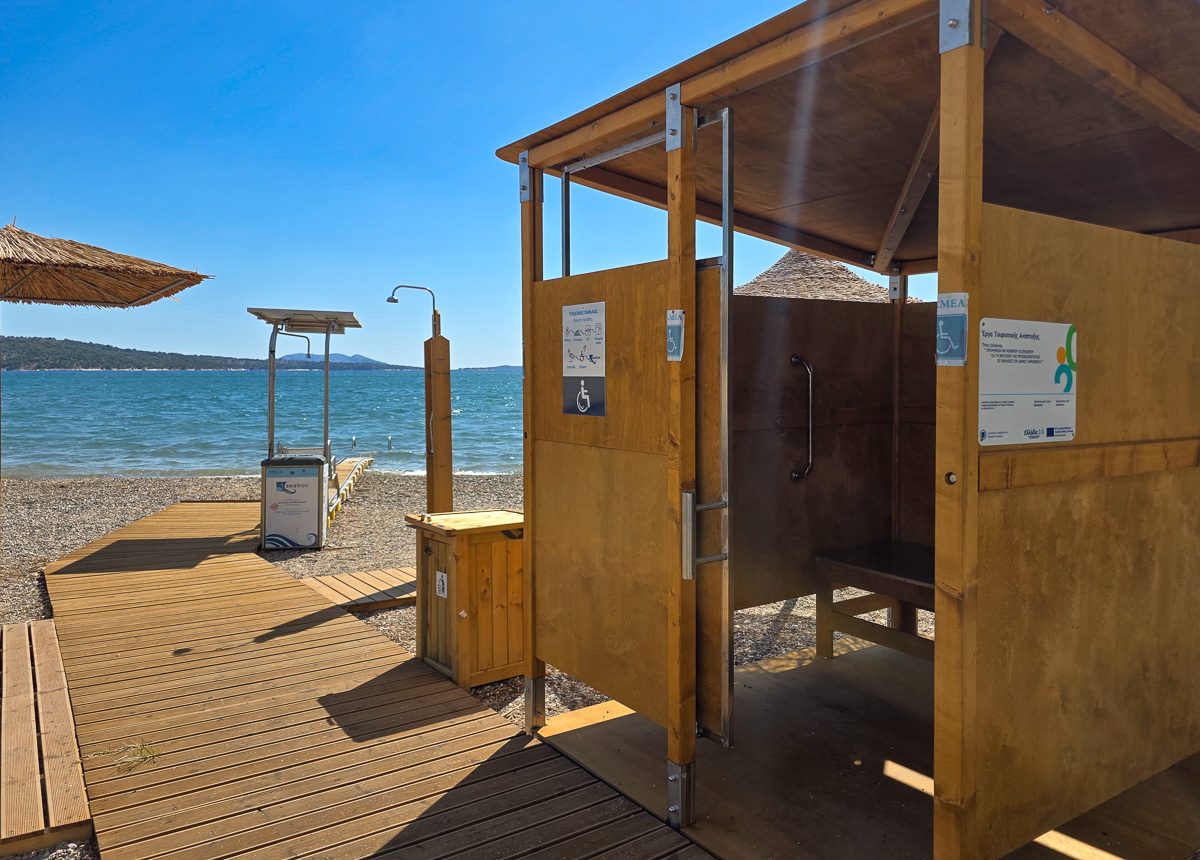
One beach caught my attention in particular, not for its setting but for its facilities. It had a SEATRAC system, together with accessible changing rooms and sun loungers, allowing people with mobility difficulties to enjoy the sea with considerably more independence.
This interested me because some of my older clients often ask me to recommend destinations in Greece that suit people with limited mobility. Finding somewhere with accessible beaches can make a considerable difference to the holiday they can enjoy.
I’d spotted more SEATRAC facilities during my travels through Aitoloakarnania than anywhere else in Greece. A bit of desktop research told me this was part of a regional initiative dating back to 2020, which began when local disability associations requested beach accessibility facilities. The Region of Western Greece began installing the systems at beaches across Aitoloakarnania, starting with Amfilochia and Astakos and soon extended to include Messolonghi.
SEATRAC is an interesting Greek invention. It was developed in partnership with the Greek company TOBEA, and the University of Patras as a research partner. It is powered by solar energy and it uses a specially designed seat to carry users into and out of the water, allowing people with mobility difficulties to access the sea independently. It’s a straightforward but important piece of technology that makes a real difference to who can enjoy a day at the beach.
Aitoloakarnania is certainly a region to consider if SEATRAC facilities are important.
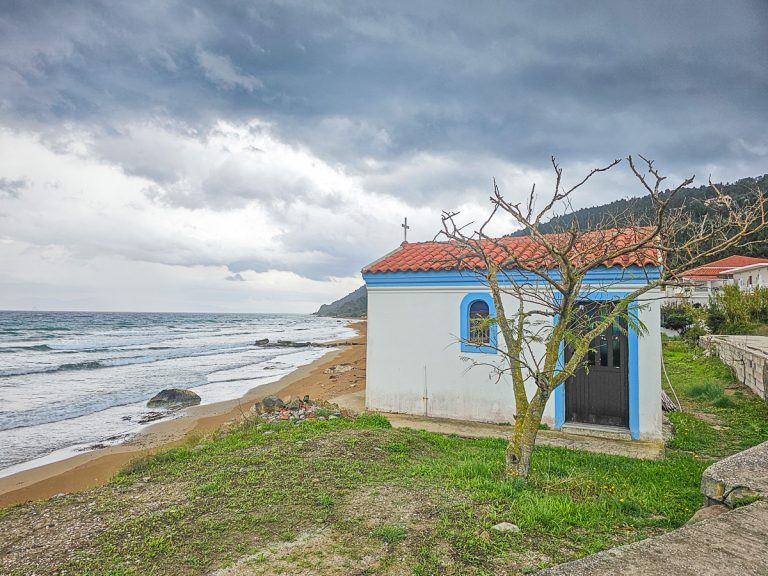
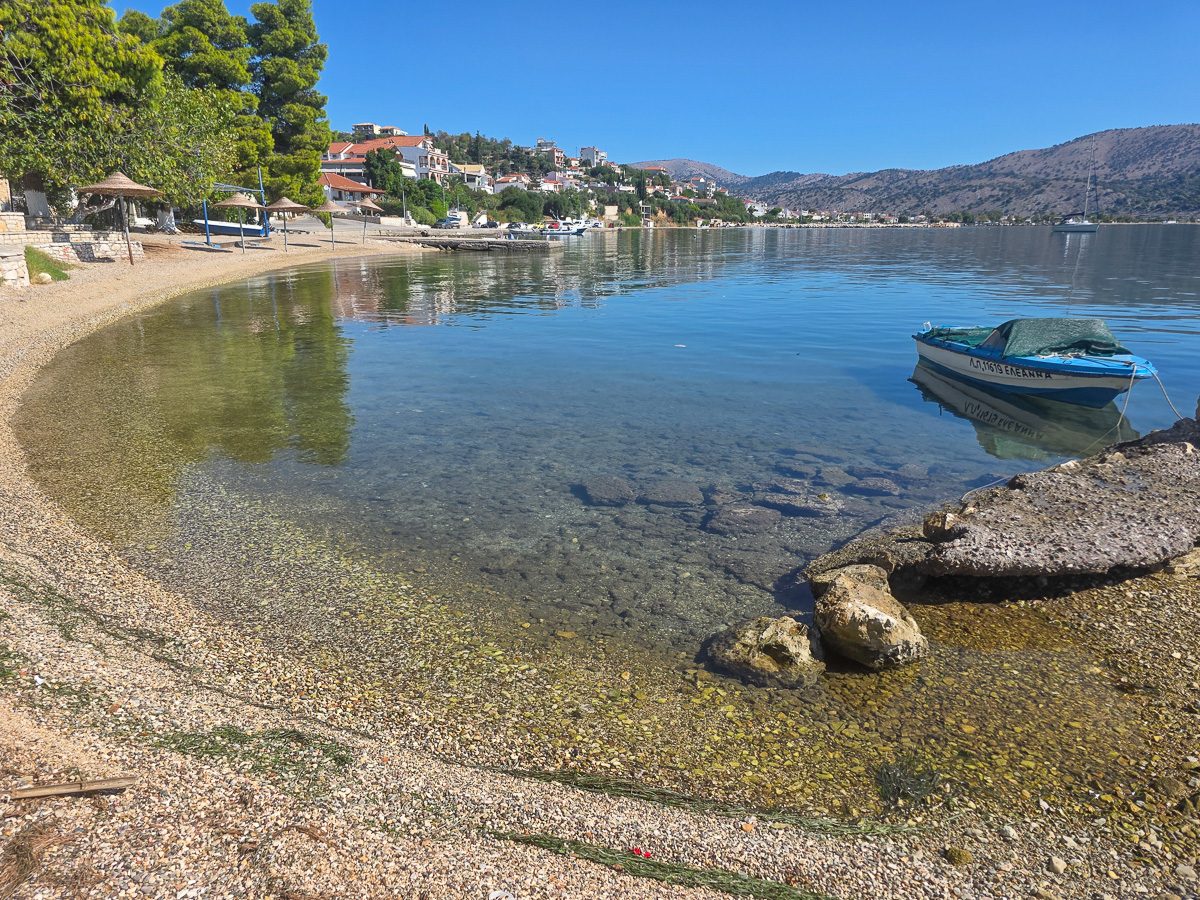
One day, I decided to follow the seafront in search of the Monastery of St George. Typically, I took the wrong path and found myself on the EP51 provincial road towards Mytikas. The monastery sits below the road, tucked into a small pine forest, and you can spot it from the coastal path. My navigational mishap did at least give me another perspective on this stretch of coastline. The little beaches continue along the shore, each with much the same pebble-and-shingle character, but with enough variation in their setting to make a change of scene worthwhile. And, best of all, they are within walking distance of the town.
The Centre of Astakos, Greece
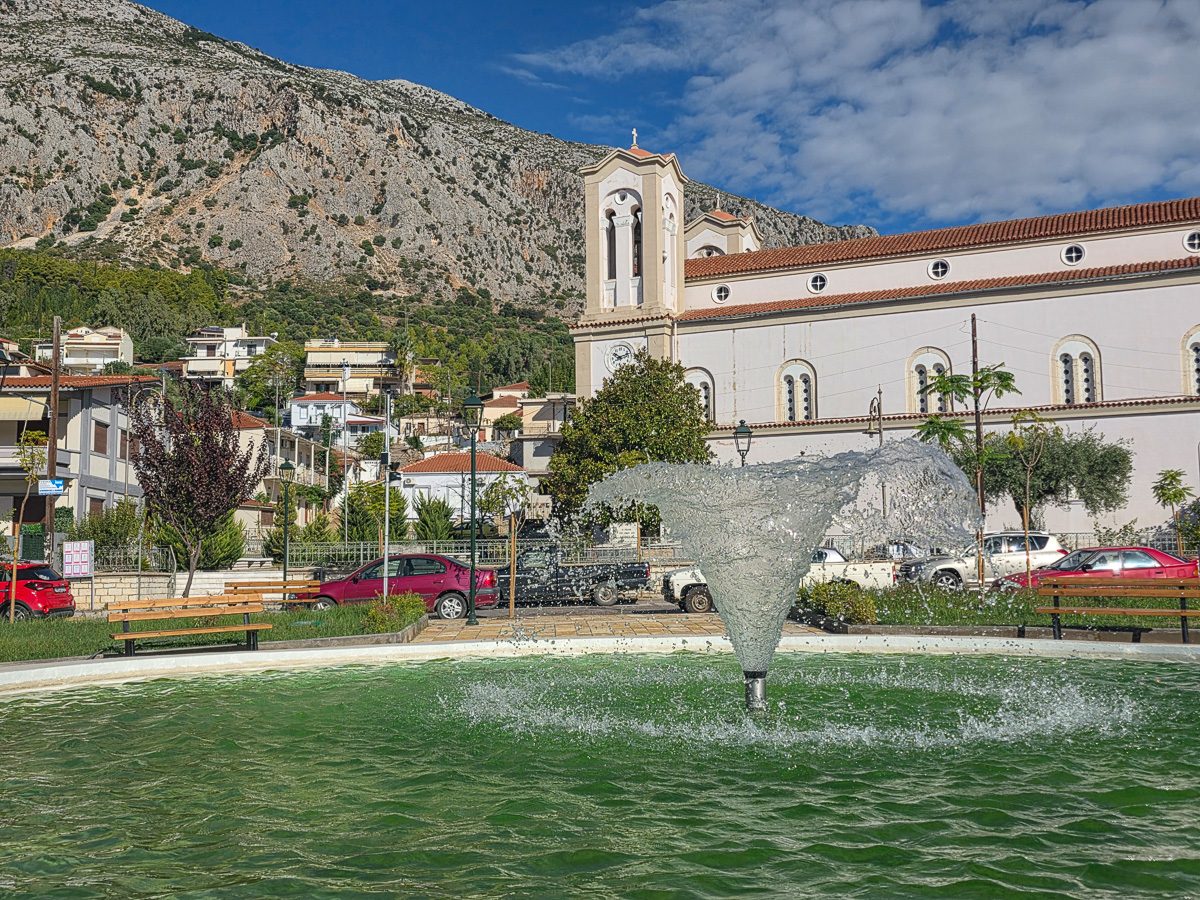
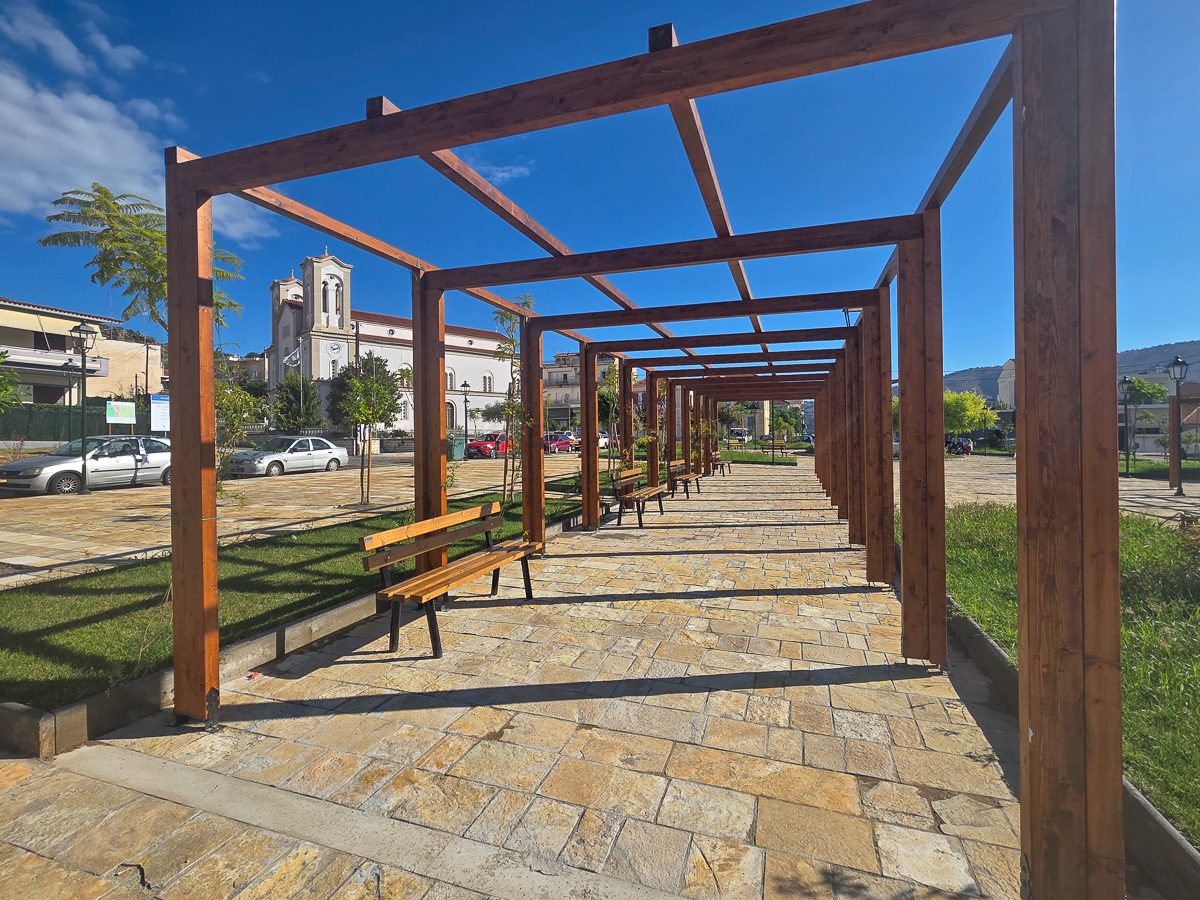
The centre of Astakos is dominated by a sizeable open square, set against the dramatic backdrop of the rocky mountainside that rises immediately behind the town. The whitewashed facade of the Church of Agios Nikolaos stands prominently on one side, its bell tower and tiled roof making an attractive focal point against the rugged mountain backdrop.
The square itself appears to have undergone a makeover in recent years. A large circular fountain occupies the centre, surrounded by paved walkways, planted borders, and benches. Along one side, a long timber pergola provides a welcome stretch of shade, with seating beneath it. Solar-powered benches also offer phone-charging facilities and Wi-Fi, letting visitors recharge while they rest. A very practical addition, and not something you come across in every small Greek town.
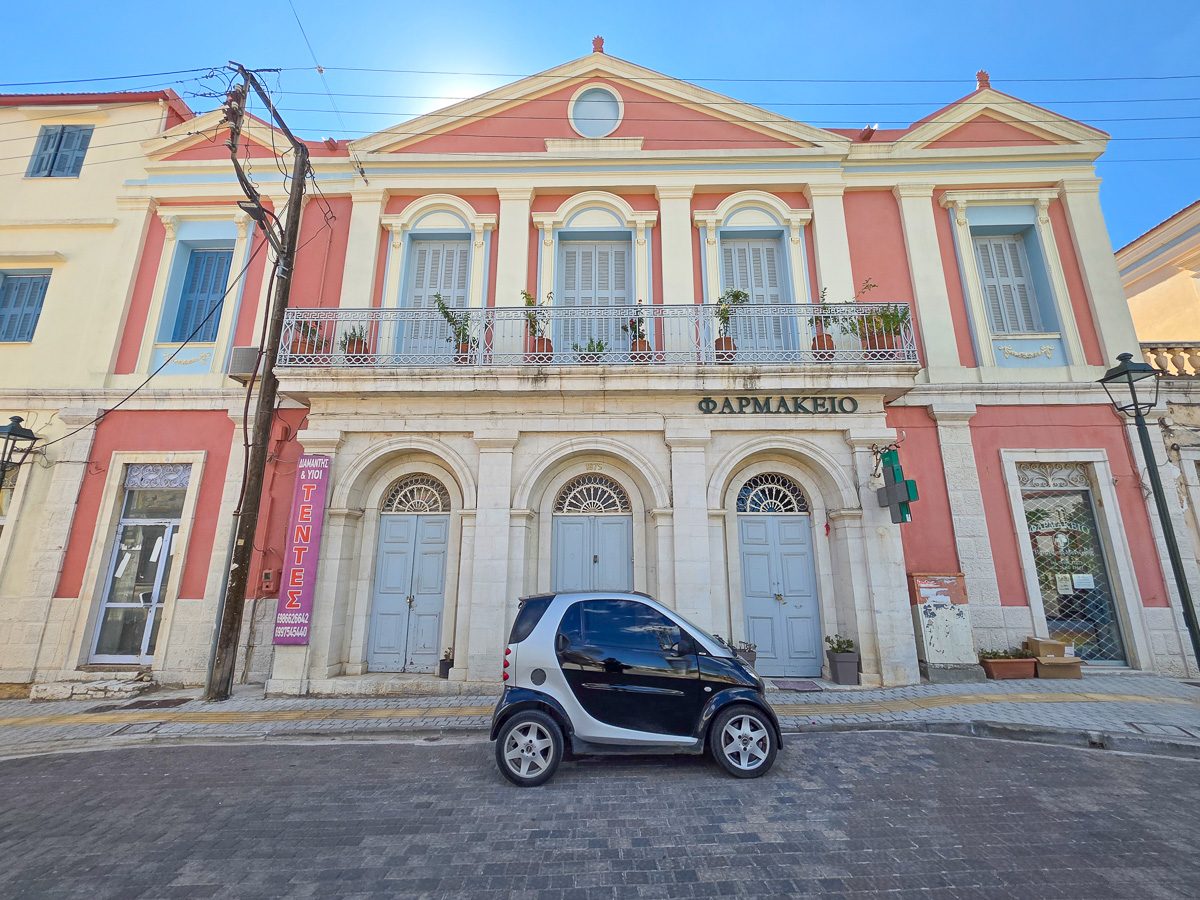
The buildings around the edge of the square are as worth a look as the square itself. Several are grand old houses with neoclassical features: tall windows, decorative balconies and ornate façades. One that caught my attention was the building that now houses a pharmacy. With its faded pink exterior and symmetrical upper-storey windows, I would guess that it was once a public building or a mansion. And all built on acorns and tobacco.
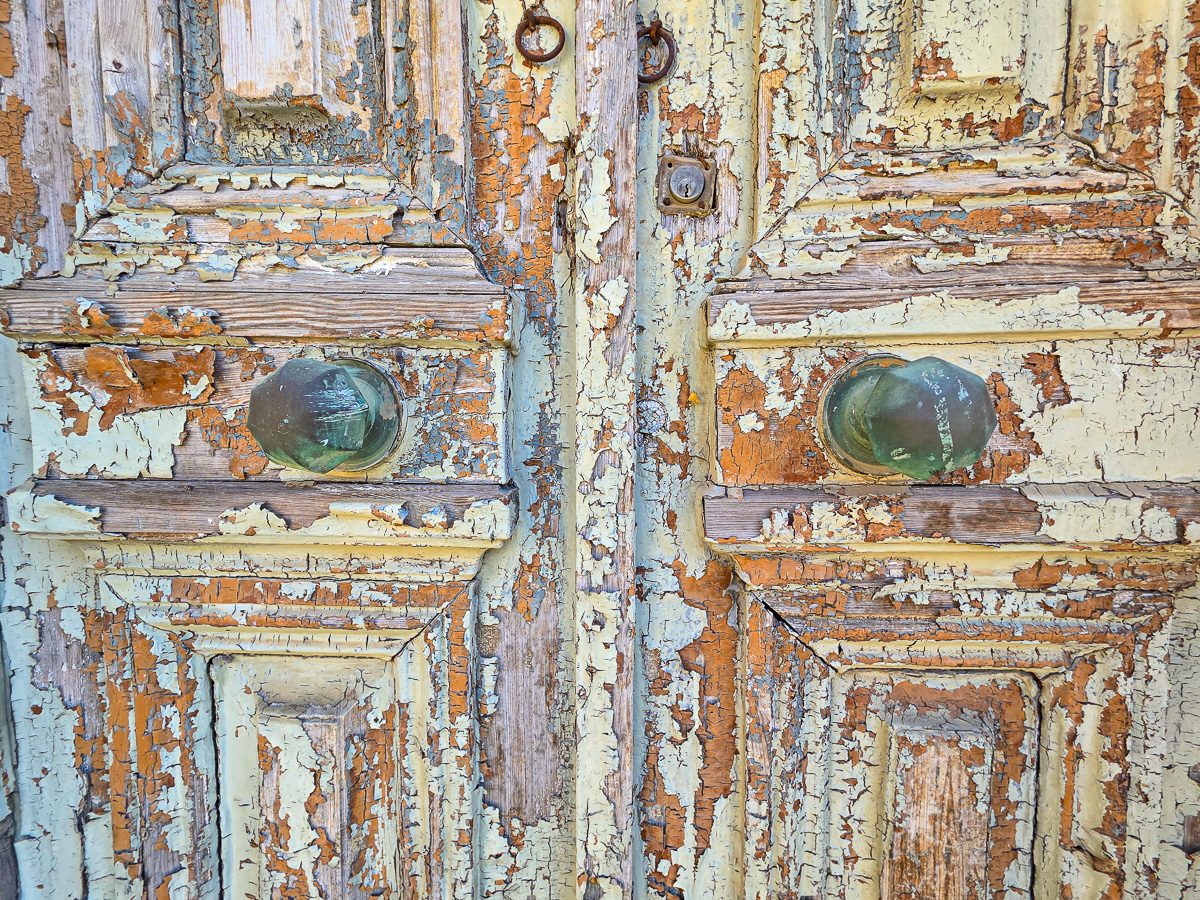
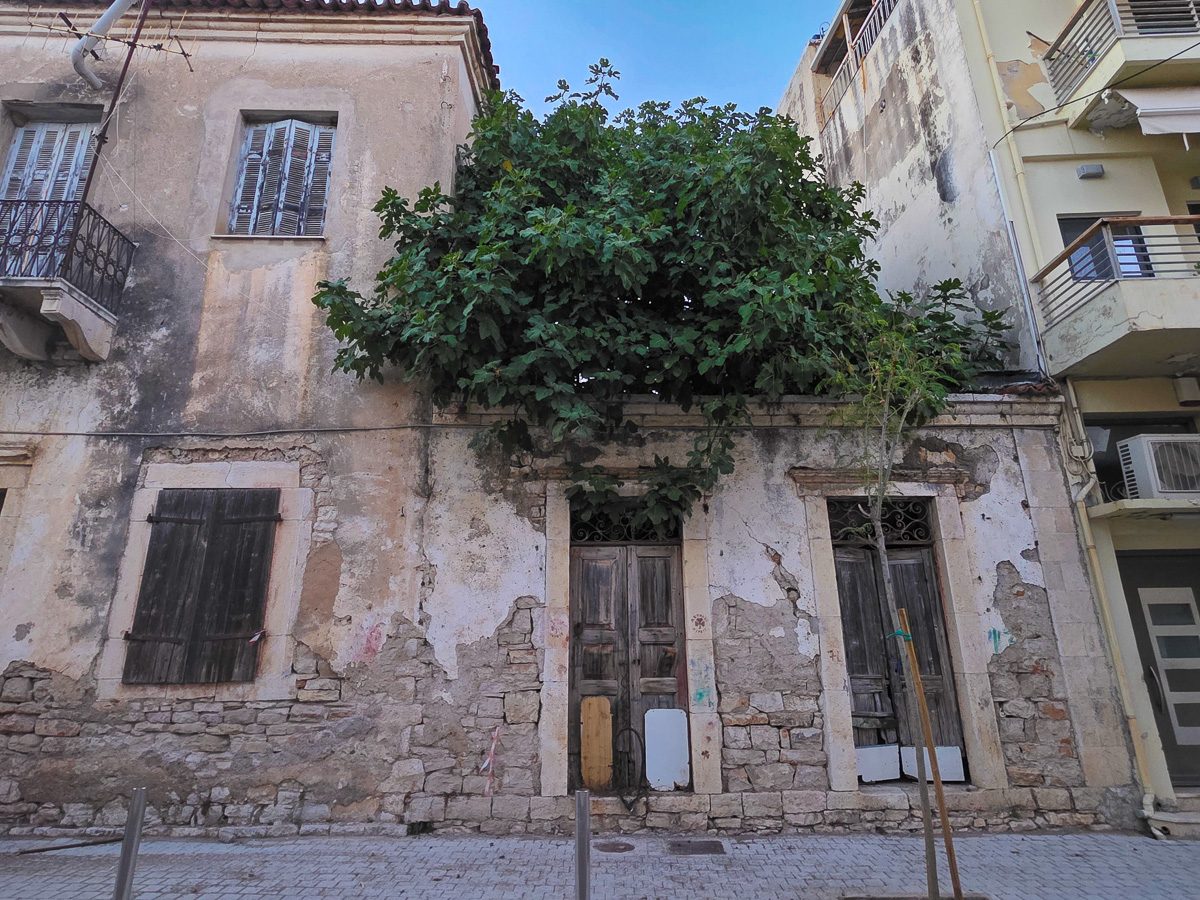
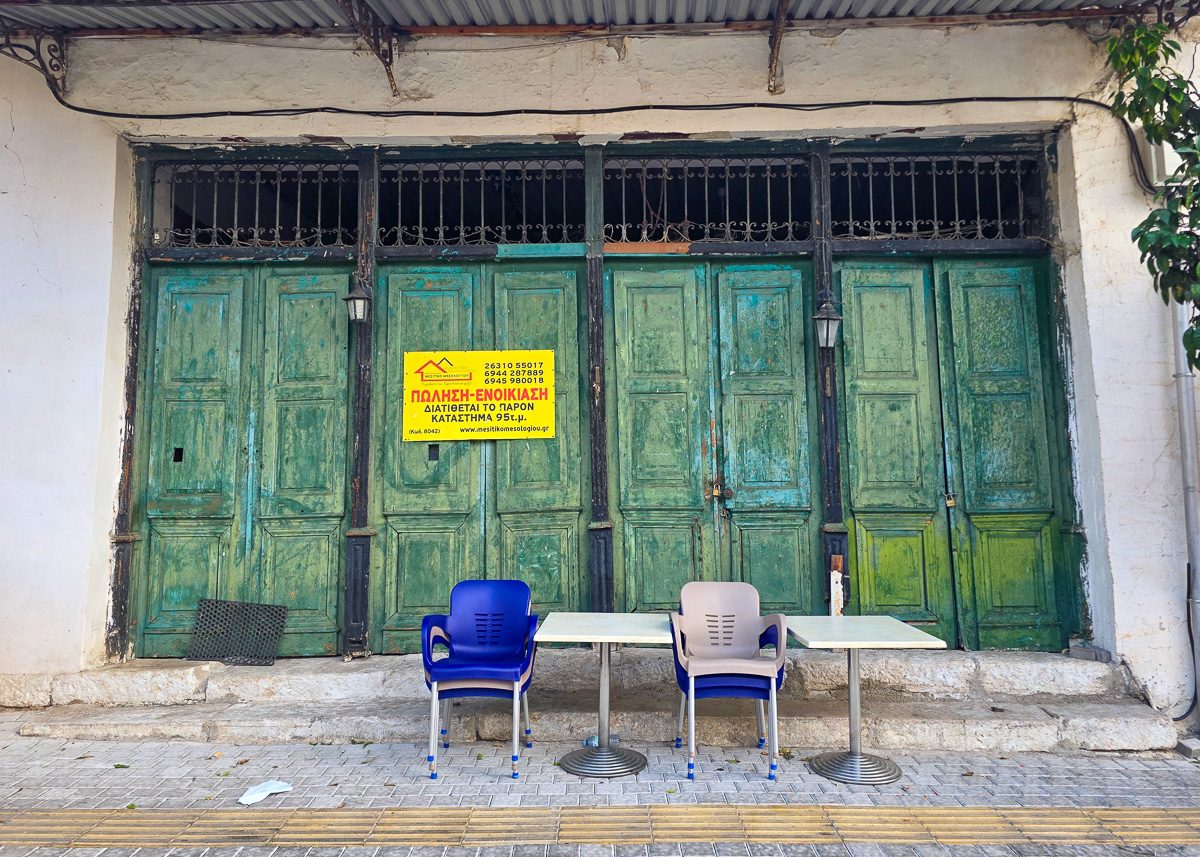
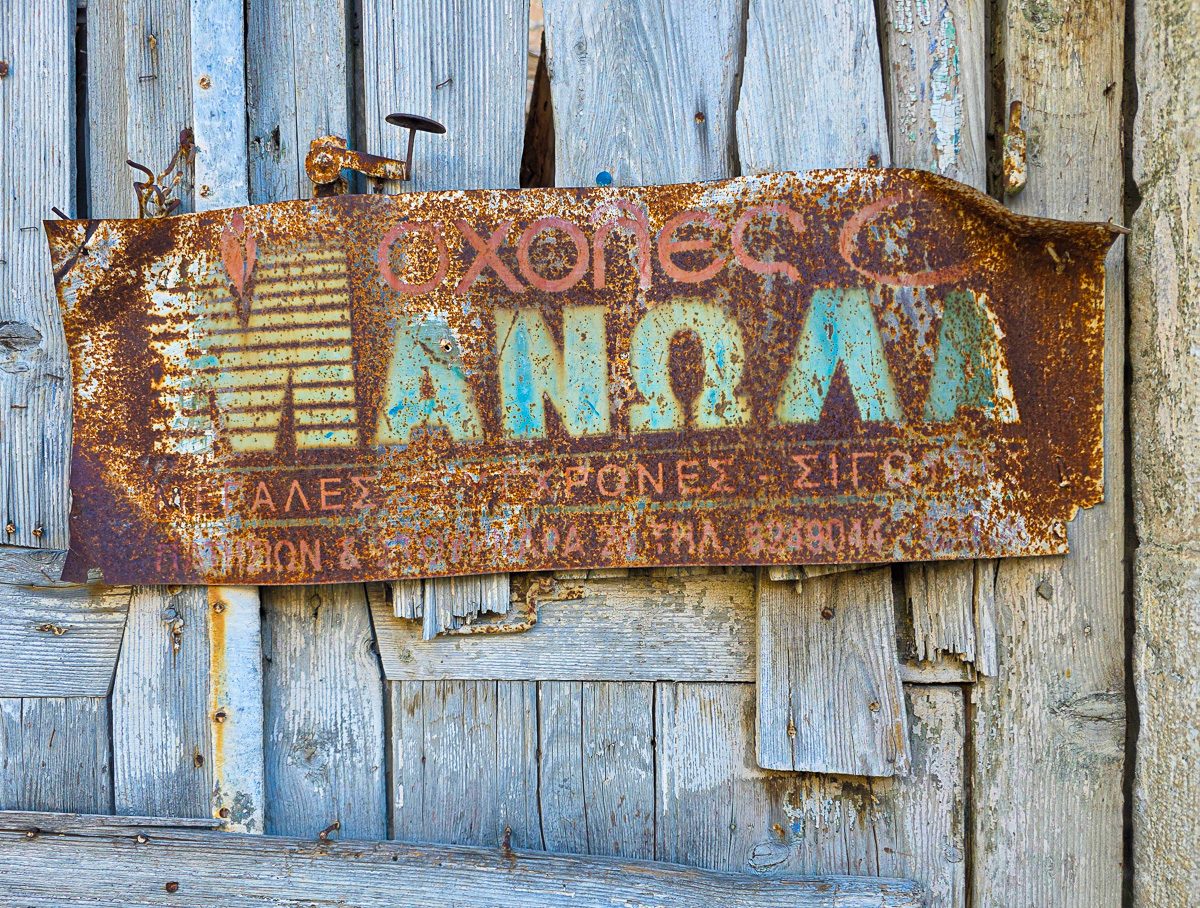
Few places give you that warm, fuzzy feeling from the moment you arrive. Astakos did. Part of that comes from the old houses, grand and simple alike. There’s just something about peeling shutters, a bit of patina and decay, and a good door. It’s the sense of the lives that went before, reaching out to tell their story to anyone who wants to stop and listen.
If you know, you know.
Astakos Lemon Juice
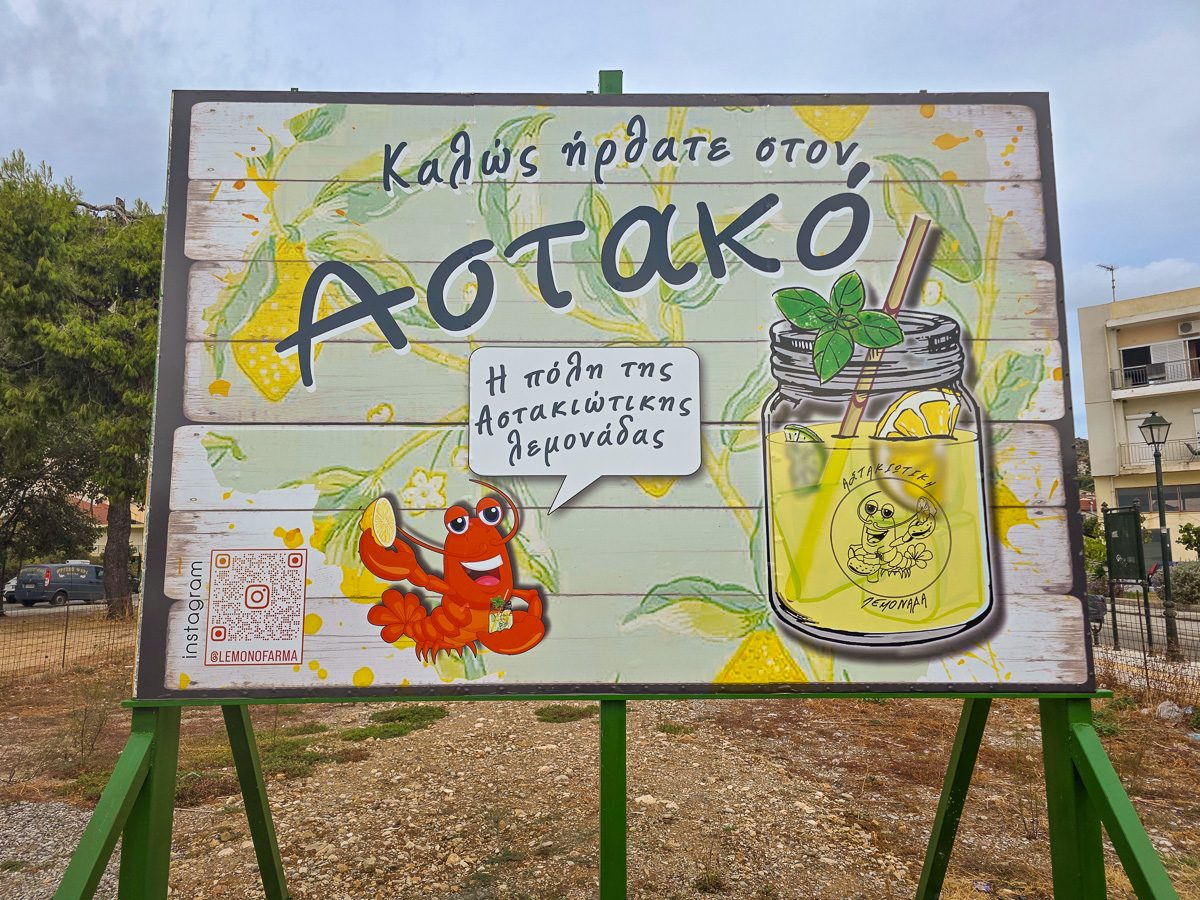
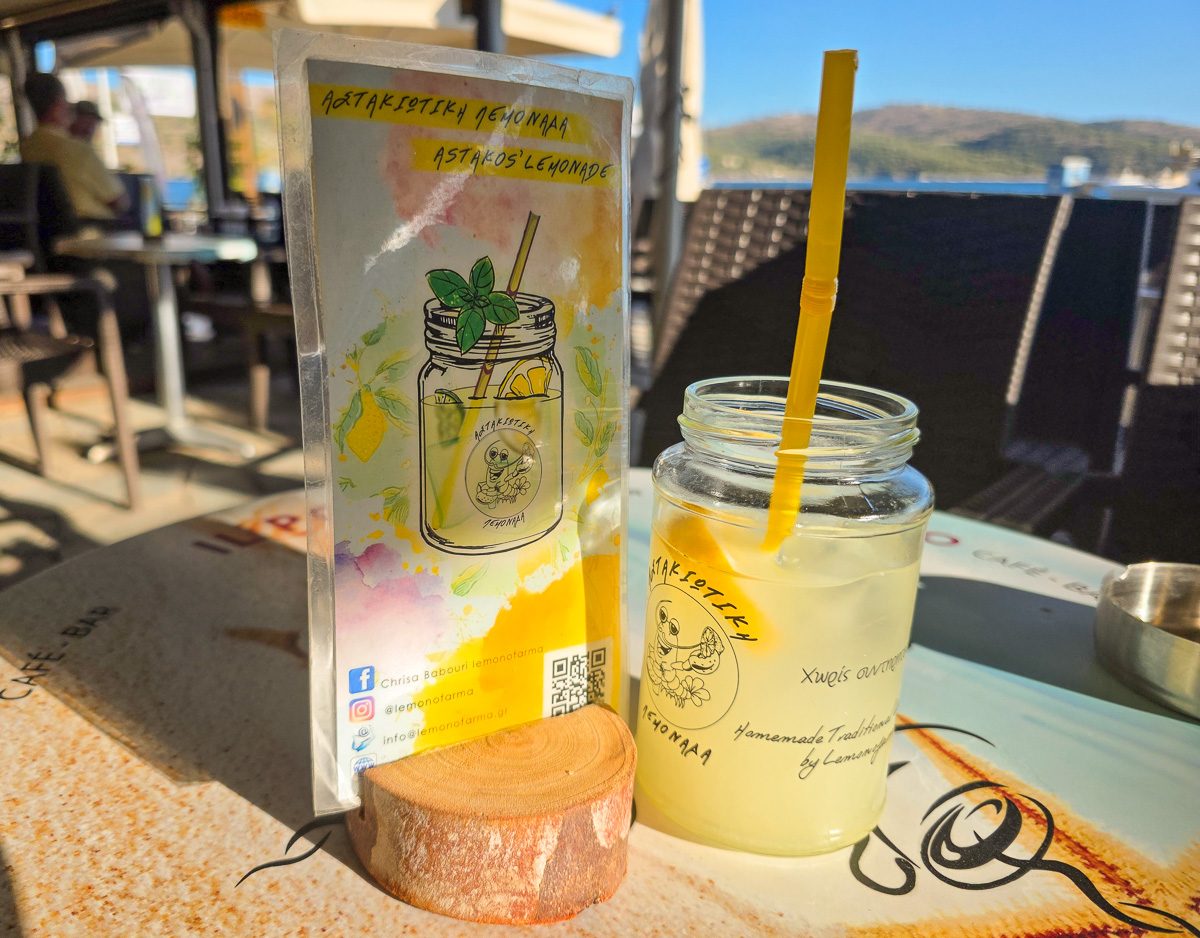
Astakos has a little secret. I say secret just because I’d never come across it before. Astakos lemonade is a local speciality called Astakiotiki Lemonada, made by a small family-run business from lemons grown in their own groves in the surrounding Aitoloakarnania region.
The business, Lemonofarma, was founded by Chrysavgi Babouri, a farmer, and her husband, Kostas Lichnos, a physics teacher. They started in 2022, turning their own lemon harvest into a bottled product. Four lemon varieties Interdonato, Nouvel Athos, Lapithou and Zampetaki- are used, and everything is done by hand. They say it has no preservatives and is sold as a concentrate rather than a ready-to-drink soft drink. This is what keeps every glass consistent. Anyone who has suffered lemon juice that was too sharp, too weak or strong enough to strip the enamel off your teeth will appreciate that.
In 2024, it won an award for taste and quality in a blind tasting. Even more impressive is this neat example of local farmers diversifying. A concentrate means a café doesn’t need to pull out the squeezer and blender, and customers still get a great product. It was close to the best thing that passed my lips every day of my stay.
Astakos Eateries
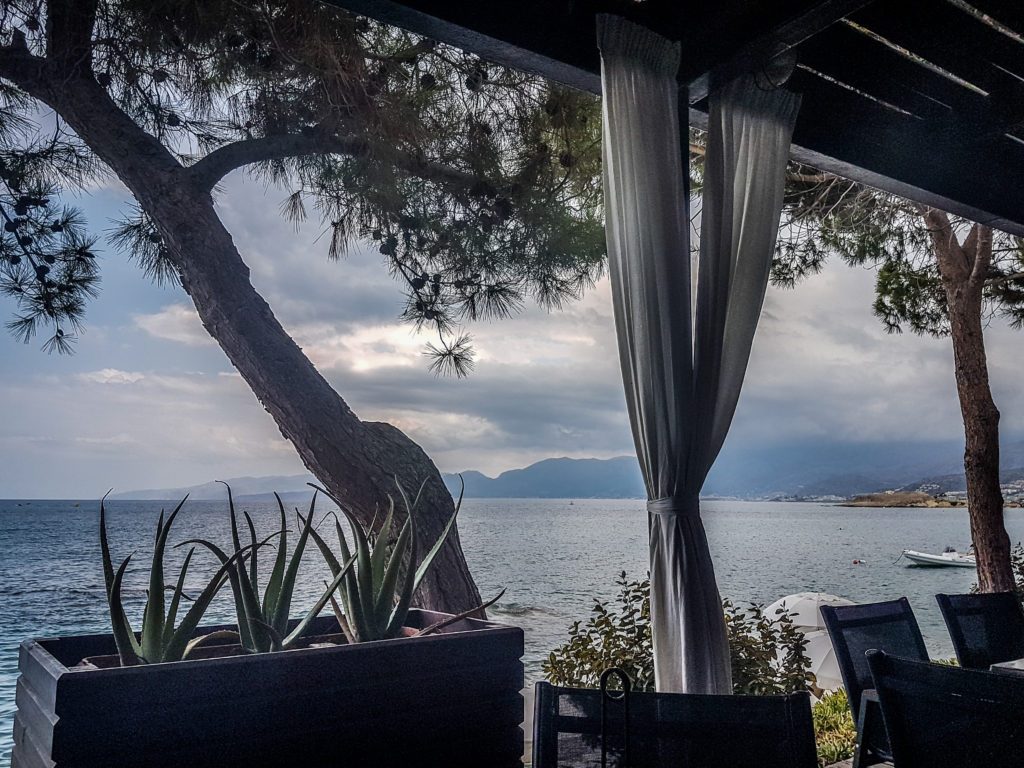
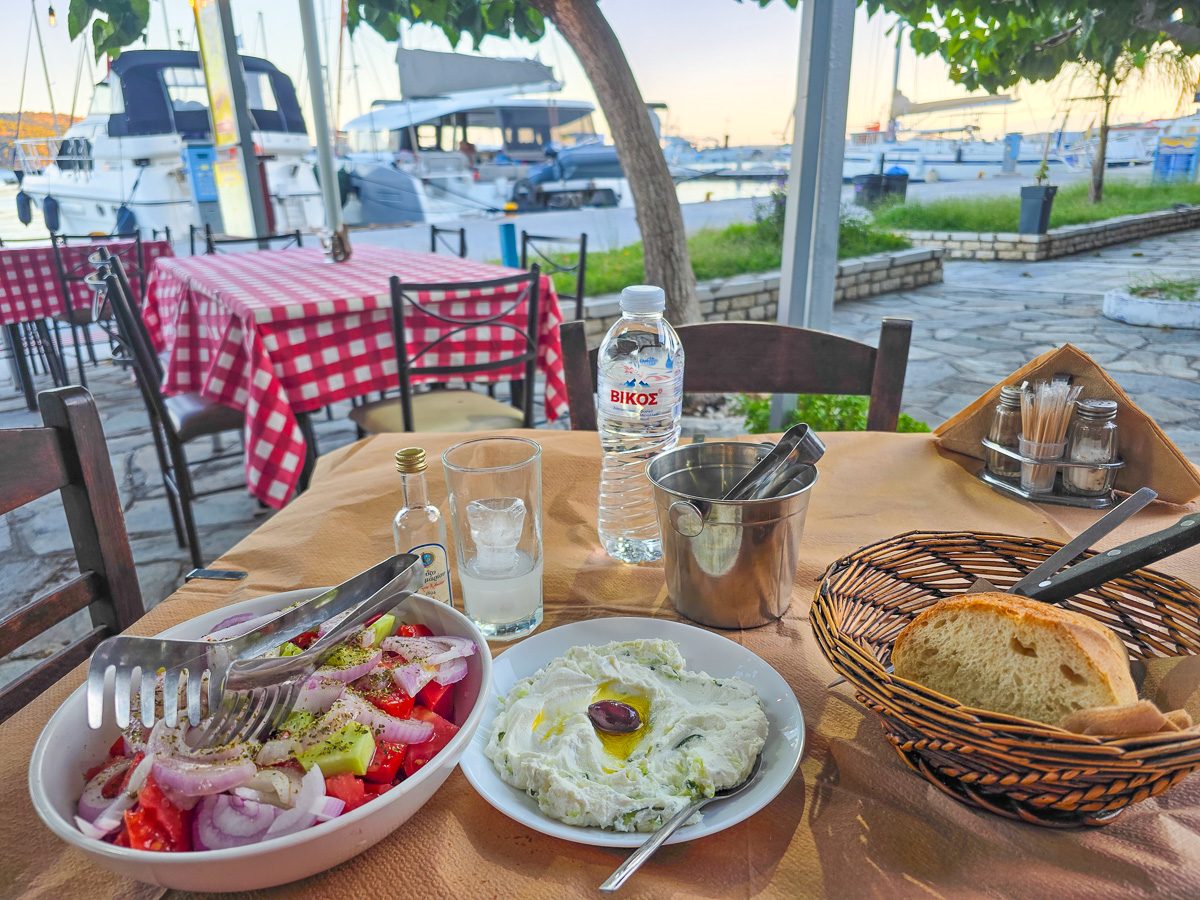
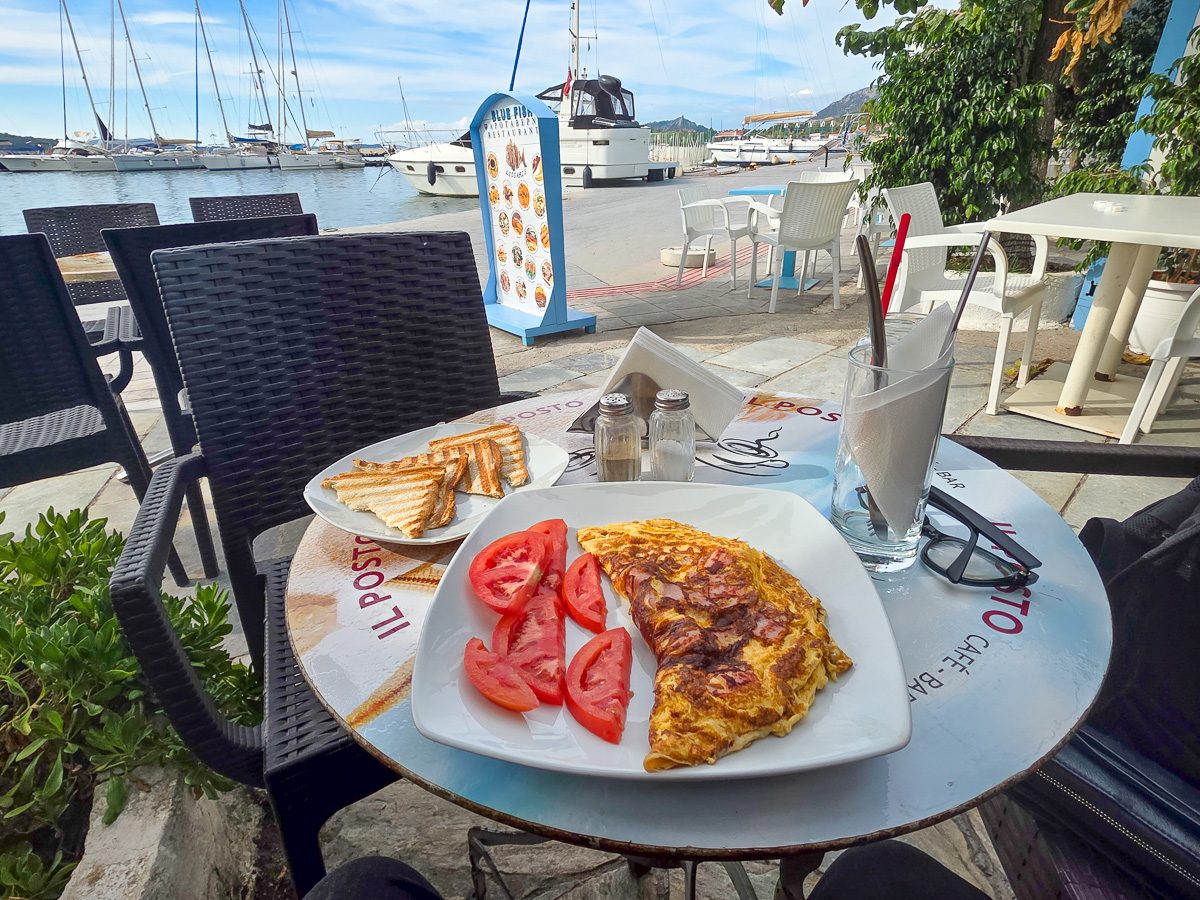
It was easy to fall into a kind of routine – breakfast at Il Posto, where I would always be greeted with a friendly welcome. Sometimes, I’d swap that out for Dryland, who, although they only did coffee, pointed me to the bakery and suggested I buy a pastry and come back to the cafe to eat it. A very nice arrangement.
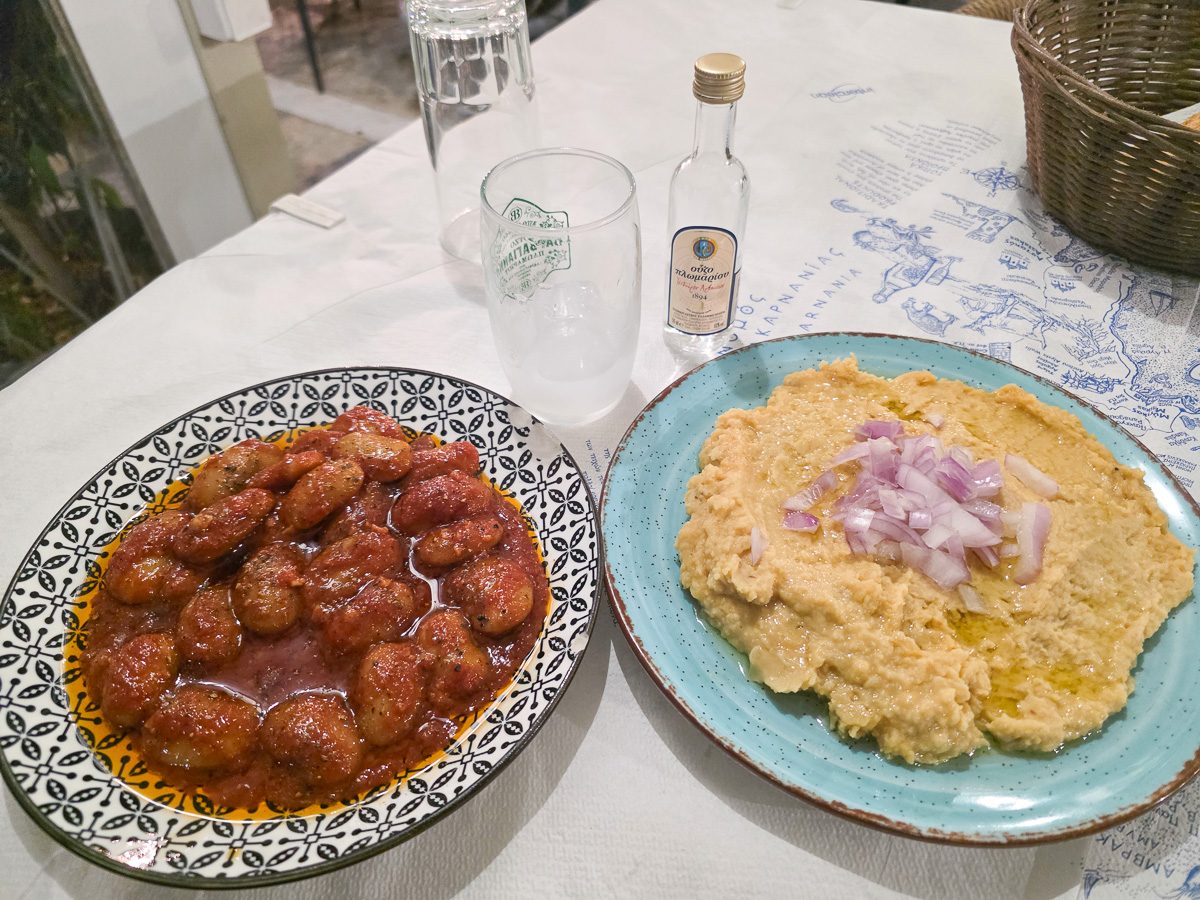
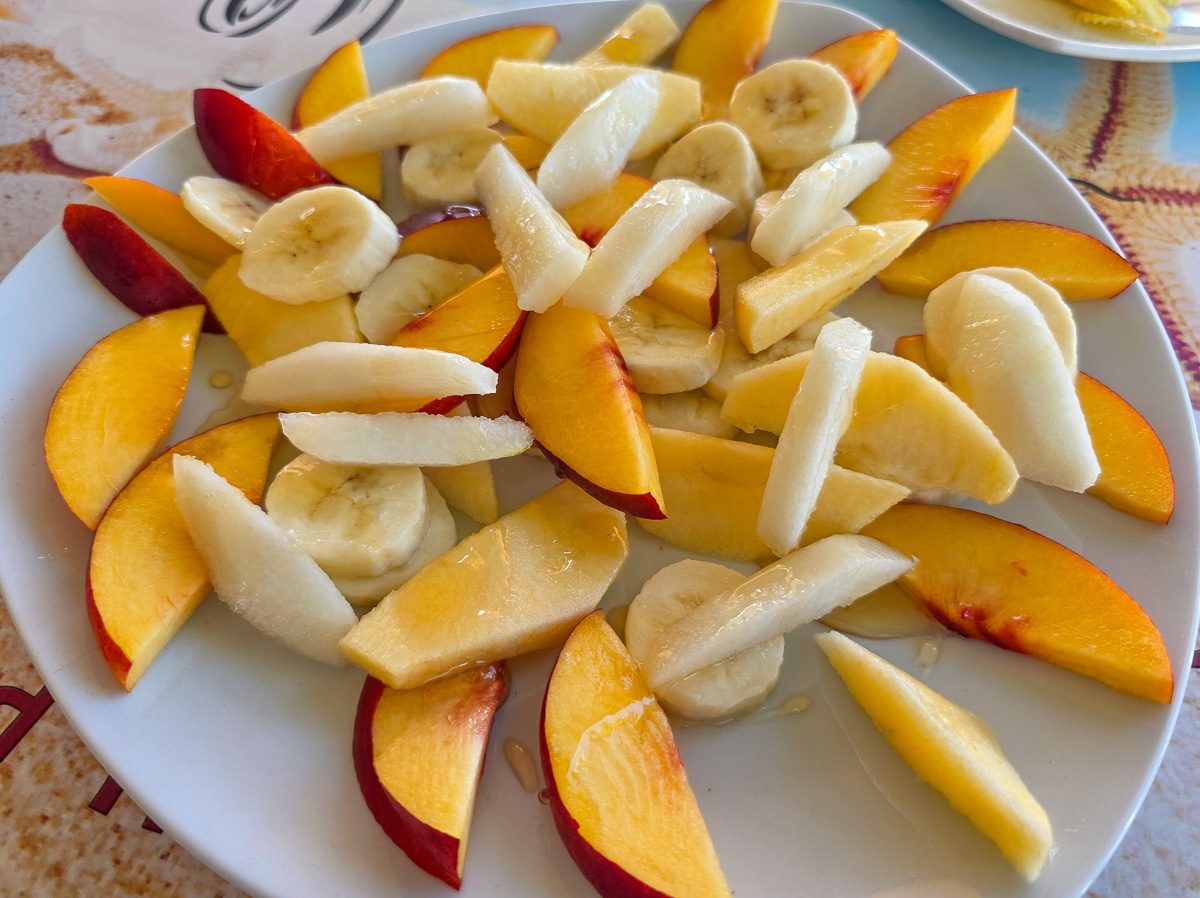
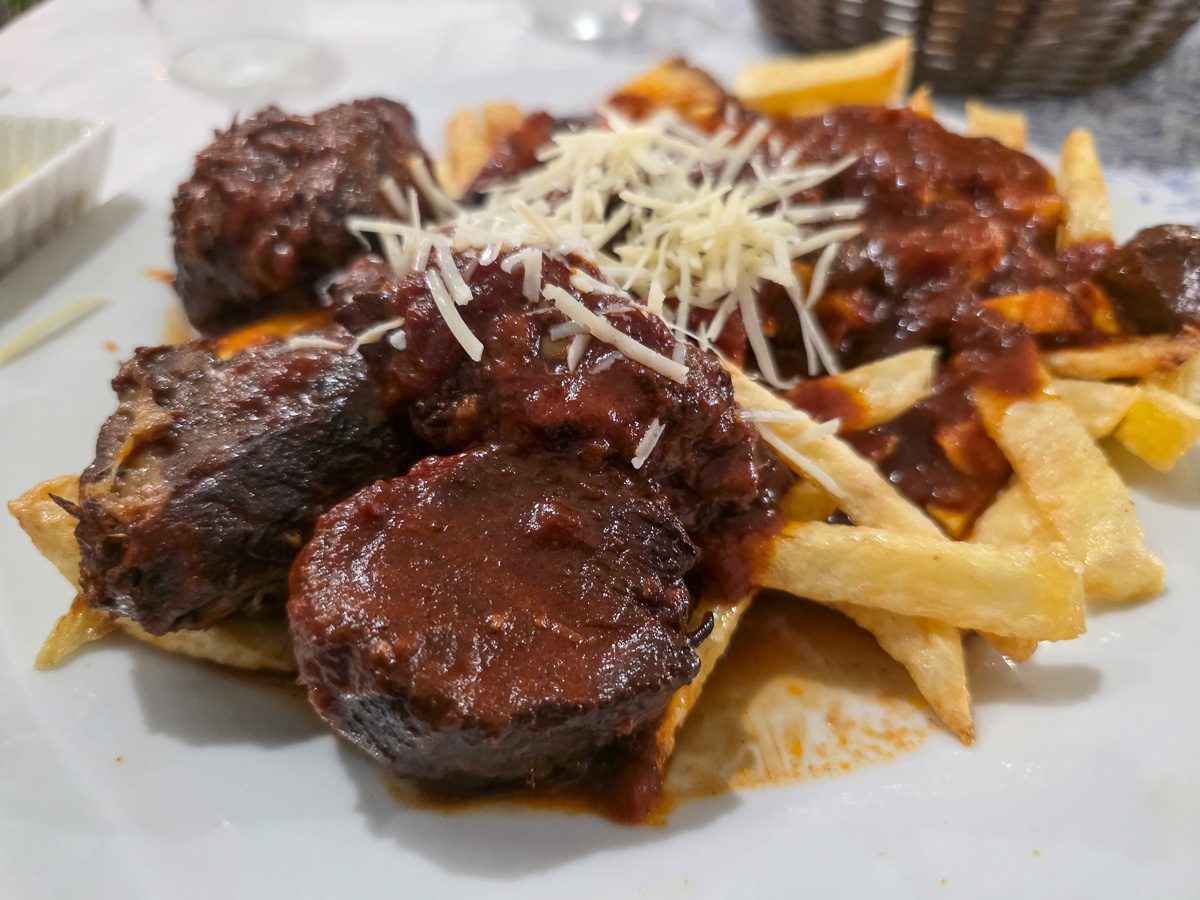
The evenings became a game of eeny, meeny, miny, mo, deciding which of the harbour front tavernas to eat at, and slowly I worked my way around them all (or so it felt). Olympic Pegasus for grilled peppers and chicken fillets in a white wine sauce, Maistros for gigantes and kokkinisto, and Blue Fish for Kolokithokeftedes and whatever grilled meats they had that day. At this time of year, finding tavernas with oven options was a bit of a challenge, but there was plenty of choice to satisfy anyone. And the bakeries and patisseries! I turned 67 during this visit and I ‘celebrated’ for want of a better word with an indulgent dessert from Alexandra Sweet Art. And I went back again another day just for the hell of it.
Is Astakos Worth Visiting?
If you’re after big sights and things to do, probably not. If you like a small working port with old houses, a folklore museum, pebble beaches and a slow pace, then yes.
I stumbled across Astakos whilst looking at a map, and stuck a metaphorical pin in it because the bus timetable worked. I booked six nights because I needed a rest, old bones and all that. Six nights later, I left with a better understanding of how the simple acorn had contributed to the town’s growth, a china mug from the museum, a taste for Astakiotiki lemonade and a camera full of doors. I call that a successful visit.
It wasn’t only the characterful old architecture. It was the friendly welcome at Il Posto every morning, and Dryland sending me round to the bakery and telling me to bring the pastry back to eat with my tea. It was Vassiliki arranging for Mrs Gianna to open the museum for one visitor and just receiving a cheerful ‘Kalimera’ from anyone I passed. In a town at the end of its summer season, with very few tourists around, I couldn’t have chosen a better place to settle for a while.
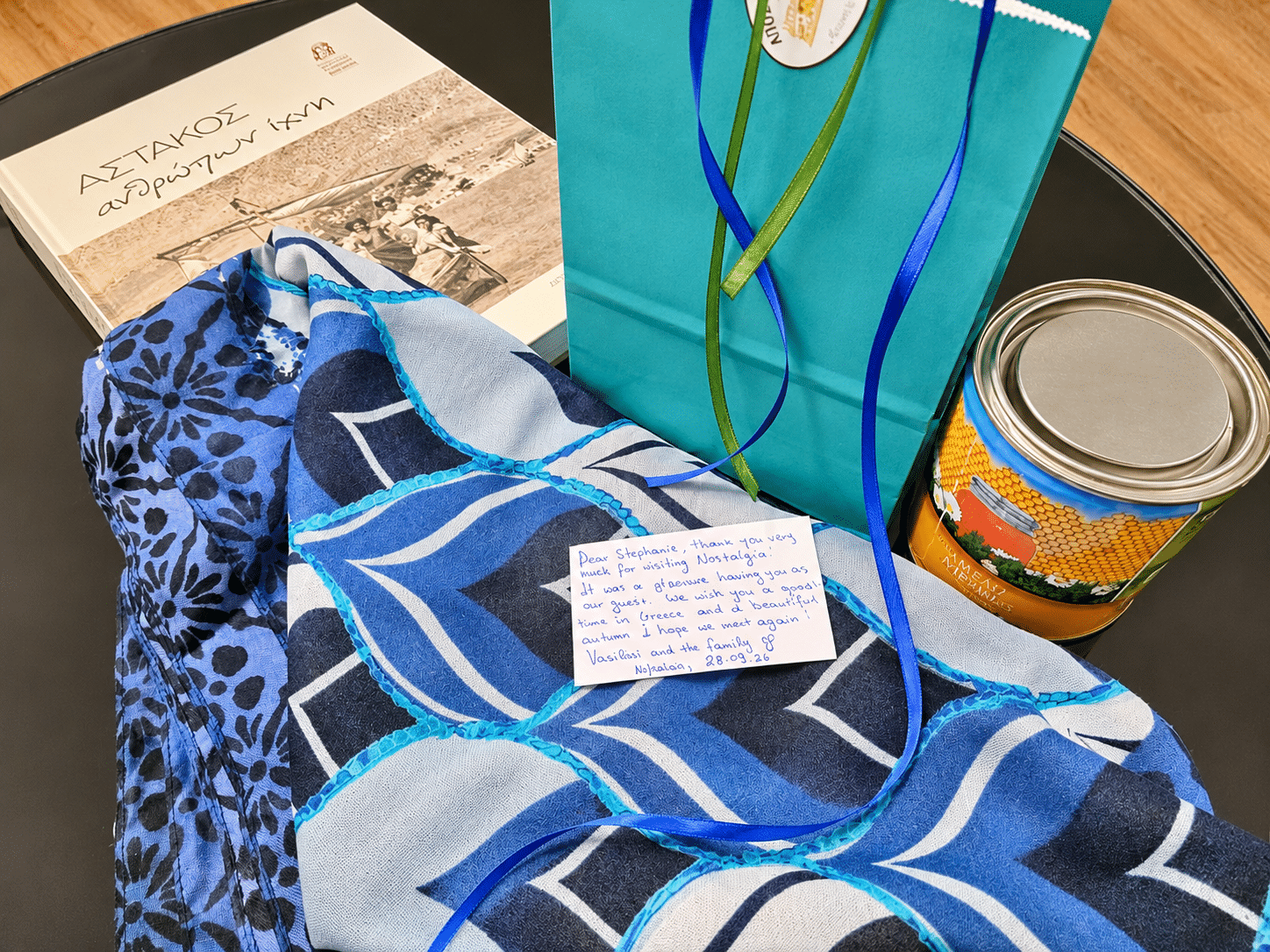
The night before I left, a text arrived from Vassiliki. She’d left something on my doorstep on her way back from the gym: a gift bag, honey from her own hives, a handwritten note and a beautiful scarf. How did she know my colours?
It was a very Astakos way to end the stay.
Discover more from
Subscribe to get the latest posts sent to your email.
MY BIG FAT GREEK TRAVEL SURVEY
How do you really plan your Greek adventures? I'd love to hear from you.
TAKE THE SURVEY →