
The Naked Truth About Oil Wrestling
Oil wrestling. Now that’s not a thing you tend to think about when you think of Greece. Say “Greece” to anyone and it’s likely to conjure up images of whitewashed villages, blue-domed churches, turquoise seas, fantastic food and legendary hospitality. Oil wrestling and oil wrestling history probably doesn’t even make the list.
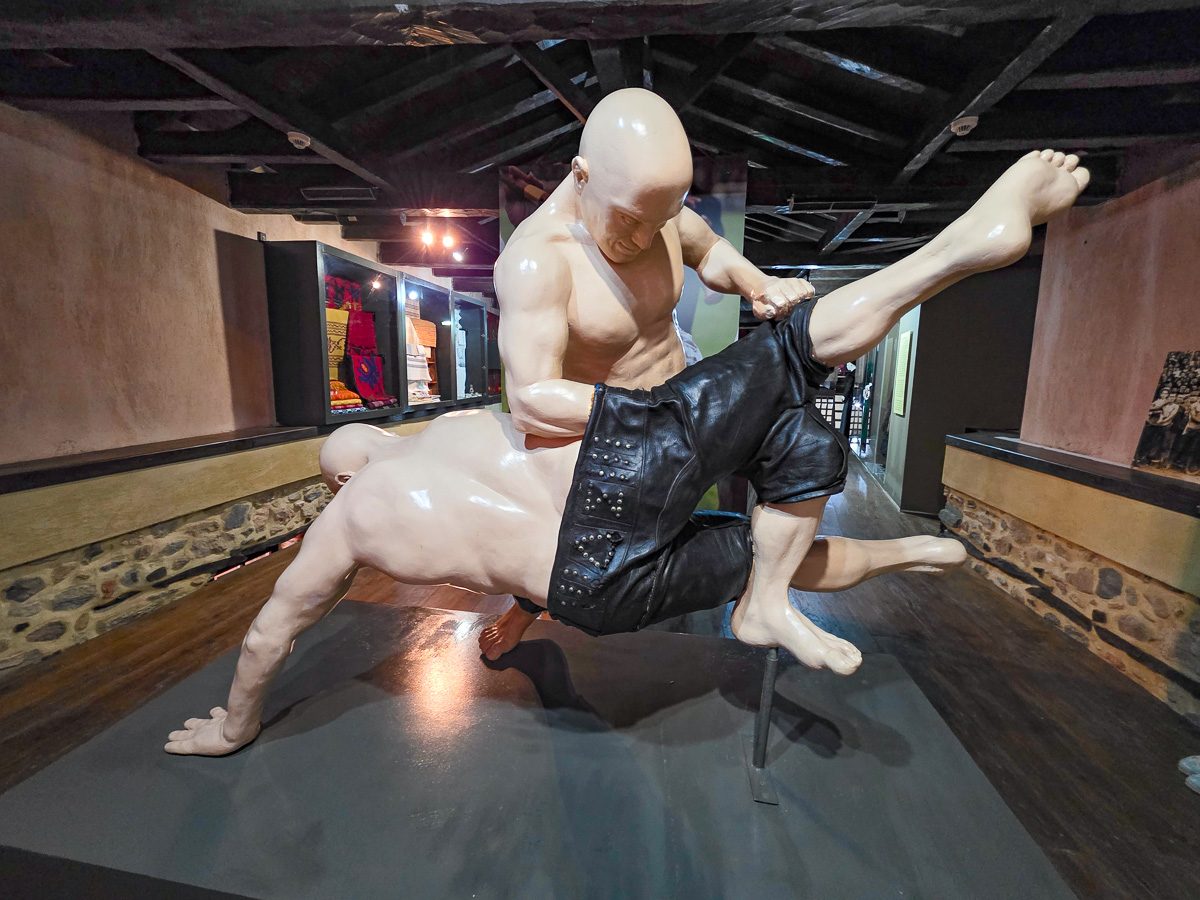
During a visit to Sochos for Carnival in 2025, I had the pleasure of exploring the town’s small museum. Housed in what I think is one of the most beautiful traditional buildings in the village, with its exposed wooden beams and magnificent sachnisi (projecting enclosed balcony), the museum tells the story of Sochos and its traditions.
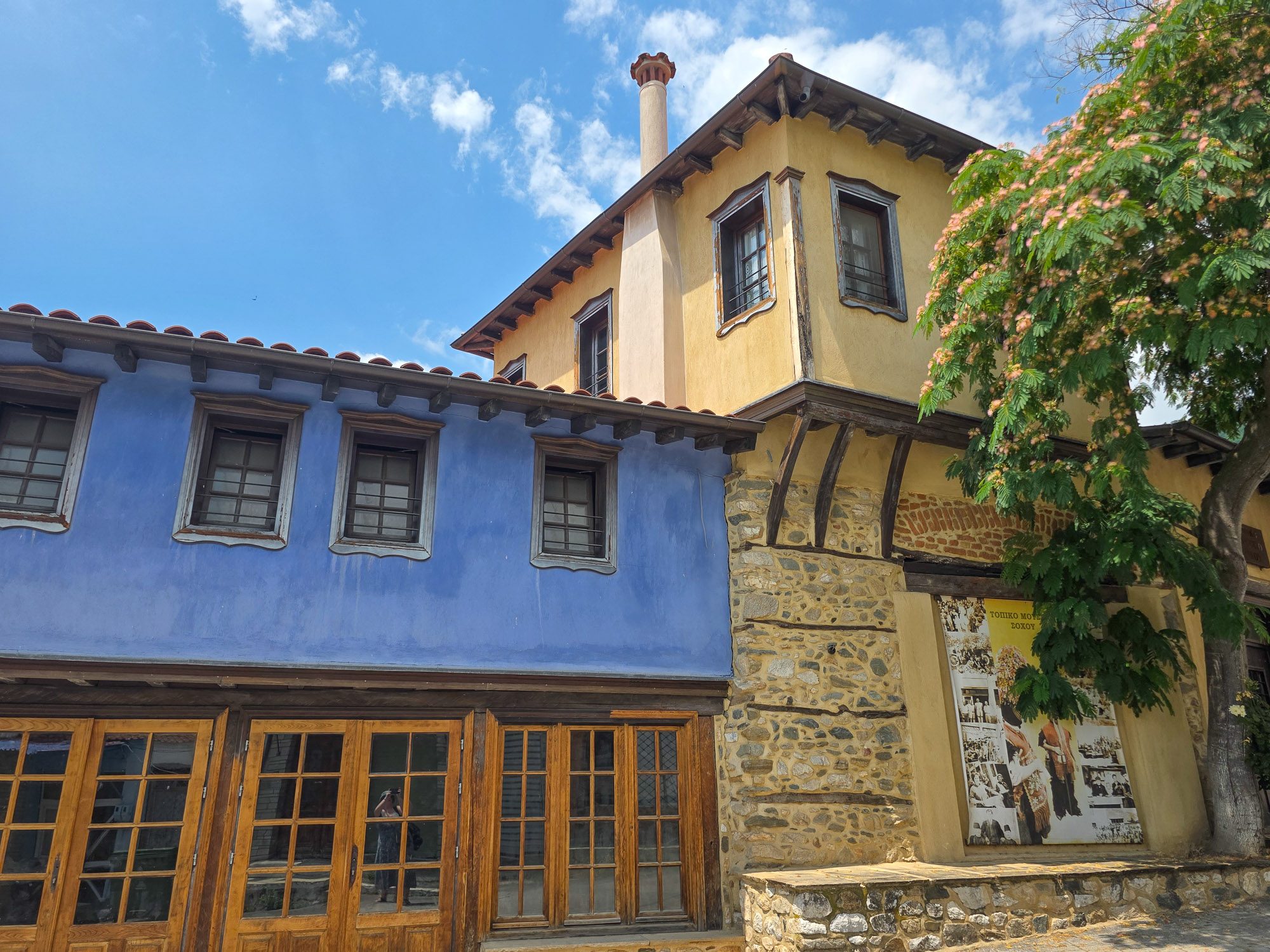
Clean Monday – Presentation of the Koudounoforoi
The ground floor is dedicated to the famous Bell Bearers of Merion (Koudounoforoi), probably the village’s most iconic symbol. But it was when I reached the first floor, passing displays of beautifully embroidered traditional costumes, that something unexpected caught my attention.
A section devoted to wrestling.
Not just any wrestling. One where competitors are covered in oil and whose aim is to force their opponent’s back to the ground, using grips secured through the kispet (the leather trousers), to win the match.
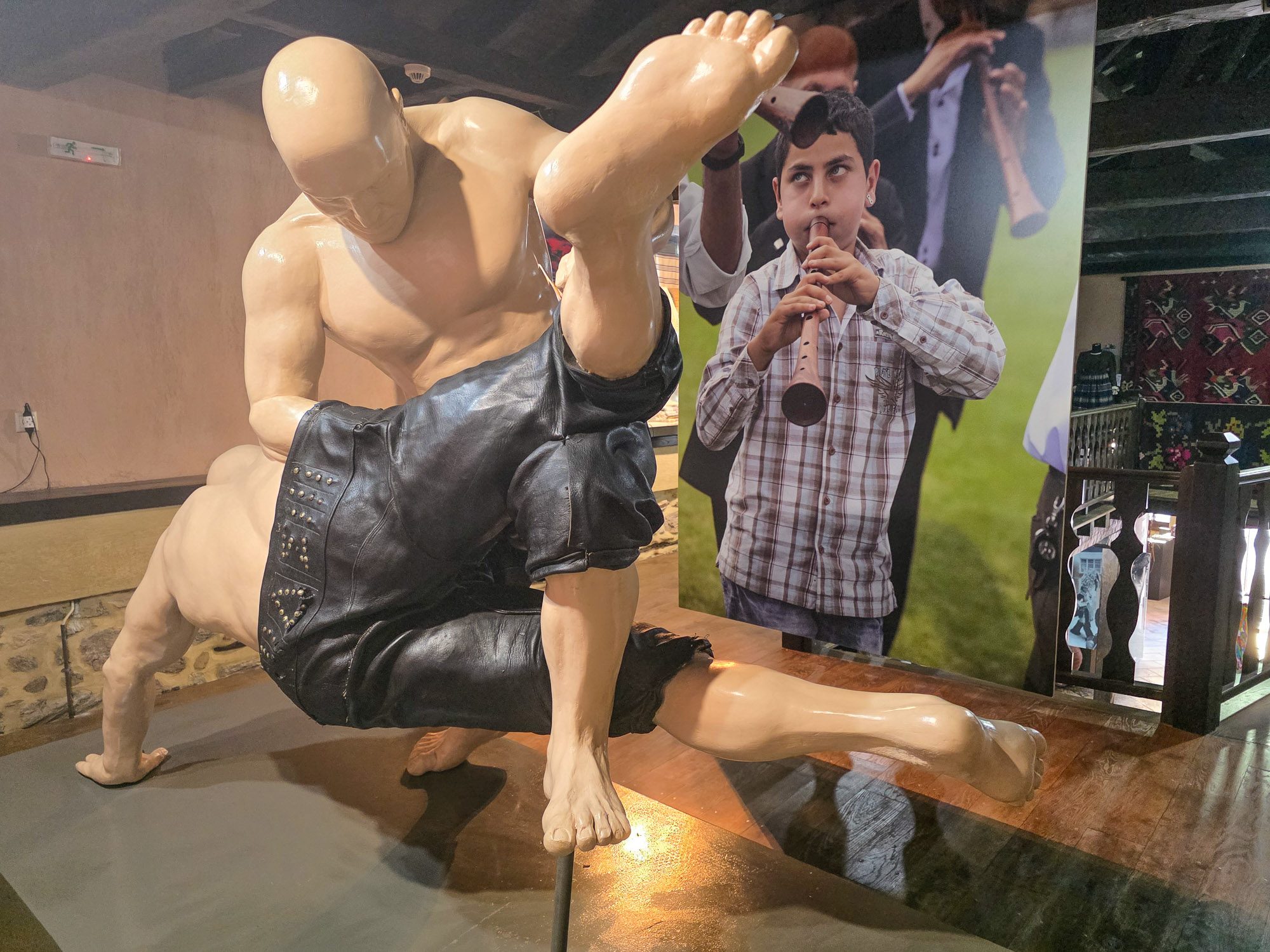
But there’s so much more to it than this and dare I say it – a little controversy about the origins of this unique and fascinating sport. Let’s begin as I try to unravel the many tangled threads.
Oily Origins
There has long been a debate over the origins of oil wrestling, with opinions often divided along national lines. Greeks and Turks alike have fiercely defended the sport as originating in their own country.
As is so often the case, history and life in general aren’t quite as black and white as that.
The origins of wrestling (with or without oil) itself are ancient, stretching back thousands of years across several civilisations. Wrestling existed long before national borders as we know them today, and the practice evolved differently as cultures interacted and influenced one another.
The Naked Truth
Evidence shows that wrestling was already an established event in the ancient Panhellenic Games. The earliest recorded Olympic Games date from 776 BC, with wrestling becoming an official event in 708 BC, but the sport itself is almost certainly far older than either date. One of the earliest surviving references appears in Homer’s Iliad, roughly contemporary with the Games’ founding, where the funeral games for Patroclus include a wrestling match between Ajax and Odysseus. Though not a historical record in the modern sense, the poem reflects traditions believed to stretch back to the Mycenaean period, centuries earlier still, suggesting wrestling was already deeply embedded in Greek society long before it became an organised Olympic discipline.
The Greeks called wrestling Pále (πάλη), a wrestler was a Palaistēs, and the schools where they trained were Palaestrae.
Olive oil played an important role in Greek athletic life. Wrestlers anointed themselves with it before training, partly to protect the skin, and we know just how important olive oil was throughout Greek history, not only in everyday life but also in religious ceremonies, medicine and ritual. Some references specifically describe the practice as “anointing,” which suggests a religious as much as a practical dimension. Olive oil occupied a sacred place in Greek society, associated with Athena, with purification, and with the Games themselves, held in honour of Zeus. So the act may have carried a ritual dedication as much as a physical one.
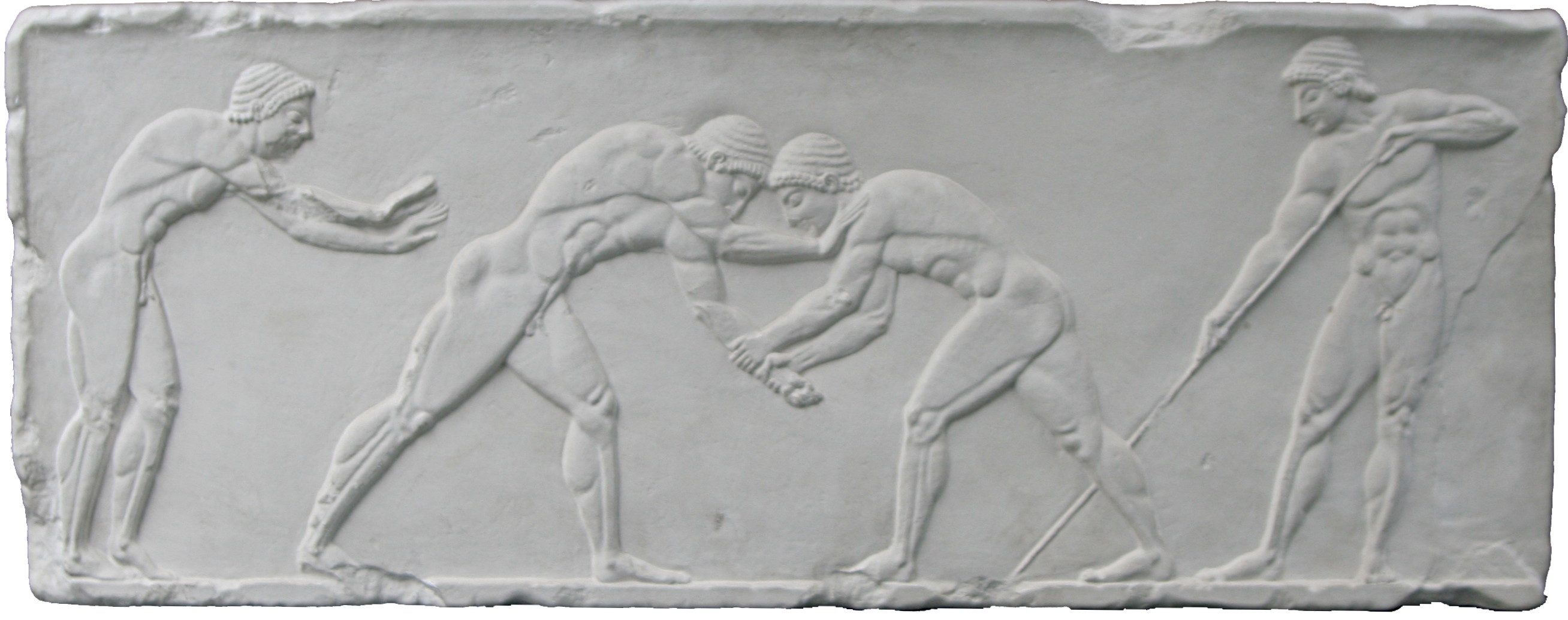
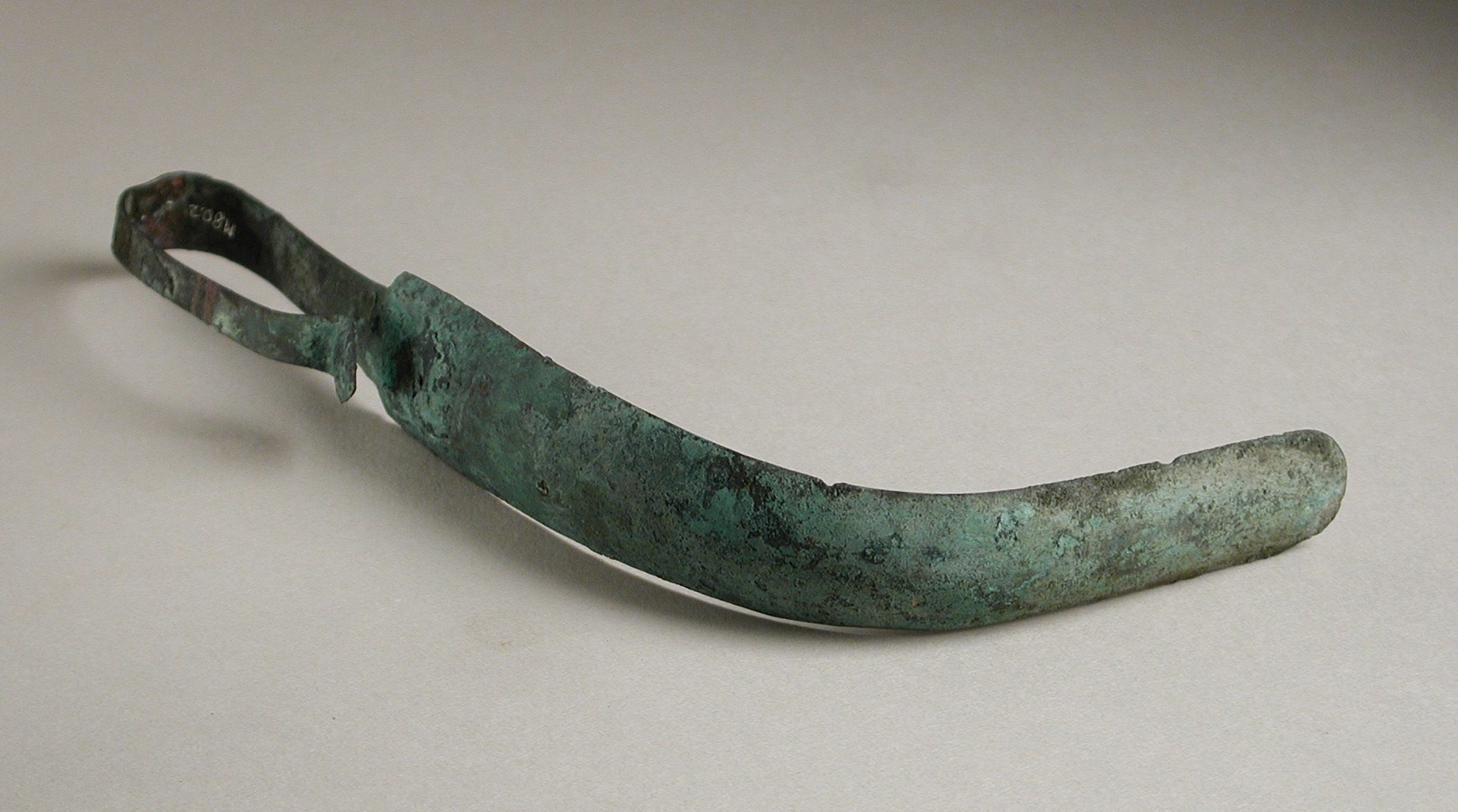
But here’s where it gets interesting. We know that Greek wrestlers grappled completely naked. However, One school of thought says that although oil was applied to the body before a contest, they also dusted themselves with sand or a fine powder, which absorbed the oil and created grip rather than removing it. After a contest, a tool called a ‘strigil’ was used to scrape off the oil, dirt and whatever else had been accumulated on the skin during the wrestling.
Another source (National Geographic) states Greek Olympic wrestlers competed oiled specifically “to enhance the challenge.”
You choose which version you prefer.
The scoring system was best-of-three-falls. A point was awarded for throwing an opponent onto their back, shoulder or hip, forcing them outside the wrestling area (skamma), or securing a submission, and because points decided things quickly, matches themselves tended to be short. Striking, biting, eye gouging and grabbing the genitals were all forbidden and punished by a referee who carried a whip.
Wrestling was considered the noblest of the ancient sports, the final and decisive event of the pentathlon, and its winner was the sole crowned champion of the whole Games.
It’s worth remembering, too, that this version of the story doesn’t simply continue in an unbroken line to today. The ancient Games, wrestling included, were banned outright in 393 AD by the Christian Roman Emperor Theodosius I, and nothing resembling them existed again for around 1,500 years, until the modern Olympics were revived in 1896. So even the Greek thread, ancient and well documented as it is, has a very long gap in the middle of it.
Belly to the Stars
Persia is where the trail often leads next, though not for the reason you’d expect. Some historians suggest wrestling dates back to the Persian era, with the earliest legendary references set as far back as 1065 BC, later recorded in Ferdowsi’s 11th-century epic, the Shahnameh (‘Book of Kings’). However, as far as I can see, there is no reference to oil usage in the sport at this time. What does connect Turkey, and later Greece, to this Persian thread is the use of the word Pehlivan, meaning “hero” or “champion,” Hellenised in Greek Macedonia and Western Thrace as pachlivanis.
And as if that doesn’t complicate things enough, the Egyptians also have to throw their hat into the ring.
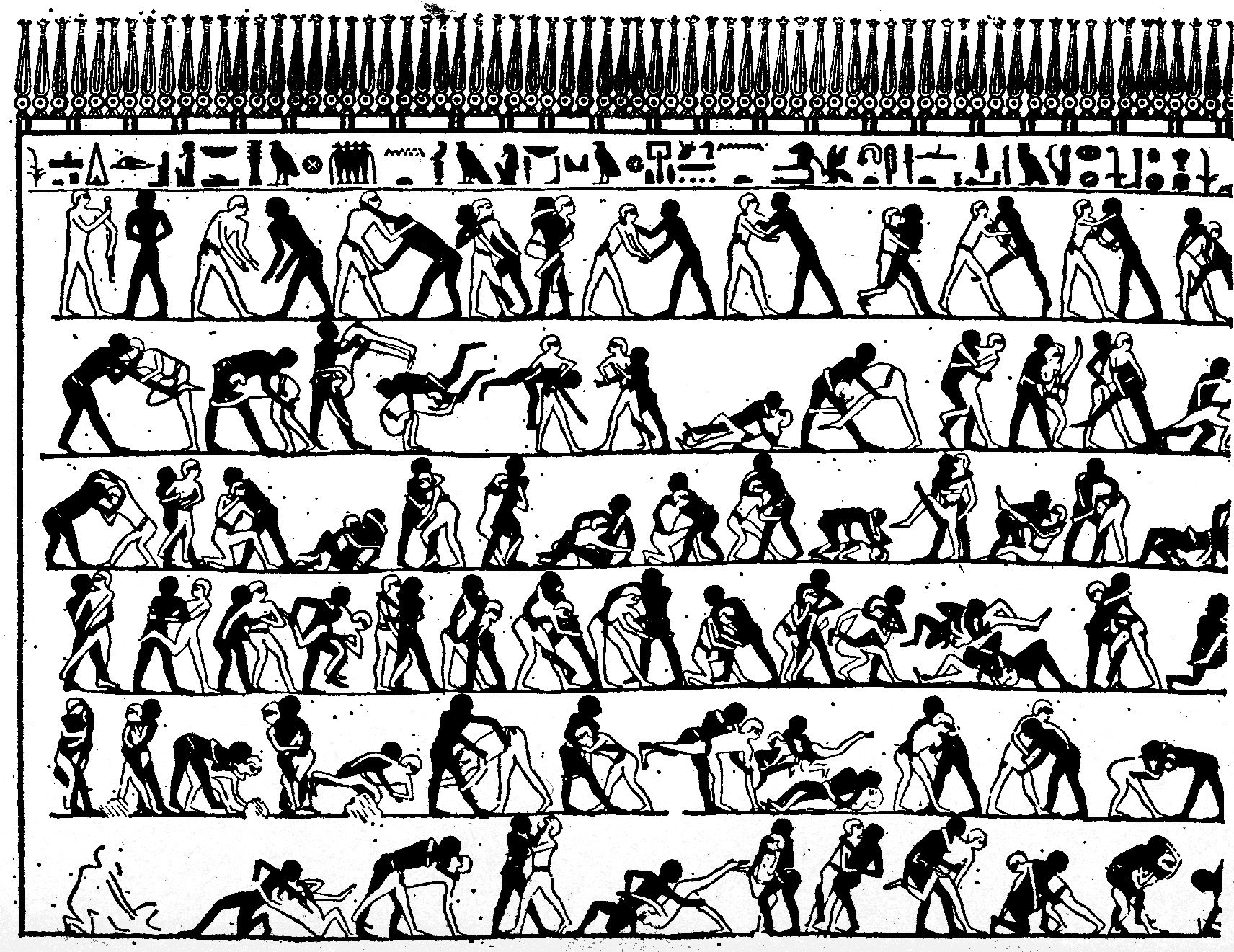
At one point during my investigation into the sport’s history, it took me all the way back to Egypt, around 2000 BCE, to the tomb of Khnumhotep II at Beni Hasan, where the walls show over 400 sequential wrestling positions, one of the earliest systematic records of grappling technique anywhere in the world. But oil? No. Not evidentially, anyway, which is a relief, because the last thing this particular debate needs is Egypt joining in as a third contender. My husband would happily make the case for Egypt being the “first” to do absolutely everything, given half a chance. His mother always insisted the Egyptians invented moussaka. But let’s not get into that one!
So, picking the trail back up in ancient Persia, we know that the ancient kingdom of Macedon had centuries of contact with Persia, through war and eventual conquest under Alexander the Great, long before any Turkic people had reached Anatolia at all. Whether that early contact is where the Macedonians picked up wrestling (oiled or not), or whether it even existed there yet to be picked up, is another question altogether. The borders of that world, in any case, looked nothing like the ones we know today.
The Turkish side of this story begins with the Seljuks, and later the Ottomans. The Seljuk Turks carried their own wrestling style, Karakucak Güreşi, westward out of Central Asia through Persian lands into Anatolia from the eleventh century, already using the Persian terms pehlivan as previously mentioned. By the time they reached Anatolia, they were already wrestlers, shaped by everything the journey had passed through.
The oiled version comes later, with the Ottomans, who, as the founding legend goes, adopted and developed it into their national sport during Sultan Orhan Gazi’s campaigns into Thrace. The story goes that in 1346, Orhan Gazi’s brother, Süleyman Pasha, led forty warriors into Thrace, two of whom wrestled so evenly matched that neither could win, fighting until both died of exhaustion. They were buried where they fell, at a place afterwards called Kırkpınar, “the forty springs,” and the tournament held there in their memory is considered today as the oldest continuously run sporting competition in the world.
It’s a great story. Whether it’s that simple is another matter. At least one academic study of the tournament argues its modern, continuous form likely only dates to the late 1800s, with the 1346 legend attached decades later, once the newly founded Turkish Republic had reason to want a long, unbroken sporting heritage of its own.
What we can establish is that oil, used as a medium to make gripping as difficult as possible, is here. The handmade leather trousers called kispet (kiouspetia in Greek), worn barefoot and bare-chested, are here, traditionally made from calf, buffalo or goat leather and weighing around 10 kilograms.
The grappling technique of reaching inside the opponent’s kispet/kiouspetia waistband or trouser leg to grab the leather itself, a move known as paça kazık, is here.
The deciding move, ending it by getting the opponent onto their back, known as “showing his belly to the stars,” is here.
Whatever side of the story you wish to err on, it’s fair to say that the version practised today, resembles the one that evolved out of the Seljuk-to-Ottoman line, which is just as well. It’s hard to imagine the original naked, sand-covered version making its way into part of a religious festival such as the Panigiri of the Holy 12 Apostles.
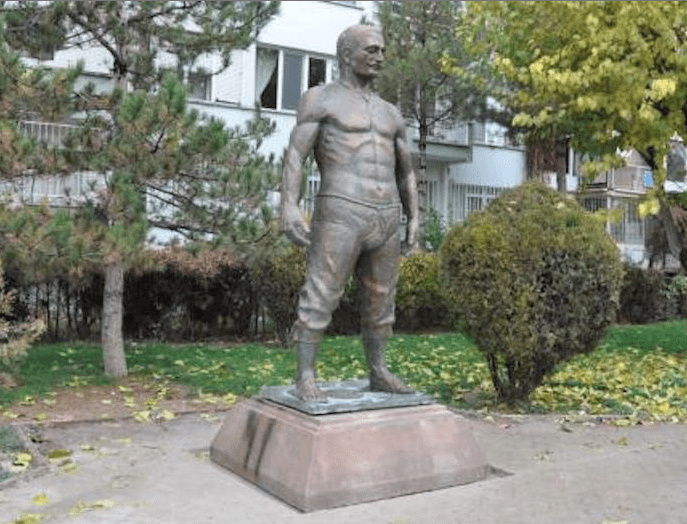
None of the oil wrestling history we’ve discussed unfolded in isolation. What we now call mainland Greece spent close to four hundred years under Ottoman rule, from the fall of Constantinople in 1453 until Greek independence in the 1820s. For all that time, Greeks and Turks lived side by side, trading, farming, worshipping, marrying, and almost certainly wrestling together, long before either country existed in the form we’d recognise today.
That entanglement didn’t end with independence, either. The 1923 population exchange forced well over a million ethnic Greeks out of Asia Minor and into Greece, and around half a million ethnic Turks the other way, out of Greece and into Turkey, uprooting entire communities on both sides that had lived alongside each other for centuries. Neither group arrived empty-handed. They brought dialects, customs, food, and very likely wrestling traditions of their own, shaped by exactly the kind of shared history this whole debate keeps trying to untangle.
Whether my account is absolutely accurate or not, the sense I get is that the Turkish claim to this sport rests on the same kind of foundation as the Greek one. Not an unbroken line back to antiquity, but a specific, later moment when a people decided this sport was theirs.
Both have tangible ties to this ancient sport, taking its influences through the exchange of cultures across Persia, Macedonia, Greece and Anatolia. Somehow those different strands of oil wrestling history found their way back together into modern day Greek, Turkish and also Balkan sporting practices, where it is proudly celebrated.
And oil, as it turns out, wasn’t just a way of complicating one sport. It became a way of complicating several.
As an aside, this bit of exploration into the history of oil wrestling reminded me of an event I saw in Dalyan back in 2016.
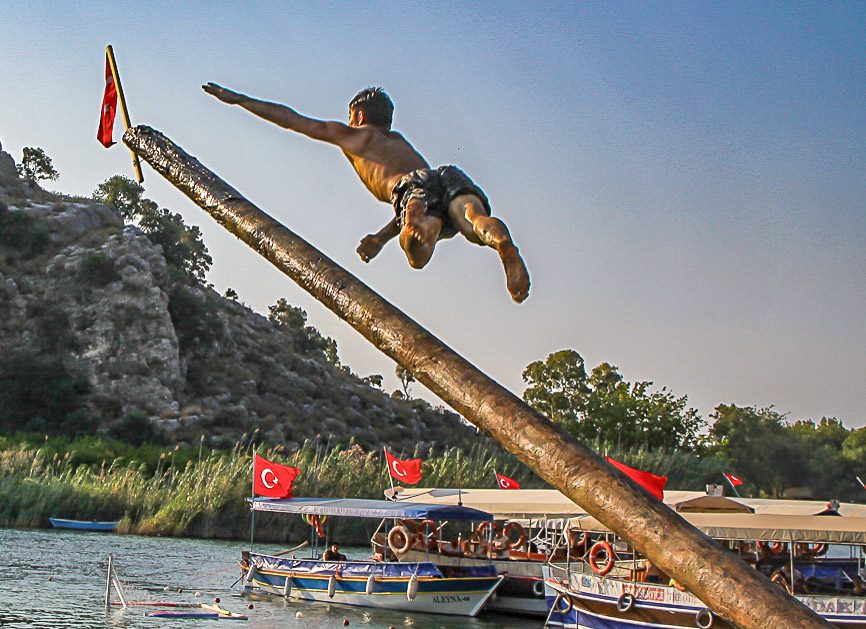
Yağlı Direk, literally “oily pole.” It’s a cornerstone event of Maritime and Cabotage Day, celebrated across Turkey every 1st of July to commemorate a 1926 law that returned maritime sovereignty and shipping rights in Turkish waters to Turkish sailors.
A long wooden mast is rigged out horizontally from a harbour pier or boat, thickly coated in oil and grease from end to end, and competitors take turns sprinting, shuffling and sometimes flying along it, trying to reach the tip and grab a flag before losing their footing.
Although on the face of it, it sometimes looked quite comedic, in reality, it’s a true test of balance, footwork and core strength. Which, of course, are just some of the key attributes required for oil wrestling.
And that brings us back to Sochos, the biggest oil wrestling competition in Greece, and among the largest anywhere in the Balkans.
In the next post, the Sochos Panigiri of the Apostles gets underway.
Discover more from
Subscribe to get the latest posts sent to your email.
MY BIG FAT GREEK TRAVEL SURVEY
How do you really plan your Greek adventures? I'd love to hear from you.
TAKE THE SURVEY →


How fascinating and so well researched and written. I greatly enjoyed that 💙🇬🇷
Thank you Barbara. Greece has more hidden layers to last a lifetime! ❤️