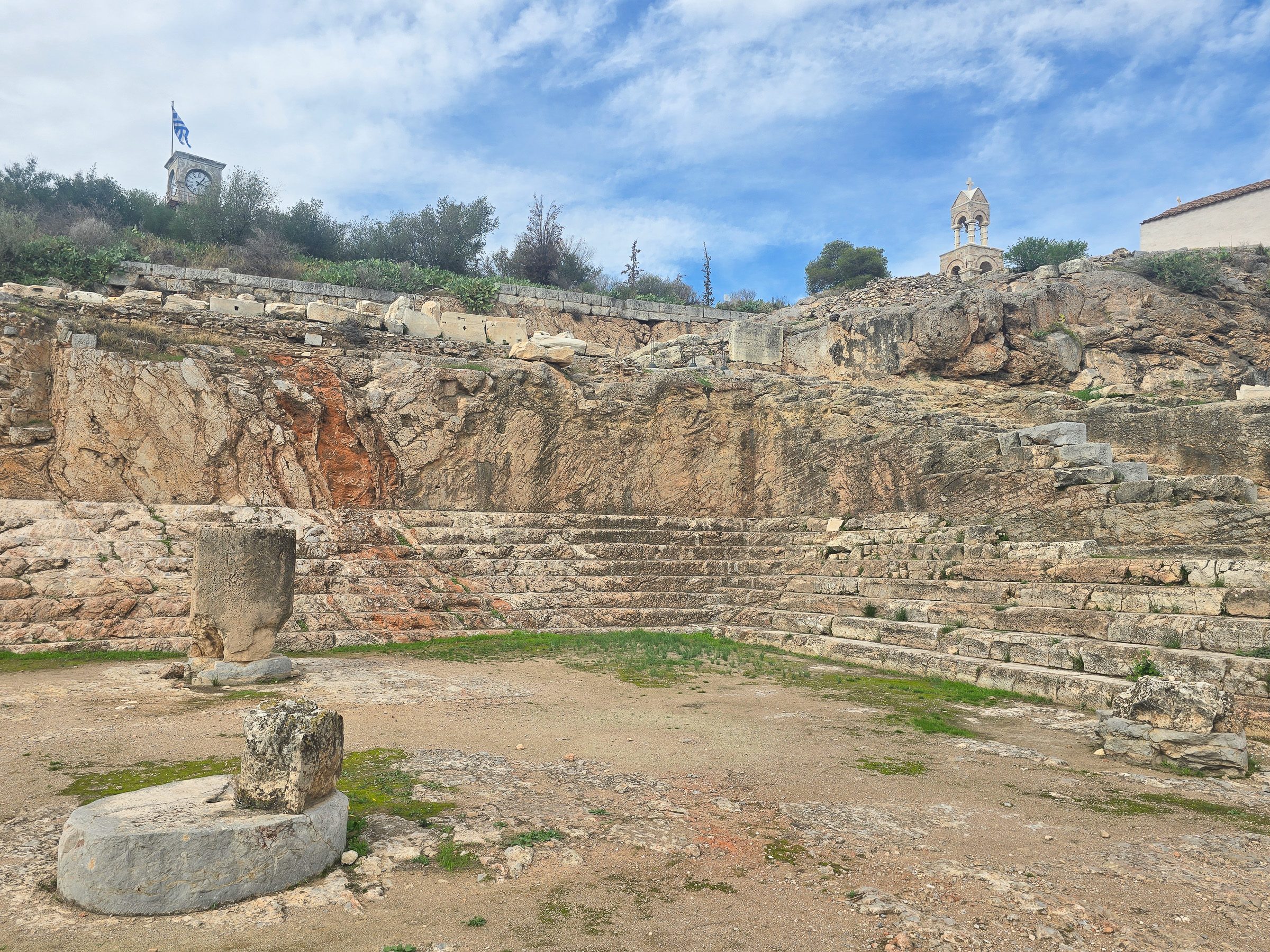
The Mysteries: What Happens in Eleusis, Stays in Eleusis
Eleusis sits about 21 kilometres west of Athens, close enough for a day trip and easy enough to overlook. Most people do. But for nearly two thousand years, this was the most sacred site in the ancient Greek world — home to a set of secret religious rites that promised initiates something no other cult dared offer: a better outcome after death. Nobody who took part ever revealed what happened inside. This post is an attempt to piece together what we think we know, and what it felt like to stand there.
The Archaeological site of Eleusis had been on my bucket list for a while — and the Eleusinian Mysteries were the reason why. Actually, I’d wanted to combine it with the Kerameikos Archaeological Site, but the latter had been closed for renovations since my last visit to Athens. Eleusis and Kerameikos are two separate and yet connected places. Ever since my stay on Samothrace a few years ago, I have become intrigued with the cult-like Mysteries. There’s something fascinating about the secrets and rituals only known to the initiates that makes a curious person like me want to know more. It’s the stuff that sets the imagination on fire.
According to Homer, the underworld of Hades was not somewhere you would be in any hurry to end up. A cold and shadowy existence where the dead drifted without memory or sense of self. Not exactly a compelling afterlife.
And yet, by the seventh and sixth centuries BC, something began to shift. Several mystery cults emerged that offered a different outcome. Not public rituals tied to the city, but something more personal. Initiation was a choice, and those who chose to take part were promised something better on the other side.
The best account of how this all began comes from the Hymn to Demeter, written sometime in the late seventh century BC by someone who sounded like they had insider knowledge. Although attributed to Homer, in truth, nobody knows who the writer was. The message, though, was clear enough. Those who had seen the mysteries would fare better after death. Those who hadn’t would not.
It all begins, as these things tend to, with a story. A myth. A legend, if you will.
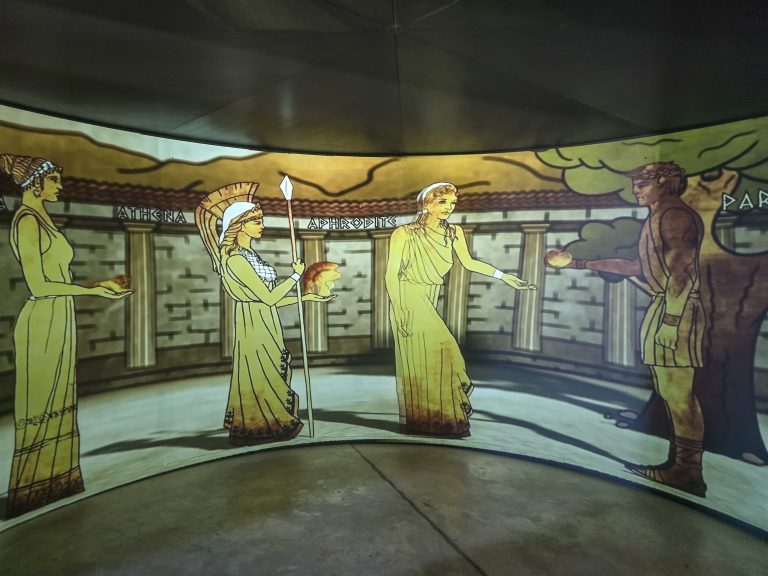
Kore, daughter of Zeus and Demeter, was out in a meadow one day with her companions, the water nymphs. Distracted by a narcissus flower, she bent to pick it. As she did, the ground split open and Hades, God of the underworld, appeared, chariot and all. Neither Demeter nor the innocent Kore knew that her father, Zeus, had struck up an arrangement with Hades and agreed that he could take her as his wife. Poor Kore was carried off into the underworld. From that moment on, she was no longer just Kore, but Persephone.
No one had heard her cries. Apart from Hecate, a quiet witness somewhere in a cave, and Helios (the sun), who seems to have had a good vantage point but little inclination to intervene.
Demeter, devastated by the loss of her beloved daughter, came down to earth to search for her but to no avail. Nine days and nights passed with Hecate, trying to piece together what she’d witnessed. The sun tried to help too. No food, no rest, just wandering as any devastated mother would. Then Helios spilt the beans, letting her know that Zeus had approved the arrangement behind her back. Overcome with grief, Demeter withdrew from Olympus and began to wander amongst the mortals disguised as an old woman.
She found herself in the fertile Thriasian plains of Eleusis, a place very much connected to her as the Goddess of agriculture, grain and fertility on earth. One day, whilst crying next to a well, she was found by the daughters of the local king. They offered her a drink of kykeon, a mixture of water, barley and spearmint. In return, Demeter wanted to repay their kindness by granting immortality to the king’s son. The ritual began by holding the prince over a fire. Maybe a tad too risky for the humans. The queen intervened before the process could be completed, at which point Demeter dropped the disguise and made her position clear.
“Build me a temple”, she demanded. “And until further notice, nothing grows”.
The earth turned brown as crops began to fail. Because the humans couldn’t grow food, sacrifices to the gods stopped, and suddenly, the whole divine system had a problem. Zeus eventually relented and ordered Persephone’s return. Hades, of course, had to comply – Zeus being the boss God and all that, but he had one trick up his sleeve. Before Persephone departed to be reunited with her beloved mother, Hades ensured she had eaten a pomegranate seed. Myth says that if you eat anything from the underworld, you will forever be bound to it.
So Demeter held the world to ransom whilst Hades held a spell-like grip on Persephone too. The only way out of the stalemate was to reach a compromise. The resolution was that Persephone would spend part of the year below in the underworld, and part above on earth with Demeter.
Demeter relented. The land began to bear fruit again, and nowhere more so than across the agricultural land surrounding Eleusis. This was her domain in every sense. But the arrangement came at a cost. Each year, when Persephone returned to the underworld, Demeter’s absence would be felt once more, and the land would follow her lead. What had begun as a personal grief became something far broader, written into the rhythm of the seasons themselves.
Before leaving Eleusis to return to Olympus, Demeter left something behind. Not just the return of the harvest, but a set of rites. The Mysteries.
Rooted in what had taken place on the Thriasian plain, they reflected that same cycle of loss and return. Just as the seed disappears into the earth only to rise again, so too did the initiates come to believe that death was not simply an end. The rites themselves were never written down, and those who experienced them were not inclined to explain. But the promise was clear enough. Those who had seen them would not face the darkness in quite the same way.
For all its myth and symbolism, Eleusis was not just the setting for a story. It became something far more structured. What began as a local cult tied to Demeter and Kore developed into one of the most important religious centres in the Greek world. The Athenians were quick to recognise its significance, claiming the Mysteries as their own and investing in the sanctuary with a series of monumental buildings. In doing so, they bound Eleusis to the city, not just spiritually but politically.
Over time, the reach of the Mysteries extended well beyond Attica. Initiates travelled from across Greece and later the Roman world to take part, drawn by the same promise that had taken root on the Thriasian plain centuries earlier. The sanctuary evolved alongside this growing influence, expanding and adapting while retaining its core purpose. By the second century AD, emperors themselves were being initiated and leaving their mark on the site, turning Eleusis into a place of both religious and imperial significance.
As the rituals evolved, it expanded beyond the bounds of Eleusis – a procession or a pilgrimage, if you like, that would begin in Athens and unfold along a route known as the Sacred Way. A journey of around 21 kilometres that connected the civic heart of the city with its western edge.
The festival would take place every year during early autumn, just as the land was being prepared for sowing. It would take nine days, mirroring the nine days Demeter searched for Persephone. The soon-to-be initiated passed through a carefully ordered sequence of rituals, beginning in Athens and unfolding step by step along the Sacred Way to Eleusis.
The Prelude
Before the initiates gathered, a set of sacred objects was taken from Eleusis to a small sanctuary on the slopes of the Acropolis called the Eleusinion. Here they would be stored and protected over the days leading up to the journey of worshipers from Athens to Eleusis, where the sacred items would be returned.
Day 1 – The Gathering
The festival began in Athens. Those intending to be initiated gathered and registered their intent. This wasn’t something you stumbled into. It was a conscious decision to take part.
Day 2 – Purification
Initiates made their way to the Phaleron Bay for ritual cleansing. A practical act on the surface, but also a symbolic one. You don’t enter something like this without first being washed of whatever you arrived with. Some pig sacrifices took place – closely associated with Demeter.
Day 3 – Offerings and Preparation
The participants began the Epidauria, a festival for Asklepios, celebrating the healer’s arrival at Athens with his daughter Hygieia. This consisted of a procession leading to the Eleusinion, where sacrifices (more pigs) and an all-night feast took place. These were not grand public spectacles so much as necessary steps. The groundwork before anything meaningful could begin.
Day 4 – Sacred Objects in Place
The sacred objects were taken from the Eleusinion and carried down into the city along the Panathenaic Way to Kerameikos.
Day 5 – The Procession along the Sacred Way
This was the main event. A one-day journey of around 14 miles starting through the Sacred Gate at Kerameikos to Eleusis.
At the head of the procession was the statue of Iacchus, carried as a figure and called out by name, a presence that led the initiates along the Sacred Way. Behind came the priestesses carrying sacred objects in cistae, followed by the initiates themselves, wearing myrtle wreaths and swinging branches called bacchoi and carrying torches. Order was maintained by Athenian ephebes, young men tasked with keeping things under control – call it crowd control or a latter-day bouncer if you like.
From there, the journey unfolded in stages:
- Across the Athenian Cephissus
The procession crossed the river over a substantial bridge. Interestingly, sections of the Sacred Way have been uncovered near modern metro stations, showing layers of use built up over centuries. Worn surfaces, repaired tracks, the marks of wagon wheels still visible. - Through fields and sanctuaries
Stops were made along the route to rest and make offerings. This was not a march so much as a series of pauses. - At the pass of Mount Aigaleo
The route narrowed between the mountains, with a stop at a sanctuary of Apollo. Later, the Daphni Monastery was built on the same site, incorporating fragments of the ancient structure. Not all of it stayed put. Three of its columns were removed in the early 19th century and sent to England (that Lord Elgin bloke again). - At the Sanctuary of Aphrodite at Skaramanga
Offerings were left in rock-cut niches. Marble doves, and representations of female genitalia. - At the Reti lakes
Two brackish lakes, one associated with Demeter, the other with Persephone. Bridges allowed the procession to pass through what would otherwise have been difficult ground. - At the realm of Crocon
Here, one of the more unusual rituals took place. Initiates had a yellow wool thread tied to their right hand and left foot. A small act, but deliberate. Presumably a form of protection. - At the river crossings
Somewhere along the route, likely at one of the Cephissus bridges, another custom played out. Groups gathered and hurled insults at the initiates as they passed. Jeers, taunts, nothing held back. This ritual abuse, called gephyrismos, may have served to humble the initiates before their encounter with the divine. - Across the Thriasian plain
The final stretch opened out into the fertile Thriasian plain. Land closely associated with Demeter and the cycles she governed.
By dusk, the procession reached Eleusis and gathered before the sanctuary.
Day 6 – Arrival and Initiation Begins
Outside the sanctuary, the initiates gathered near the Kallichorion well, where Demeter was said to have rested. Here, the first rituals began.
Day 7 – The Mysteries Themselves
What happened inside was never properly recorded. Those who took part did not speak of it. References remain to things done, things said, and things shown. That’s as far as it goes.
Day 8 – Plemokai
Libations were made for the dead and the underworld deities using special vessels. A quieter day, but no less important.
Day 9 – The Return
The initiates made their way home. No longer as a single procession, but in smaller, scattered groups. Whatever had taken place, it was now carried back with them.
So that’s all the (rather long-winded) context. Now into the sanctuary itself.
As with most archaeological sites, Eleusis does not represent a single period of time. Much of what is visible today, including the Roman triumphal arch, belongs to a later period when the sanctuary was expanded under imperial patronage.
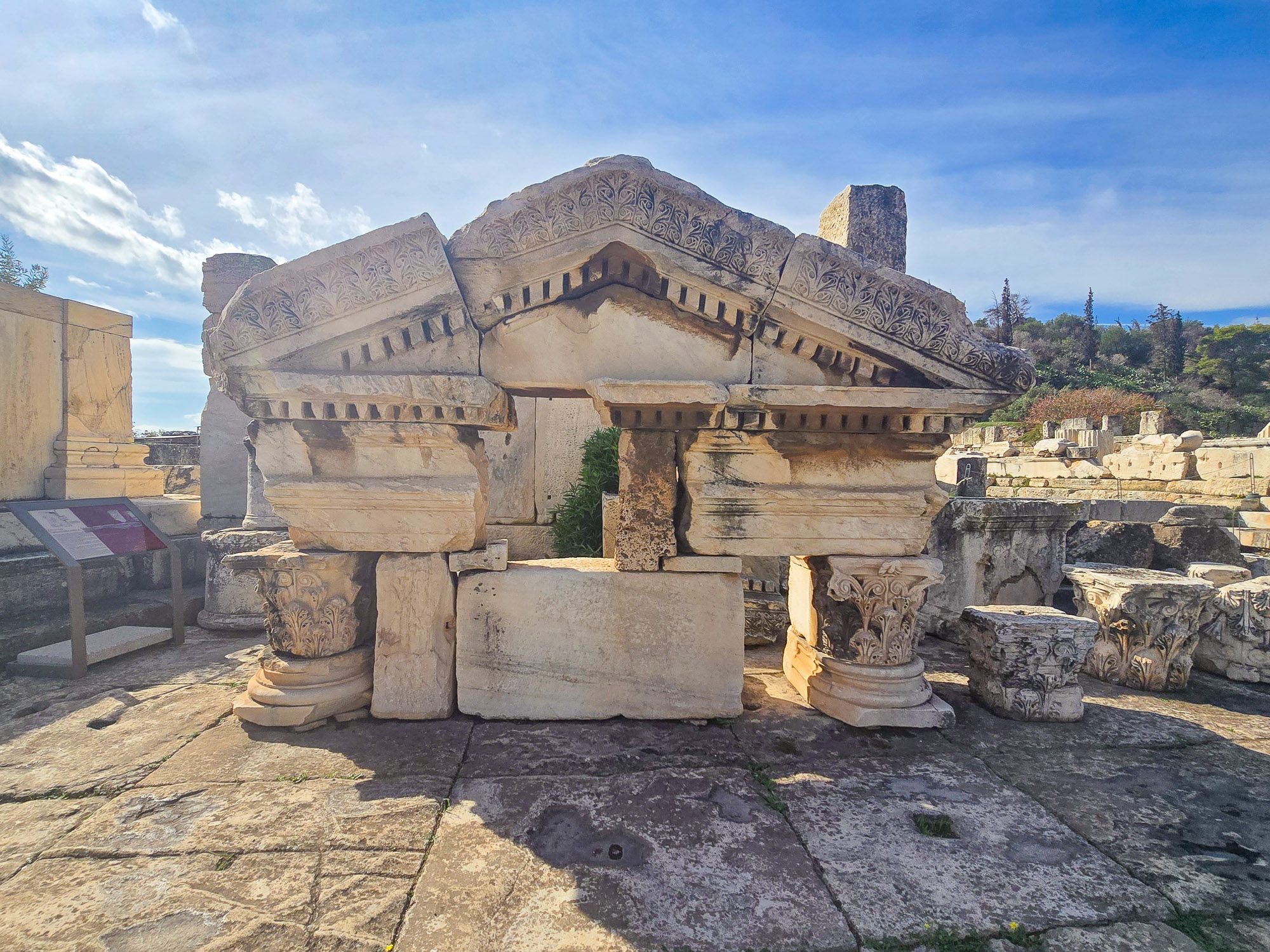
Initiates would have arrived at the outer walls of the sanctuary, many of them already fasting. This was a deliberate act of commemoration mirroring the nine days Demeter had wandered without food or rest in search of Persephone.
One of the first significant places included in the rituals was the Well of Kallichoron, also known as the Well of Fair Dances – the very place where Demeter was said to have rested during her search. Here, libations were made, and the women of Eleusis danced in her honour.
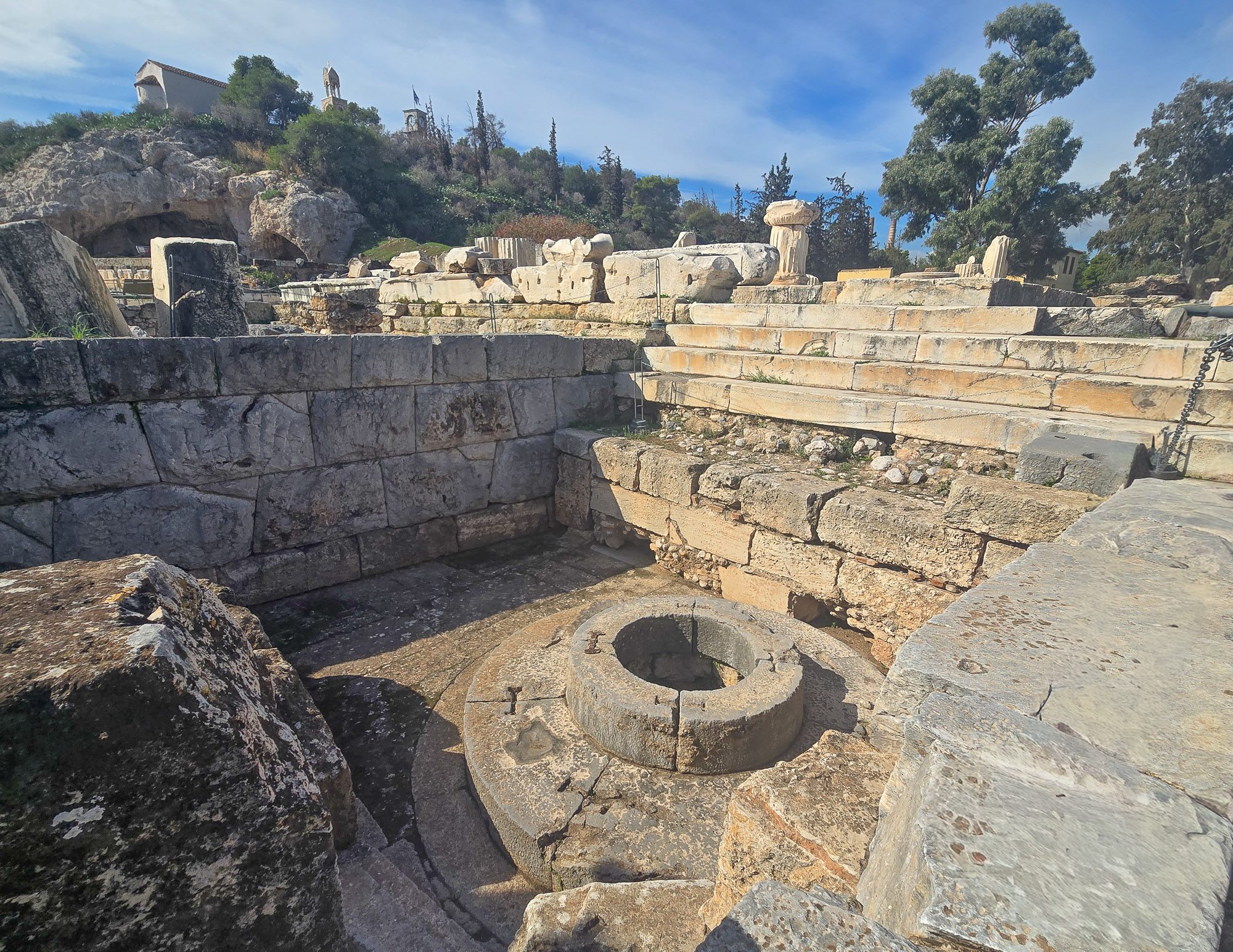
From there, they would have passed through the Greater and Lesser Propylaea of Eleusis, the main gateways into the sanctuary. These weren’t just thresholds but significant architectural structures, with columned façades and a presence that felt closer to a temple than a simple entrance.
The Greater Propylaea is the first real threshold. Structurally, it was modelled on the Acropolis gateway and was adorned with a medallion of the Roman emperor and philosopher Marcus Aurelius – a reminder of how far the Mysteries had travelled from their origins by the time the Romans arrived.
Here, the initiates broke their fast by drinking kykeon, the same barley water and mint drink that Demeter had been offered at the well. Some scholars argue that ergot, a fungus that grows on barley, may have been an active ingredient containing compounds related to LSD. This would have made the fasting initiates particularly susceptible to its effects. It remains unproven, but it is a plausible theory.
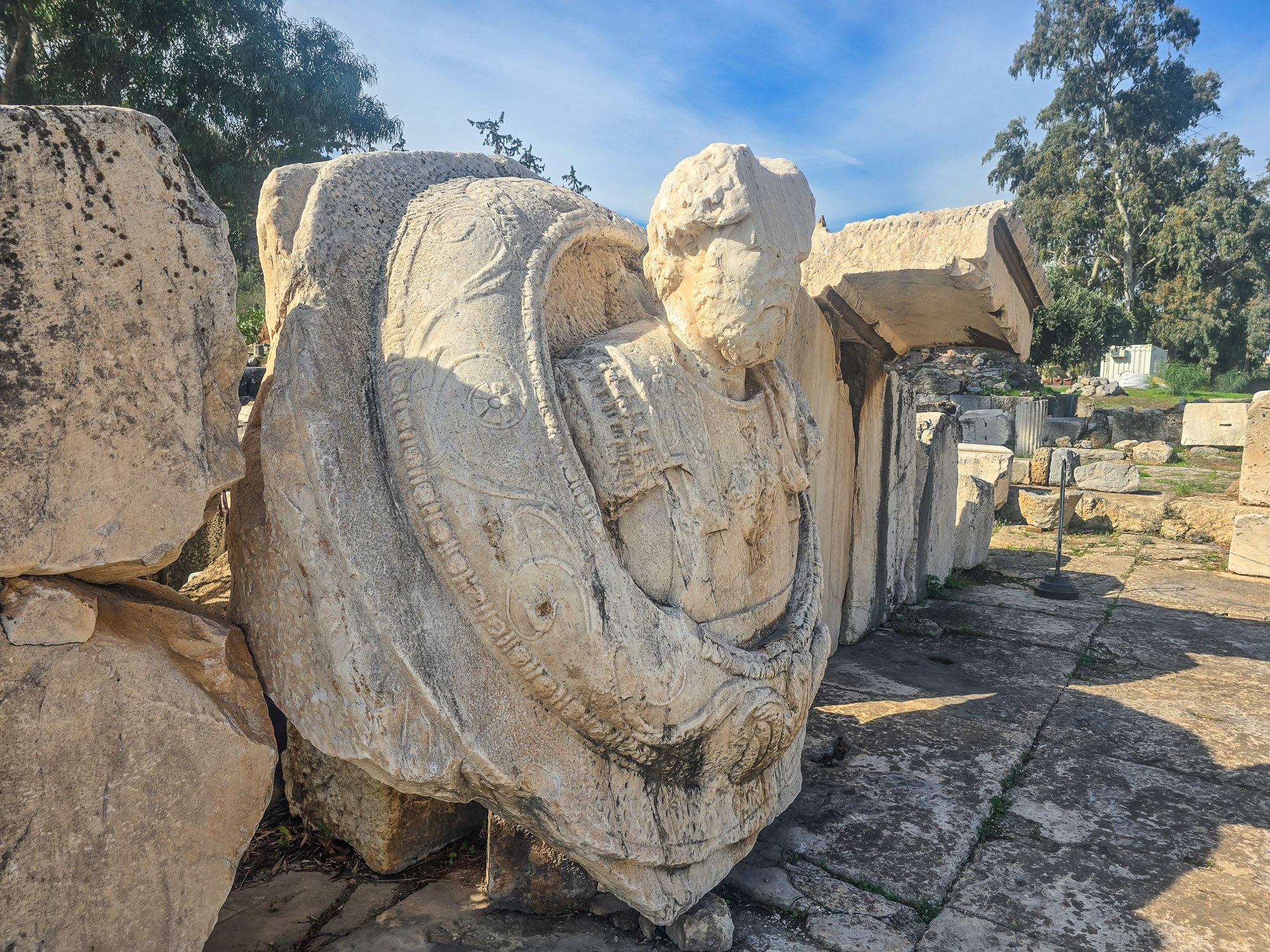
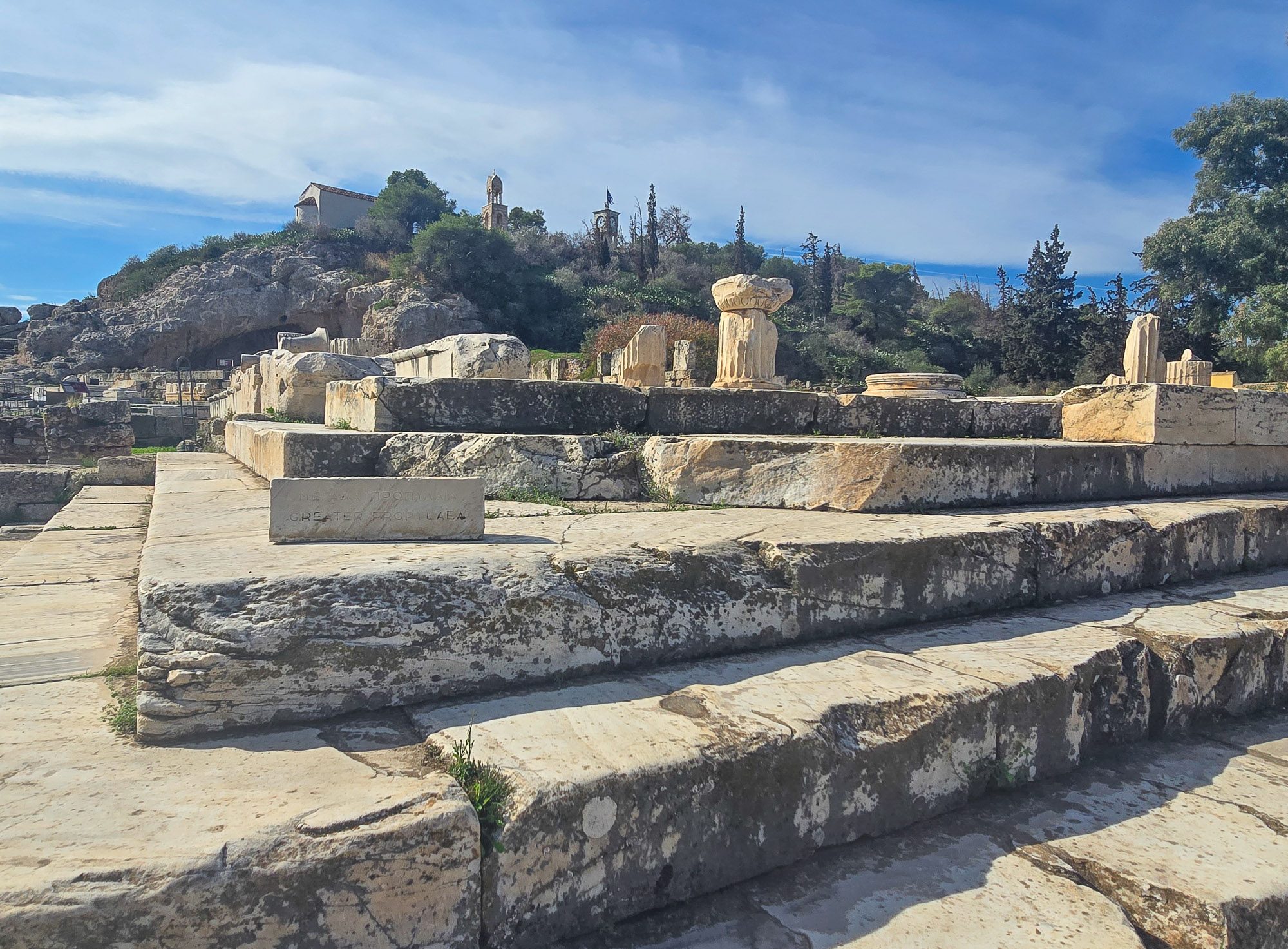
The next significant threshold was the Lesser Propylaea, bringing the initiates closer to the inner sanctuary, reinforcing that sense of transition. Each step taking them further from the ordinary world and deeper into something more contained.
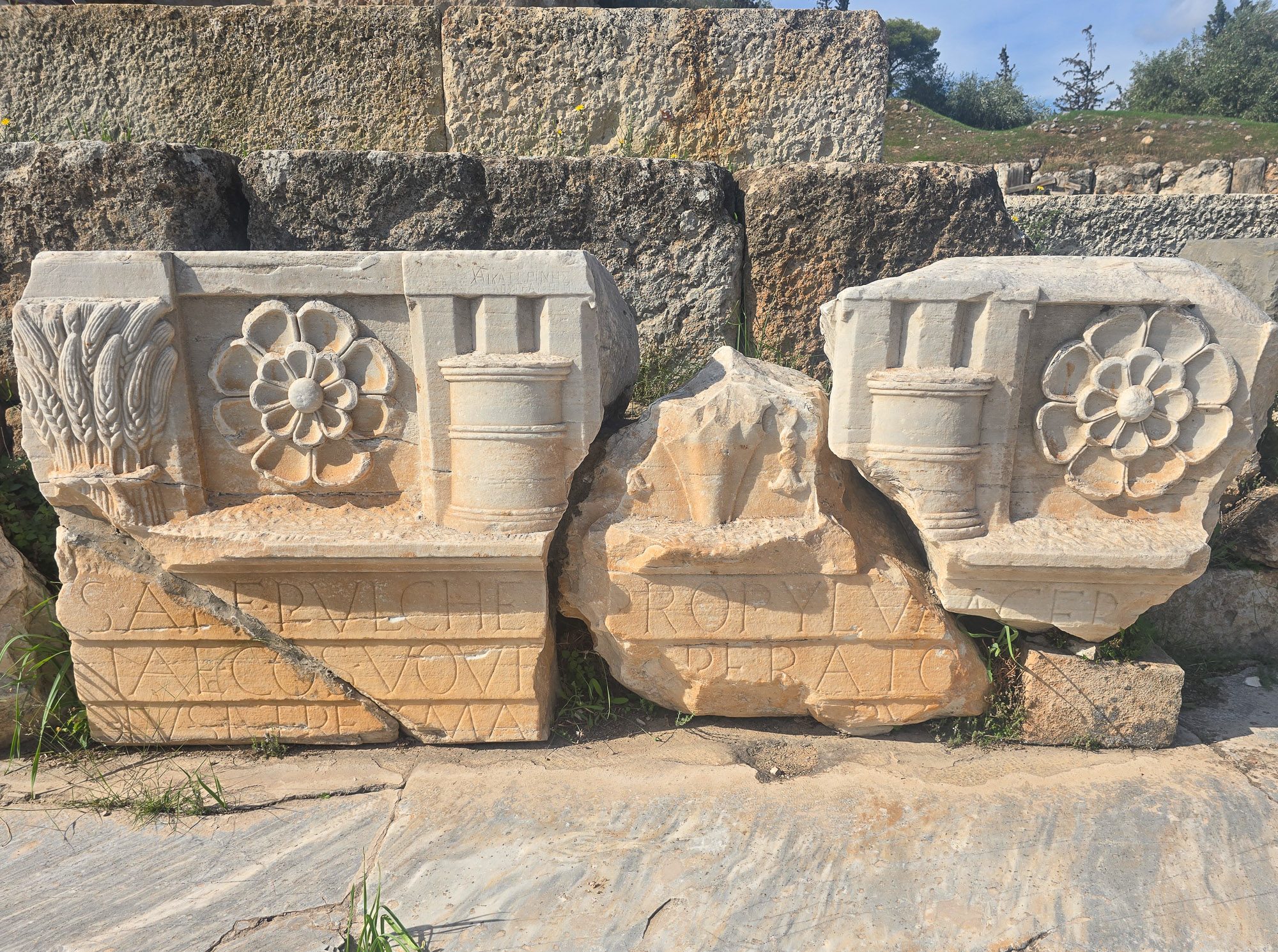
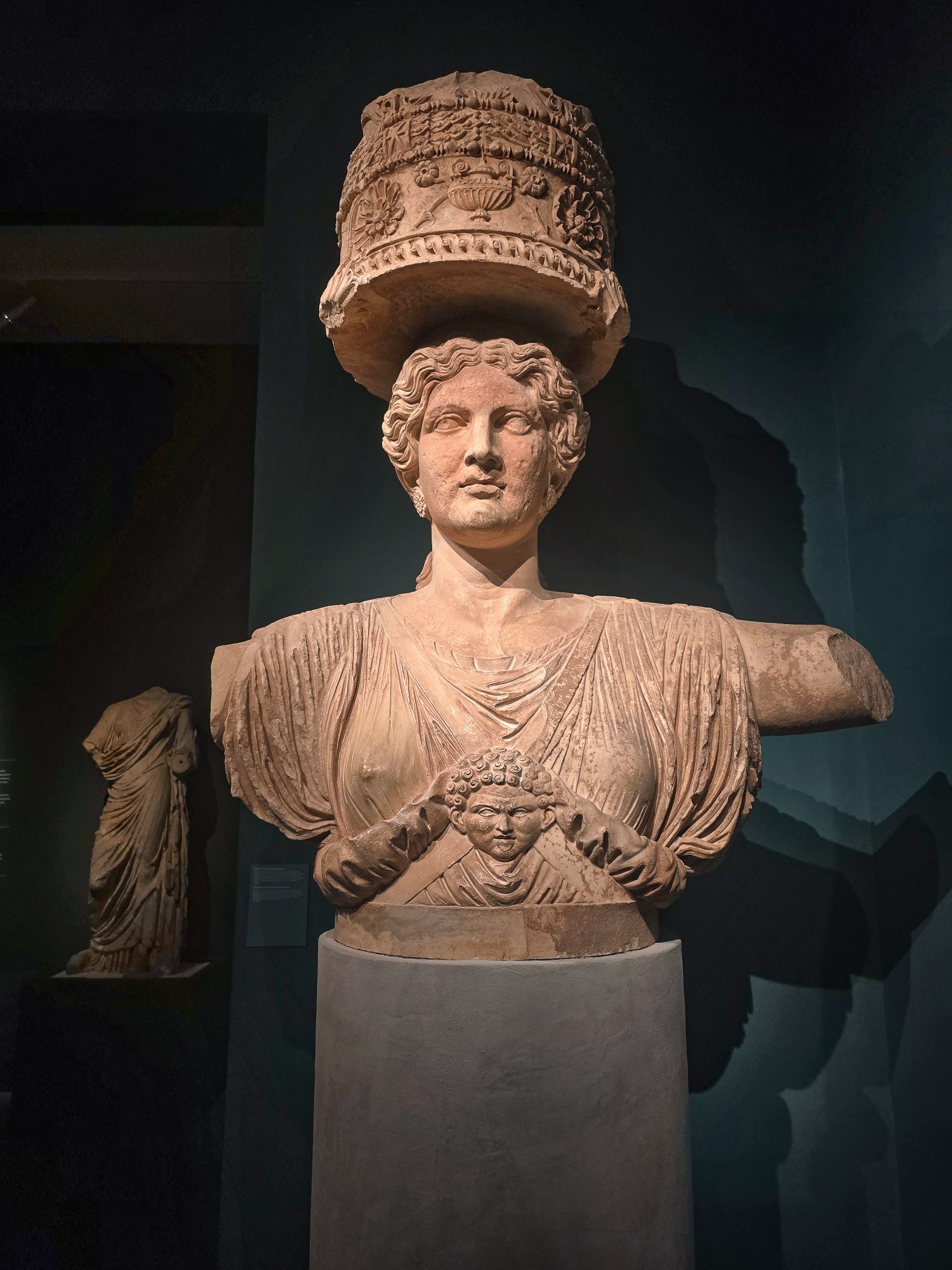
The frieze of the outer portico had been decorated with cult symbols of Demeter – sheaves of wheat and rosettes. The inner portico had two Caryatids, in place of two of the columns on part of the structure. These weren’t decorative extras. They carried weight, both structurally and symbolically, marking this as a space of importance rather than a simple passage.
Unfortunately, here is another example of artefact theft. Only one of those Caryatids remains in situ today, housed in the on-site Eleusis Museum. The other was removed in the early 19th century by Edward Daniel Clarke with permission from the Ottoman government at the time. It is now in the Fitzwilliam Museum in Cambridge.
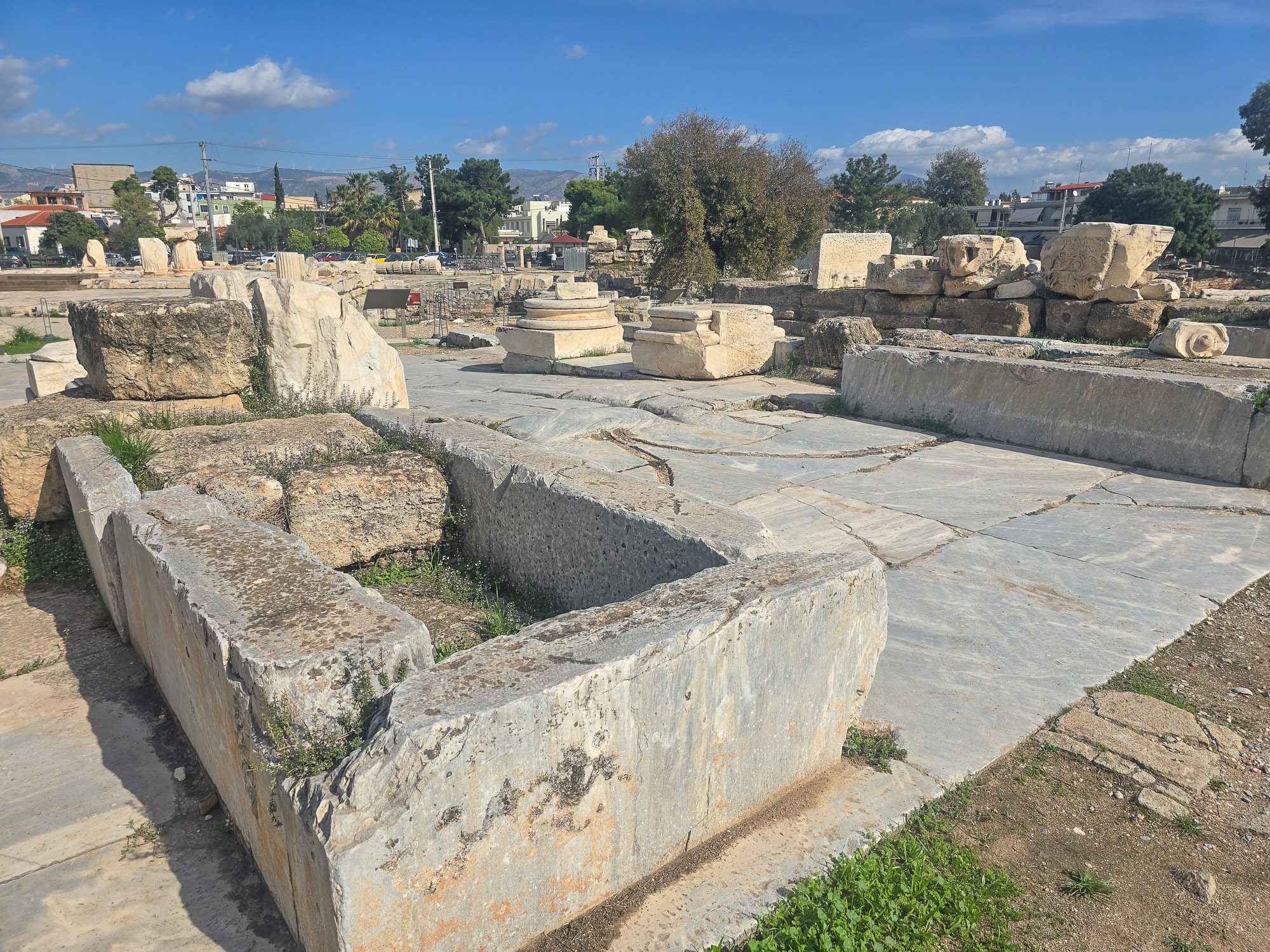
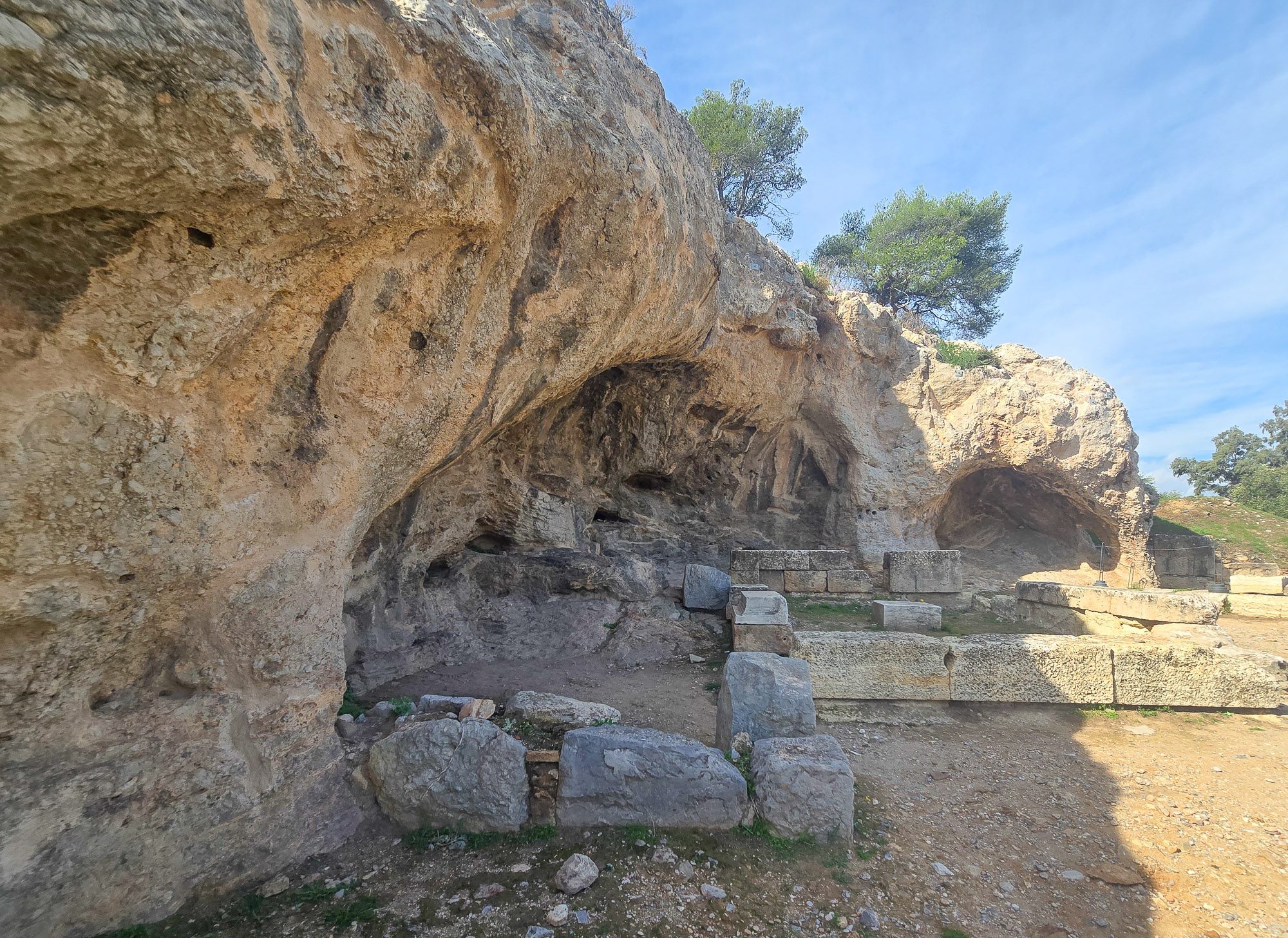
Beyond the Lesser Propylaea is the Ploutonion (Temple of Pluto), a cave-like cleft cut into the rock and associated with the place where Hades had abducted Persephone. It is not grand. Easy to miss, if anything. But symbolically, it places the initiates at the edge of the underworld before they have even stepped inside.
It is believed that high drama was part of the ‘show’ laid on for the initiates, often including re-enactments. Some theories say that a shaft or false well extended down next to the cave, though there is no physical evidence of this. During such a re-enactment, a priestess playing the role of Persephone would emerge from it before the waiting initiates. This was more than just a commemoration. It was an immersive experience.
As I passed, I saw in one of the niches a pomegranate, sitting there intentionally. Somebody had come prepared.
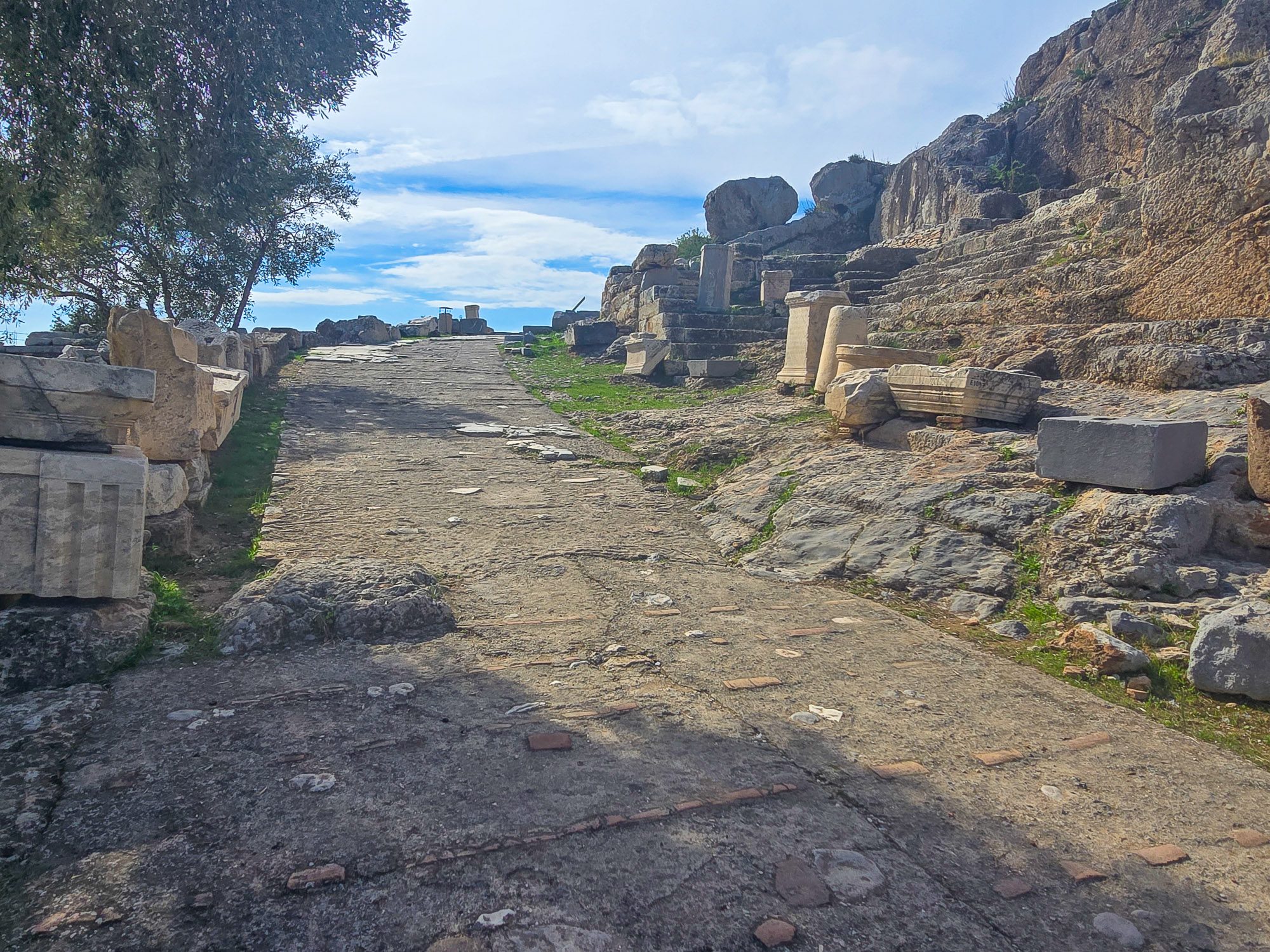
The path of the processional way begins to rise, giving a sense of heading towards something more elevated, both physically and otherwise.
Finally, the initiates were led to the Telesterion, the most important part of the sanctuary. By its final phase, it was a large, almost square structure, around 50 metres across, capable of holding thousands of initiates. It was an enclosed space, stepped on all sides, drawing everyone’s attention towards the centre. At its heart, the Anaktoron, a small enclosed chamber that housed the sacred objects of the Mysteries and was accessible only to the hierophant, the highest-ranking priest.
What actually happened inside remains unclear. Even famous writers and philosophers who were initiated — among them Sophocles, Pindar and Cicero — only ever hinted at transformation without revealing anything.
What we do know, however, is that the mysteries consisted of three main elements.
Dromena – things done. Possibly reenactments (often linked to the story of Demeter and Persephone)
Legomena – things said. Spoken words, sacred formulas, teachings, or explanations
Deiknumena – things shown. The revelation of sacred objects, likely by the hierophant, often described as a key moment
No written doctrine. No central text. Religion here was experienced, not explained. What mattered was the outcome. Those who took part believed they would face death differently.
What we can imagine is a whole range of tools working on the senses at once. Music, burning torches, dancing, chanting, the drinking of the kykeon. The revelation of sacred objects at carefully chosen moments. Darkness, then sudden light. The atmosphere inside the Telesterion was not incidental to what was being communicated — it was the message.
Because the culmination was not doctrine or explanation. It was an experience. Those who had sat in darkness, fasting and overwhelmed, were brought finally to something that felt like the opposite. Light, peace, and the promise that death was not the end. Although much of this is speculation, we can draw upon modern religious practices for context. The use of music, incense, darkness and light to heighten spiritual experience is not unique to ancient Greece. It is present in Orthodox Christian liturgy, in Catholic Mass, and in Jewish Passover ritual. The tools are different. The intention is not.
The Telesterion is roofless now, open to a bright October sky. Standing inside it on a warm late October afternoon, almost entirely alone, the first thing that struck me was the grid of column bases laid out across the floor. Unlike an amphitheatre or any other performance space, the columns would have broken the sightlines for most of the people inside. You could not have seen everything from where you sat. Which made me wonder whether that was rather the point. Partial views. Glimpses. Carefully controlled moments of revelation rather than a clear line of sight to whatever was happening.
For the most sacred space in the ancient Greek world, what remains of the Anaktoron is almost nothing. It’s as if the earth itself decided to finish the job the initiates had begun, swallowing up the last traces of whatever it was they had worked so hard to keep secret.
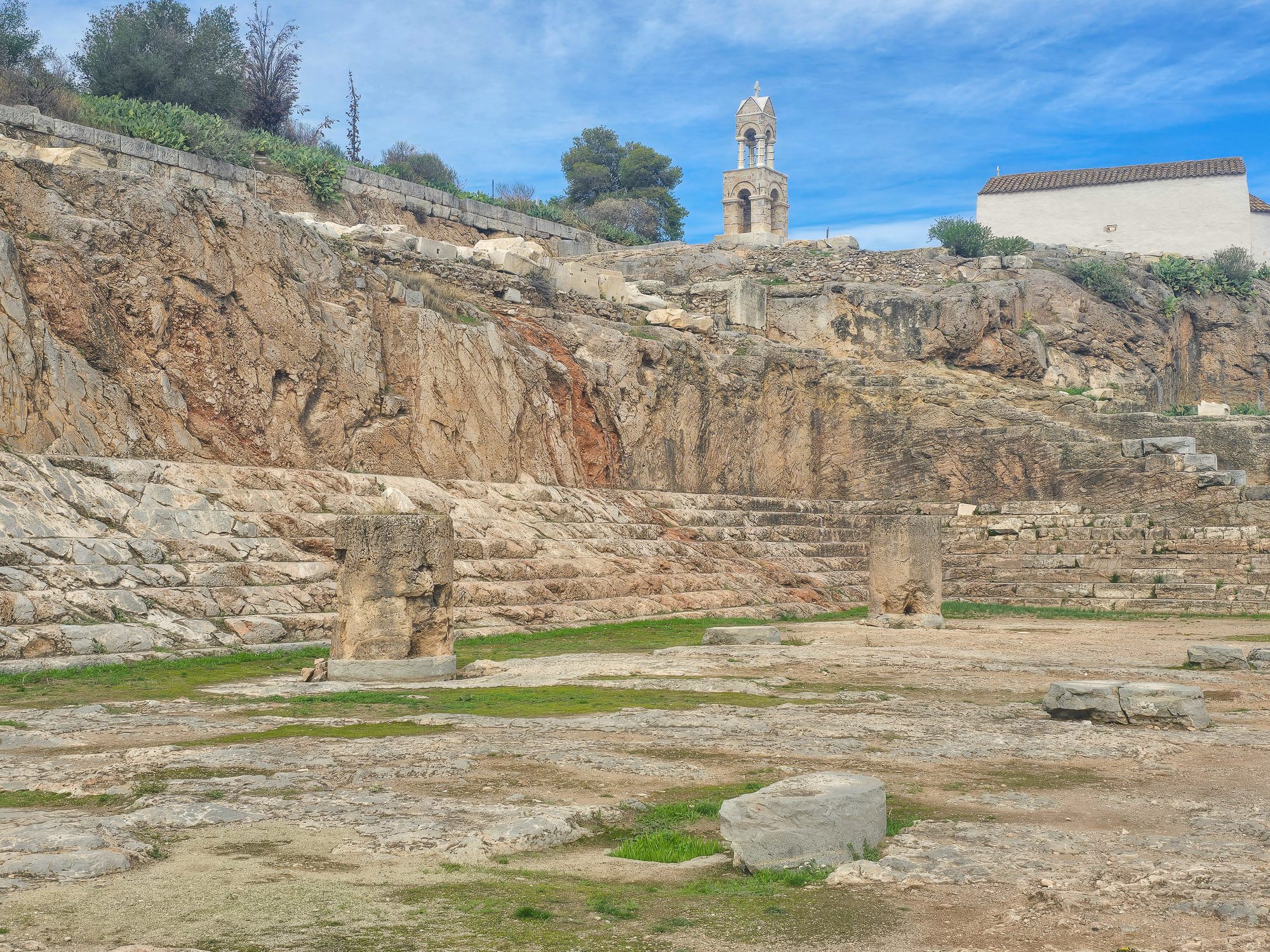
Over time, the sanctuary grew. What began as a local cult became something far more significant. The Athenians recognised its value early on, expanding the site and integrating it into their civic identity. By the Roman period, Eleusis had become a centre of international importance.
Emperors such as Hadrian and Antoninus Pius were all initiated into the mysteries. They left their mark in the form of buildings, infrastructure, and public works, some of which can still be seen today.
The cult endured for centuries, adapting as needed, until it didn’t. The rise of Christianity did not immediately end it, but it did set things in motion. By the late 4th century AD, under Theodosius I, the old practices and all forms of idolatry were formally suppressed. Not long after, the site was damaged during invasions, and the mysteries came to an abrupt end.
And yet, standing there now, it doesn’t feel like a place that has been completely silenced. The essence of the place was never in its objects alone.
It was in the experience. The journey. The shared understanding among those who chose to take part and then chose not to speak of it. Which, in a way, has done more to preserve its hold on the imagination than any written account ever could. Not just for the archaeological site itself, but for what it represented. This wasn’t just another set of ruins. This was a place built around an idea. One that promised something rather more ambitious than most ancient cults dared to offer.
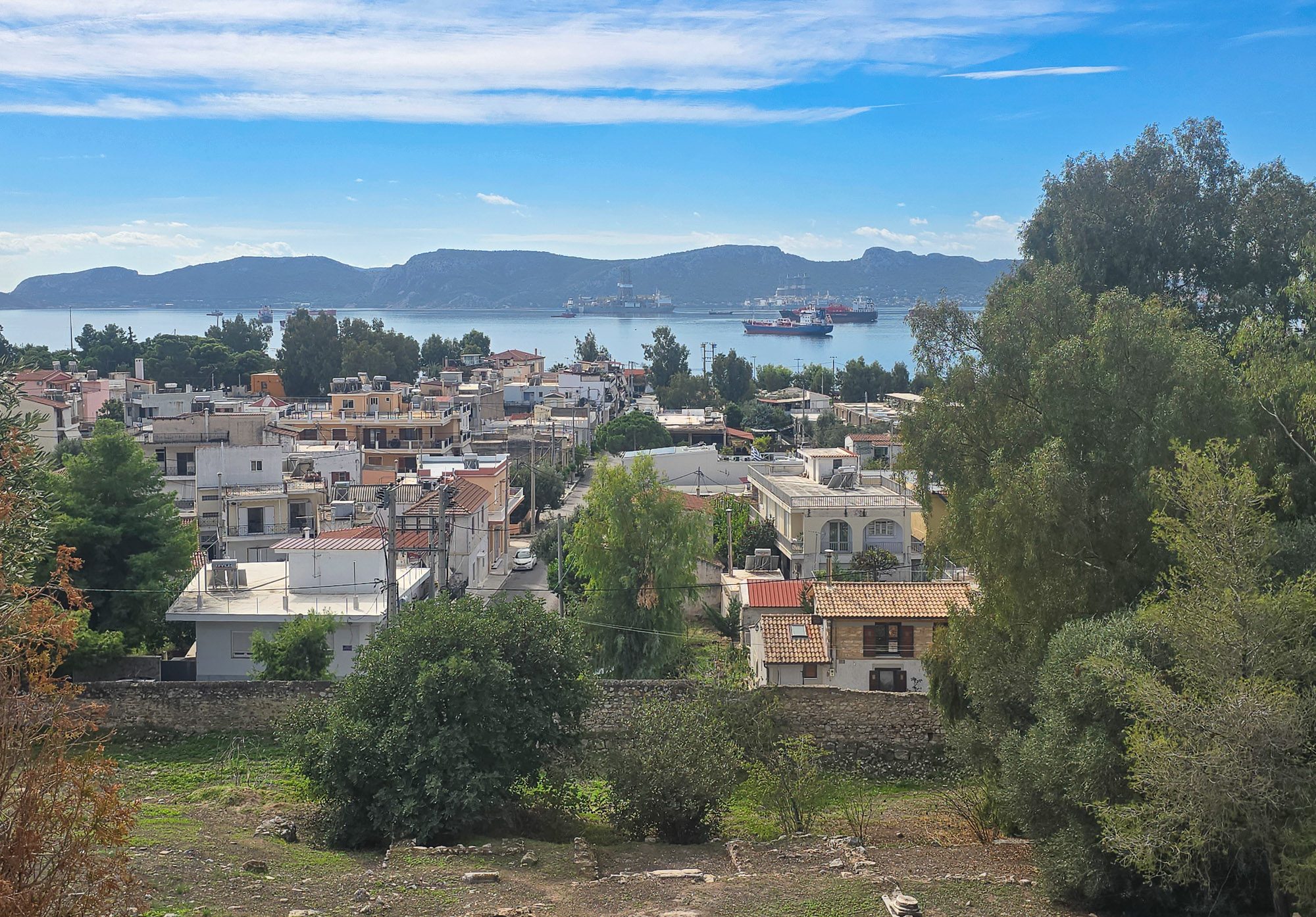
And just like that, as I reached the outer walls of the sanctuary, I was pulled back to reality as I looked out across the Gulf of Elefsina towards Salamina, modern life carrying on as it always has. Whatever the initiates believed they found here was left behind in silence, but the sense of it, even now, is hard to ignore.
Details of the Archaeological Site of Eleusis can be found here: Archaeological Site of Eleusis
Discover more from
Subscribe to get the latest posts sent to your email.
MY BIG FAT GREEK TRAVEL SURVEY
How do you really plan your Greek adventures? I'd love to hear from you.
TAKE THE SURVEY →