
The Dance and Song of Zalongo: The Story of the Women of Souli
Today’s itinerary had one of my bucket list items right at the top of the agenda. And yet I nearly chickened out of it in the weeks leading up to arriving in Preveza.
The story of the Dance of Zalongo had enticed me for years, but all of a sudden I began to get anxiety about the climb. Not the amount of steps, (all 410 of them), not the embarrassment of holding everyone up (well, a bit), but that recurring dread that comes with my ever-worsening vertigo.
I will never forget nearly getting stuck at the top of Kalymnos Kastro once. The climb up was fine, lots of narrow, winding steps with my eyes fixed on the Kastro above. When it came time to make the descent, I had a panic attack that rendered me completely immobile. I was adamant that the only way down would be via helicopter, (as if that would have been less horrific). Eventually I made it down on my derriere, one slow step at a time, and if you know those steps, you will know what hard work that was. It was nearly pitch black by the time I reached the bottom and the whole sorry episode left me with a bit of trauma.
Anyway, I began to drop little hints to Ioannis by subtly adding other things to the itinerary, hoping something would get squeezed out. Ioannis just kept managing to adjust things accordingly. Even if I had been more explicit about my concerns, he would have called me something unrepeatable and would have made me do it anyway.
Instead, I decided to reach out to friends who had done this visit before and was given absolute reassurances that it would be fine. I still had that sick feeling in the pit of my stomach, but at this point I just decided to go with the flow.
Peter and I met up with Ioannis and Angeliki, his wife and co-owner of Epirus Traveller, and set off for the 30-kilometre drive to the monument of the Dance of Zalongo.
Zalongo
We arrived outside the small monastery at the foot of the cliff. Looking up, I could just make out the silhouette of the monument’s upper half. Angeliki offered us pastries fresh from the bakery. I was too nervous to eat. At this point, I just wanted to get the climb up and down over and done with. Later I realised what a mistake that would have been.
We began to climb up the 410 winding stone steps, wildflowers sprouting from every nook and cranny. Tree roots had forged their way through the limestone rock, splitting it as they grew. Ioannis pointed out some bear droppings and Angeliki kept me engaged in conversation to distract me from my anxiety. We did not have to walk very far before I realised that the steps were wide enough to mask the drop on the other side. Angeliki, who was leading the way, stopped at regular intervals, almost exactly at the right moment for my stamina limits.
The monastery had now almost disappeared from view, well beneath the cliffside, and the views across the rolling hills and valleys of Preveza and the Ambracian Gulf opened out in the distance. I was beginning to enjoy the climb and kicked myself for building this up into something so ridiculously far from reality.
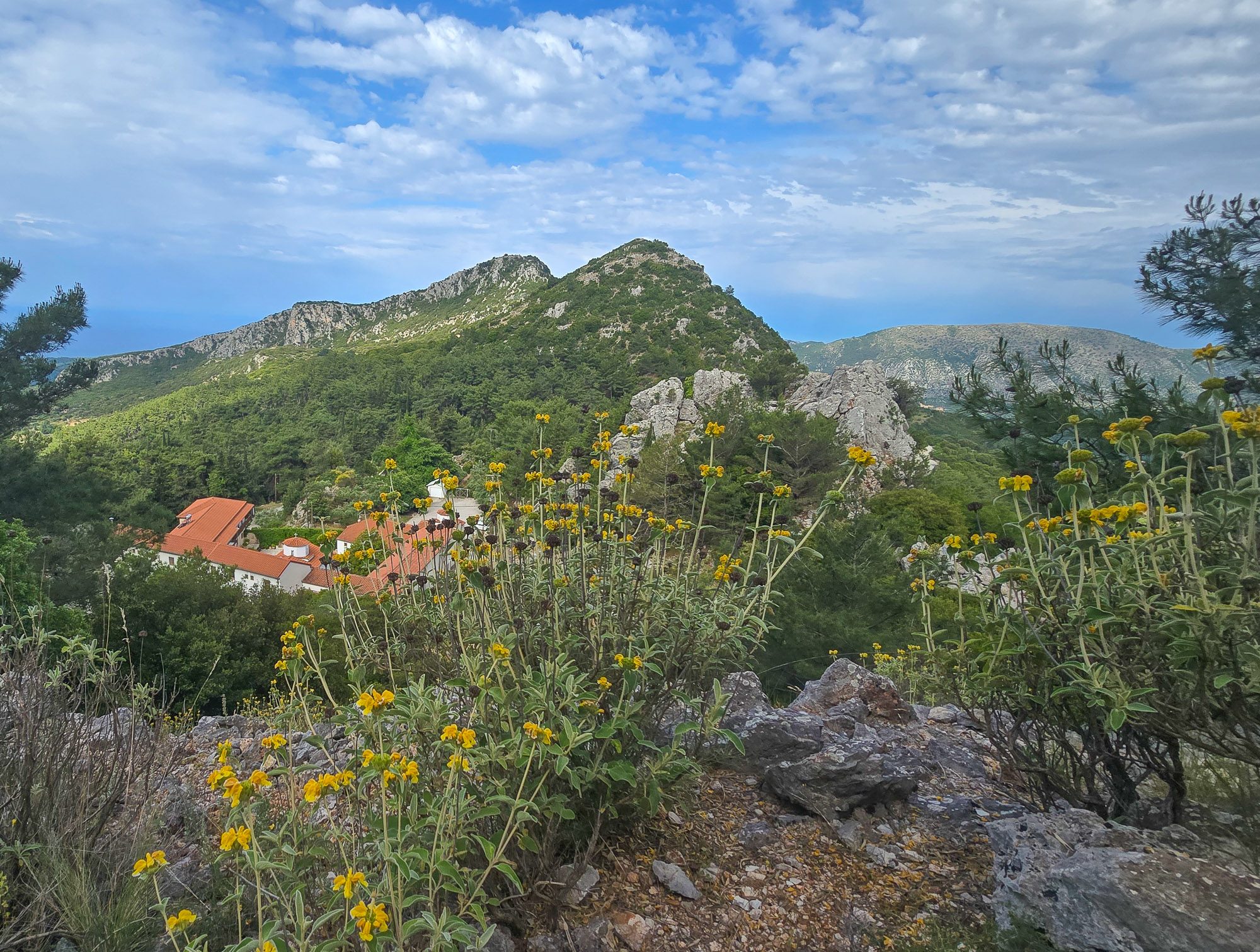
Soon we were almost at the top of the rocky outcrop on Mount Zalongo known as Stefani. Our last few steps brought us out onto a flat plateau, eyes immediately drawn to white stone figures towering above us.
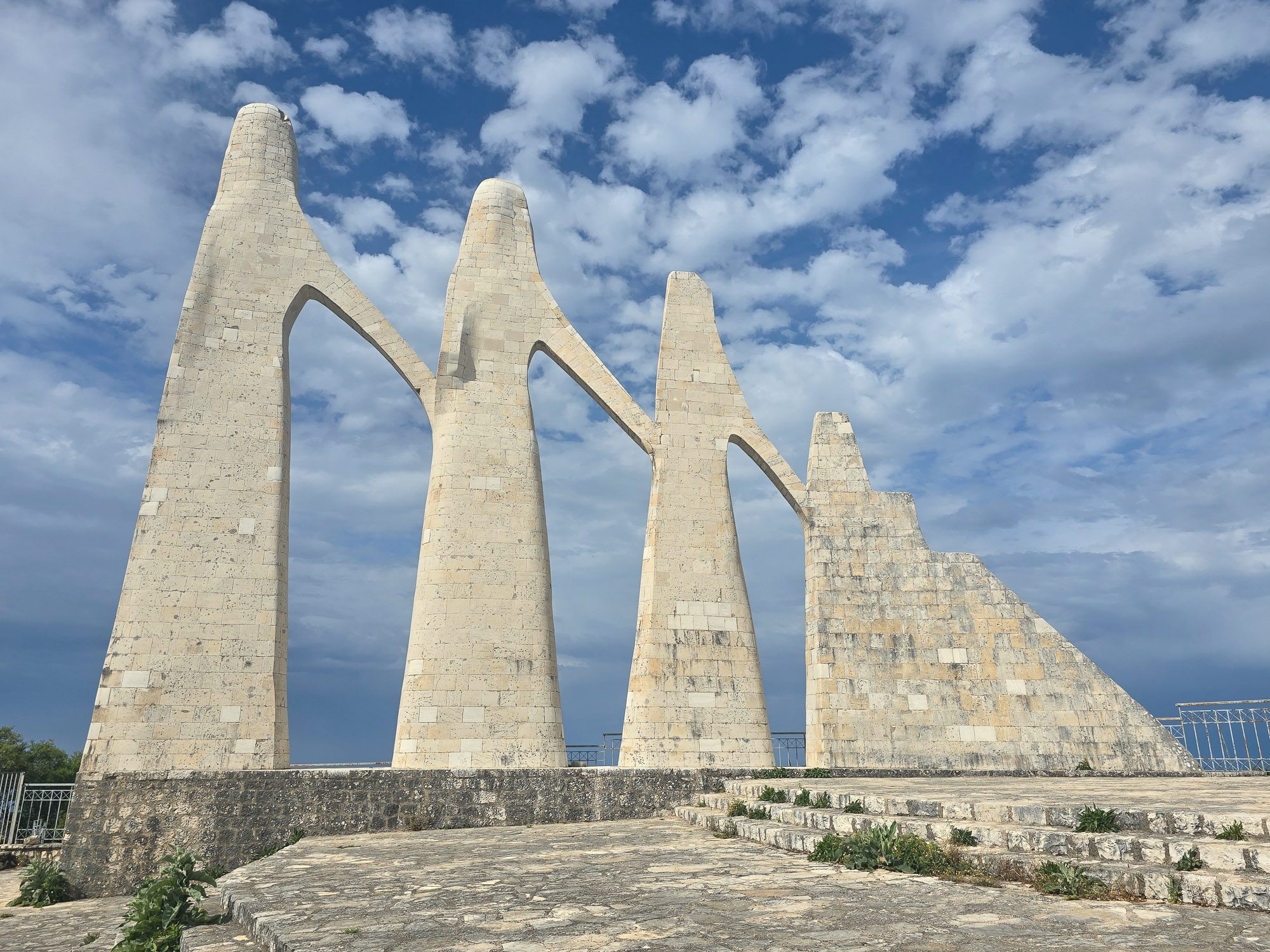
The monument was created by sculptor Georgios Zongolopoulos and unveiled in 1961. The white stone figures, larger than life, show the women mid-dance, caught at the moment before the end. From a distance they are striking. Up close they are something else. What it does not prepare you for is the edge of the cliff. Standing at the top and looking out across the Ambracian Gulf, you understand in a way that no written account quite conveys just how deliberate a choice this was. There was no confusion about where they were or what lay below.
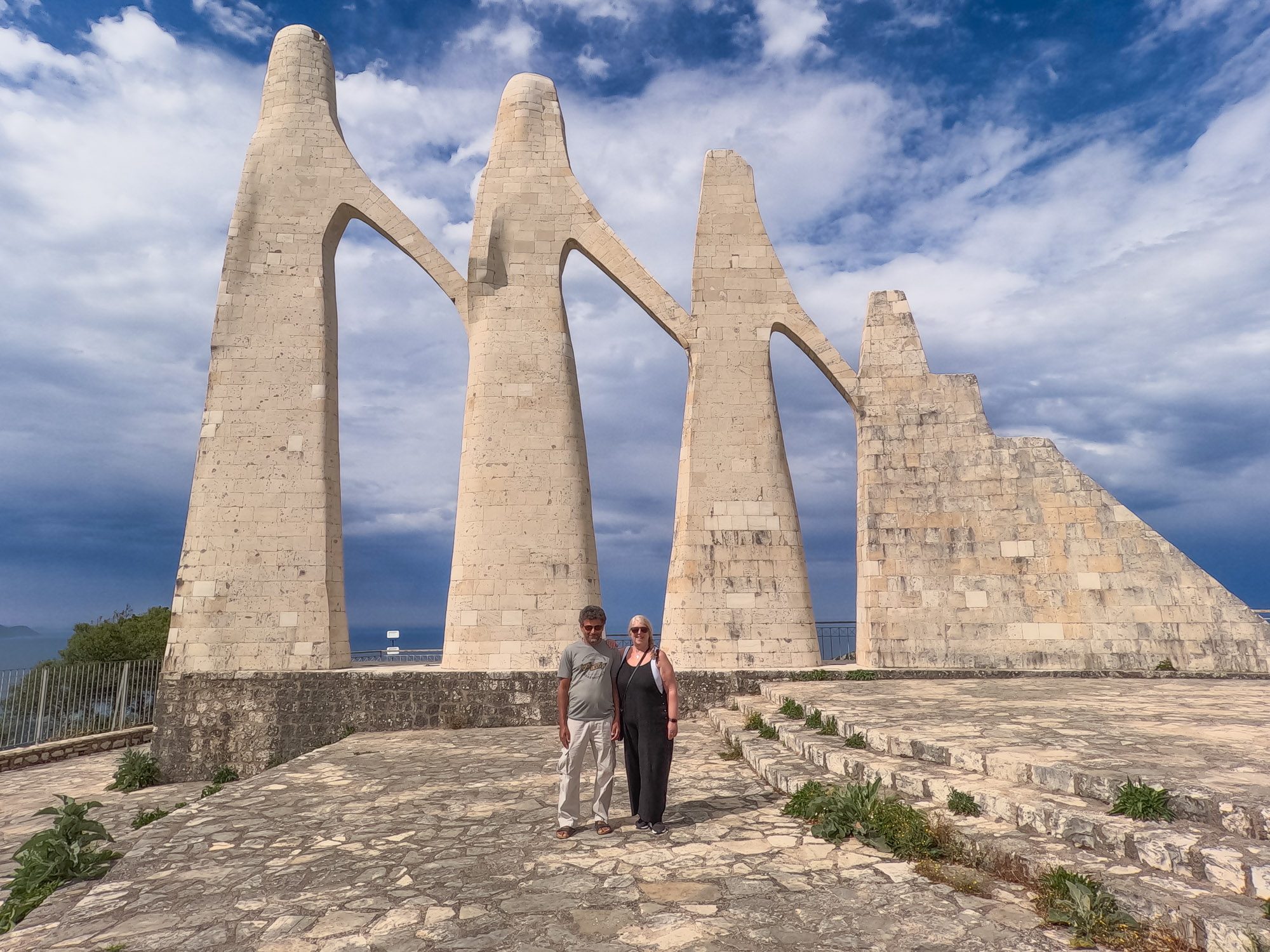
Walking around the perimeter, the realisation of having made it slowly settled in. Even knowing the history before arriving, standing in the place itself takes a moment to absorb. Then Ioannis began to tell us the story.
“This is the place where a very sad and very brave moment of humanity took place.” he said as he walked towards the perimeter fence and stood looking out across the mountain range beyond. “Let’s start with the geography.” Pointing to the mountain range in the distance, Ioannis told us how the Souliot community had grown over generations from a small cluster of original settlements into a confederacy of villages spread across difficult, remote terrain. People had moved into these inaccessible mountains partly to escape Ottoman pressures, and what began as a place of refuge gradually became something more organised and more powerful.
During the Ottoman occupation, the Souliots had managed to maintain a degree of autonomy that was unusual for the period. The core Souliot villages paid taxes to the Ottoman state, but relatively modest ones, and the absence of Ottoman officials living among them gave the community considerable practical freedom. The surrounding villages under Souliot protection operated under a different arrangement again, with the Souliots effectively replacing local Ottoman authorities and collecting a modest tribute in return for protection. For a period, this suited everyone well enough. The Ottoman authorities tolerated Souli’s independence partly because a buffer of fiercely independent mountain fighters was occasionally useful.
That tolerance ran out. By the late eighteenth century, the Souliot confederacy had expanded its sphere of influence significantly across southeastern Epirus and had become too powerful to ignore. They were, as Ioannis put it, “very tough and difficult people”. He said it as a compliment.
Ali Pasha had tried and failed to subdue them more than once. In 1803 he tried again, this time with greater force. The Souliot fighters held as long as they could, but the end was coming. As the situation became desperate, the women and children were sent ahead to this place, to hide among the cliffs while the men fought on back in Souli.
At the Monastery of Agia Paraskevi in Kougki, the heart of Souli, a priest named Samuel made a final stand. Surrounded and out of options, he detonated the monastery’s gunpowder store, killing himself and the Ottoman soldiers who had broken through. Ioannis reminded us that we had seen a representation of this event in the Pavlos Vrellis Museum a day earlier. The Souliots who remained fought until there was nothing left to fight with.
The Ottomans then gave chase and around sixty women and their children found themselves trapped at the top of the rocky outcrop of Stefani.
Ioannis continued the story as he moved towards the monument. As the soldiers approached, the women understood exactly what capture meant. Their sons would be taken as fighters. Their daughters would be taken to be part of a harem, and untold acts committed against the women. There was only one option.
From the top of the 150 metre high cliff, the women threw their children and babies over the edge. That part of the story in itself needed time to settle.
The story that we all know, and which is represented in the monument itself, is that the women joined hands and began a traditional circle dance uniting them in their continued act of bravery, defiance and sacrifice. In those last moments, the women jumped from the cliff.
Various documented accounts written sometime after support the story of the dance. Others not. What isn’t up for dispute is that the women of Souli made the greatest sacrifice imaginable at this place. A small chapel on the rocks below commemorates the place where the women and children were united in death.
Nearly a century later, in 1903, poet and playwright Spyridon Peresiadis wrote a theatrical drama called The Dance of Zalongo, bringing the story of the Souliot women to the stage for the first time. It premiered in Athens in 1906. The song that emerged from it, Farewell Poor World, with music by Ioannis Sakellaridis, was first published in print in 1908 and spread throughout Greece through theatrical performances. It became so embedded in Greek culture that it is now known simply as The Dance of Zalongo. Its poignant words speak of farewell to the world, to life and to a homeland, comparing the women of Souli to a fish that cannot live on land, capturing the central theme of the story.
Ioannis told us that this is a very sad part of Greek history and that the song is very emotional for Greeks. He then invited us to take a seat.
Standing steps away from the monument, with arms around each other, and completely unexpectedly, Ioannis and Angeliki began to sing the song to us.
On top of the hill of Zalongo with the Ambracian Gulf spread out on one side and the mountains of Souli on the other, this moment shared with our dear friends was one of those special moments.

After taking in that moment and the last views over the surrounding landscape, we reluctantly, we made a move to begin the descent back down. I’m glad to report that it was considerably easier than going up and not the nerve-wracking experience I thought it would be. As long as Peter took the side with the drop on it that is.
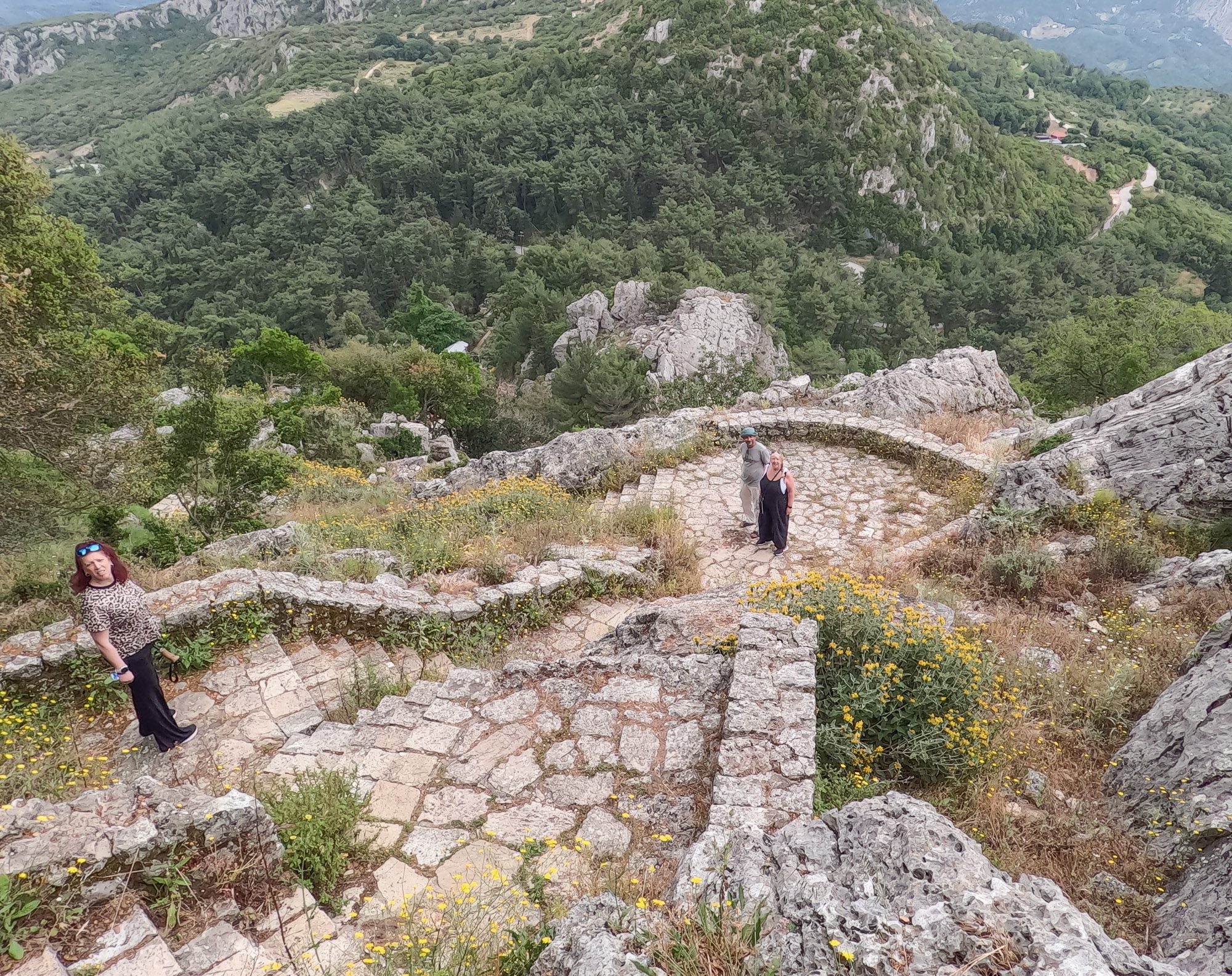
Nearing the base of the hill, Ioannis pointed out the small chapel on the rocks, the place where the women and children met their deaths. Ioannis looked at me and told me that it was not for me, as there were narrow steps on the way up to it. He and Peter climbed to it whilst Angeliki and I walked to the monastery.
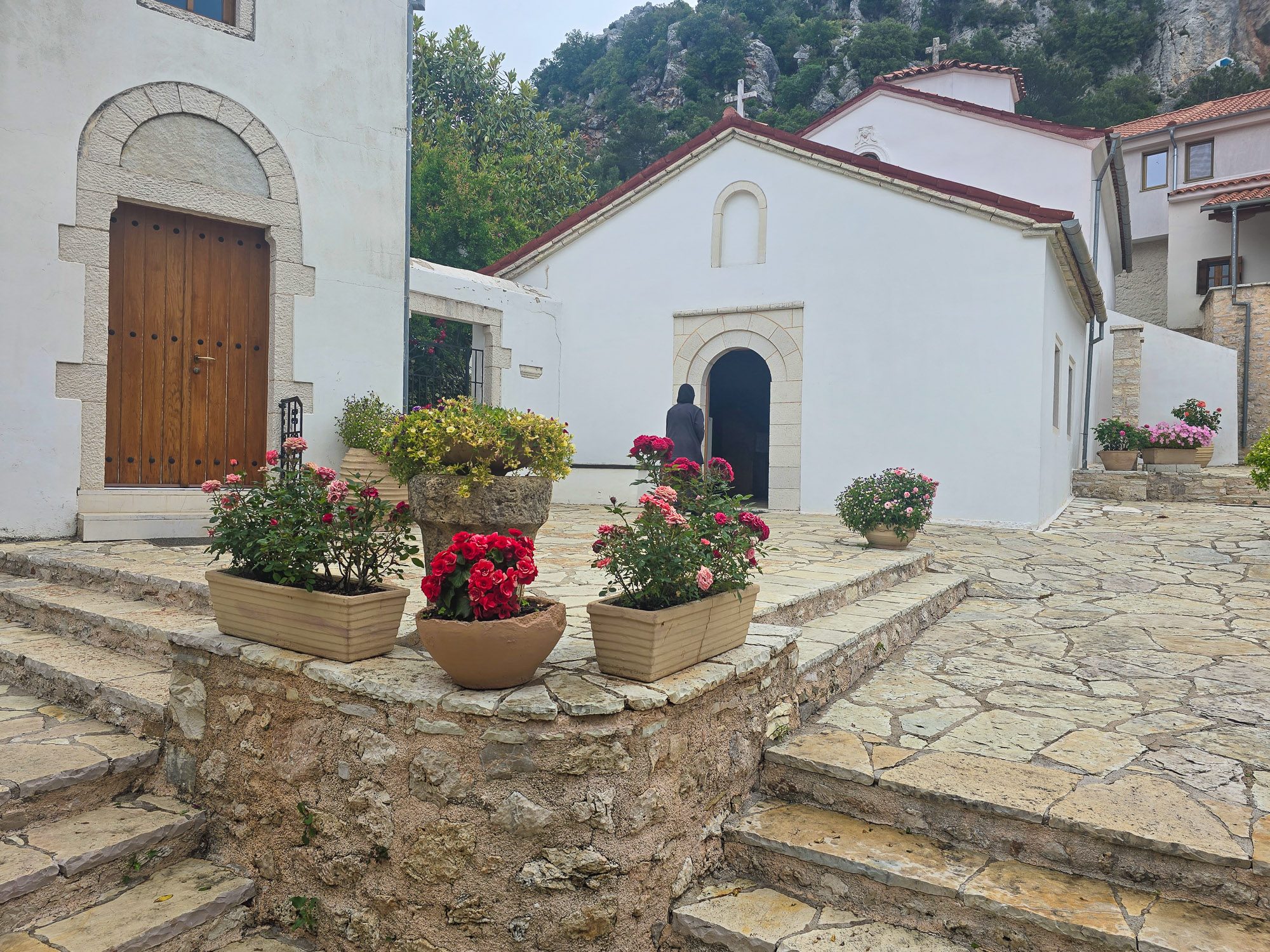
The Holy Monastery of Agios Dimitrios of Zalongo is small and unassuming, which feels appropriate given what the hillside above it carries.
During the Ottoman period it became a meeting point for local armatoles and chieftains, and the monks were directly involved in the resistance against Ottoman rule. Saint Kosmas the Aetolian stayed here for about a month in 1777. In the aftermath of December 1803, a group of Souliots who escaped from the cliff above fled towards the monastery, where they were eventually captured. The two places are part of the same story.
Inside, the church is a small single-aisled basilica with a dome. The frescoes were completed in 1816, thirteen years after the events above. Painted by Ioannis and Christodoulos from Korytiani near Ioannina. The painters would have known people who were there.
The monastery has been burned, damaged by earthquake and rebuilt more than once since then. It now operates as a women’s convent and is a protected historic monument. Visiting hours apply, so worth checking ahead if you plan to go inside.

Today, the sacrifice of the Souliot women is commemorated each year at Zalongo through the Zaloggeia, an annual memorial ceremony held in October at the Sacred Rock. The event includes a memorial service, speeches, wreath-laying and performances of the Dance of Zalongo. Although the Zaloggeia have traditionally been held at different times, including August, the modern commemoration is generally held in October and is not intended to mark the exact anniversary of the event. The women and children died at Zalongo in December 1803, making December the true historical anniversary, while the October Zaloggeia has become the principal annual public commemoration of their sacrifice.
Epirus Traveller is run by Ioannis and Angeliki from Ioannina. If you want to understand Epirus rather than just pass through it, they are the people to contact.
Discover more from
Subscribe to get the latest posts sent to your email.
MY BIG FAT GREEK TRAVEL SURVEY
How do you really plan your Greek adventures? I'd love to hear from you.
TAKE THE SURVEY →

I am not a lover of heights & suffer from anxiety too but like you I had to make the climb because the story had captured me several years before I made it there & I had to see the place. There were many stops to catch my breath & sip water on the way up! Once at the top the statues rise above you magnificently & as you say, when you glance over the edge – obviously some distance away, you appreciate what the women faced that fateful day & you can’t help but marvel at their bravery. The walk down was easier but by the time I reached the bottom my legs were like jelly & I couldn’t stand. Incredible place & well worth the climb. I also recommend visiting the ancient Greek ruins at Cassope just down the road. Views from there out over the Ambracian coast are equally impressive. Epirus never fails to impress. Such a magical region of true, wild beauty & fascinating history. So many more adventures of discovery lie ahead xx
That’s so true Annabel. I was rather late in discovering Epirus. I had visited over a decade ago but in recent years have been able to discover it with fresh eyes. Vertigo is a real nuisance. I can force myself at times but there are limits. Unless you have it, nobody really understands that it’s nothing to do with fear of falling but more of an inner-ear balance thing.
There are so many stories of heroism that have touched my heart during my travels – Kalavryta is certainly up there with Zalongo. These are the stories that resonate and the places I remember most. I’m sure it’s the same for you too. Thank you for your message. ❤️