Bridges, Lagoons and Roman Ruins: A Day in Epirus with Epirus Traveller
After our visit to Zalongo the day continued with our guides and dear friends Ioannis and Angeliki from Epirus Traveller. The next stop on our itinerary was a visit to Arta. Ioannis loves making me walk across scary stone bridges but the one at Arta was different
Arta and an Evzone Encounter
The road into Arta follows the Arachthos River, and the bridge announced itself before the town did. Wide, gently arched, built from pale stone that has aged comfortably into the riverbank over several centuries. I knew immediately that this was not going to be one of those bridges.
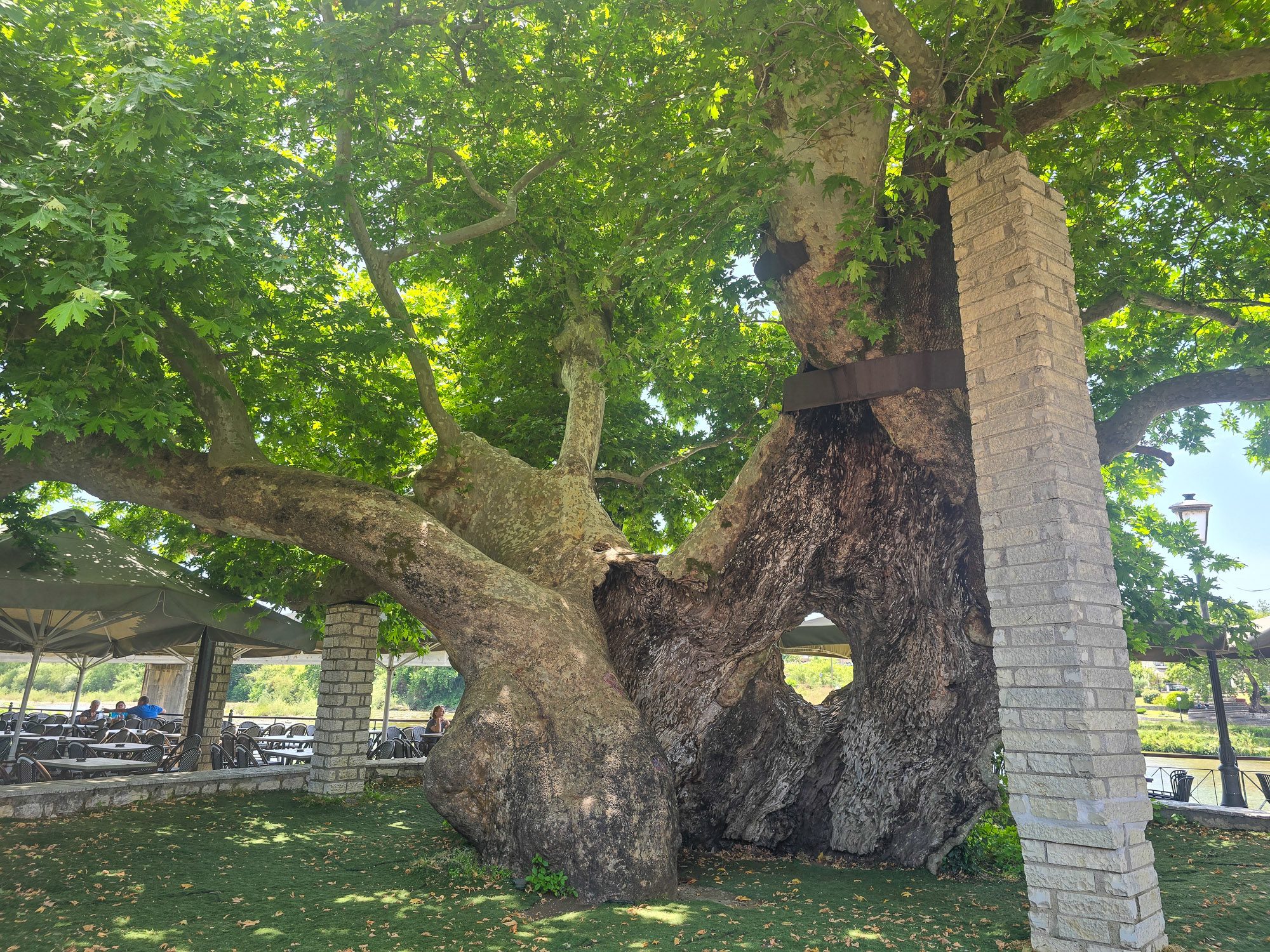
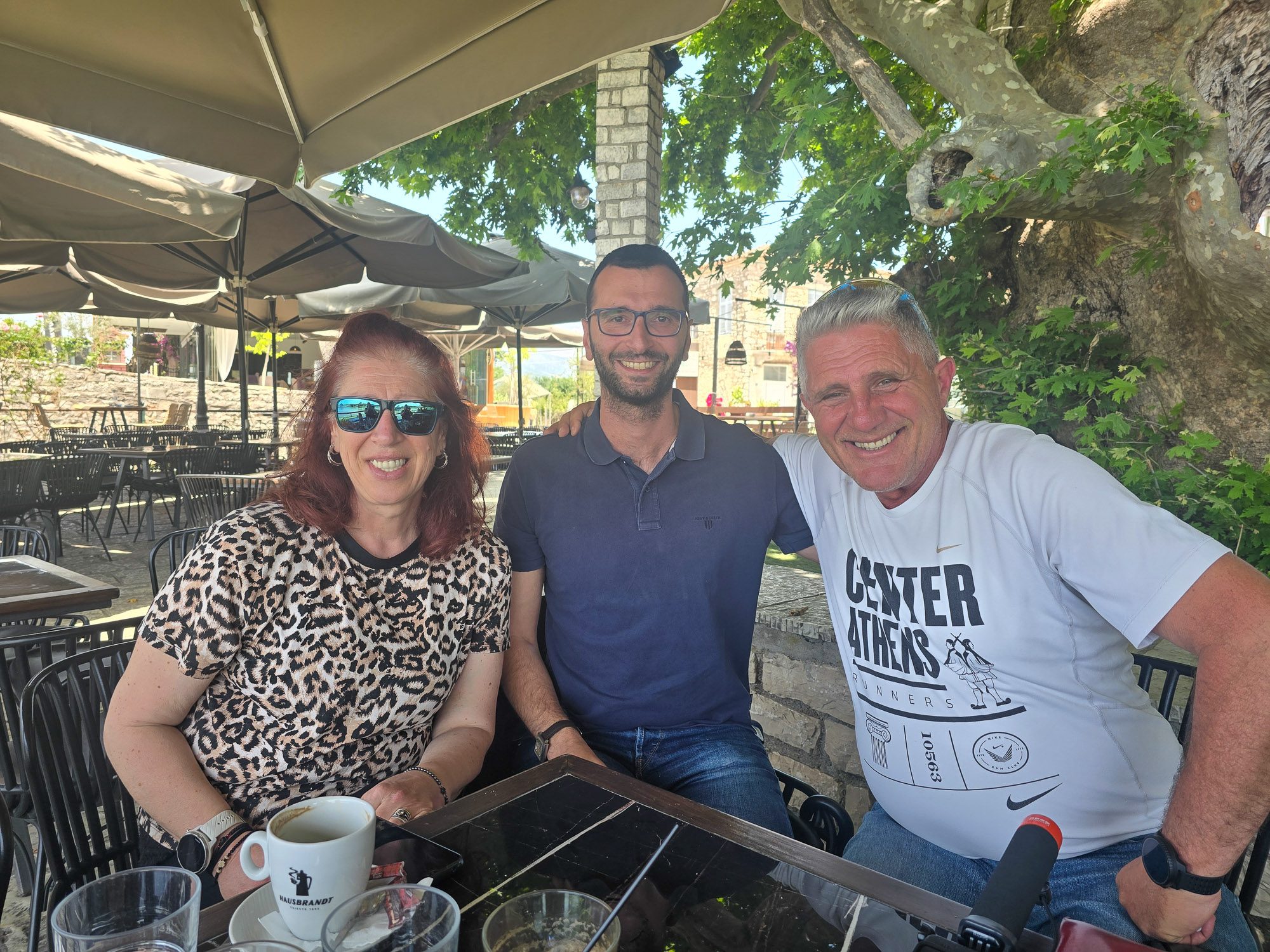
Ioannis suggested coffee before we crossed. There was a small café beside the bridge entrance, set in the shade of one of the most remarkable plane trees I have seen. The trunk was enormous, heavily buttressed at the base, its branches spreading so wide that the café had grown up around it rather than the other way round. Someone had gone to considerable lengths to stop those branches collapsing, metal supports, careful intervention, the kind of attention reserved for something considered worth preserving. The tree had clearly decided it was going nowhere regardless.
We were sitting beneath it when a man appeared and greeted Ioannis. This was not unusual. Ioannis seems to know almost everyone in western Greece. But, as I was soon to find out, this introduction had been arranged deliberately,
Knowing my fascination in the Evzones (not in a creepy, stalker-like way) Ioannis had arranged this meeting with Alexandros, a former presidential guard who once served with Ioannis. Now, had I known about this beforehand, I would have prepared some of the delving questions that I’ve had in my mind for a while. However, even put on the spot, I needn’t have worried because the conversation flowed easily
He talked about what it means to serve as a member of the Presidential Guard. Not the ceremonial version, the one tourists photograph in Syntagma Square, but what the uniform actually requires. Discipline. Pride. Respect. Values he said had carried through every part of his life since leaving service. He spoke of Ioannis as a commanding officer: strict but fair, and never willing to ask of his soldiers what he would not do himself. Even in later years as a trainer, Ioannis would complete the full gruelling routine of the changing of the guard. Nobody in the Presidential Guard is an individual. The entire structure, the guarding of Syntagma Square, the Parliament, the Presidential Mansion, is carried out as a collective.
The selection process is demanding, the training more so. The barracks conditions during training were not pleasant. Cramped, dark, deliberately testing. Not everyone made it through. Those who did carried that knowledge as a permanent part of their service.
Every Evzone is paired with a partner matched for height and build, and that partner stays with them through training and through service.
The ceremony itself, what visitors see and photograph in Syntagma Square, is not incidental to the role. On Sundays, the full dress parade in the traditional fustanella requires hours of preparation. Each pair of Evzone helping to dress the other ensuring every pleat of the fustanella lies exactly right. Every strand of the long black tassel on the farion cap must be perfectly straight. Nothing during the changing of the guard is permitted to be less than exact. Not a movement, not a flinch, not a cough in extreme heat or torrential rain.
I was also interested to hear that Alexandros is from the village of Mellisourgoi, a neighbouring village of Pramanta where Ioannis was from. I’d written in an earlier post the story of the rivalry between the two villages, so won’t repeat it here, but it seems that it was so far in the distant past that even people from opposing village sides can now laugh about it.
The conversation was longer and more detailed than this. But some of what was said belongs to the people who said it.
We said our goodbyes with real gratitude, to Ioannis for arranging it, and to Alexandros for giving a stranger a bit more understanding of what it takes.
The Bridge of Arta
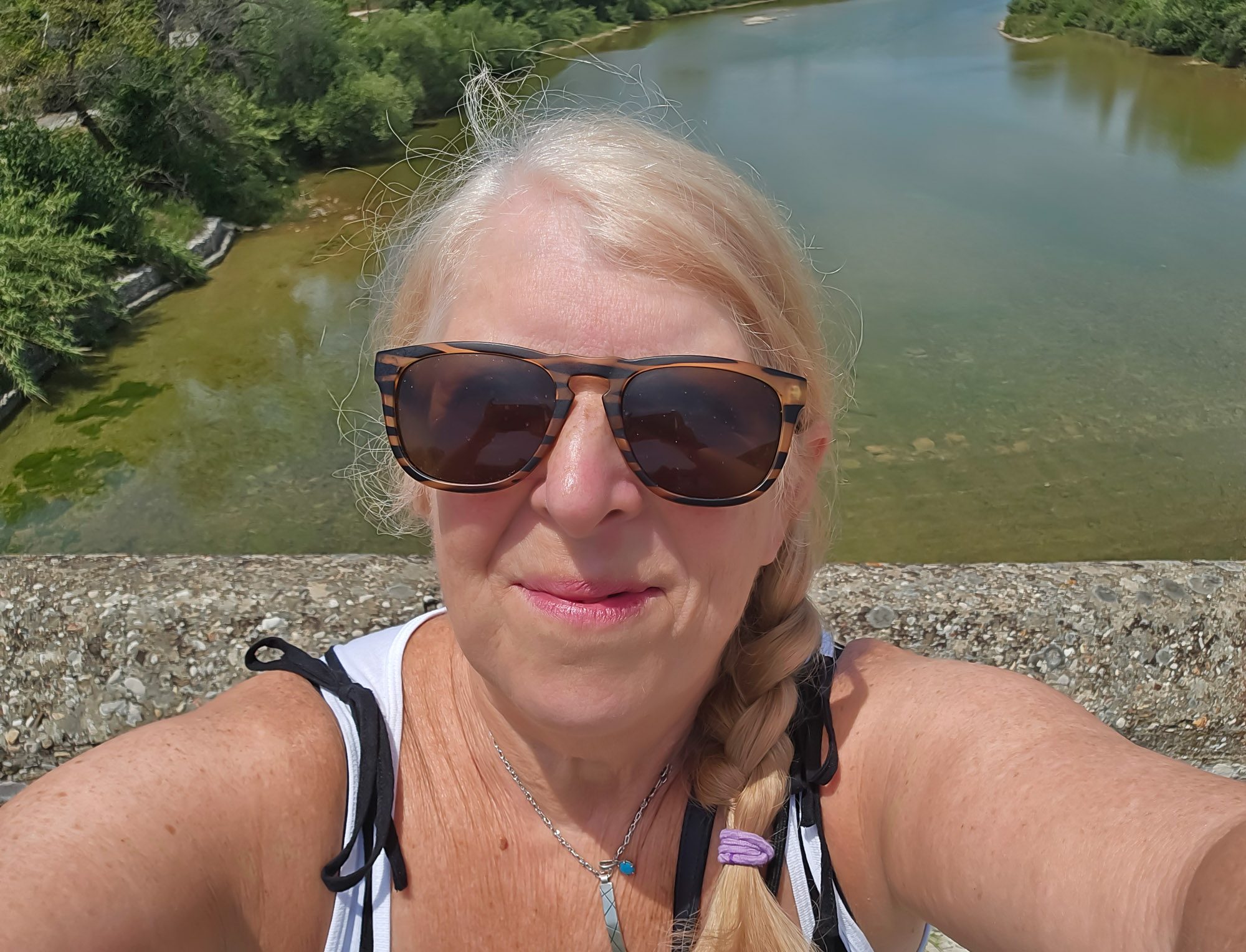
The bridge was exactly as it had appeared from a distance. Wide, not particularly high, the water below was shallow enough to see every pebble on the riverbed. The Arachthos meandered in both directions, the banks lush and green in the afternoon light. Even with a tendency towards vertigo that has made several Greek bridges a rather more dramatic experience than intended, this one presented no difficulties whatsoever. I would like to claim it was courage. It was mostly just a very sensible bridge.
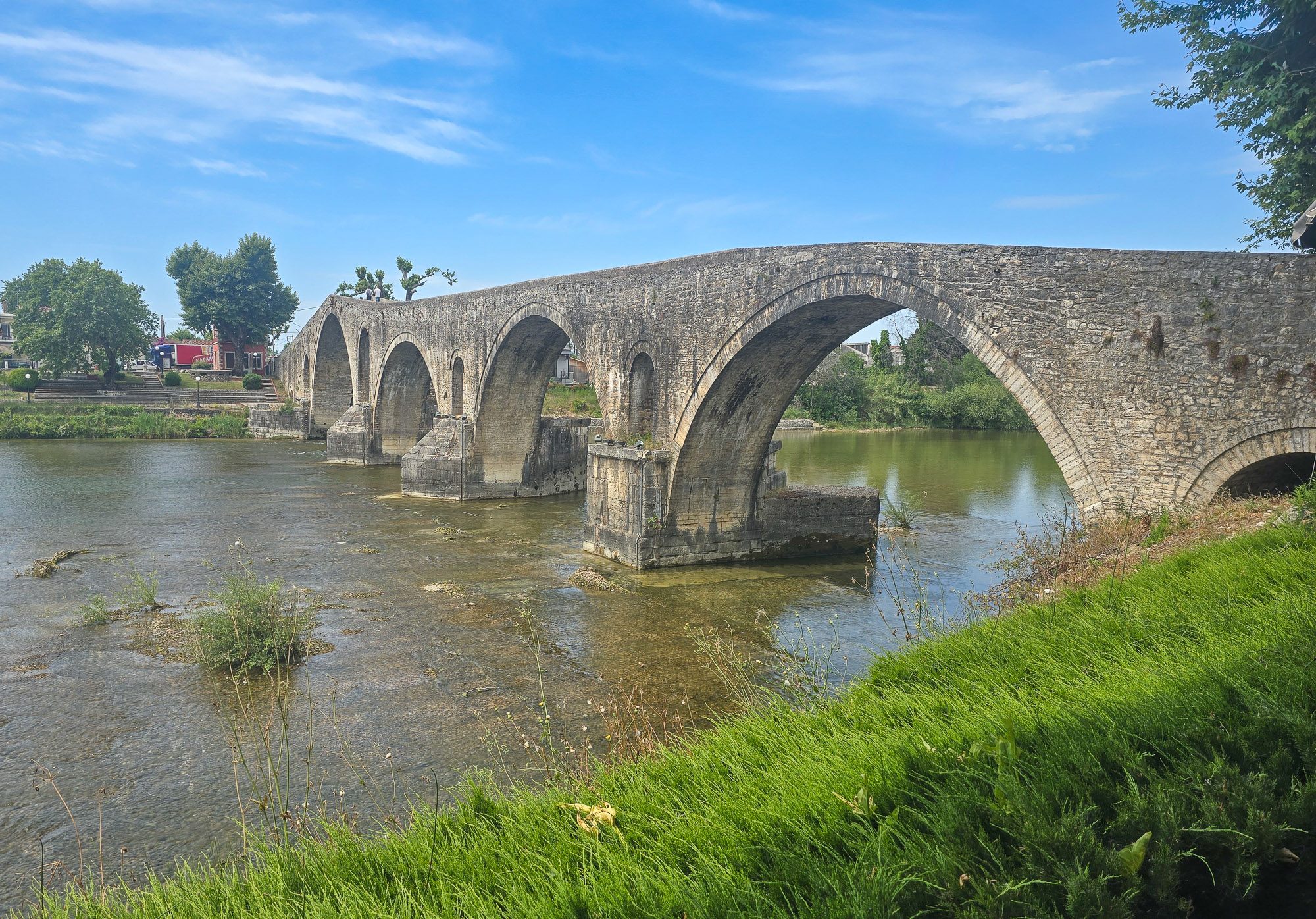
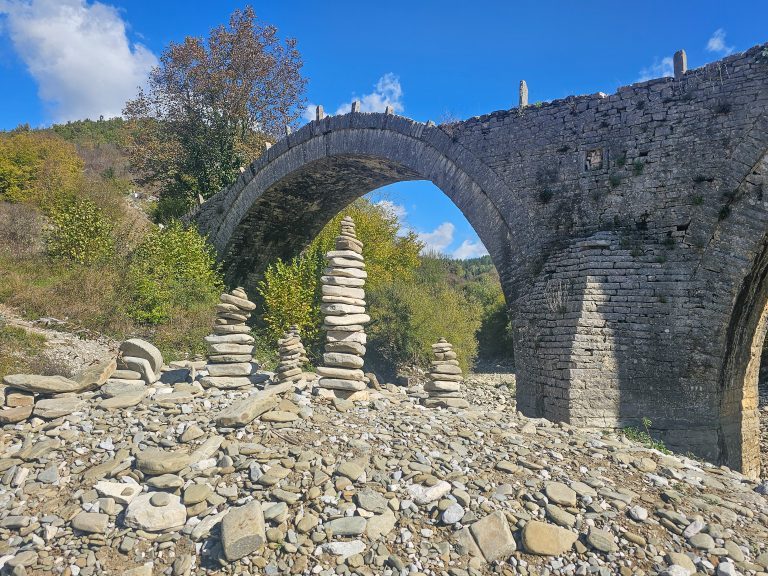
The crossing here goes back a long way. There may have been a bridge on this site as far back as the third century BC, during the time of Pyrrhus, King of Epirus. The stone structure you walk across today is principally the result of Ottoman-period rebuilding, with its present form dating to the early seventeenth century and major work completed around 1612. It is 145 metres long and 3.75 metres wide, with a distinctive, slightly irregular arrangement of arches rather than the neat symmetry of later bridges. The largest arch spans around 24 metres. The foundations were engineered specifically to handle the Arachthos, a notoriously powerful river prone to flooding, with relief arches built in to allow floodwater through when the river rises.
And then there is the legend.
According to the traditional folk story, 45 master builders and 60 apprentices worked on the bridge. Every day they built it and every night it collapsed. Eventually a bird revealed the supposed solution: the wife of the master builder had to be buried alive in the foundations. She was brought to the bridge, walled in, and the bridge finally stood.
The story became the subject of one of Greece’s most famous folk songs, Tou Gefyriou tis Artas, the Bridge of Arta. It is not unique to this bridge. It reflects an old Balkan and Greek folk motif in which a major construction project requires a human sacrifice to make it permanent. More than anything it reflects the engineering challenges of building substantial foundations in such a powerful river, which gave rise to the story of a structure that kept failing. Bridges like this do not collapse because of absent sacrifices. They collapse because rivers like the Arachthos are difficult to build across.
The bridge has had one more unexpected chapter in its history. After Arta became part of Greece in 1881, the bridge became the frontier between the Kingdom of Greece and the Ottoman Empire. The highest arch marked the border until the Balkan Wars of 1912 to 1913.
So what looks like an attractive old stone bridge over a pretty river has, in sequence, been an ancient crossing, a medieval and Ottoman infrastructure project, the subject of one of Greece’s most celebrated folk songs, and an international frontier. Not bad for something 3.75 metres wide.
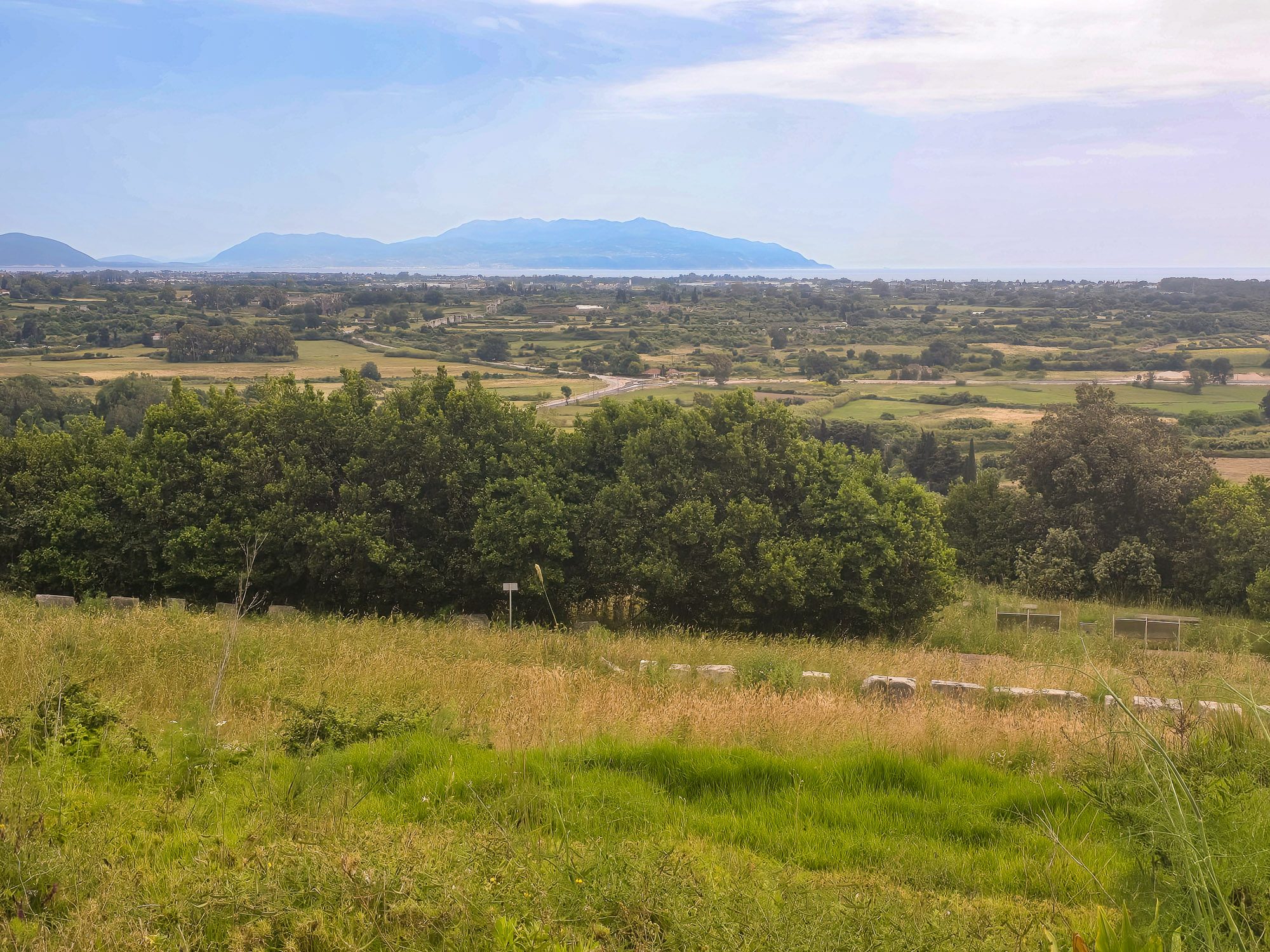
Koronissia
From Arta, we drove out across the Ambracian Gulf towards Koronissia, though drove is slightly misleading, because the road itself is part of the experience. A narrow causeway barely wider than two lanes, carved along a natural boundary between the lagoon and the open gulf, with nothing but shallow water on either side for most of its length. The gulf to the south, the lagoon to the north, and a strip of tarmac threading between them.
Koronissia is connected to the mainland only by that road, built in 1972. Before it, the island’s 160 or so permanent residents reached Preveza by boat. The Church of the Nativity of the Virgin Mary at its centre is the surviving remnant of a monastery founded in the tenth century, most of which has long since gone.
The lagoon surrounding it is no incidental feature. The Ambracian Gulf is one of the most productive fishing grounds in Greece, protected under the Ramsar Convention and the Natura 2000 network. Grey mullet, sea bass, sea bream, eel and the gulf’s famous large prawns, the gambari, are caught here using traditional trap systems called divaria, a word derived directly from the Roman vivarium. The fishing cooperative at the island’s entrance holds exclusive rights to the lagoon and responsibility for its protection. Around thirty fishermen maintain the ditches, cut the reeds and keep the water circulating. The lagoon supports around 300 species of birds, including silver pelicans with a wingspan exceeding three metres, flamingos, herons and cormorants.
The land next to the small car park was a small beach lined with straw parasols. Further along, a patch of land dotted with trees sloped gently down to the water’s edge. The trees looked deliberately planted, the kind of stabilising measure that makes sense where land meets shallow water and the ground needs to be held together. Below them, reed beds divided the shallows into pockets, narrow strips of land creating micro lagoons within the larger one. Close by, two figures waded in the shallows holding a net between them, dredging the water for whatever delicacies would land on the table. Fish, straight from the lagoon to the plate, is what brings people to this unique little place.
Lunch was at Patentas fish taverna on the island and it didn’t disappoint.
Ancient Nicopolis – The Campsite Memorial of Augustus
Ancient Nicopolis, the City of Victory, was founded by Octavian in 31 BC, immediately after the Battle of Actium, on the very promontory where he had camped before the battle. His victory there over the combined forces of Mark Antony and Cleopatra ended over a decade of rivalry, brought down the Roman Republic and gave the world the Roman Empire. Octavian was subsequently declared the first Emperor of Rome by the Senate in 27 BC, and from then on took the title of Augustus.
This was a city built on triumph, populated by people relocated from the surrounding region, intended to announce to the ancient world that what had happened here had changed everything. It had. The Roman Republic ended at Actium. The Roman Empire began. Nicopolis was the monument to that moment.
For anyone who has already walked the headland at Preveza and stood across the channel from the Aktio promontory, Nicopolis adds another layer. At its peak it had a population of around 150,000, a theatre, an odeon, baths, temples and an aqueduct stretching fifty kilometres from the Louros springs. Later came a dense concentration of early Christian basilicas whose mosaic floors survive in remarkable condition. The site is vast. We drove between sections, which is the practical approach. On foot, covering Nicopolis properly would take the better part of a day.
We began at the upper terrace, north of the main city on Michalitsi Hill. Access was via a narrow track rather than a main road and this part of the site was overgrown and seemed less visited. It wasn’t immediately obvious how significant this site is.
The Campsite Memorial of Augustus was built between 29 and 27 BC on the hill where Octavian had camped before the Battle of Actium in 31 BC. This was the exact spot from which he directed the battle that ended the Roman Republic. After his victory over Antony and Cleopatra, he erected this monument here, on that same ground, before founding Nicopolis below. It was dedicated to Mars and Neptune, and the outer wall of the monument once held the bronze rams captured from the enemy warships at Actium. A trophy of the naval victory, displayed on the hillside above the city built to commemorate it.
It was not difficult to imagine Augustus surveying the view that was purposefully aligned so he could look across the gulf where the battle had been fought. Although not much remains on this particular site, the intention was clear. This was built to be seen from the water below. It was not a modest gesture.
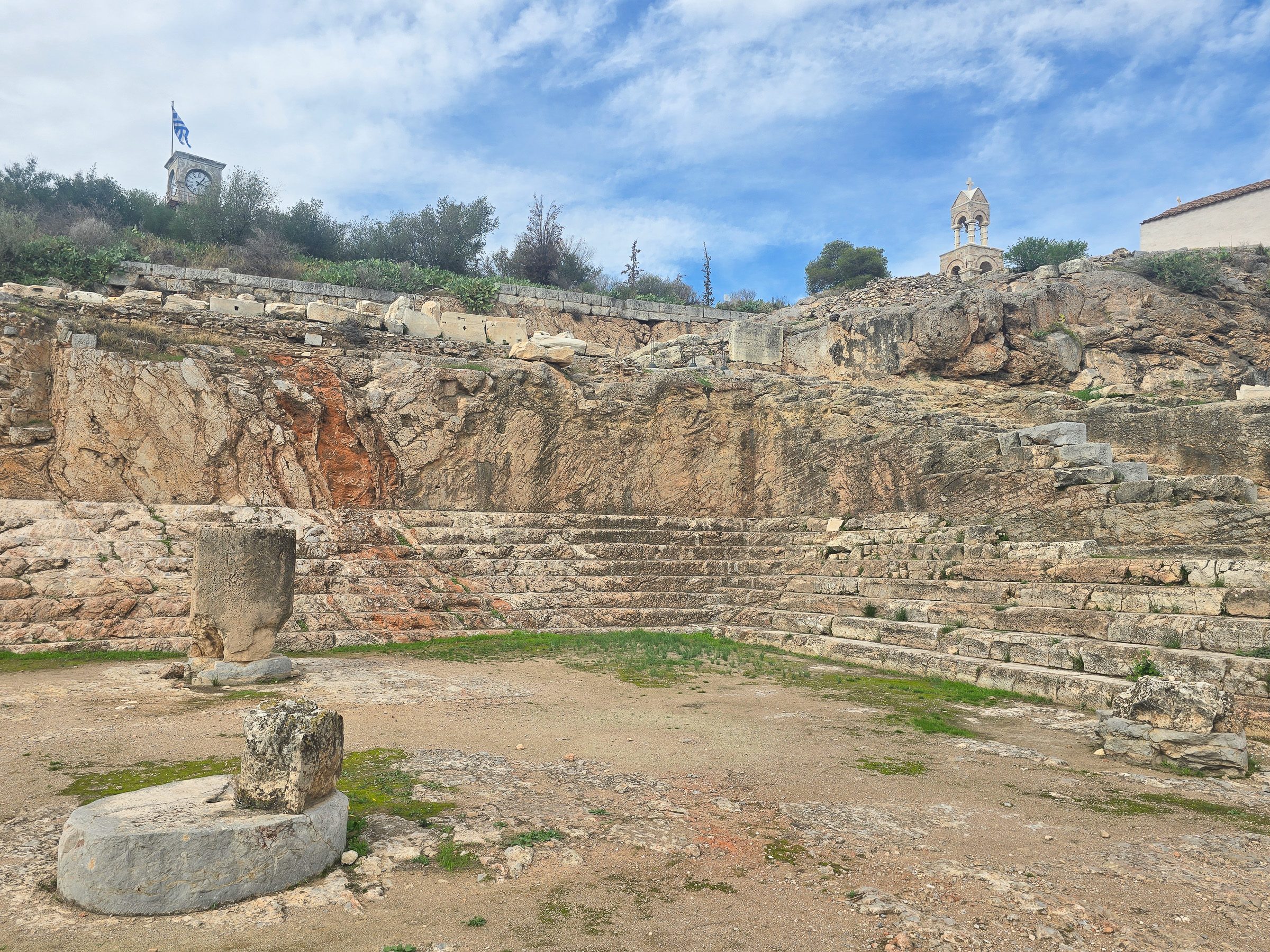
What survives is substantial enough to make sense of. A large Pi-shaped stoa once enclosed the upper terrace on three sides, with an outer Doric colonnade and an inner Corinthian one. The back wall is still standing, its small square openings the original putlog holes from the construction scaffolding. The stone column drums lying in the foreground are remnants of that portico. At the centre of the courtyard stood a monumental altar, roughly 22 by 6.5 metres, with fragments of white stone and marble bases still visible against the wall.
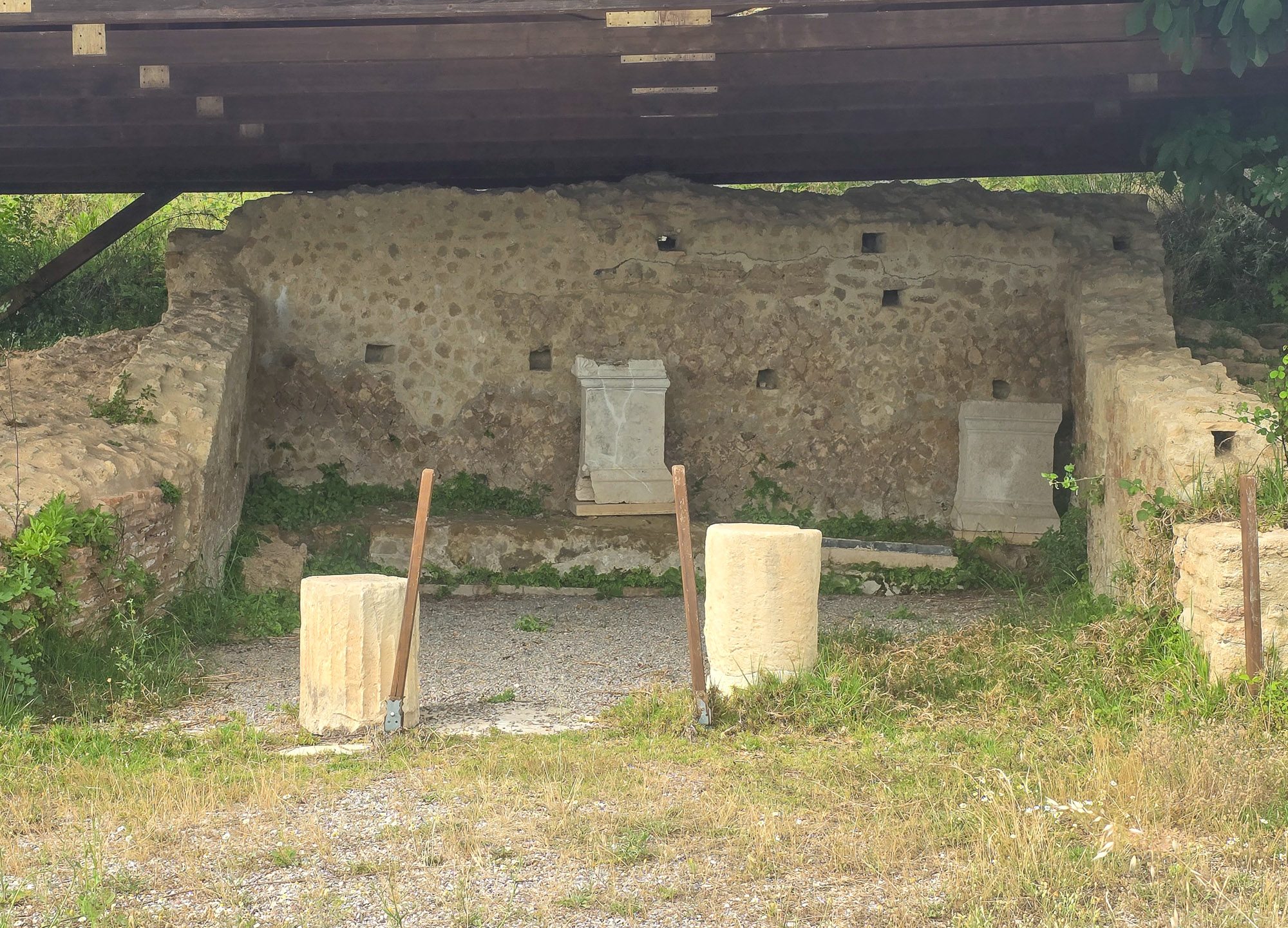
Below the monumental altar was the Roman garden terracing, known as the opus topiarium, an example of formal gardens laid out in geometric formations. The Romans treated their gardens as seriously as their architecture, filling them with clipped boxwood, laurel, cypress and myrtle, kept watered by clay channels. The outline of the structure gives a sense of how formally the landscape was arranged around the victory monument.
Inscription fragments from one of the retaining walls, were unfortunately masked by the undergrowth. But we do know that this massive monumental inscription proclaimed Octavian’s victory and peace secured on land and sea.

The Great Theatre
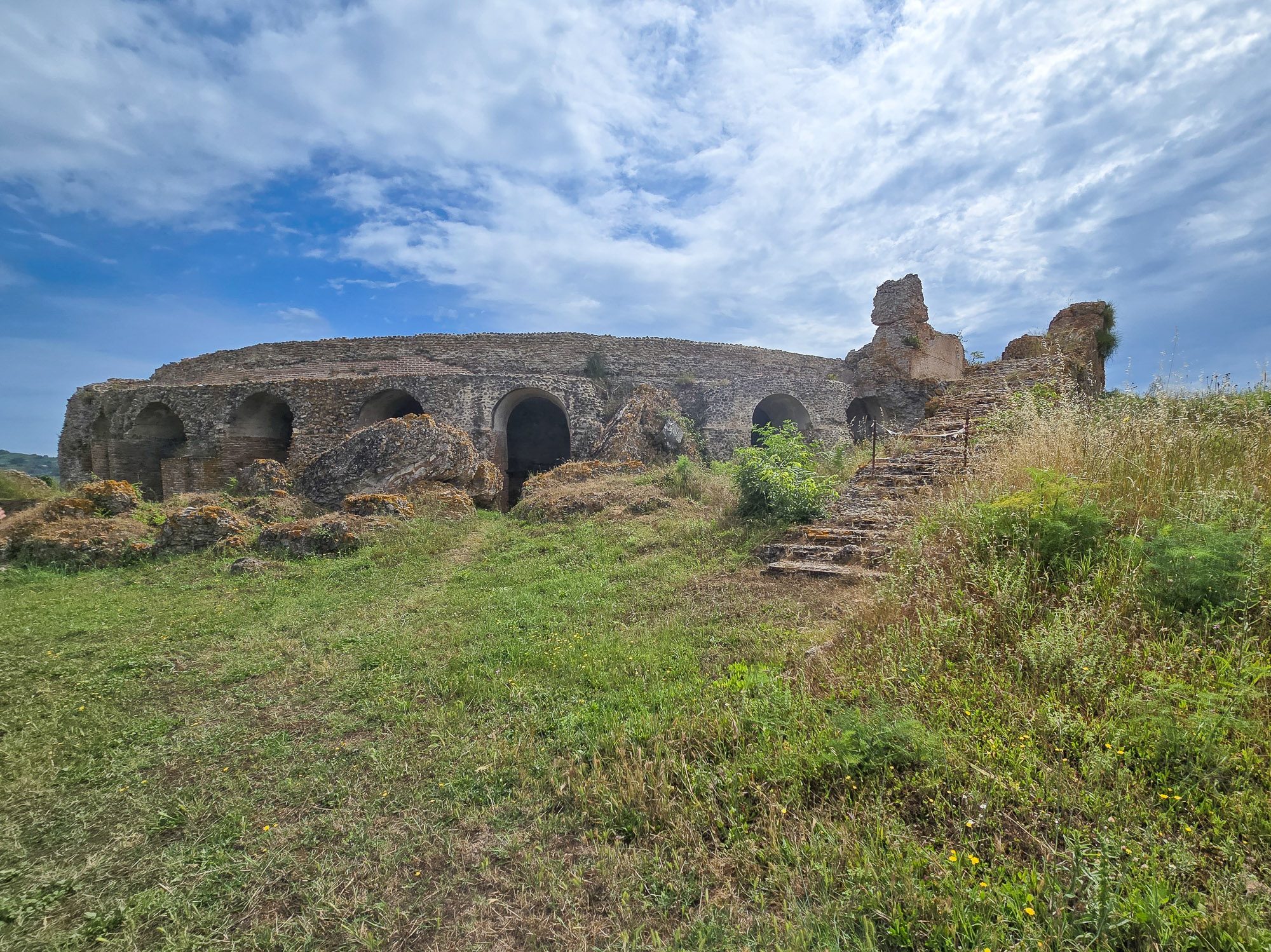
A short drive to the Great Theatre, which remains largely unrestored but unlike many archaeological sites where you are left staring at stones and guessing, here enough survives to give you a real sense of the original building. The seating rows curve around the orchestra in pale stone, the auditorium making use of the natural slope of the ground in the Greek tradition. Wildflowers had seeded themselves between the seats and along the orchestra floor. The stage building rises at the back, parts of it still standing around nine metres high, which gives the space its scale.
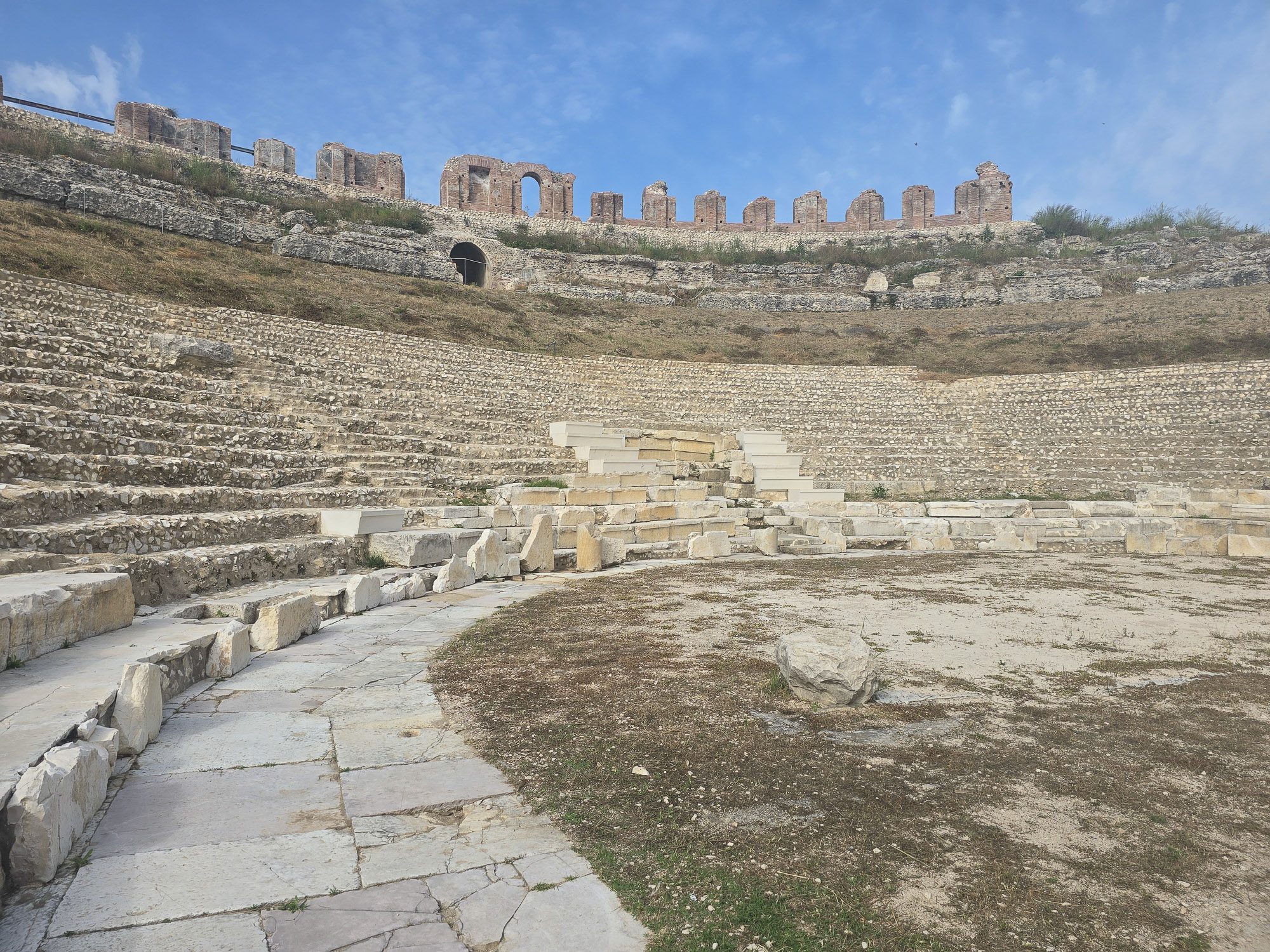
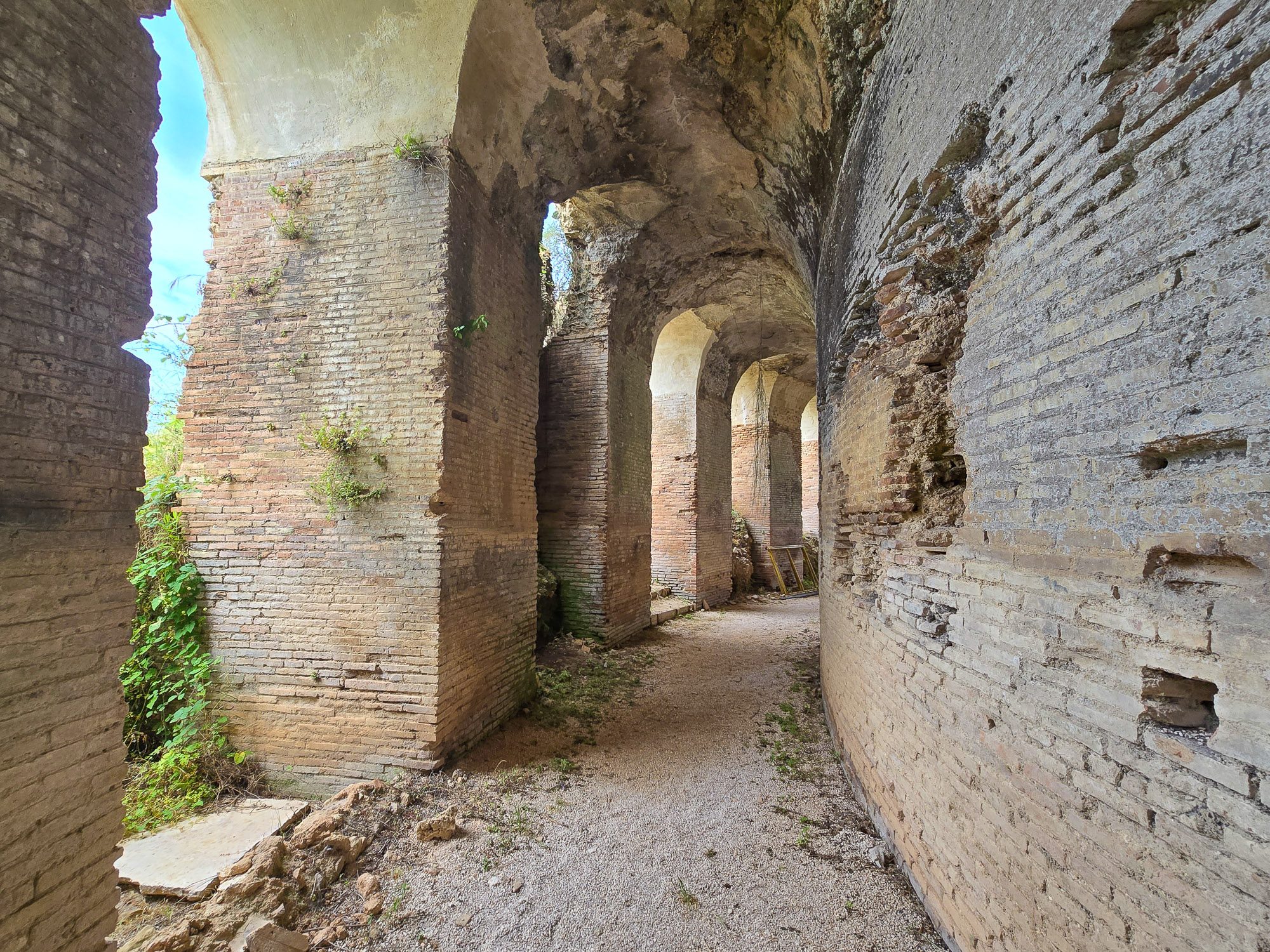
The theatre formed part of the complex associated with the Actian Games, established by Augustus to commemorate his victory at Actium and modelled on the great Panhellenic games. They included athletics, horse racing, music and theatrical performances. What I found interesting was the mixture of Greek and Roman design. The upper seating was supported by a series of vaulted galleries, substantial stone passageways built beneath the auditorium. Walking through them, the engineering makes itself clear. The circular openings cut into the vault ceilings are light wells, designed to let in air and light and to help with acoustics.
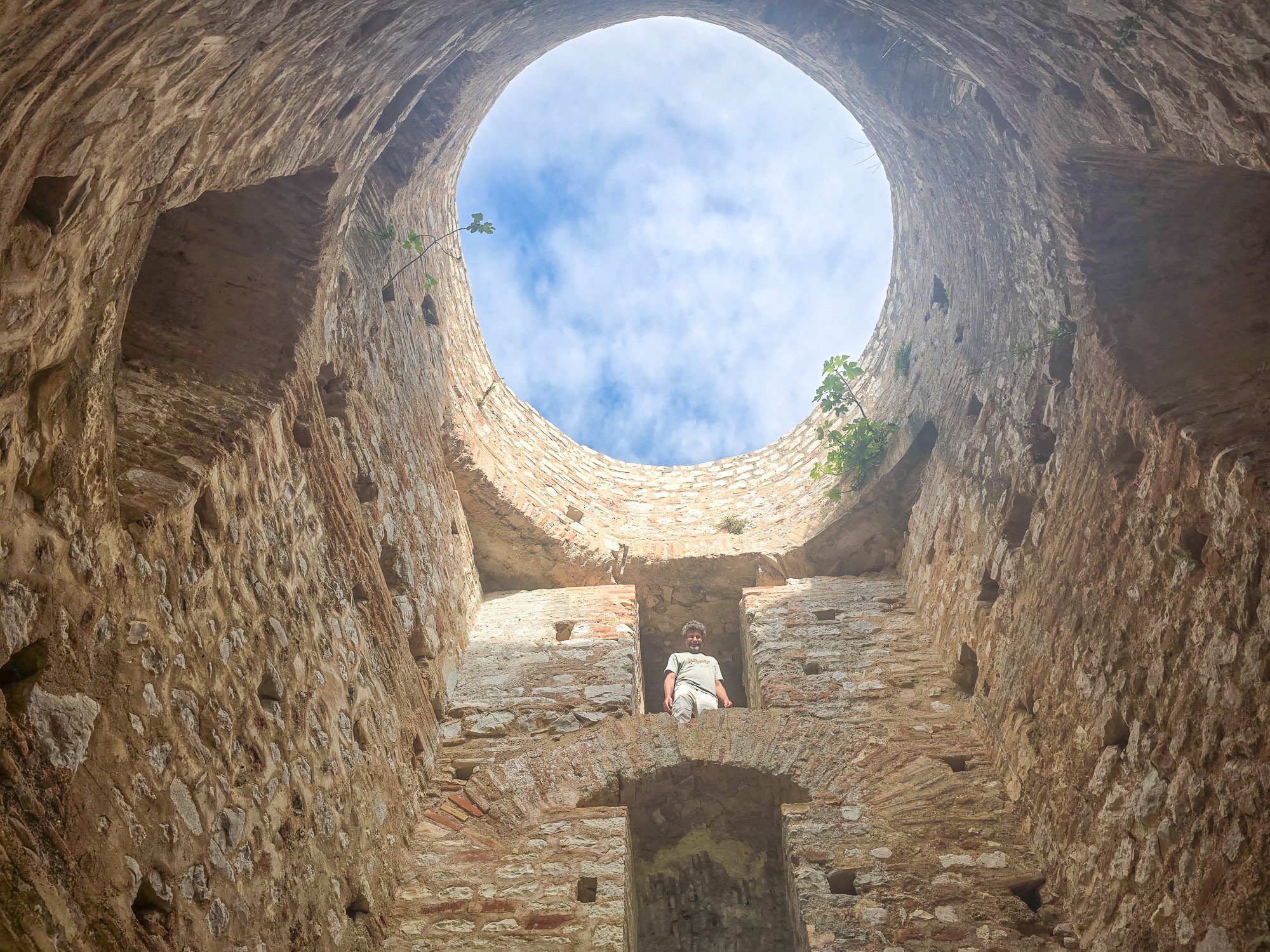
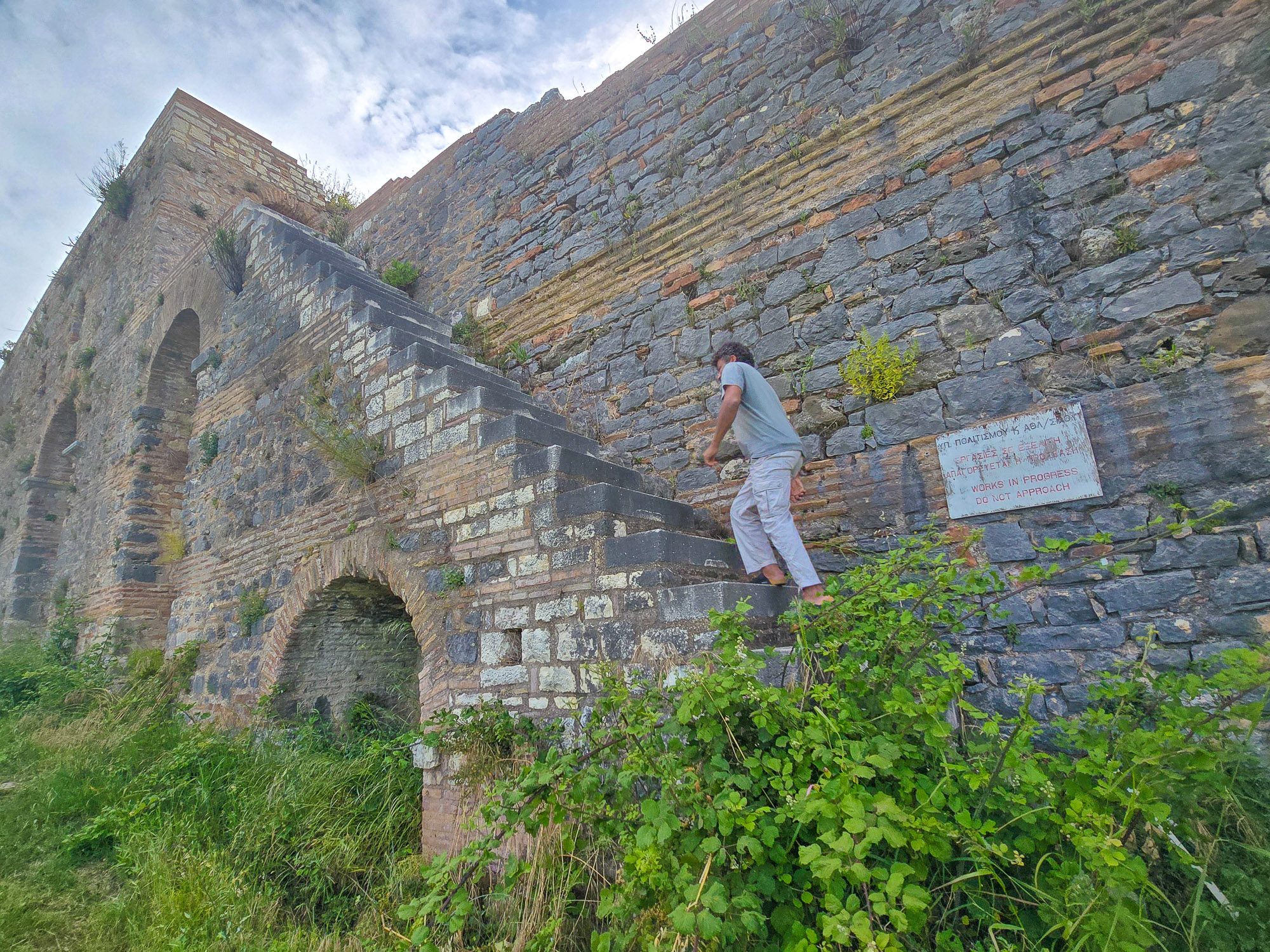
On the exterior, the arched openings at the lower level of the stage building are the vomitoria, the entry and exit passages designed to move large crowds in and out quickly. The name comes from the Latin for to spew forth, which is exactly what they did with audiences at the end of a performance. Nothing more dramatic than that, despite what the name suggests. A sign on the wall advised us not to approach. Peter seemed to treat it as an advisory rather than an instruction.
The theatre eventually fell into ruin as Nicopolis declined, its stone reused elsewhere. Restoration has been ongoing since the 1960s, with the most recent phase funded at 2.8 million euros. Excavation has unearthed the channel for the stage curtain between the stage and the orchestra, confirming the mechanism for raising and lowering it. At its peak the theatre held around 10,000 spectators. Greece has nominated Nicopolis for UNESCO World Heritage status. The theatre is working towards being a living venue again rather than simply an archaeological site, which feels like the right ambition for a building this substantial.
The House of Ekdikos Georgios
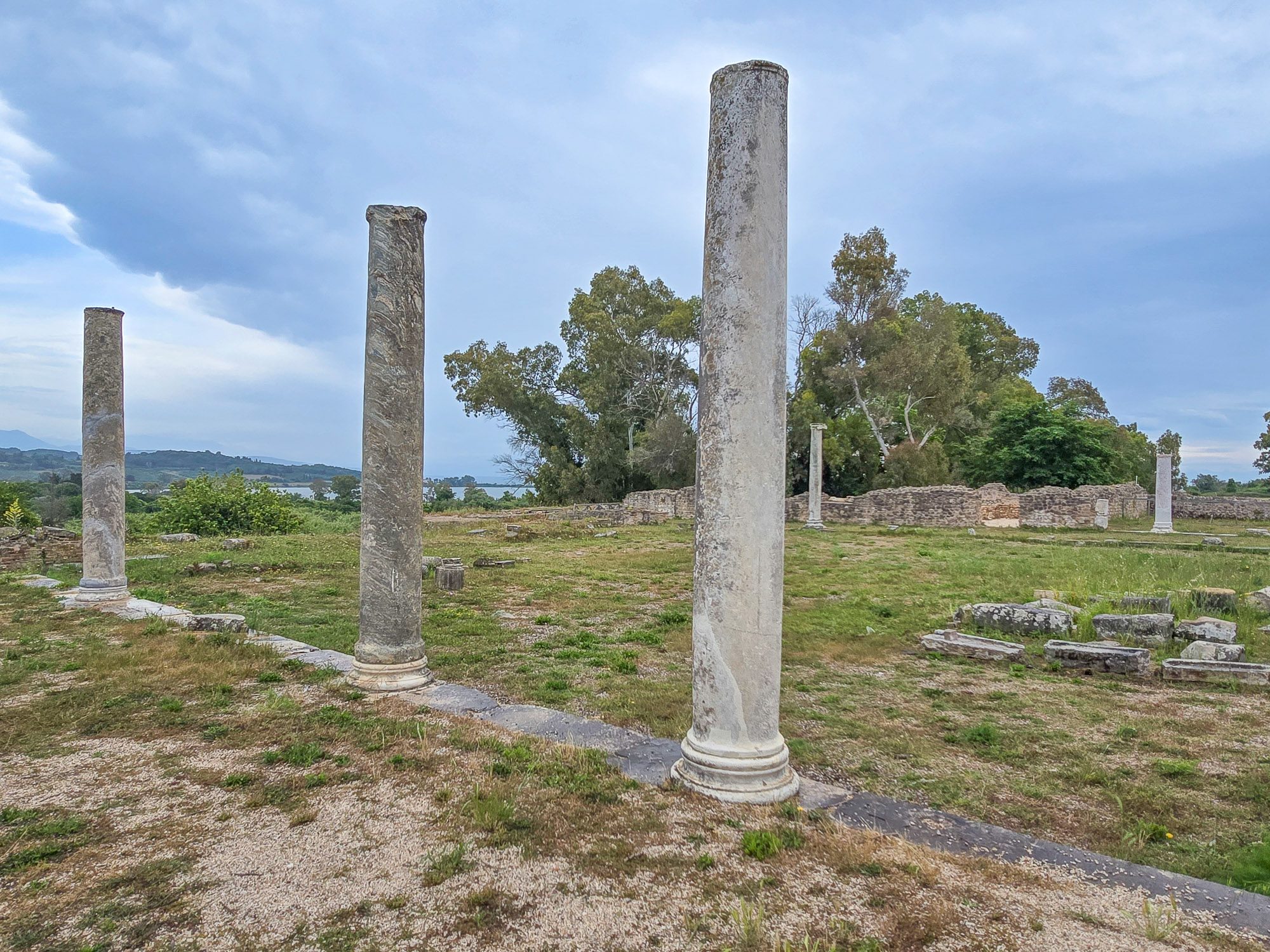
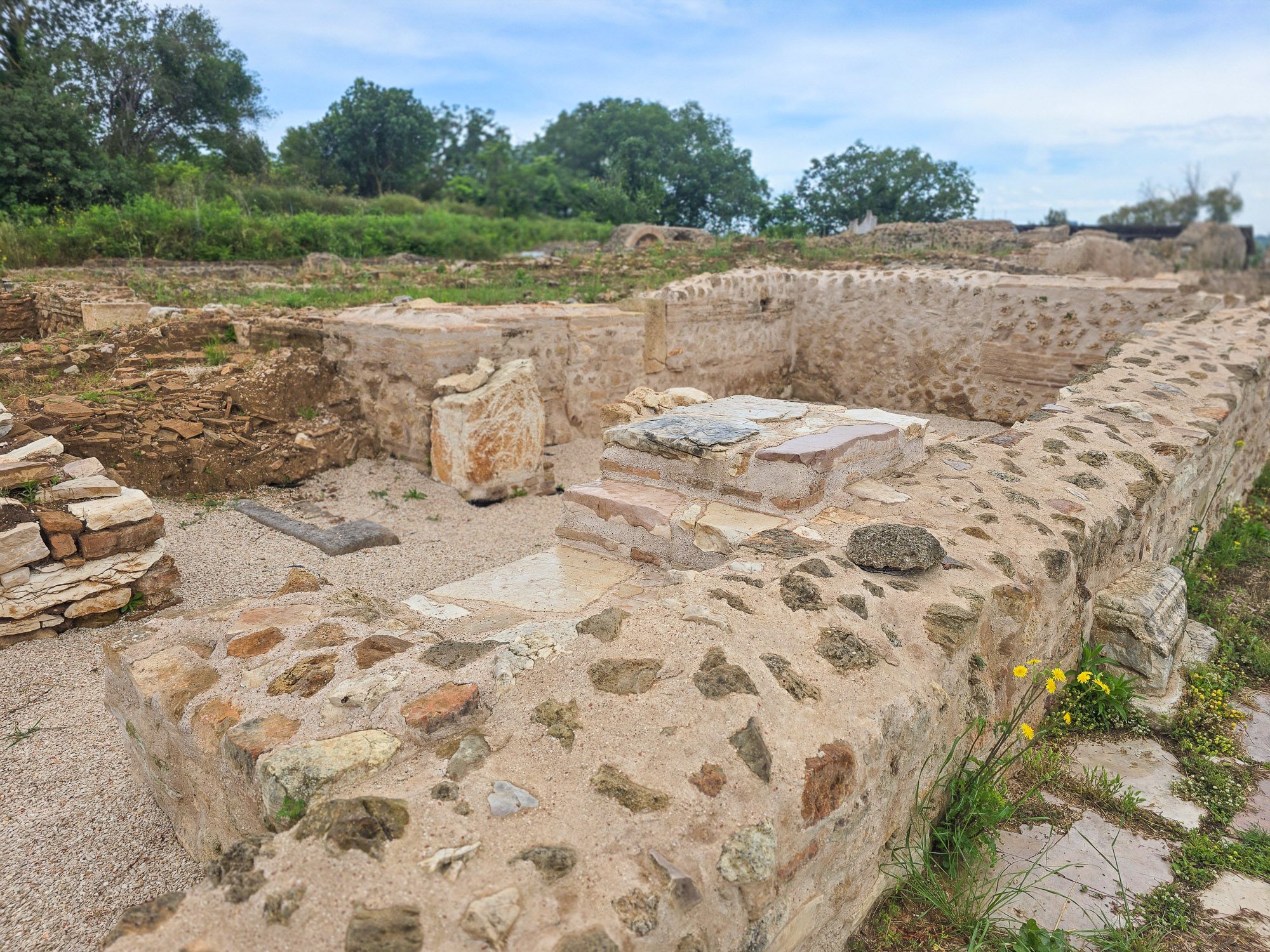
The House of the Ekdikos Georgios takes up an entire city block, which gives you some idea of the scale of wealth in Nicopolis at its peak. Built in the first century AD, it sat on the main east-west street of the city and was at least two storeys high. The entrance portico kept visitors dry while small workshops flanked either side, a reminder that even the grandest Roman residences tended to have a practical commercial element attached.
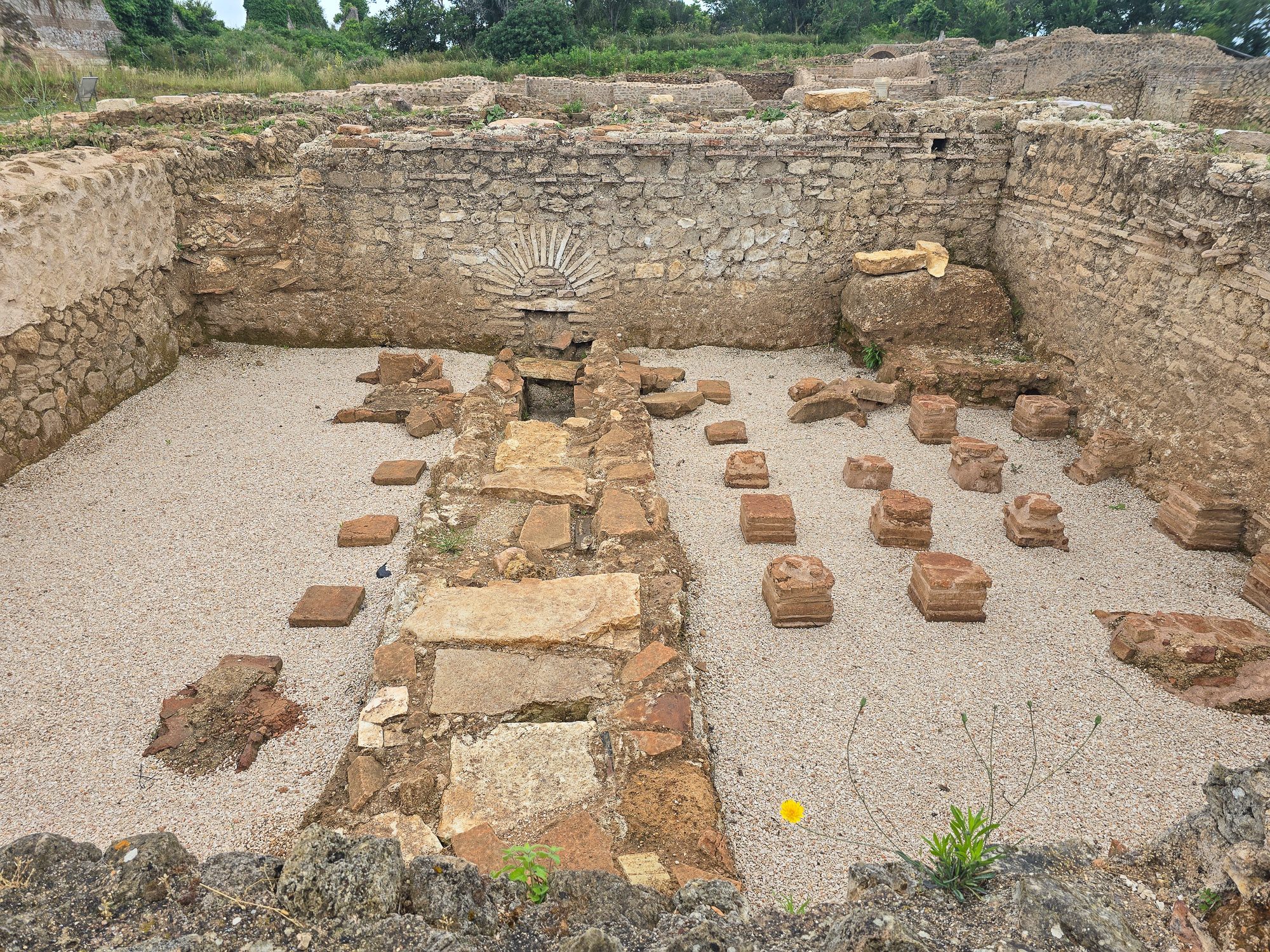
Inside, the floors were marble and mosaic, the walls decorated with coloured plasterwork and marble panels. The atrium had a shallow rainwater collector set into the floor, the impluvium, which brought water in through an opening in the roof above. Beneath the floors, a hypocaust system provided underfloor heating. Beneath the street outside, drainage pipes carried waste into the city’s central sewage system. The Romans were thorough.
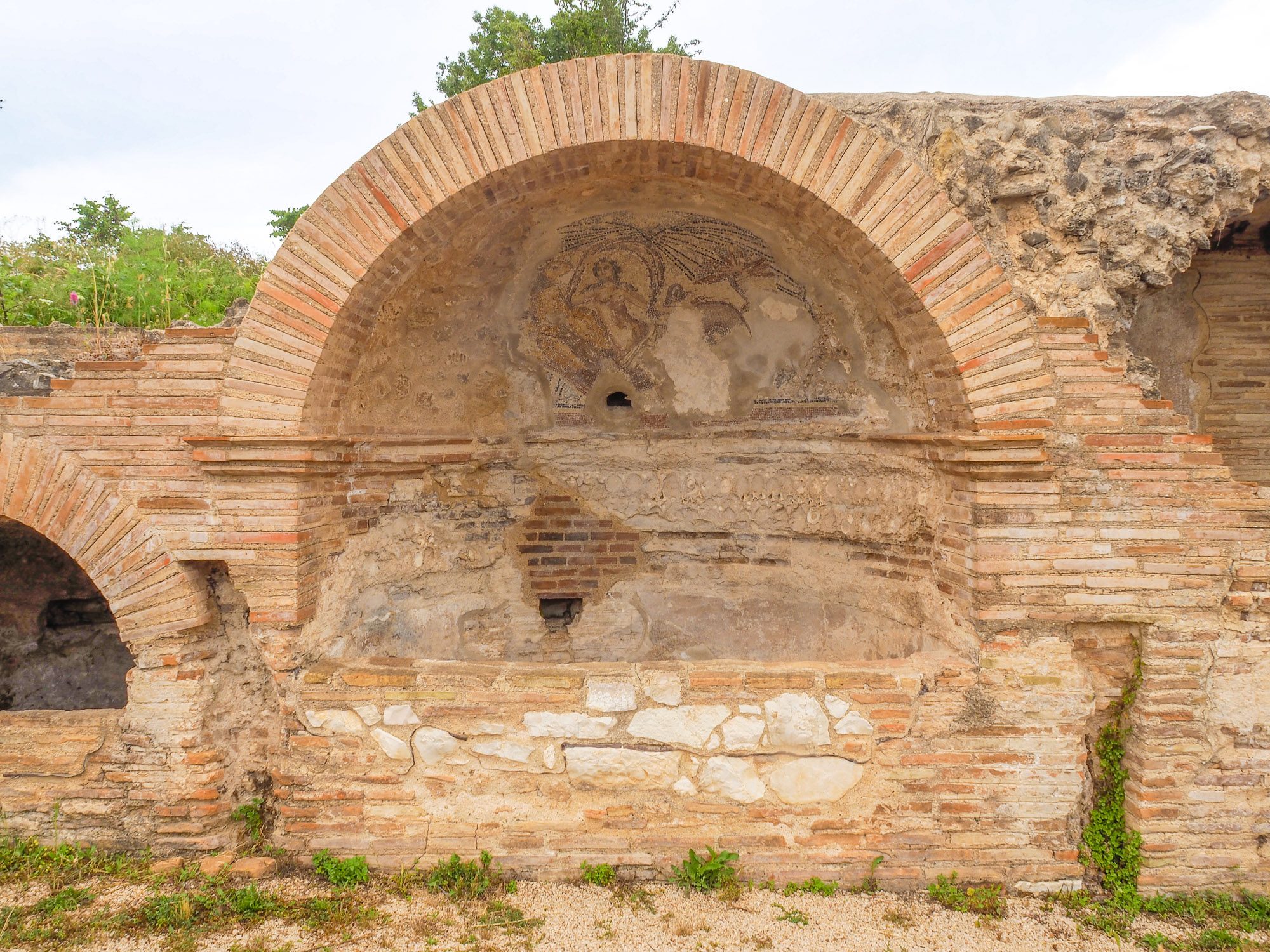
The northern part of the house drops to a lower terrace where the nymphaeum survives in good condition. The largest of its four niches contains a wall mosaic of a Nereid riding a sea monster, still visible inside a handsome brick arch. The vault above was decorated with winged figures of Victory holding palm branches. For a private house rather than a public building, it is a considerable piece of work.
The owner received clients in a formal reception room for the daily ceremonial greeting known as the salutatio. By the fourth century the property had passed to a man called Georgios, who held the title of ekdikos, roughly equivalent to a public defender, charged with protecting ordinary people against abuses by those in power. His name and title survive in a mosaic inscription in the southern portico. The bath complex is still legible in outline, and evidence suggests it was later repurposed as a baptistery.
The Basilica Complex
About 100 metres from the Ekdikos Georgios house stands Basilica A, also known as the Basilica of Bishop Dometius. It was the first basilica of Nicopolis at which excavations were carried out, beginning in 1915, and it sits in the southern part of the Early Christian city. The church measures 54 by 37 metres, a three-aisle timber-roofed basilica with rubble masonry walls alternating with courses of brick. Two bishops named Dometios were involved in its construction and decoration, the second completing the mosaics in the third quarter of the sixth century.
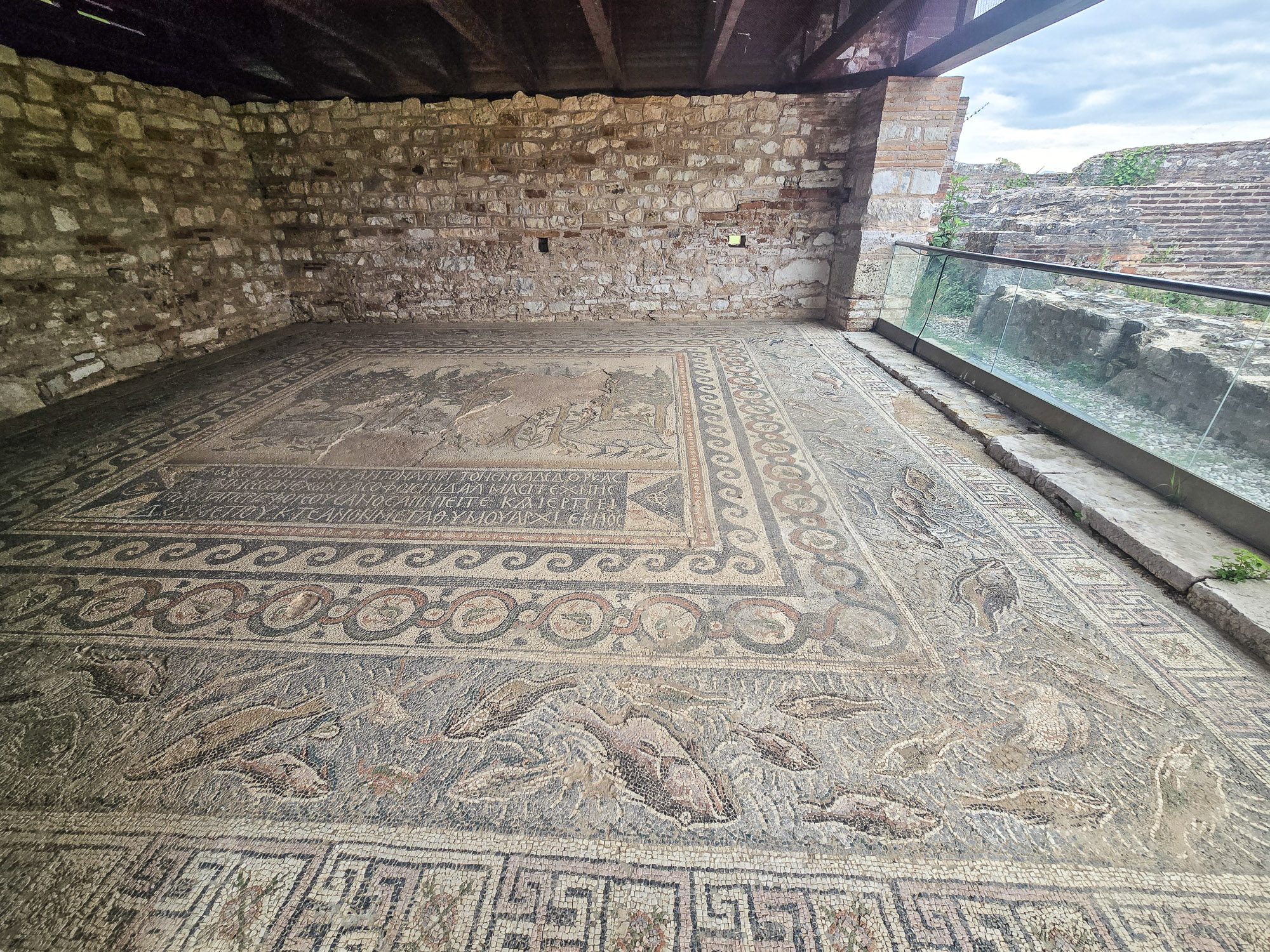
The mosaics are the reason to visit and they are among the finest surviving examples of Early Christian mosaic work in Greece.
The south apsidal annex, the diakonikon, used for receiving offerings from the faithful, contains what is described on the site’s own information board as one of the finest pavements in Early Christian Nicopolis. It depicts 147 squares filled with animal and plant motifs: fruits, flowers, hares, geese, partridges, storks, shrimp, cuttlefish and lobsters. In the chamber apse, a vine grows from an amphora surrounded by nine peacocks, a motif carrying Eucharistic symbolism. A four-line inscription at the entrance names Dometios as the dedicator.
The atrium mosaics cover all three surrounding porticoes, repeating the animal and plant themes throughout. In the west portico a five-line founder’s inscription mentions both bishops named Dometios and the church’s patron, Saint Demetrius.
Five of the human figures depicted in the mosaics are fishermen, shown using lines, rods, harpoons and nets. Two others are hunting birds. Nicopolis was a significant fish production centre whose catch from the Ambracian Gulf was known across the Roman world, and the mosaic record is specific enough that modern researchers have identified the species shown. The rounded body and fleshy lips of several fish panels are consistent with grouper. Those rendered in blue suggest dentex.
The Apostle Paul came to Nicopolis around 63 AD, most likely in winter. His letter to Titus refers to Nicopolis directly and he founded a church here, one of the earliest centres of Christian teaching on the western Greek coast. The site now sits on the cultural route In the Footsteps of the Apostle Paul.
The Roman Odeon
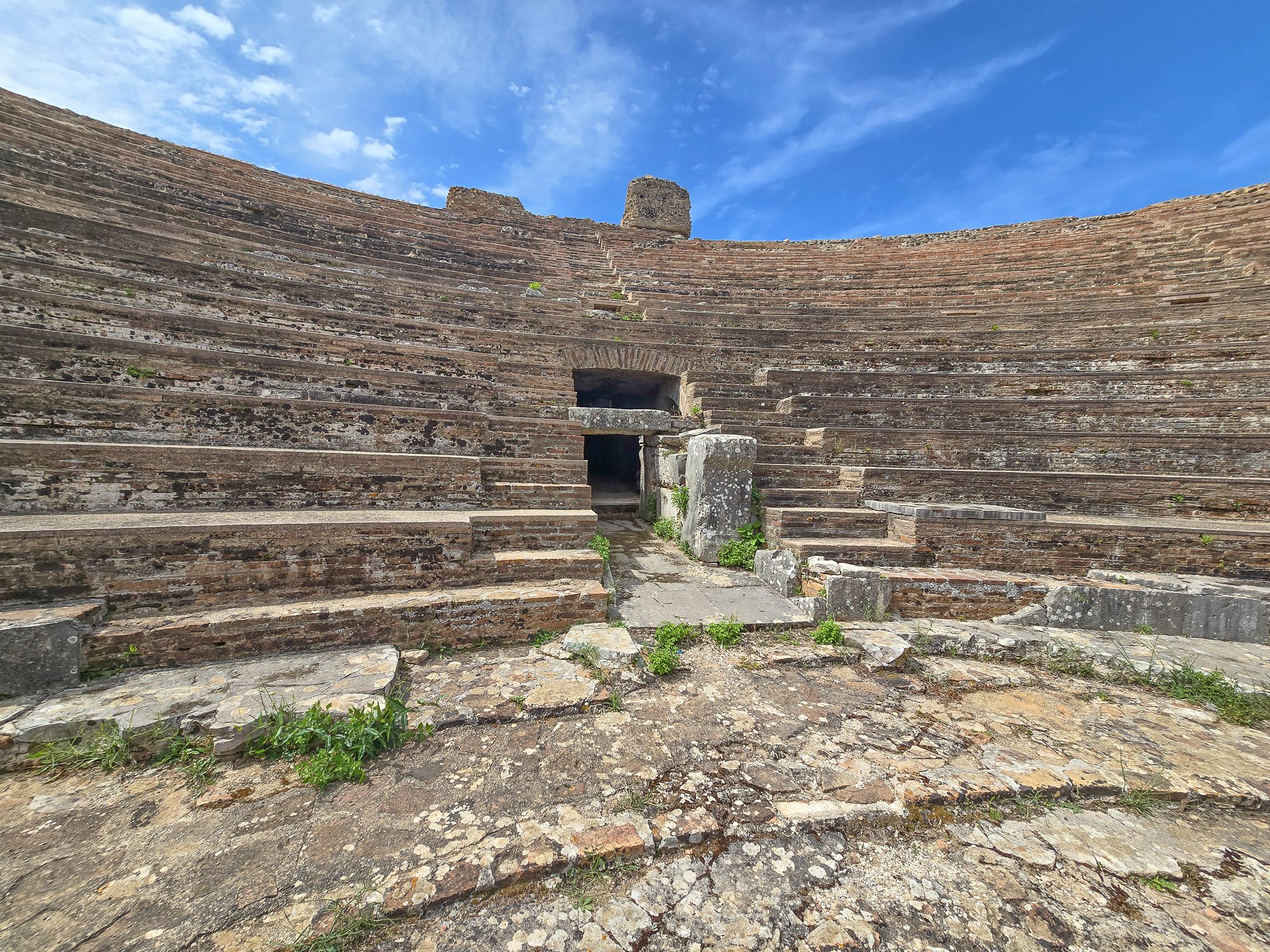
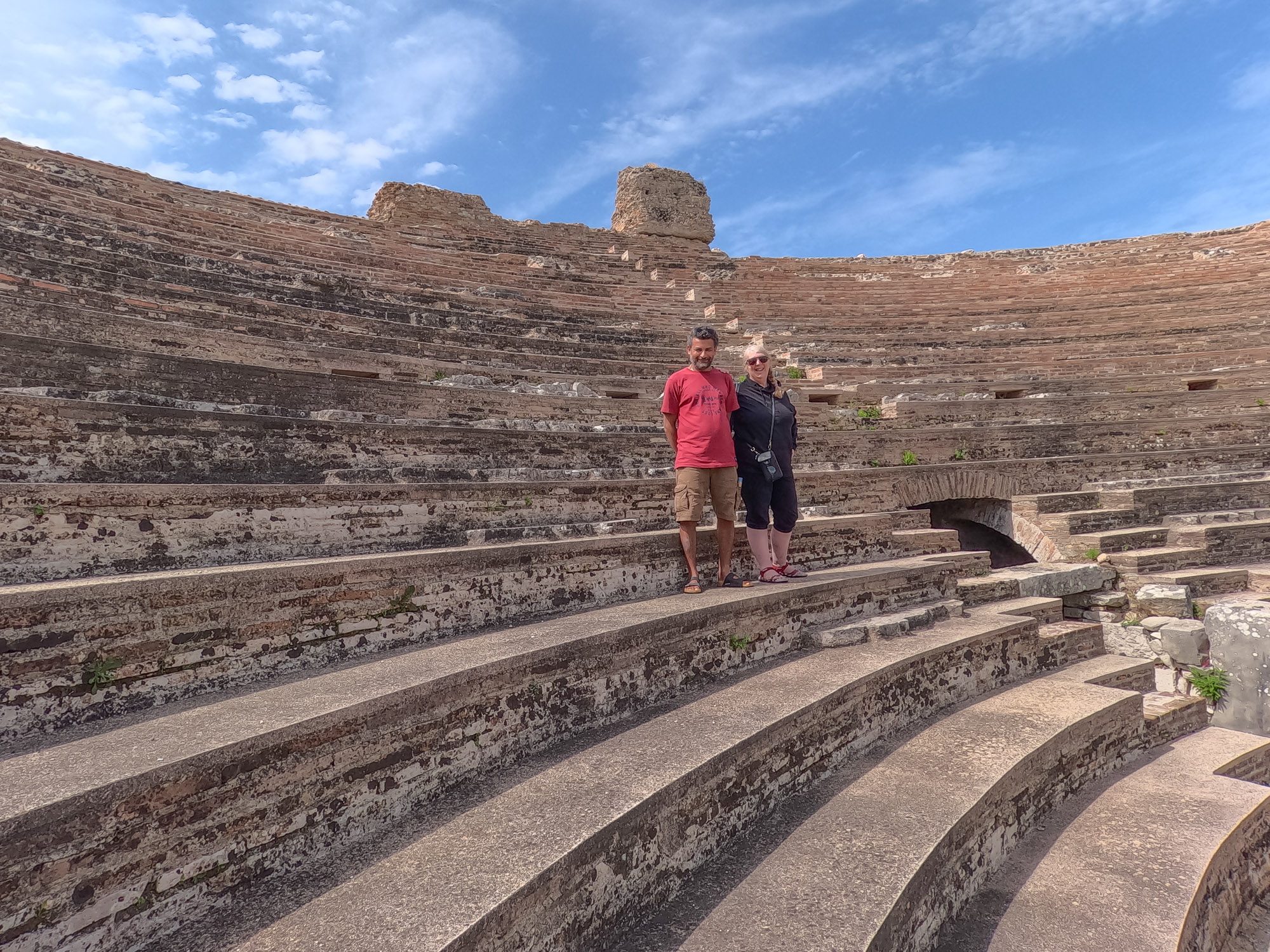
The Odeon sits at the centre of the ancient city, adjacent to the Roman agora. Built in the early first century AD during the reign of Augustus, it had a capacity of around 1,600 and was used for lectures, literary and musical contests and theatrical performances during the Actian Games honouring Apollo. For the rest of the year it most likely served as a council chamber. It has 19 rows of seats divided into two sections by a central corridor, and its stage building rose to two levels.
The Odeon has a connection that is easy to miss. When Emperor Domitian expelled all philosophers from Rome around 93 AD, the Stoic philosopher Epictetus came to Nicopolis and established his school here. He stayed until his death around 135 AD. His teachings, documented by his student Arrian in the Discourses and the Enchiridion, have influenced Western philosophy ever since. Whether he lectured in this particular building is not confirmed, but it is the obvious candidate.
Anyway, Ioannis thought this would be a great opportunity for me to sing in the auditorium whilst he videoed it. My response was not on his or anyone else’s nelly! I have a voice that sinks ships, plus despite the impression I may give, I’m very much the introvert and have more interest in observing than performing. Instead I volunteered Peter.
Peter is a good old sport and willingly (almost) took to the stage and recited a poem in Arabic. Well done Peter and thanks for getting me out of a scrape with embarrassment!
That brings our whistle-stop tour of Zalongo (the previous post), Arta, Koronissia and Ancient Nicopolis to an end, and all brought to life by our wonderful friends and guides Ioannis and Angeliki of Epirus Traveller
Epirus Traveller
Next, a final roundup of this trip that took us from Kefalonia to Ithaca and Meganisi followed by Lefkada and Preveza. And Ioannis was right all along. I’m glad that I followed his advice and gave more time to Preveza than Lefkada. And even then, we only just managed to squeeze everything in!
Discover more from
Subscribe to get the latest posts sent to your email.
MY BIG FAT GREEK TRAVEL SURVEY
How do you really plan your Greek adventures? I'd love to hear from you.
TAKE THE SURVEY →