The Pechlevanides Compete: Inside Greece’s Greatest Oil Wrestling Festival
On Tuesday, the last day of the festival, as the early evening heat began to wane, there was a noticeably different atmosphere around Sochos. The quiet lull of the hot afternoon was replaced by a growing sense of anticipation.
As I walked up through the cobbled streets towards the old aloni, now the Menelaos Vasilikos Stadium, a steady stream of cars made their way up through the outskirts of the village. People continued arriving on foot from every direction. The audience had travelled from neighbouring villages and beyond.
The unmistakable cry of the zournades drifted across the rooftops, seeming to draw people towards the arena long before it came into view.
The musicians have been playing at this festival for longer than anyone living can remember. Less well known is that until the 1950s, the wrestling itself was organised by the church committee, with the municipality only taking over after that. The link between the competition and the feast of the Holy Apostles it belongs to has never been merely ceremonial.
Foteini, a community representative who graciously gave me her time told me that the zourna is believed to have evolved from an ancient Greek instrument called the Oxiavlos. The name is Greek. Wrestling was practised in Greece long before the ancient Olympic Games. Another piece of evidence linking Greece and Greeks alike to this sport. Though not quite in its original naked format.
The Naked Truth about Oil Wrestling
There appeared to be not one but two groups of musicians, and as the evening progressed I understood why. The raw, guttural cry and beat of the music never stopped once, showing as much relentless determination to see it through to the end as the wrestlers about to compete.
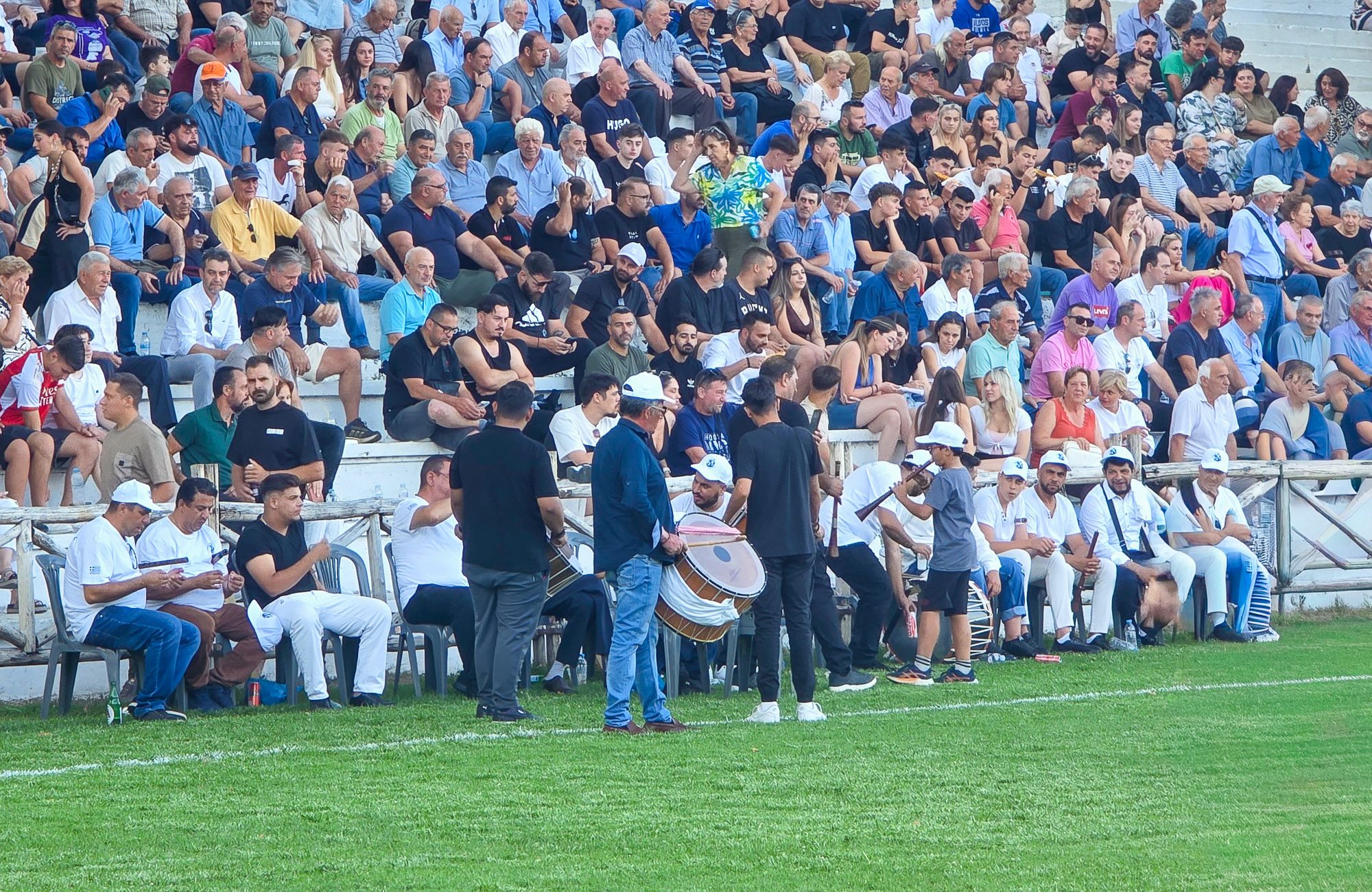
The stadium itself was thrumming with fast-food stalls already doing brisk business, charcoal barbecues sending fragrant smoke into the warm evening air. Local cafés and bars had erected pop-up bars along one side of the arena, groups gathering around tables with food, beer and tsipouro already flowing. Opposite sat another line of tents occupied by municipal officials and festival organisers.
It was impossible not to appreciate the scale of organisation required to stage an event like this, months of planning, countless volunteers, the efforts of the local authority all combining to produce something that appeared absolutely effortless. Behind the scenes, I suspect, it was anything but.
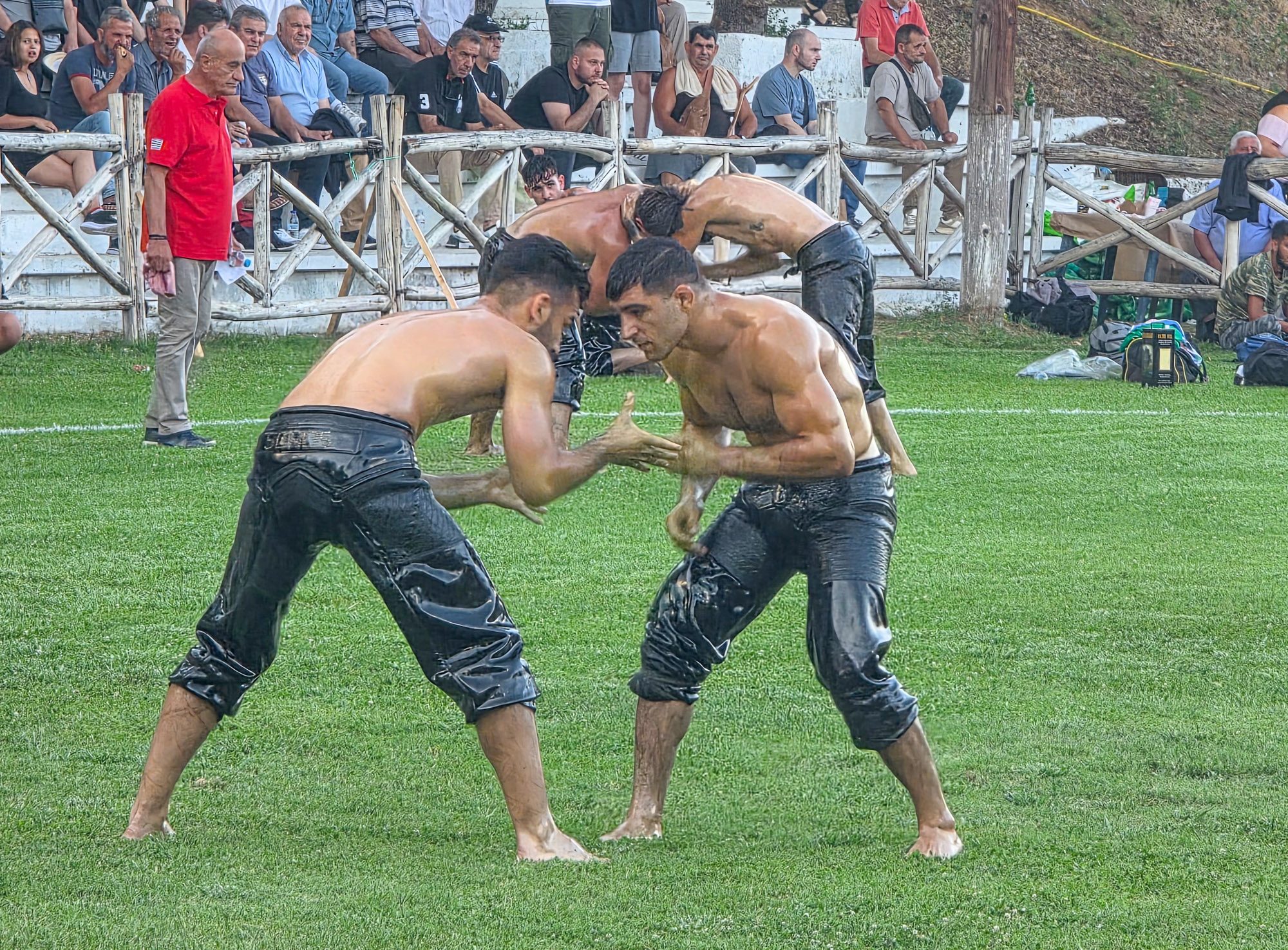
Along one side of the arena, the Category One and Two wrestlers had already begun preparing. Pairs of wrestlers helped one another tighten the leather straps of their kiouspetia, pulling firmly around the waist and just above the knees, where a loose fastening might offer an opponent the slightest advantage. Others checked each other’s oil coverage, making sure every exposed part of the body glistened evenly.
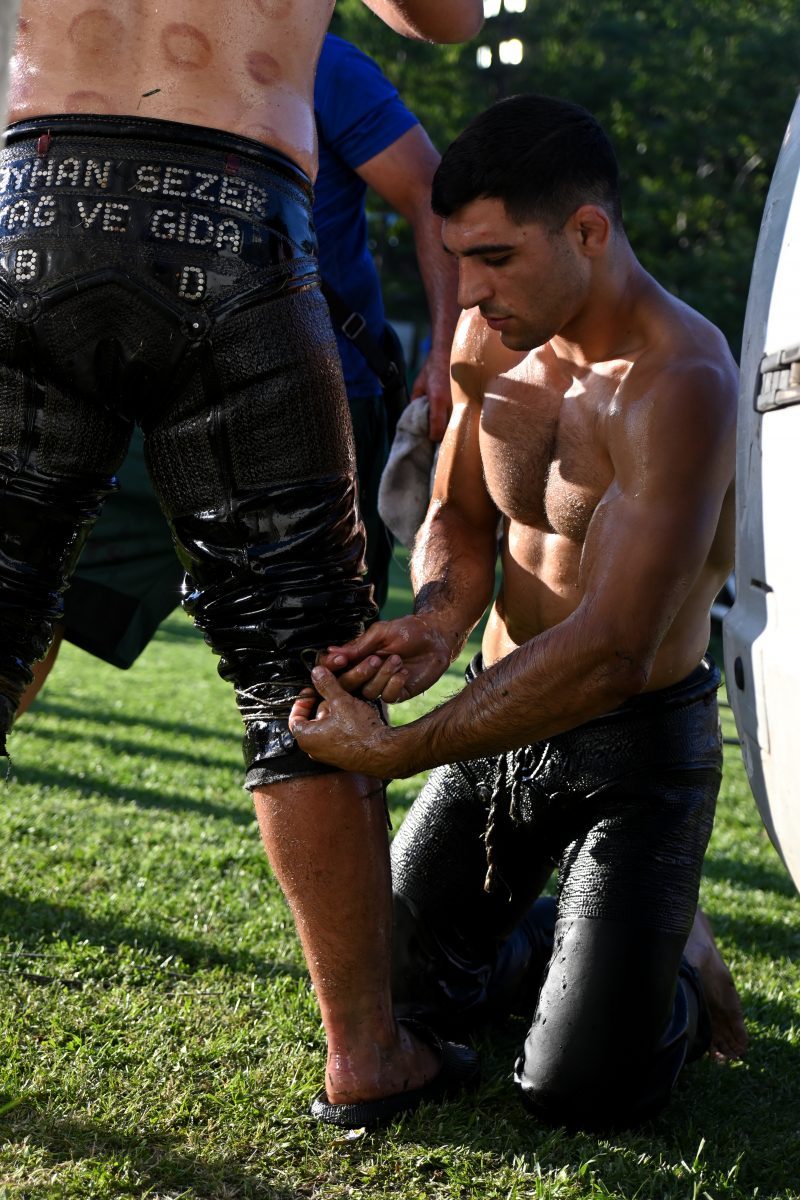
This was followed by a series of warm-up exercises, such as stretches, lunges, arm swings and waist twists. There was a broad array of body types in the line-up. Tall, short, stocky and slender, which quickly put paid to my assumption that the sport was suited to one particular build. As I was to discover watching the competition, more than anything it was skill and experience that gave the advantage – not height, not muscles, not weight.
The referees, easy to spot in their bright red shirts printed with the letters SKAL, the initials of the regional association of sports officials based in nearby Lagkadas, gathered in the centre of the arena for a roll call of both categories.
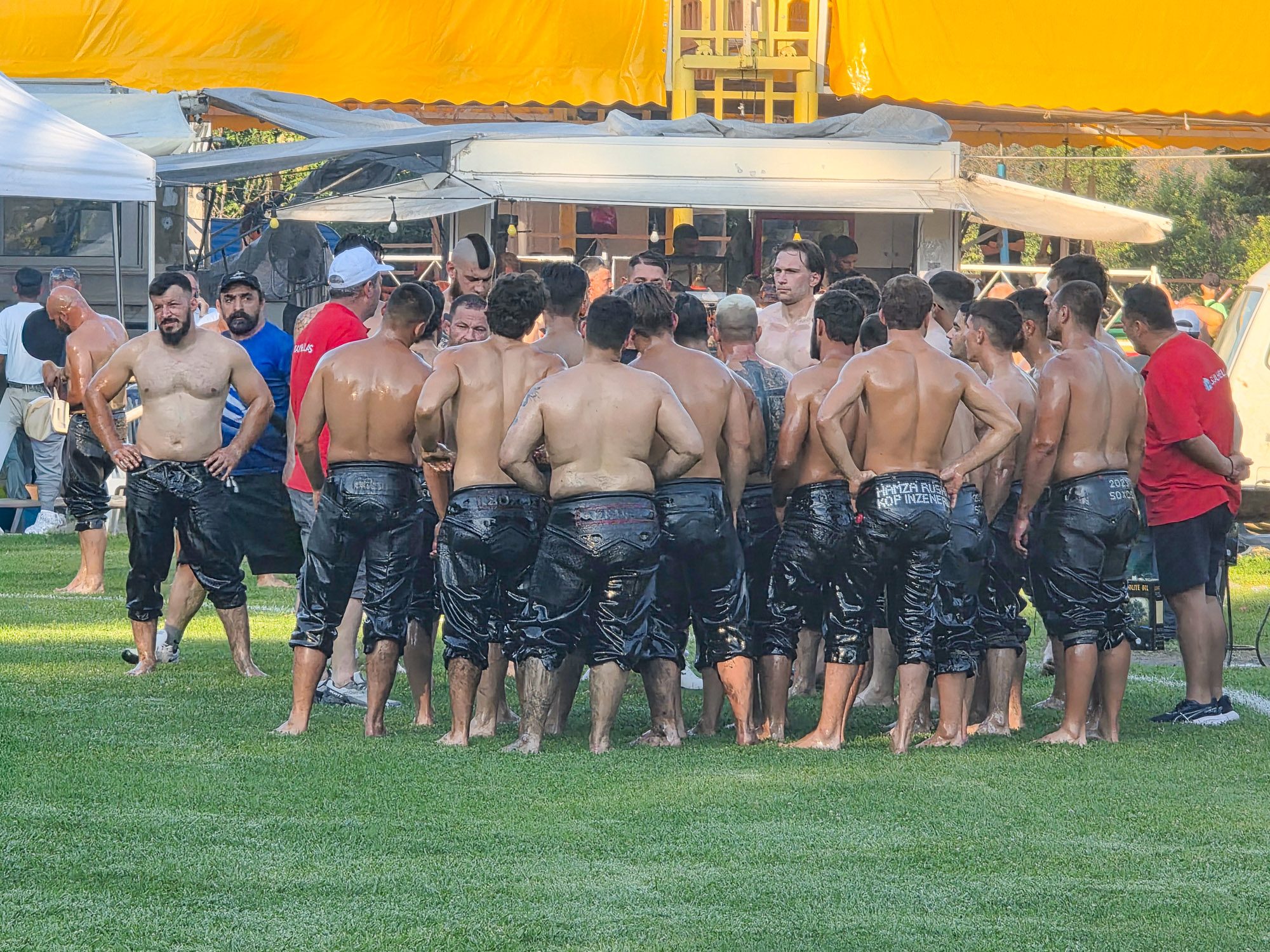
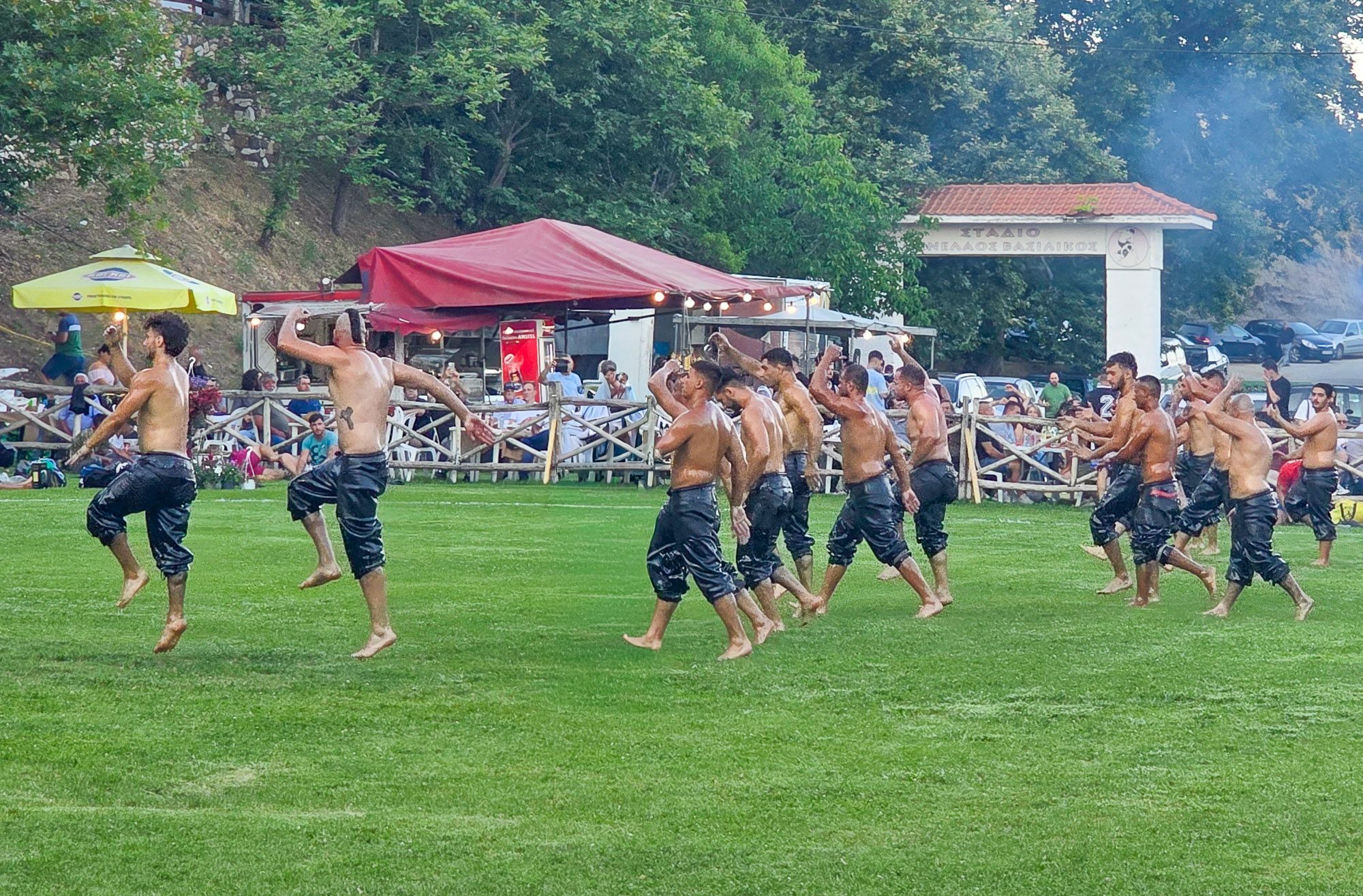
Then came the ‘Peşrev’, known locally as the Pesrevi, the ceremonial pre-match ritual that has accompanied oil wrestling for centuries. Moving in unison to the steady rhythm of the zournades and daoulia, together they marched forward with deliberate steps, arms swinging rhythmically before slapping their thighs and knees. It was accentuated by springing into the air on one foot whilst bending the opposing leg – a move I described as a ‘Peter Pan leap’ that was almost balletic. This was an acknowledgement of the ceremony and the opponents standing alongside them. It wasn’t simply a warm-up. It was tradition.
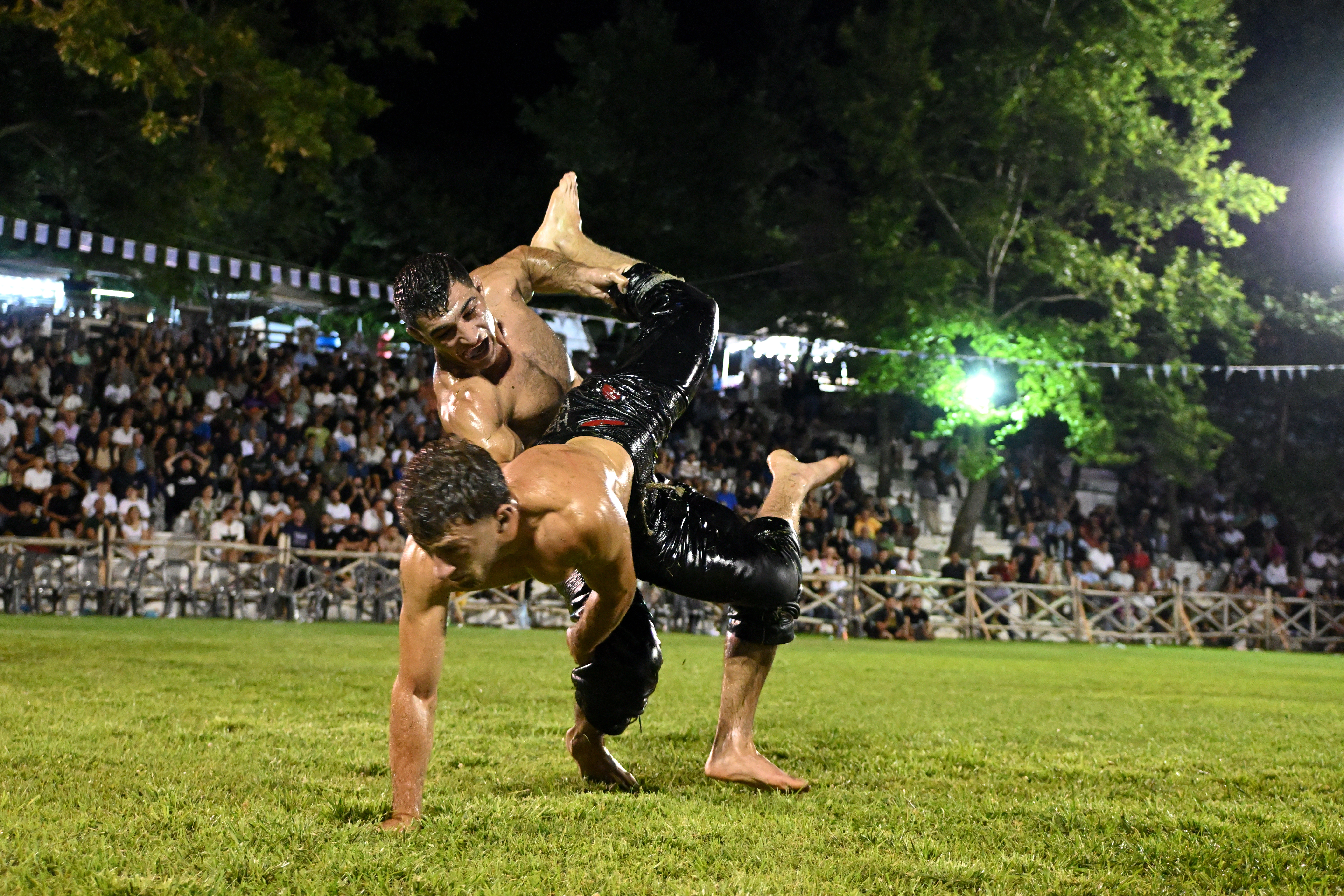
Only once it was complete did the competitors move into their pairs, each greeting his opponent with a handshake and brief embrace before settling into position, some crouching low with hands extended, others reaching immediately for control around the shoulders, some circling patiently, searching for the slightest opening, others testing their opponent’s balance from the very first moment.
Focusing on just one contest proved almost impossible. With about a dozen pairs competing simultaneously across the field, every time one pairing caught my attention, another seemed to erupt into action elsewhere. I quickly gave up trying to follow individual matches, and instead found myself watching the arena as a whole, an ever-changing landscape of movement, strategy and sheer physical effort.
Occasionally a roar from the crowd signalled that someone, somewhere, had finally made their opponent show his ‘belly to the stars’. More than once I turned just in time to miss it.
Some matches were fast and furious. Others slow and measured. Occasionally almost stationary, two men locked together, each waiting for the other to commit to their next move. At any one time, a lot was going on on the field. As one round entered its last few death throes, the next group of wrestlers had already entered the arena to perform another Pesrevi even more vigorous than the previous one.
I’d imagined the most uncomfortable part of watching oil wrestling would be to see competitors slammed onto the ground, or have the full weight of an opponent’s forearm pressed across the neck. It wasn’t. As the contests grew longer and more intense, sweat mixed with oil began to run directly into the wrestlers’ eyes, and time after time I watched them blinking furiously, screwing their eyes tightly shut for a split second before forcing them open again. Trying to keep focus on the opponent whilst their eyes were on fire seemed quite a challenge in itself. Occasionally the referee paused proceedings just long enough to hand over a cloth and a bottle of water, and the wrestlers quickly wiped their faces, rinsed their eyes, and resumed exactly where they’d left off.
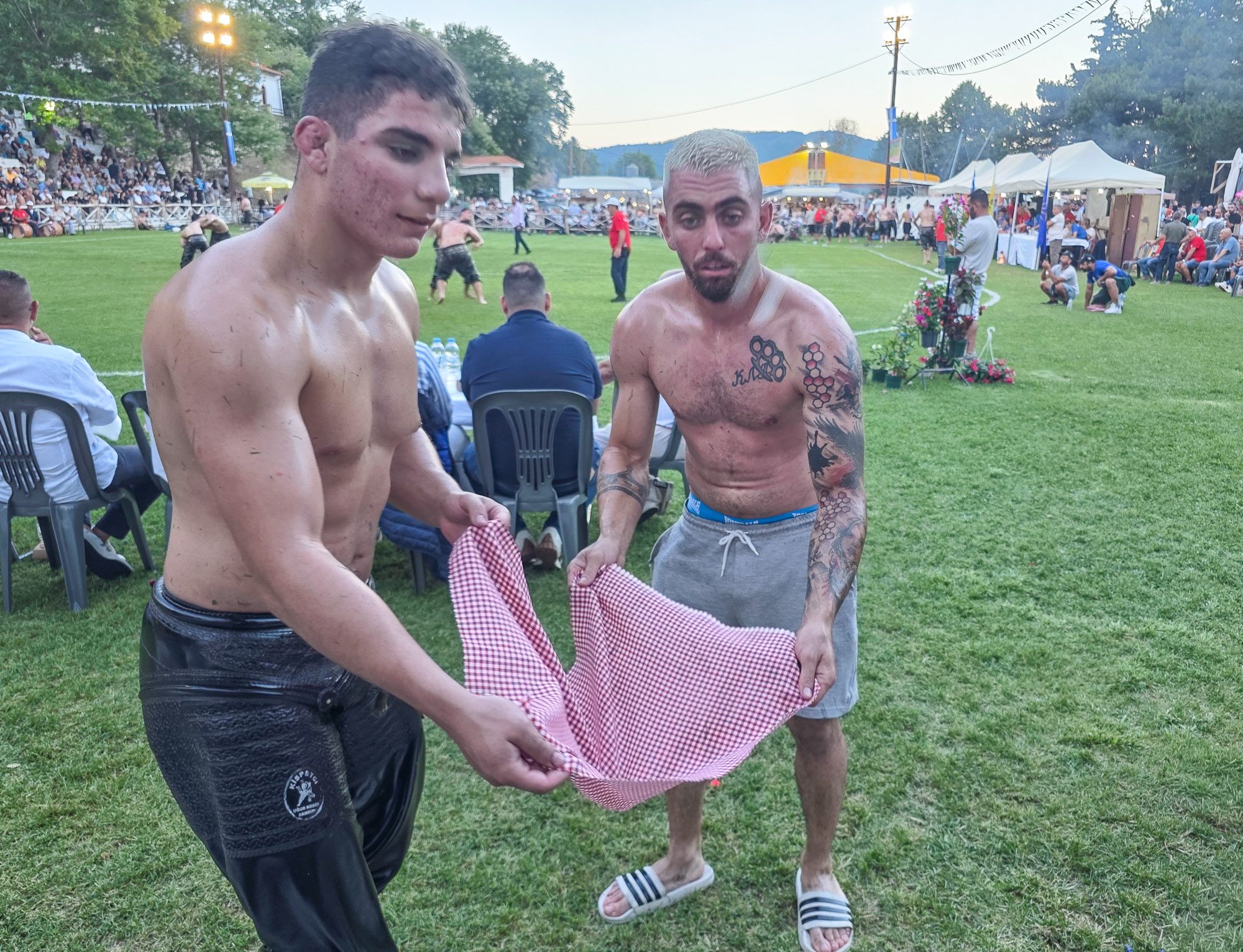
Again, as with the junior competition, the ‘parsa ’, a cloth carried by both competitors, was taken around the arena for donations. They carried the whiff of olive oil as they passed. Not the aroma of a first-press virgin olive oil that you’d eagerly dip your bread in. Something a bit more – utilitarian, shall we say.
The musicians, who until then had remained seated along the edge of the arena, occasionally sprang to their feet, continuing to play as they slowly made their way around the stadium, first towards the tables occupied by local dignitaries, then weaving between the marquees where increasingly cheerful spectators offered glasses of tsipouro and words of gratitude for everything they bring to the festival – atmosphere, tradition and endurance. Remarkably, the music never faltered. The shrill cry of the zourna and the relentless beat of the daouli became the pulse of the entire evening.
As darkness slowly settled over the stadium, the atmosphere shifted again, the number of competitors gradually reducing until there were just a couple of pairs on the field. Those who remained were now evenly matched, every contest lasting longer, every advantage harder won.
The bouts stretched on, neither wrestler willing to concede, neither prepared to make the smallest mistake. The determination I’d admired in the children’s competition earlier that day was still here, only now forged through years of experience.
The musicians responded by matching the intensity of their playing as though willing the remaining competitors to find one final reserve of strength.
At the end of the night, winners were declared. Trophies were awarded and the evening came to an end.
The one thing that left the greatest impression on me throughout this whole contest was the sportsmanship and camaraderie shown on the field. Even after a gruelling bout which resulted in one winner and one loser, a handshake and an embrace were almost without exception given. Whatever side a contestant fell on at the end of a bout, their response was gracious and it was humble. Attributes that will carry these men a long way beyond the aloni.
I left the floodlit stadium in the early hours of the morning and made my way back through the quiet streets of Sochos, the sound of the excited chatter faded behind me now muffled into the hillside.
I’d arrived expecting to watch a traditional sporting event. What I left with was different.
Oil wrestling may be what first draws people to Sochos. It isn’t what makes the festival special. That’s something harder to define. It lives in the generations who carry it forward, the musicians who barely stop all night, the wrestlers who come here to compete and a community that seems to have no interest in letting its traditions become a performance. It is a tradition that Sochos carries with an enduring pride.
It’s fair to say that I left that stadium with more questions than I had answers – as I do with most Greek festivals I’ve attended.
Thankfully, I was able to get a deeper insight into the sport through my interview with Beach Wrestling World Series champion and winner of his category at the Sochos competition Christos Christoforidis.
Meet the Champion: A Conversation with Christos Christoforidis
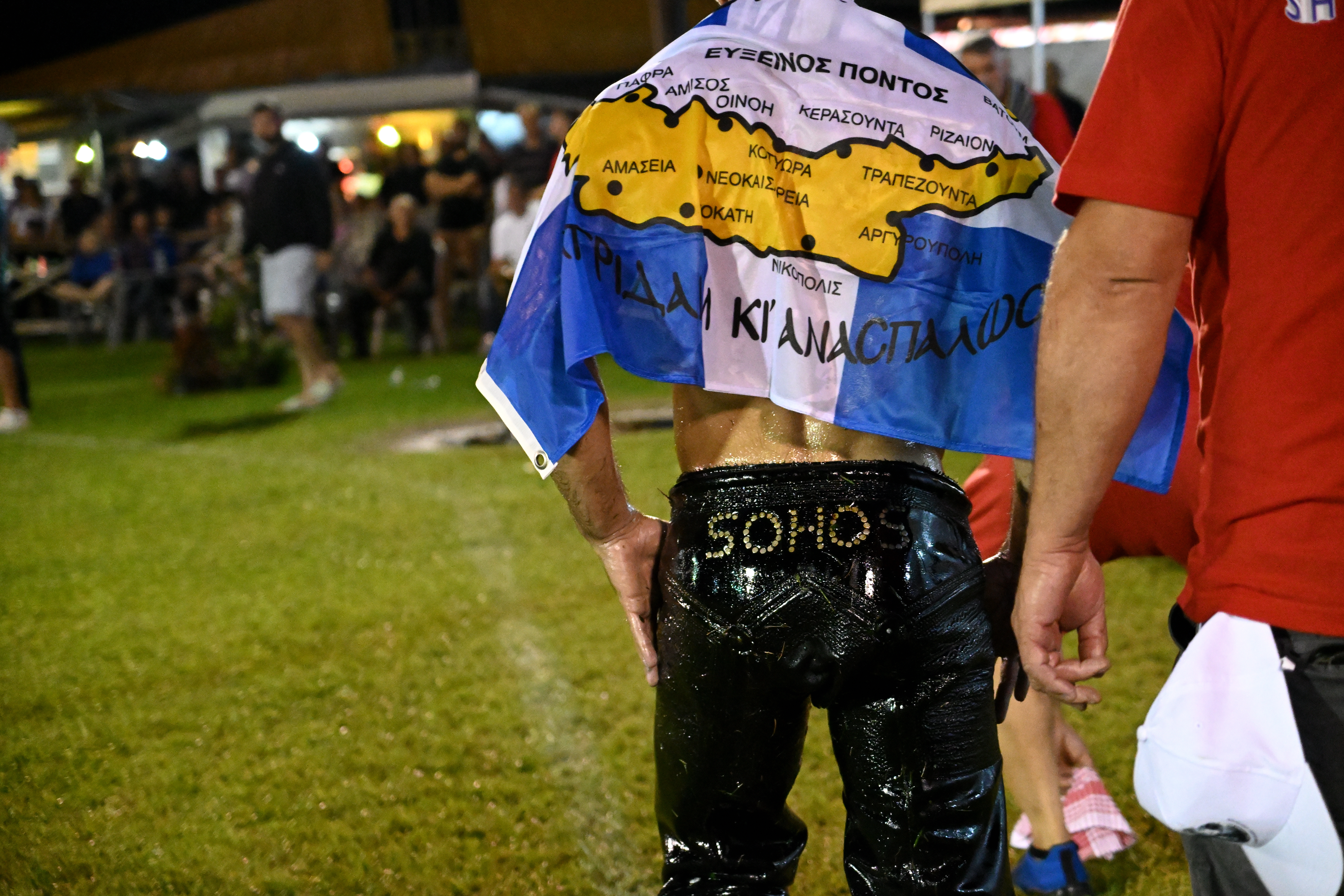
Christos Christoforidis is a Thessaloniki-based wrestler and member of the Nikolaos Karypidis Wrestling Club, named after the Greek wrestler who competed in the 63kg category at the 1968 Mexico City Olympic Games. Christos has been training there since December 2012. He also coaches at Grappling School Thessaloniki and is a Beach Wrestling World Series champion. At Sochos this year, he won his category outright with five wins, including victories over two North Macedonian national freestyle champions in his semifinal and final.
After watching him compete, I was keen to find out more, and Christos turned out to be a generous interviewee.
Q: How did you first get into wrestling?
A: “I knew the sport from a very young age through my uncles and had already been going to a wrestling gym from the age of three or four. I officially joined a club just before I turned thirteen.”
Q: What drew you to that club specifically?
A: “It was the first club I found. I really liked the training atmosphere and even more the sport itself. I wanted to join on the spot and wrestle. Even though I was only twelve, I went to the gym on my own, without my parents.”
Q: What were you hoping to achieve at Sochos this year?
A: “I was chasing first place. I would be very happy with only that.”
He got it.
Q: You faced two North Macedonian national champions in your semifinal and final. What was that like?
A: “Certainly, when you compete against champions, that alone shows a lot. Although I was in very good condition, the athletes from Skopje know oil wrestling very well, which makes things quite difficult. It is much more dangerous to make a mistake and have them exploit it. You have to be much more careful because one mistake can cost you immediately.”
Q: Your family has Pontic roots. Can you tell me about that?
A: “My great-grandparents grew up there, in Santa in the Pontus region, and from either Trebizond or Samsun on what is now Turkey’s Black Sea coast. From a very young age I knew how to speak Pontic, since I spoke Pontic with my grandmother, my uncles and aunts, and of course with my parents too.”
It is exactly the kind of story I wrote about in Part One of this series. The 1923 population exchange that moved well over a million ethnic Greeks out of Asia Minor into a Greece many of them had never actually lived in, carrying dialects, customs and traditions with them. Christos is a living thread of that history.
Q: Has that heritage shaped you as a person and as a wrestler?
A: “Pontic families have a stricter discipline, but it is good for shaping principles.”
Q: The origins of oil wrestling are fiercely debated. Where do you personally stand on that question?
A: “The only thing that is 100% certain is that wrestling, which is the main sport, comes from ancient Greece.”
This from a man whose own family lived for generations inside the Ottoman world. He has considered the alternative. This is where he has chosen to stand.
Q: How does oil wrestling differ from Olympic or freestyle wrestling?
A: “The basic skills are the same. It requires more emphasis on patience because it is a much longer match and you must keep in mind above all not to risk being put on your back. Better to concede a point that will not cost you as much.”
He then added something unprompted: “I think it may be the best sport and all children should do it from primary school age.”
Q: Have you competed in oil wrestling festivals outside Greece?
A: “There were proposals twice for oil wrestling abroad, but in the end it did not work out and I did not go. I would want to at some point. As for the international competitions I take part in abroad, these are mainly beach wrestling world championships. There, the level is even higher because you compete against international champions and even Olympic champions.”
Q: Can you explain the parsa tradition to someone who has never seen it?
A: “After each match we pass through the stands holding cloth, and we shout Άντε μπάρμπαδες — come on, uncles — to encourage people to give money to the wrestlers. The custom is called βγάζω την πάρσα, bringing out the parsa.”
Q: Finally, how would you describe what wrestling means to you?
A: “It is a noble sport, but a difficult one. It asks for ambition and humility in equal measure.”
A fair description of the whole festival.
Thank you Christos. I really appreciate your time and good luck for future competitions.
Discover more from
Subscribe to get the latest posts sent to your email.
MY BIG FAT GREEK TRAVEL SURVEY
How do you really plan your Greek adventures? I'd love to hear from you.
TAKE THE SURVEY →