Tourlida: A Tiny Island of Salt and Stilt Houses
Getting from Nafpaktos to Tourlida
The time came to leave Nafpaktos. I’d already decided to head in a westerly direction, keeping my sights set on a couple of airport options for when I eventually decided to return home.
Getting from Nafpaktos to Tourlida turned out to be another lesson in how Greece’s regional bus network is organised. The bus from Nafpaktos to Antirrio is an urban bus service run by KTEL Aitoloakarnanias (try getting your chops around that one after an ouzo or two). These are local buses and easy to distinguish from the intercity and regional coaches. The service runs frequently throughout the day, but that’s the easy bit. I needed to find a bus that connected from Antirrio to Messolonghi without a long wait in between. Or, even worse, minutes to spare between the connection. Both services local and regional are run by the same company, same website, so no problem there. The timetable, however, only showed the starting point in Patras. Having already made that journey by bus once, I estimated the Antirrio leg at about fifteen minutes. From there I found the two connecting buses I needed.
It was fairly easy in the end. The urban bus departed at 9am from the back of the square behind the harbour. The journey to Antirrio took fifteen minutes, and before I knew it I was back at the Antirrio bus station, adjacent to the fort and the ferry port, in the shadow of the bridge looming overhead.
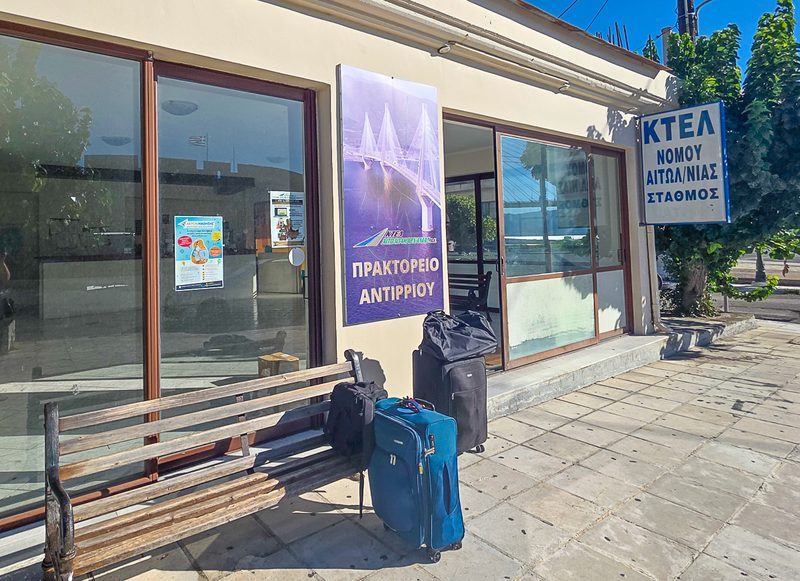
Inside, I bought my ticket to Messolonghi, just 4.30 euros, with confirmation that the bus would depart at 10am. It worked like a well-oiled machine.
Just to note there is a direct bus from Nafpaktos to Messolonghi – just one per day at the time of writing. It departs from outside the National Bank in the Nafpaktos town. However, its scheduled departure time is 0745. If you don’t like the early departure, the connecting bus is the alternative option.
The journey took about forty minutes, through a landscape scarred with quarries and swathes of agricultural land. The bus was full of young people, heading back to university, stopping at a satellite campus for Patras University along the way.
At Messolonghi I was able to pick up a taxi right outside the bus station to take me the five kilometres to Tourlida. I’ll admit, the drive along the road connecting the island wasn’t the quirky little journey I’d imagined, not like the ride across to Koronisia, all twists and turns along a narrow road with not much either side of it.
The road to Tourlida was built in 1885 under the sponsorship of the statesman Charilaos Trikoupis (yes, the same one the bus station and ferry terminal in Patras were named after), and is a fairly substantial affair, wide enough for two lanes of traffic, a cycle path and a pedestrian walkway beside.
I’d messaged my host to let her know my arrival time, and she said she’d do her best to have my room ready. And it was.
The Island Apartments
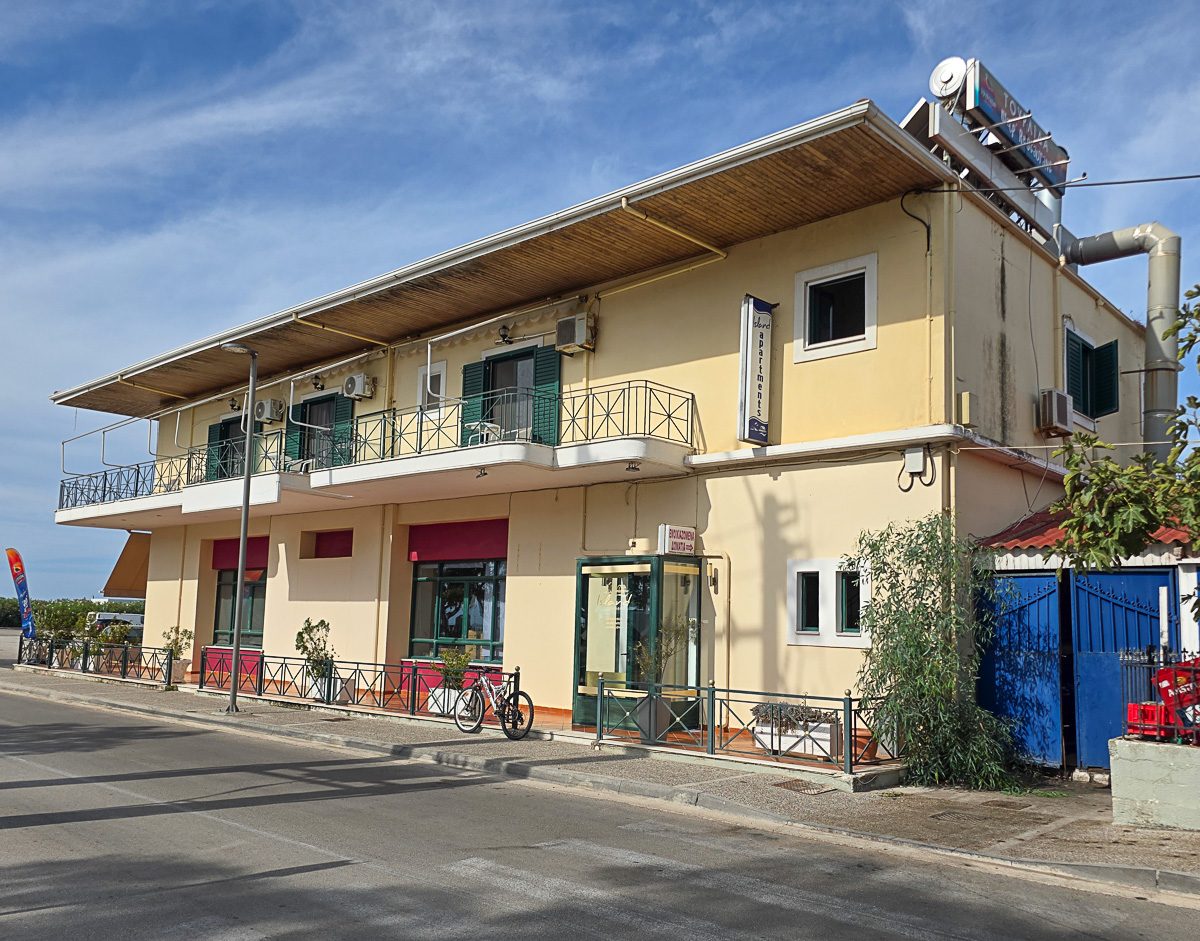
There’s really only one accommodation option on Tourlida, Island Apartments, located right on the water’s edge and above a well-renowned taverna called Tourlida Sunset Restaurant, which specialises in the seafood the lagoon itself produces, more on that later. Other smaller accommodations exist but they are far and few between.
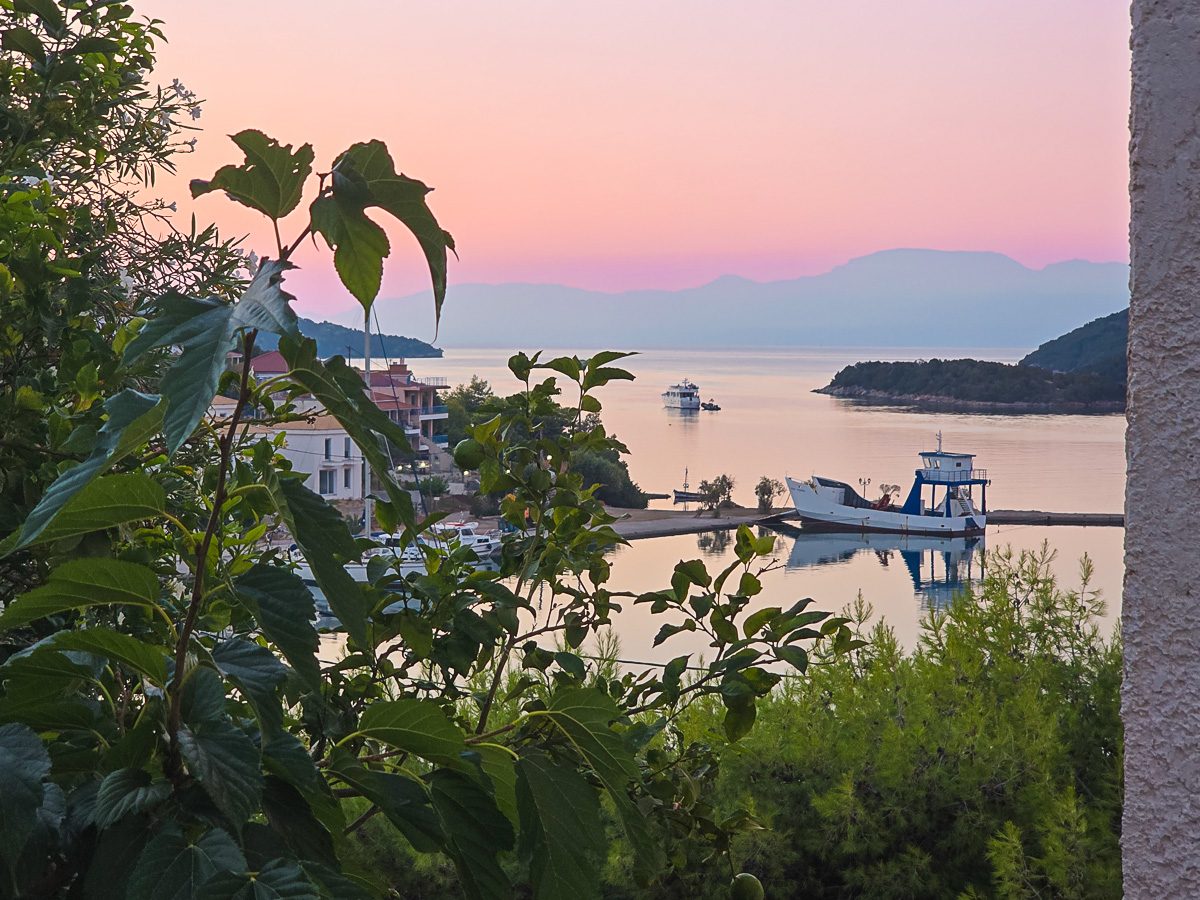
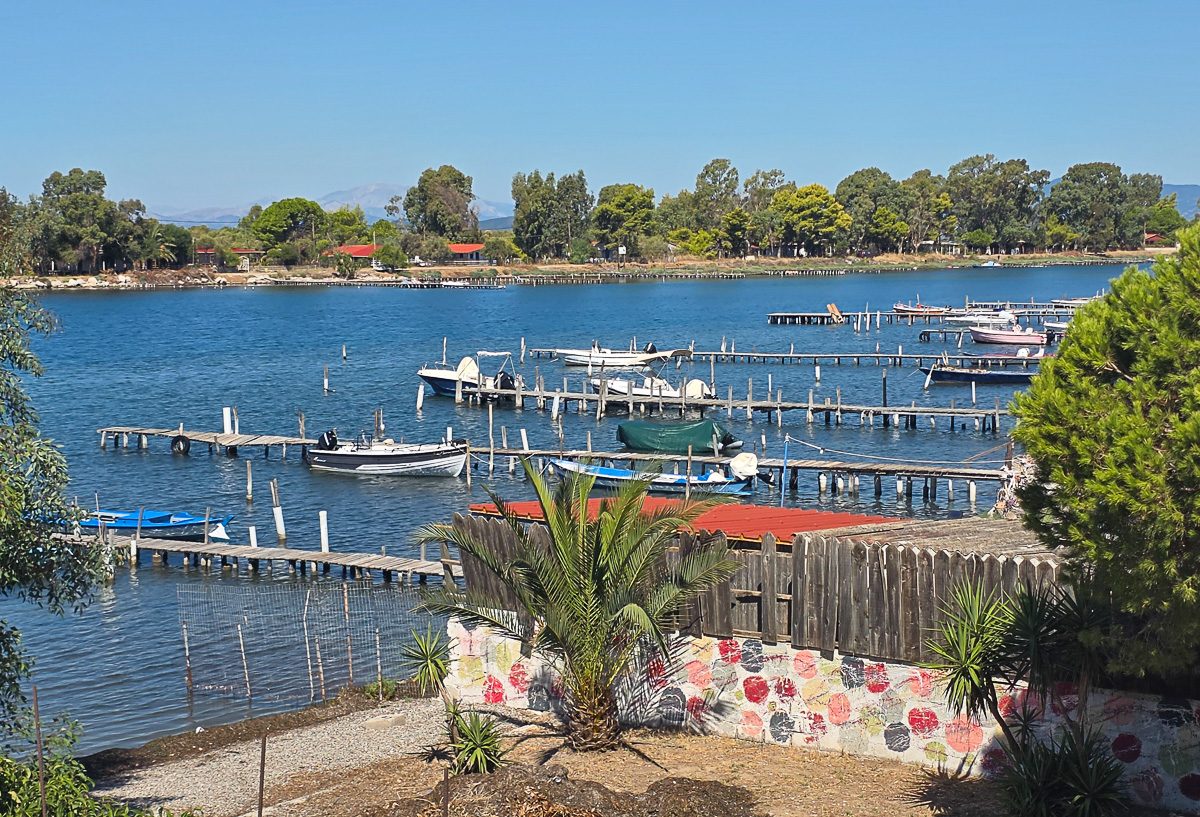
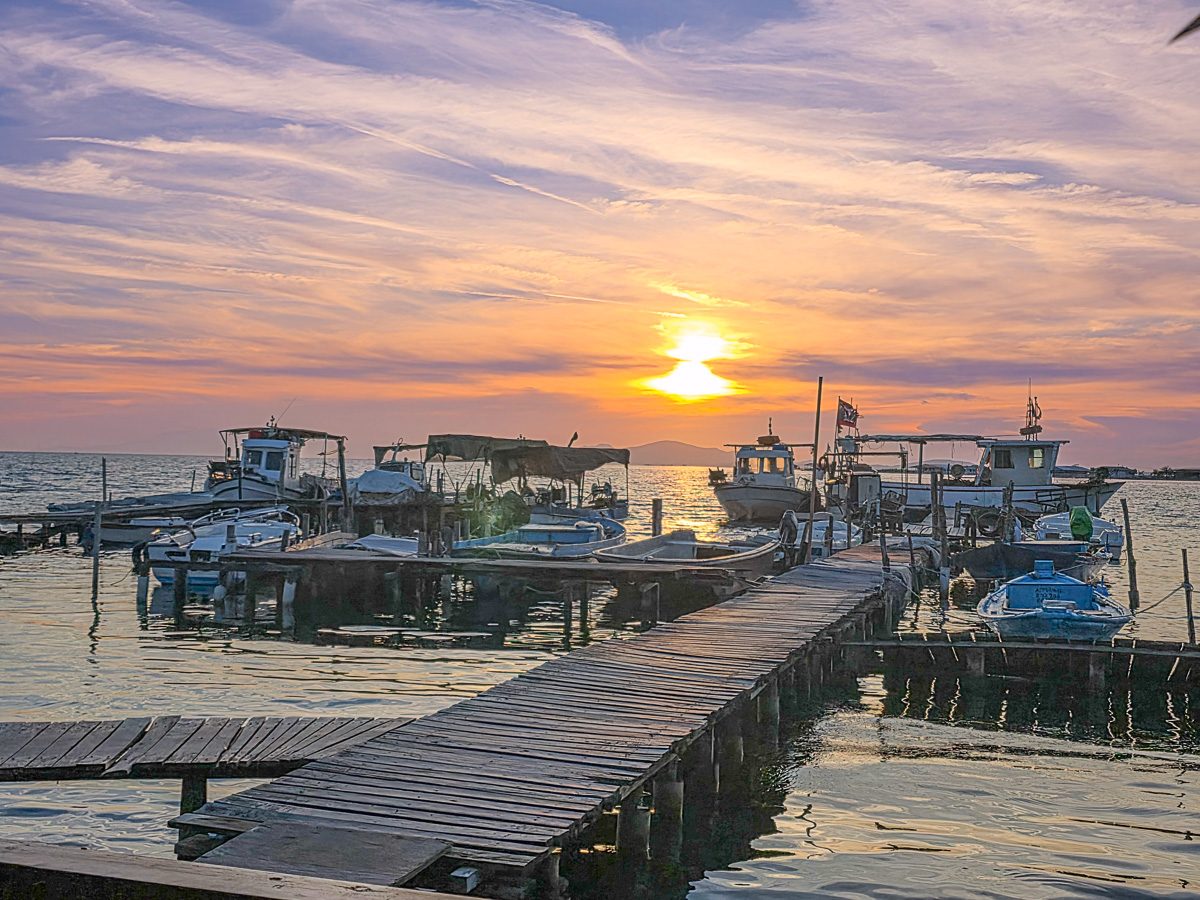
My room was modern and newly refurbished, soft grey tones, a slatted wood headboard, air conditioning, a small kitchen area with fridge and coffee making facilities tucked into one corner. The bathroom was exceptional, with a proper walk-in shower with a marble-effect finish, nothing tired or dated about any of it. And I was delighted to have a large balcony with an excellent view over the lagoon. Down below, the traditional fishing boats moored to narrow wooden jetties. As picturesque as this was, this was not for decoration. This are proper working boats.
I’d booked two nights and asked my host if I could extend but unfortunately there wasn’t any availability. With the weekend coming up, I expect this place is in high demand for a weekend getaway.
I booked Island Apartments through Booking.com at 73€ per night.
Book Island Apartments, Tourlida here:


The Pelades
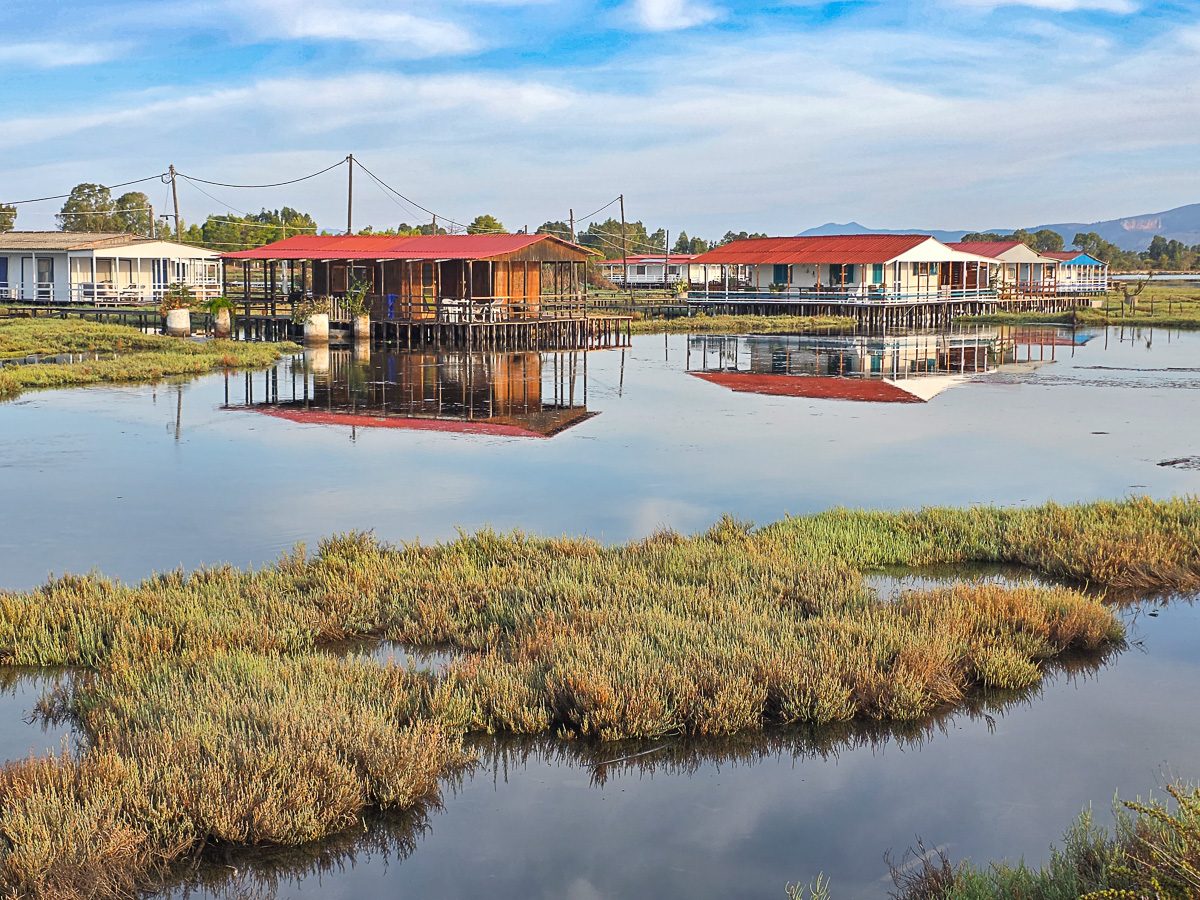
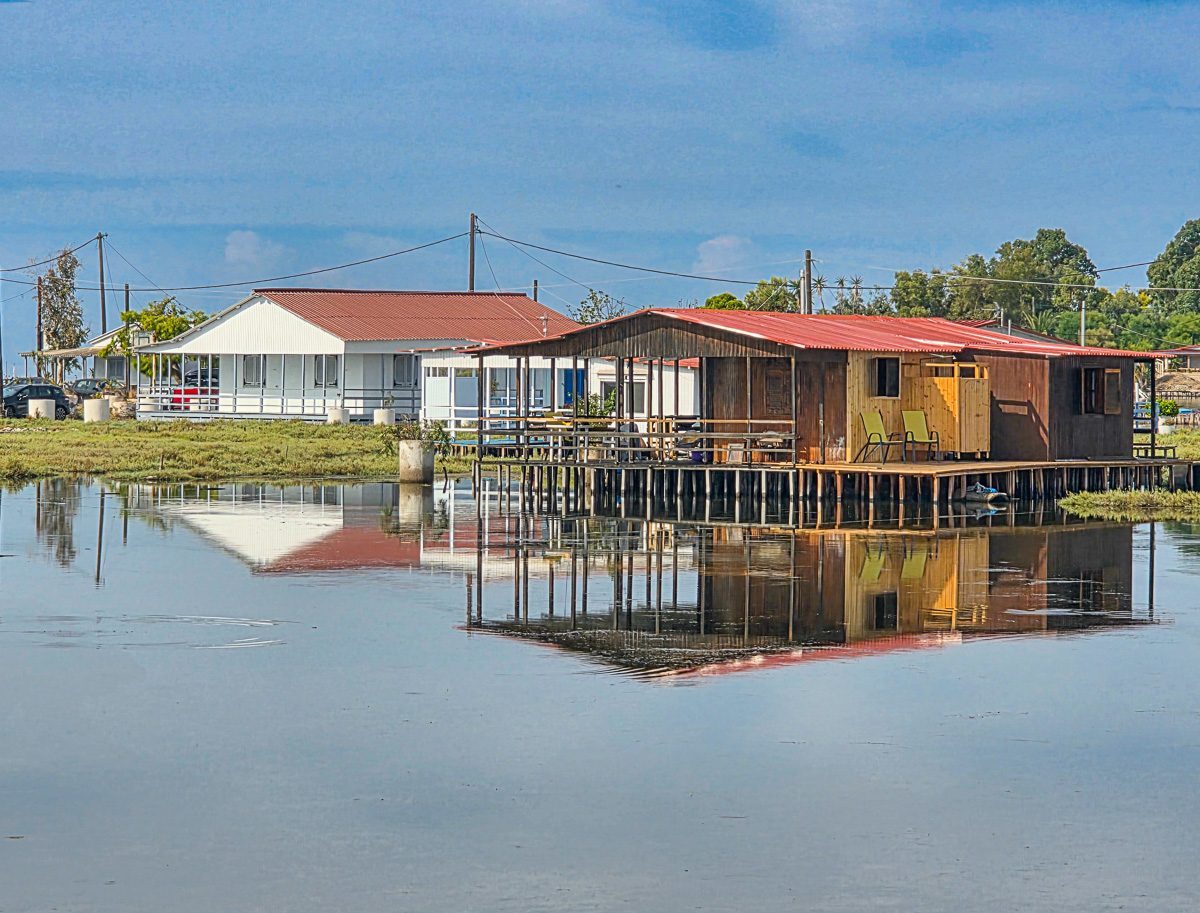
Sitting adjacent to the apartments is a cluster of traditional fishermen’s houses known as Pelades built on stilts along the edge of the lagoon. Fishermen first settled here in the sixteenth century, and the earliest versions of these huts weren’t timber at all, but a kind of waterproofed straw and reed construction, built up on stilts specifically to keep them clear of the water below. Timber came later. These are now mostly holiday homes rather than working fishing huts, though the structures themselves, raised platforms on wooden piles driven into the lagoon bed, haven’t changed much from their original purpose. A few are still worked by fishing families, the right to a particular spot in the lagoon apparently passed down rather than bought outright, which is part of why so few ever come up for sale even now.
The Salt Museum
A visit to Tourlida must include the Salt Museum which is about a 15 minute walk from Island Apartments along a road that cuts through the sea edge and the perimeter of the salt pans. I arrived at the Salt Museum just as a coach party of elderly Greek ladies were departing. Five euros got me in, along with an audio guide that filled in the gaps the information boards left.
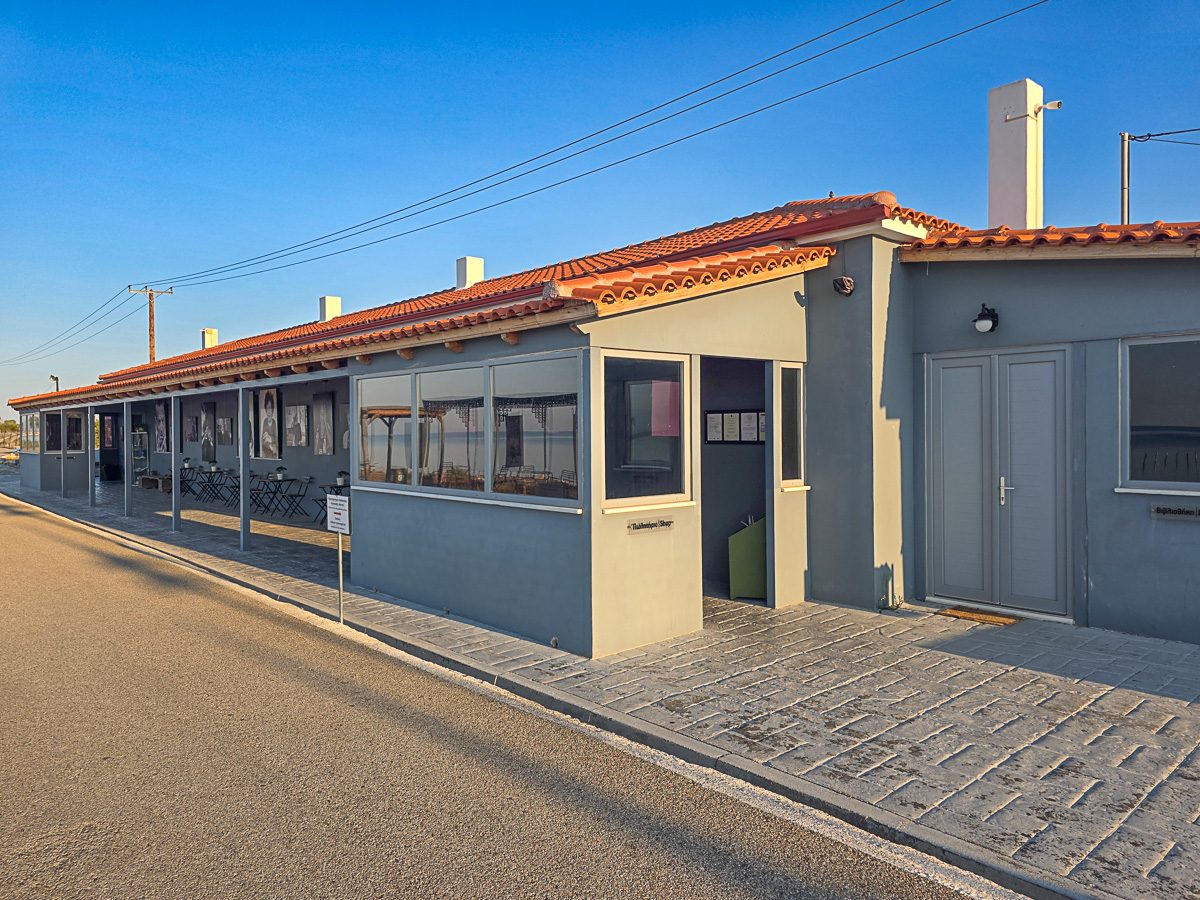
The building itself was constructed in the 1930s as housing for alykarios, workers brought over from the Ionian Islands to harvest the salt, known then as the Thalamos, five rooms facing out towards the pans. From the 1950s, workers came from Messolonghi itself instead. By the late seventies it had become a straw store for the horses that hauled the salt carriages, then sat abandoned once diesel engines replaced them in 1983, until it was restored in 2010 to house Greece’s first and only museum dedicated to salt.
The museum’s own emblem, on display near the entrance, is a black and white photograph by Nikos Siamos, an image of a mountain of salt reflecting in the lagoon creating a diamond shape split by a single horizontal line. It was donated exclusively to the museum for this purpose.
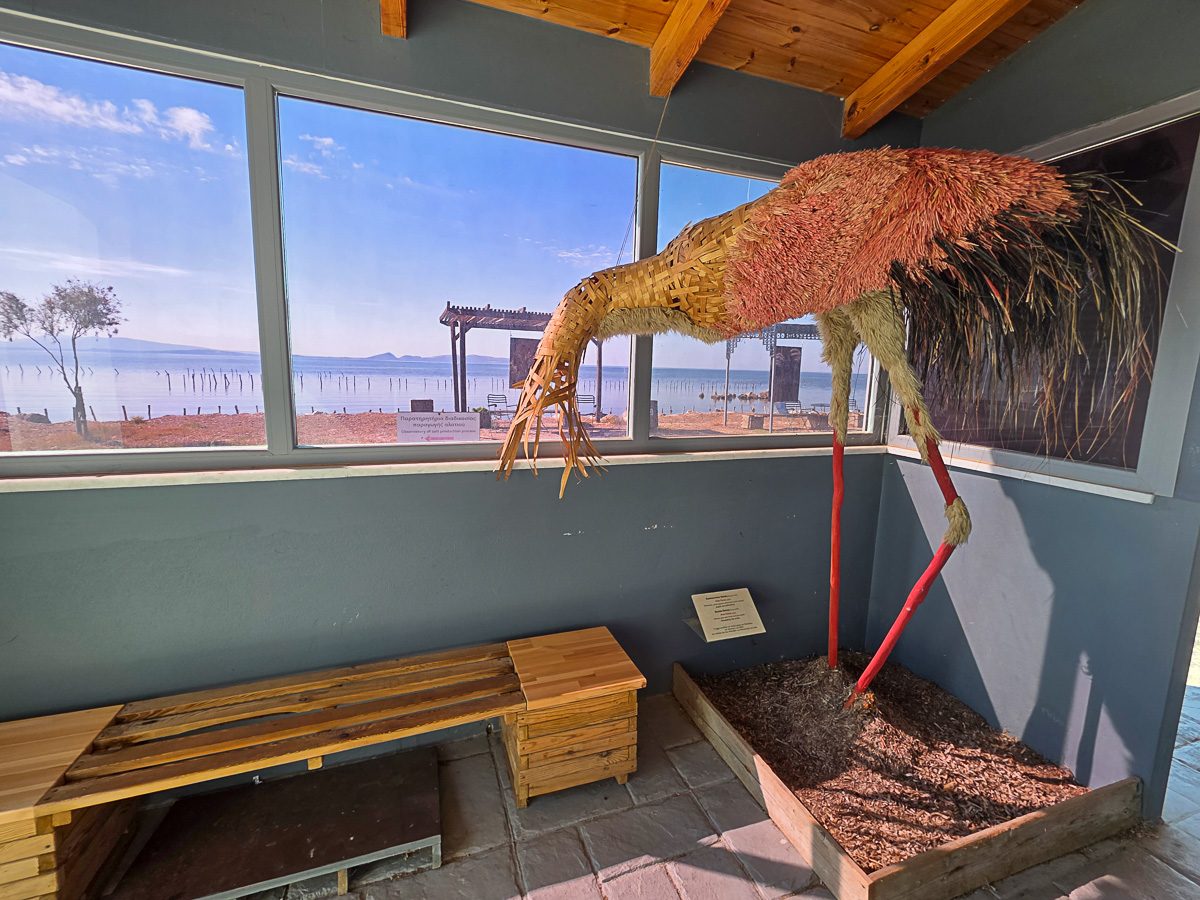
The saltworks themselves go back further than the building, first recorded in Venetian archives from 1418, when ships from Ragusa arrived to load salt. Production ran more or less unbroken until 1964, when the works closed, later reopening under private management.
The interior of the museum is beautifully curated. Each room guides you through general information about salt through to production and usage.
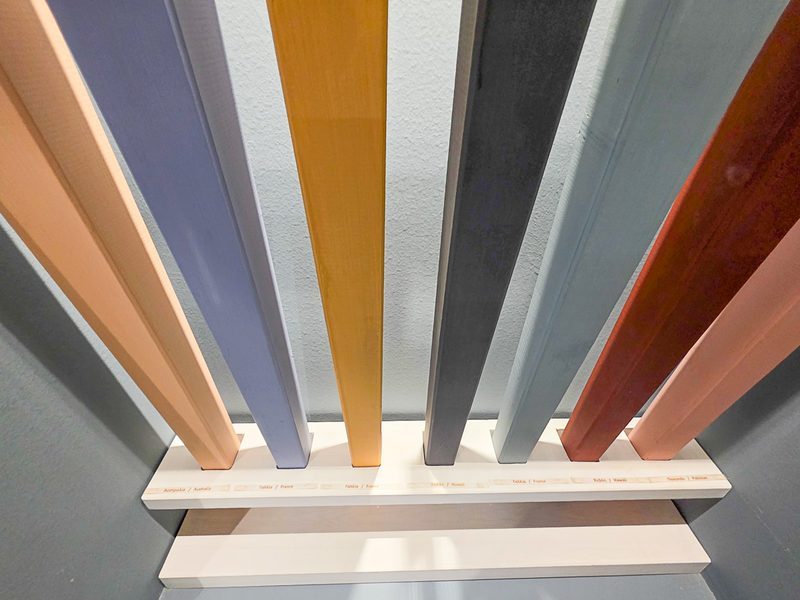
Salt from around the world comes in many colours, each one down to something different. Himalayan pink comes from iron oxide trapped in the crystals, the more iron, the deeper the pink. Hawaiian red gets its colour from alaea, a volcanic clay mixed in as the salt forms. Black Himalayan salt is really more reddish-grey, its flavour coming from sulphur rather than the colour itself. Grey sel gris picks up its tone from the clay in the pans it’s harvested from. The display is like a work of art.
The Messolonghi salterns, White at the main site near Messolonghi and Black here at Tourlida, together produce around 135,000 tonnes a year, the White works alone are responsible for 120,000 of that and roughly 60-80% of Greece’s entire salt output, the largest in the country. The Black saltworks at Tourlida takes its name not from the colour of the salt itself, which isn’t black at all, but from how it compared to its counterpart, less pure, less white, than the salt produced at the main White works near Messolonghi.
Seawater is channelled through basins from March, evaporating through spring and summer before harvest begins in September, washed and piled into the outdoor mounds, some fifteen metres high, that dominate the landscape here. Messolonghi is the only place in Greece producing genuine fleur de sel, the afrina, gathered by hand while everyone else’s salt is scraped up by machine.
Salt was once treated as something closer to sacred across Egyptian, Greek, Roman, Jewish and Aztec traditions. The ancient Greek word als meant both salt and sea, and gave its name to cities and regions right across the world as a result, Salzburg, Hallstatt, Salinas, for example, and even several towns local to me, Northwich, Nantwich and Middlewich, where the “wich” suffix marks out historic salt-producing sites, a pattern going back to Anglo-Saxon England.
The collection of old photographs told their own story. Alykarios, the workers who did this, were brought over from the Ionian Islands in the early days and housed together in the Thalamos, the very building the museum now occupies. It was hard, physical work, entirely seasonal, tied to the rhythm of evaporation rather than a set schedule. Seawater channelled into the pans from March, tended and watched through the heat of summer, then the harvest itself in September, salt washed, raked and piled by hand into mounds that could reach fifteen metres high.
For decades, horses hauled the loaded carriages between the pans, only replaced by diesel engines in 1983, and even now, the finest grade, the afrina, is still gathered entirely by hand, no machinery at all, since a machine would crush the very thing that makes it valuable.
Afrina is the finest grade of salt produced in Messolonghi’s Hellenic Saltworks nearby. It’s a wafer-thin layer that forms on the surface of the pans as seawater evaporates, delicate enough that a gust of wind can destroy it before it’s harvested by hand, no machinery involved. The French call the same thing fleur de sel. Messolonghi’s own afrina comes in at 99.5% sodium chloride, reckoned the best produced anywhere in Greece.
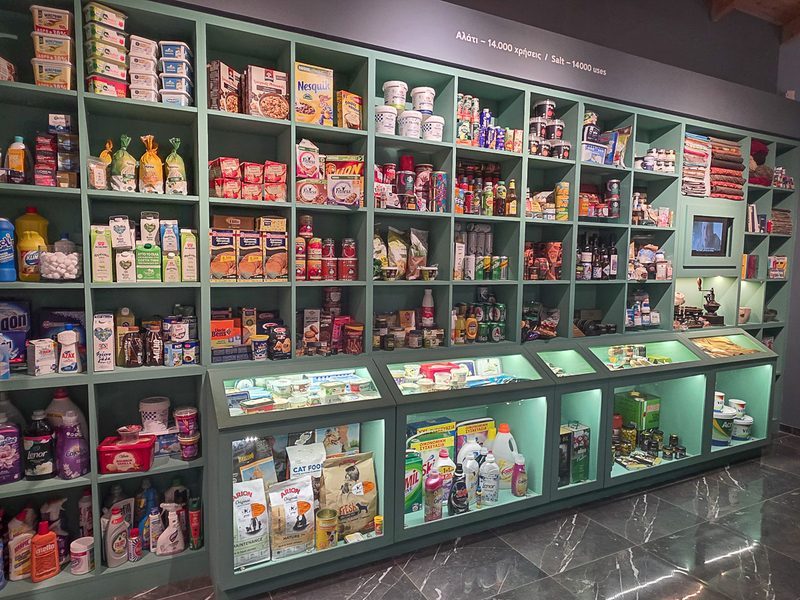
Beyond the kitchen, salt turns up in glass and ceramics manufacturing, leather tanning, photography, dyeing, television screens, medicine, even firefighting materials. Fourteen thousand uses according to the museum’s own count and display.
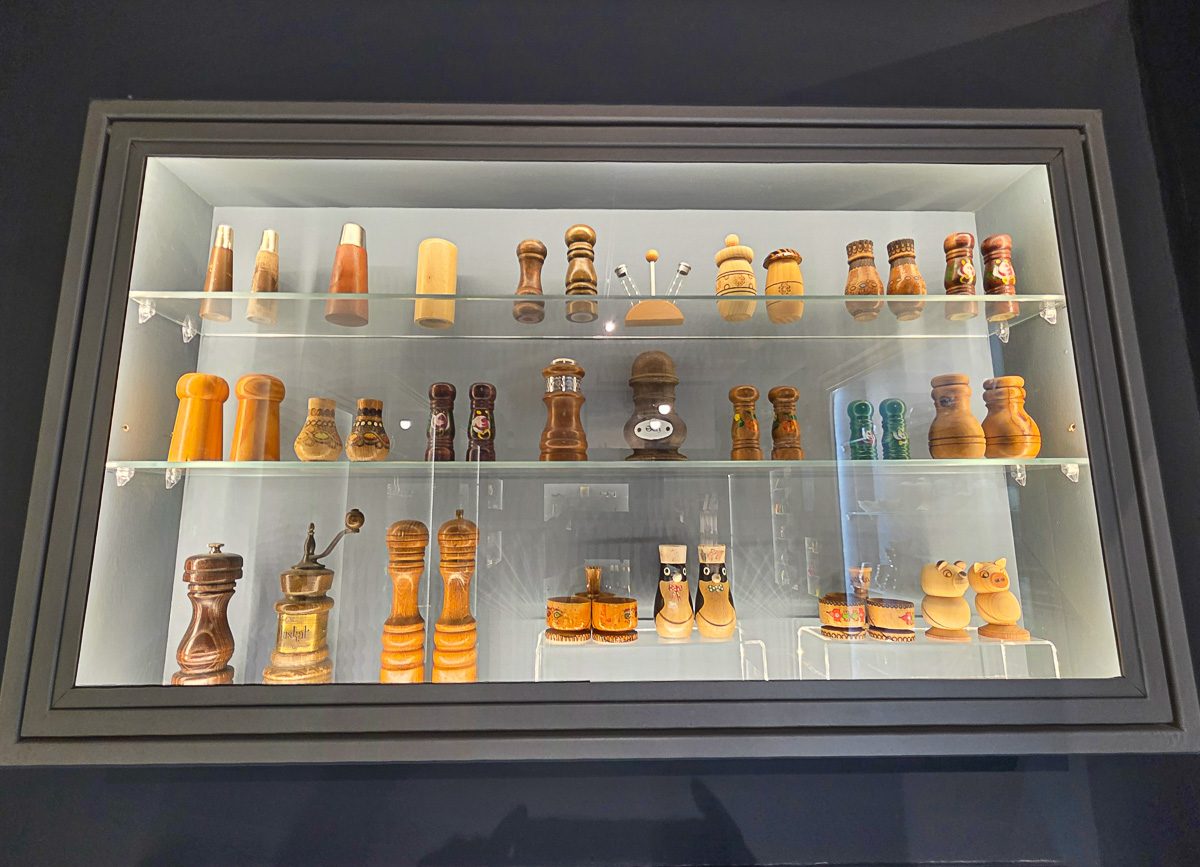
Towards the end of the museum is a magnificent collection of salt shakers from the novel to the traditional and whole heap of others in between.

The museum shop tempted me, which is a rarity as I’m not really a shopper. On this occasion I left having bought afrina, a book about salt, a container of salt in every colour just because I liked it, and soap. To hell with the luggage allowance. I’ll throw clothes away if necessary.
It’s a very informative museum, though one thing I didn’t come away with much sense of what all the machinery sitting outside was for and how it was used, but that was not a hardship. Outside the museum is a striking photography exhibition featuring images of local people from the Messolonghi area by Nikos Aliagas, the French-Greek television presenter whose own family comes from the town. It’s definitely worth a visit to this unique museum.
Walking Tourlida
The first thing you notice when arriving on Tourlida is how flat and open it is. It’s almost as if the island is at absolute sea level, which feels a little perturbing at first. The island sits on the outer edge of Kleisova Lagoon, looking out over the Gulf of Patras. This is salt and fish territory. Tourlida isn’t a huge salt producer in comparison to nearby Messolonghi, for example, but it does have a historic pedigree of producing some of the highest quality salt in Greece.
The salt flats look barren at a glance, but they’re anything but. The pans themselves support brine shrimp, tiny crustaceans that thrive in water too salty for almost anything else, and it’s these shrimp, eaten in quantity, that turn flamingos pink – a true example of ‘you are what you eat’. Avocets, herons, cormorants and pelicans all use the flats and the wider lagoon, the birds tending to nest on small, raised islets set apart from disturbance.
Around the edges, where the ground turns from salt-white to something plants can actually tolerate, tamarisk and other salt-loving species grow in a band that exists nowhere else nearby, a whole ecosystem built entirely around surviving conditions that would kill almost anything else outright. The whole area is protected under the Ramsar Convention as a wetland of international importance, recognising this unique landscape that looks hostile and turns out to be highly specialised instead.
I woke early with one aim: flamingos. A young woman at Tourlida Beach had told me not to miss them. When I asked where to find them, she waved her arm in the vague direction towards the Salt Museum, and said “the other side of the lagoon.” So off I went.
The temperatures were perfect for walking, and the humidity that seemed to be a permanent fixture during this trip was still asleep. The sun was barely over the hills in front of me and everything the colour of weak tea. The silence was the first thing I actually noticed, not an absence of sound so much as a single sound repeating – the sea gently lapping at the water’s edge. Two fishermen were out on the lagoon in flat-bottomed boats, moving without any apparent effort, the water so still they seemed to be gliding across glass rather than through it.
I passed the ruins of the old salt works first, a weighbridge, a guardhouse, a tool store, walls half collapsed, but still a reminder of the island’s industrial history.
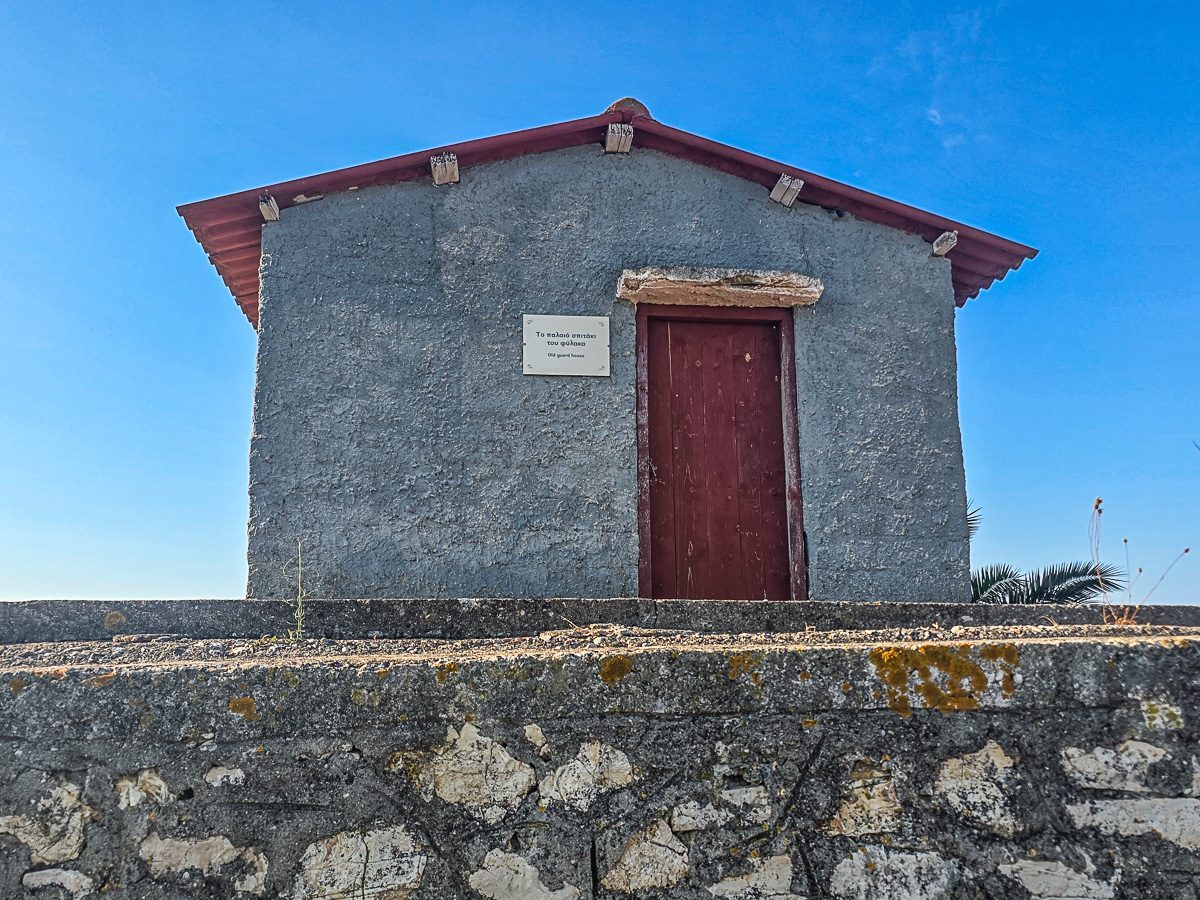
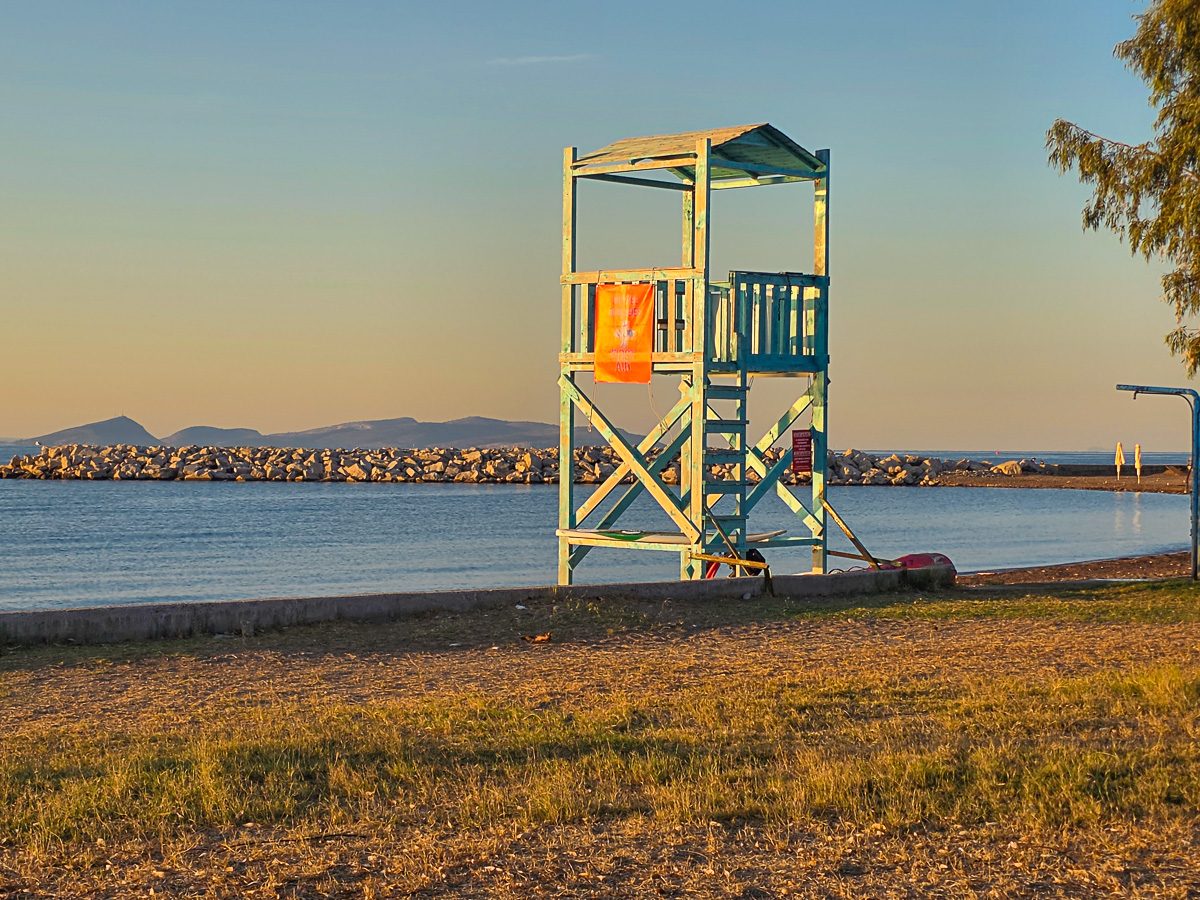
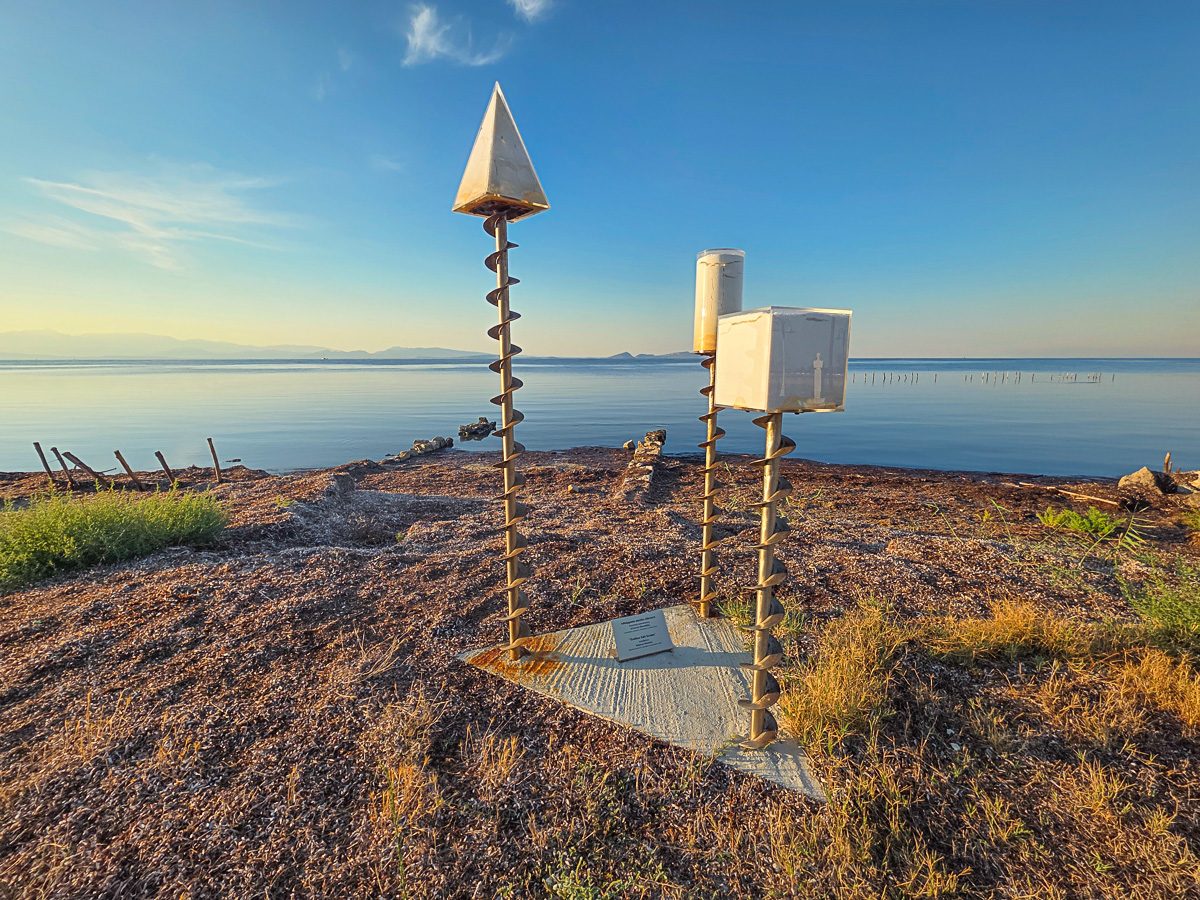
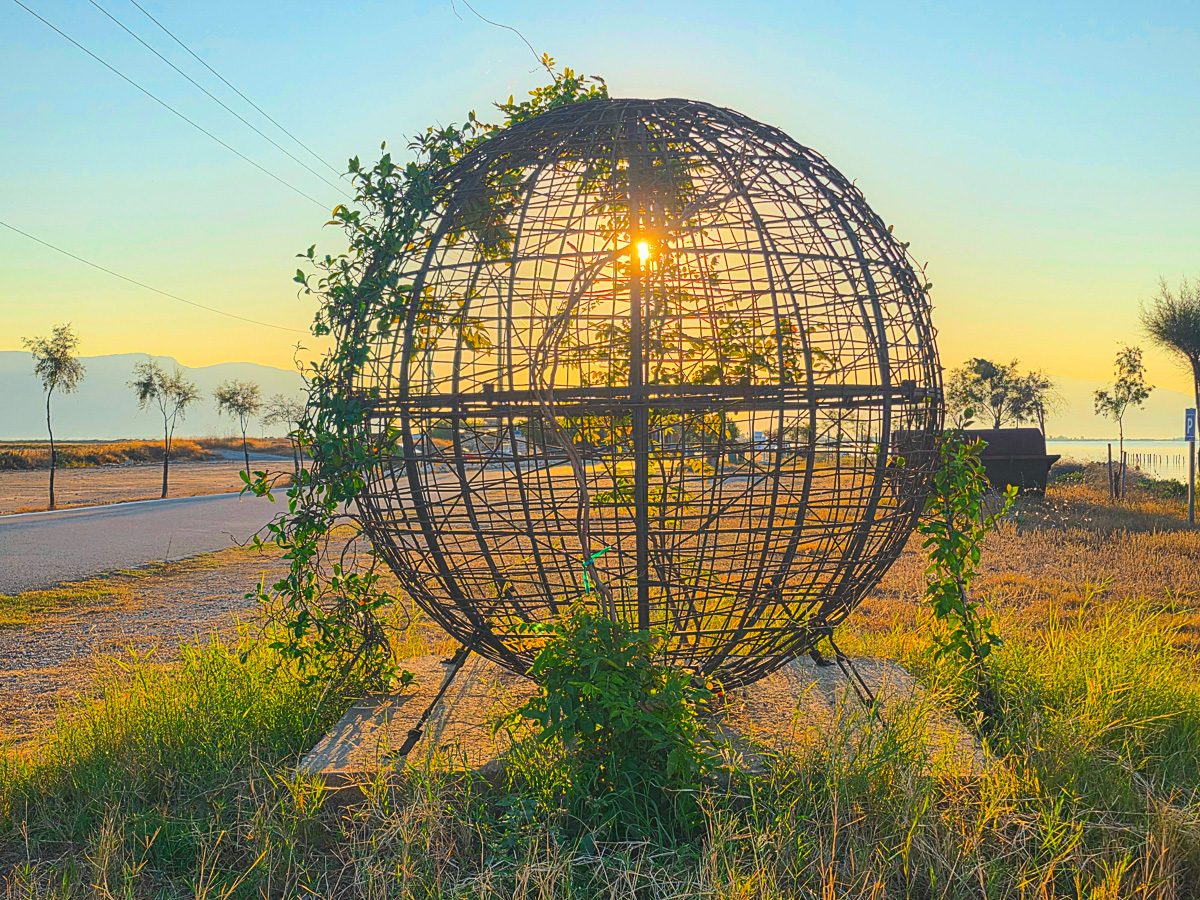
There was something about the early morning light, the silence and the wide open space that made everything more noticeable, even everyday structures such as the lifeguard tower. On the approach to the museum, a collection of public art pieces, the jetty and even the cracked, silted bottom of the lagoon stood out as something to be admired. Man-made and nature, both earning their place in this very special landscape.
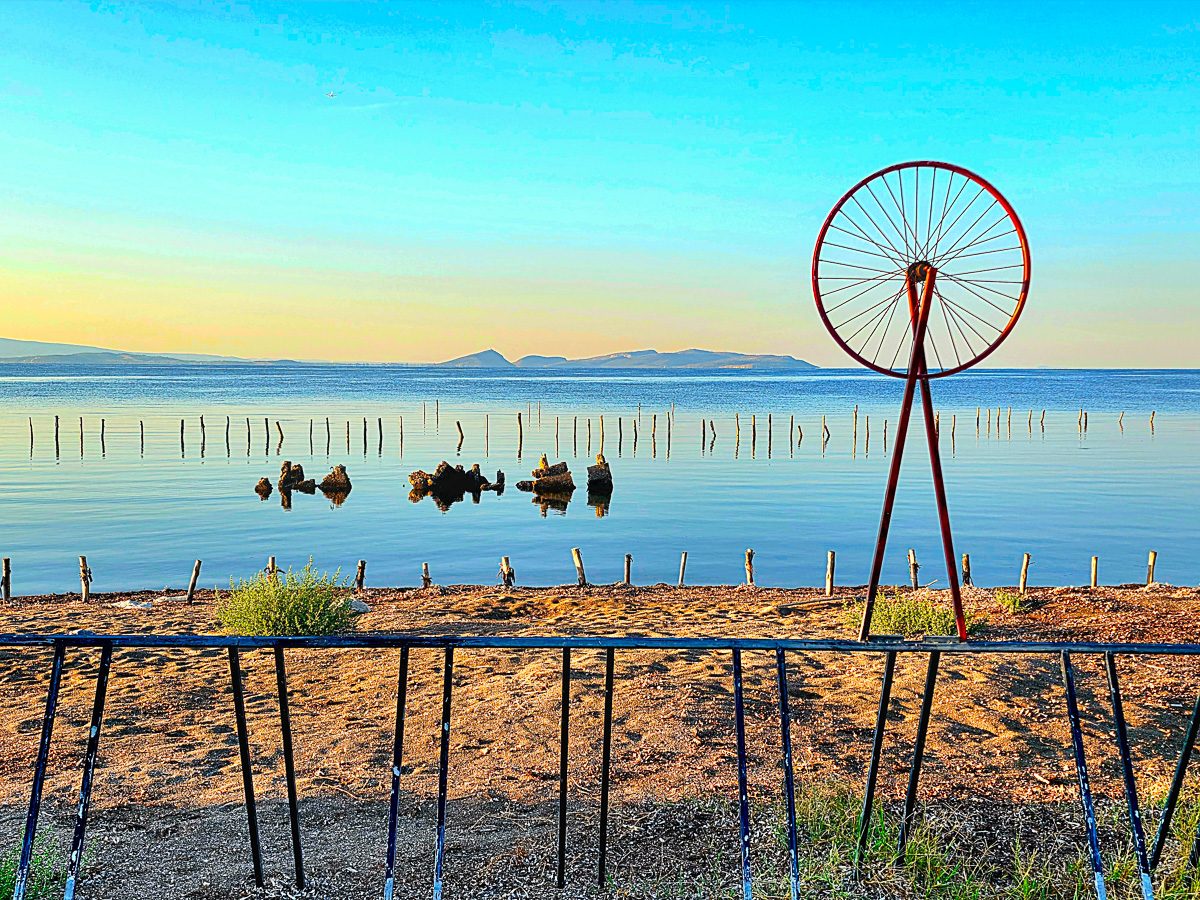
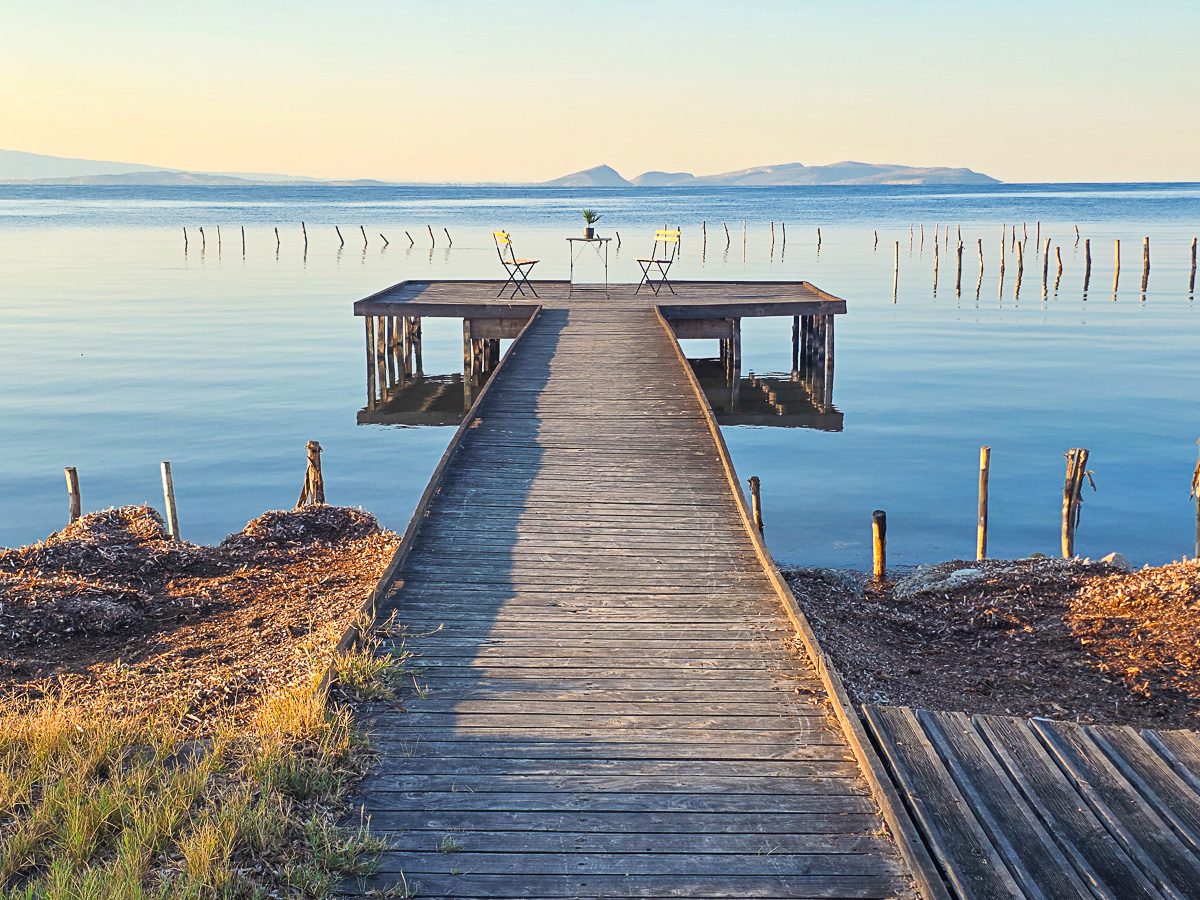

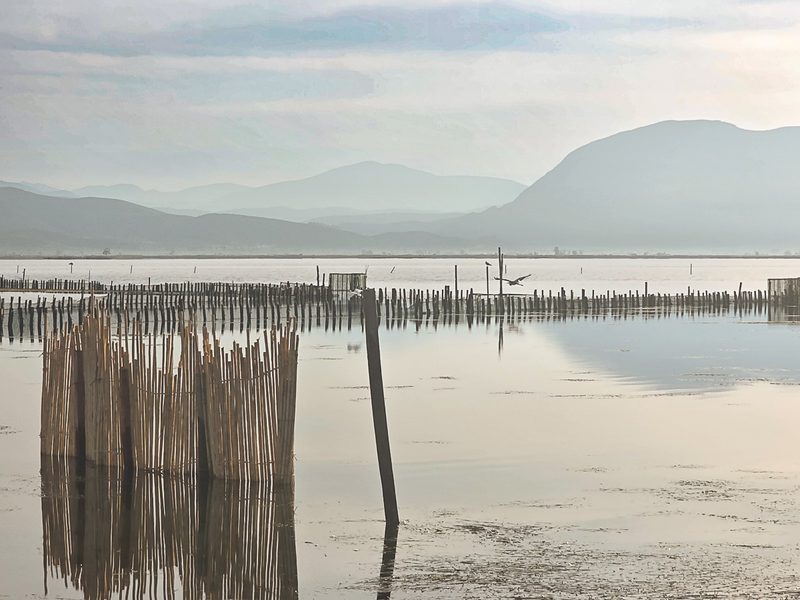
At the point where the dirt tracks met, I stopped. The lagoon here was completely flat, mirroring the mountains on the far side almost an exact replica. I switched on the Merlin app and let it work through the calls drifting past, one after another: Western Yellow Wagtail, Black-Bellied Plover, Sandwich Tern, Caspian Tern, Common Greenshank, each name popping up on the screen one after the other. Herons stood motionless in the shallows, statue-still until they leapt into action, scattering the gulls around them. A cluster of white birds lifted off somewhere further out, too far to identify, circled once, and settled again. No flamingos, though. Not that morning anyway. Maybe tomorrow.
Tourlida Dining
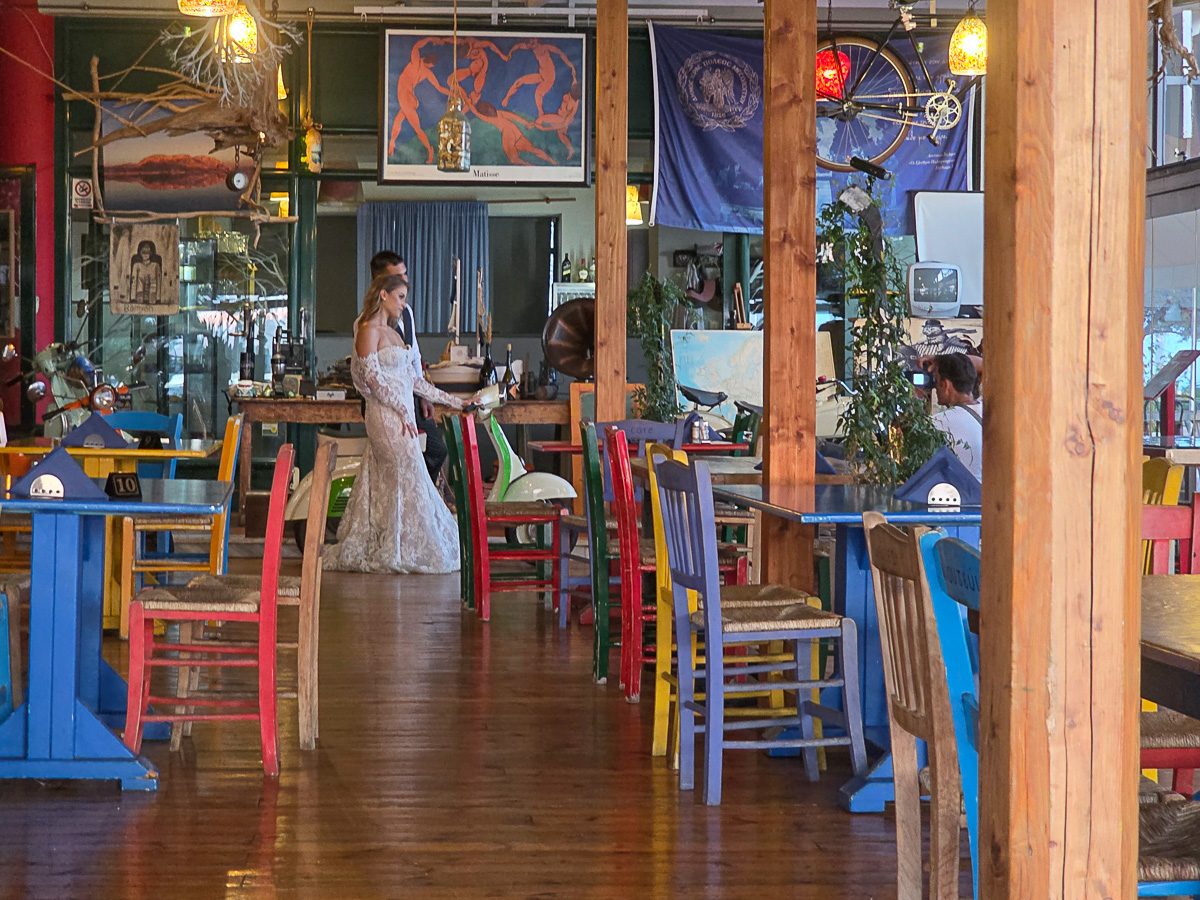
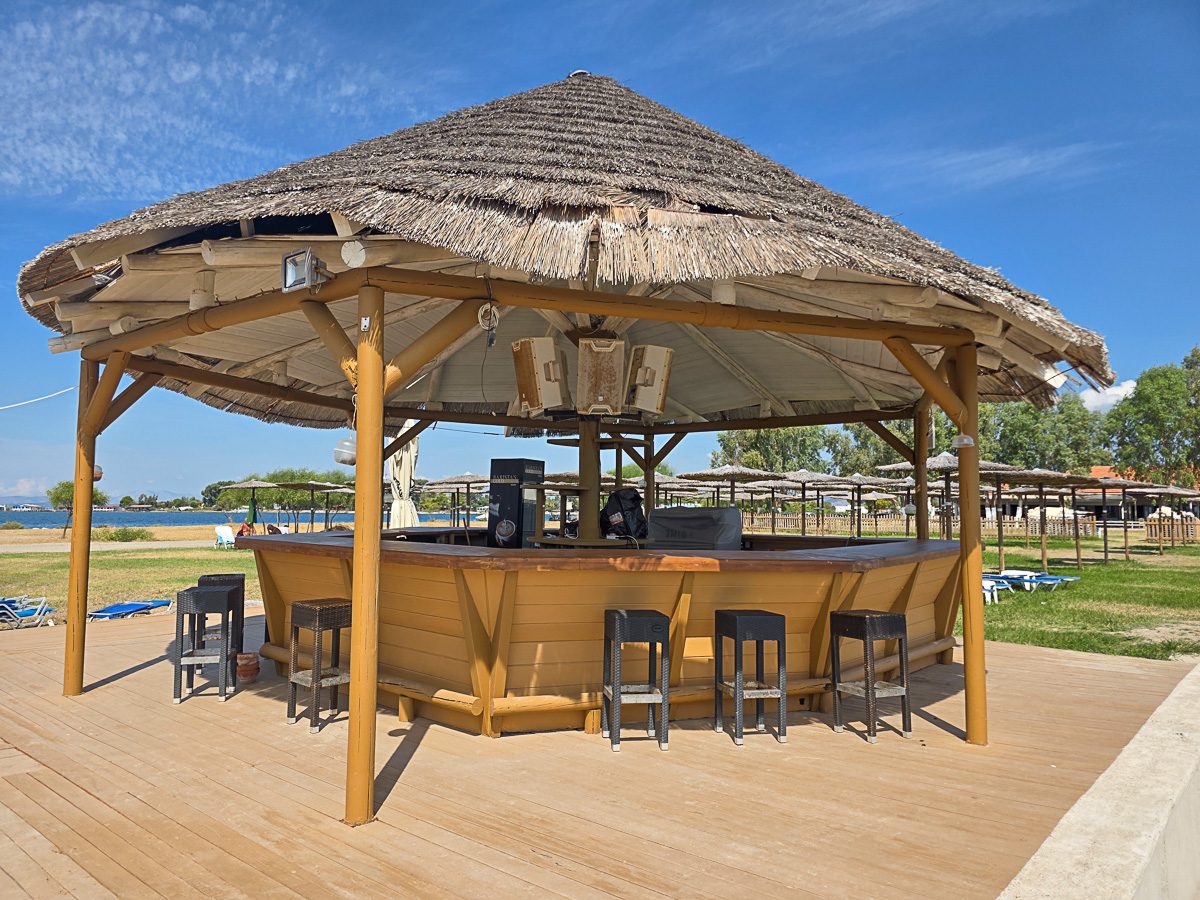
There are only two places to eat here. Tourlida Sunset Restaurant is one of the big draws to the island, with an extensive menu featuring fish from the lagoon but also a good selection of traditional Greek and meat dishes. It has an interesting decor with a collection of scooters, motorbikes and other memorabilia on display. It’s got a pretty large footprint ideal for wedding parties, though it still manages to create a feeling of intimacy. And if you’re not holding your actual bash there, it seems a popular place to come and have wedding photographs taken.
Of course the outward-looking view over the traditional fishing boats moored to rickety wooden jetties is pretty special, and it really comes into its own at sunset. Here you are guaranteed great hospitality, wonderful food set in a beautifully atmospheric setting. It’s open daily from 1200.
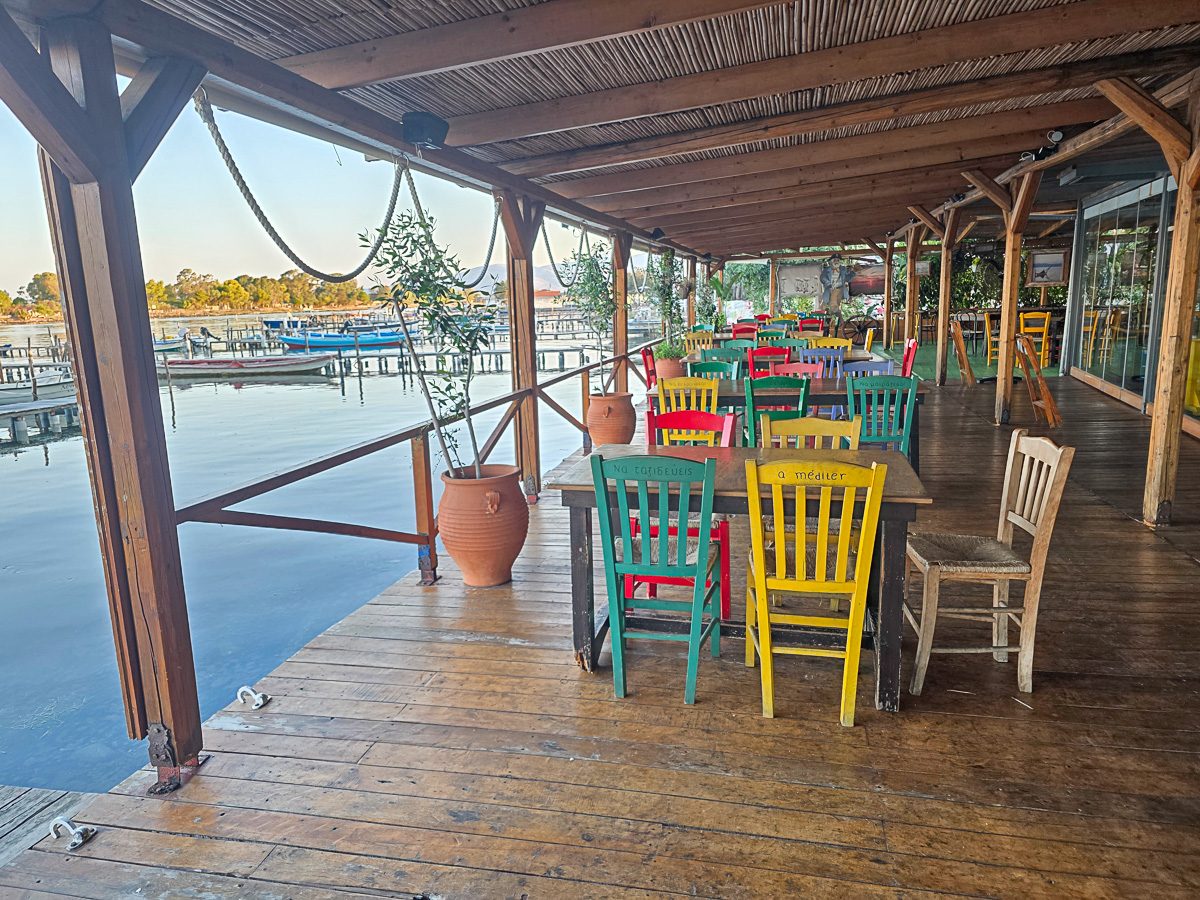

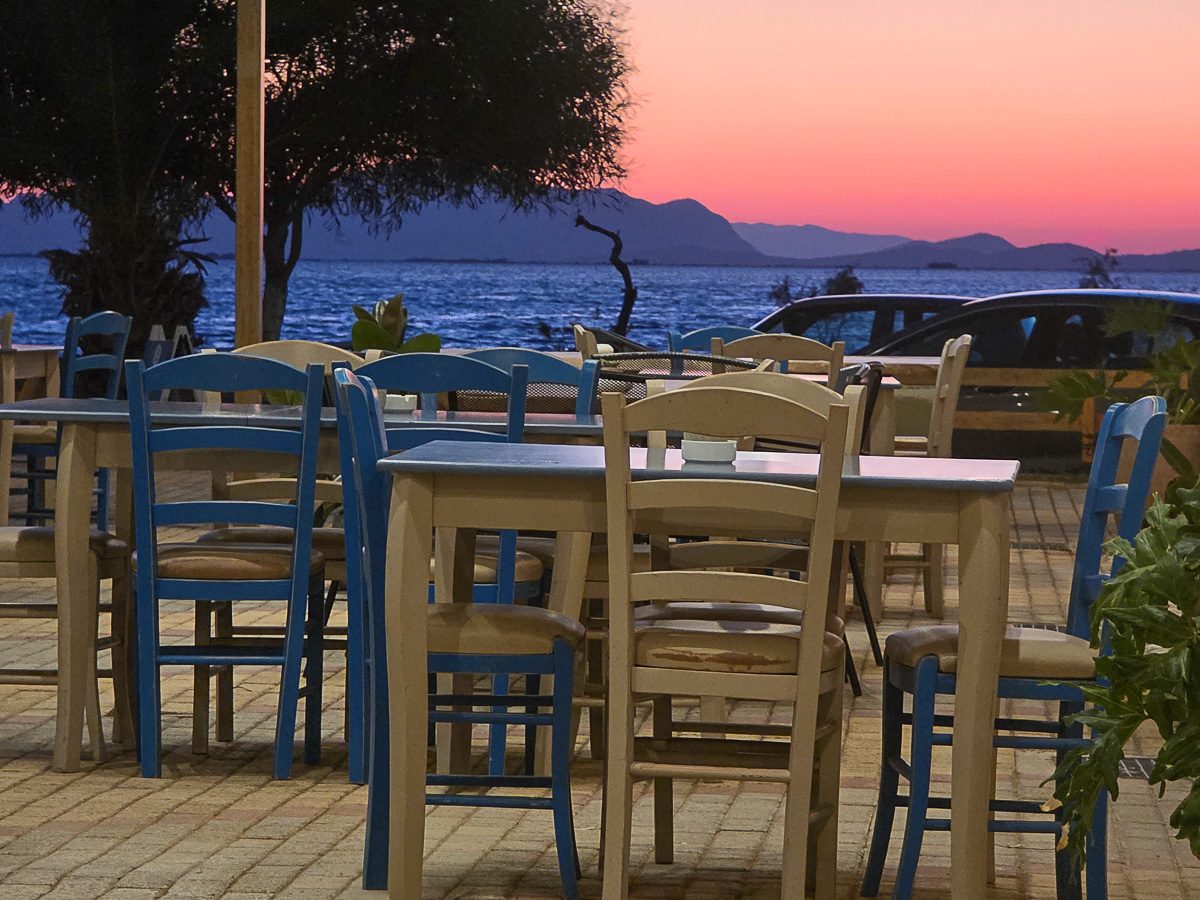
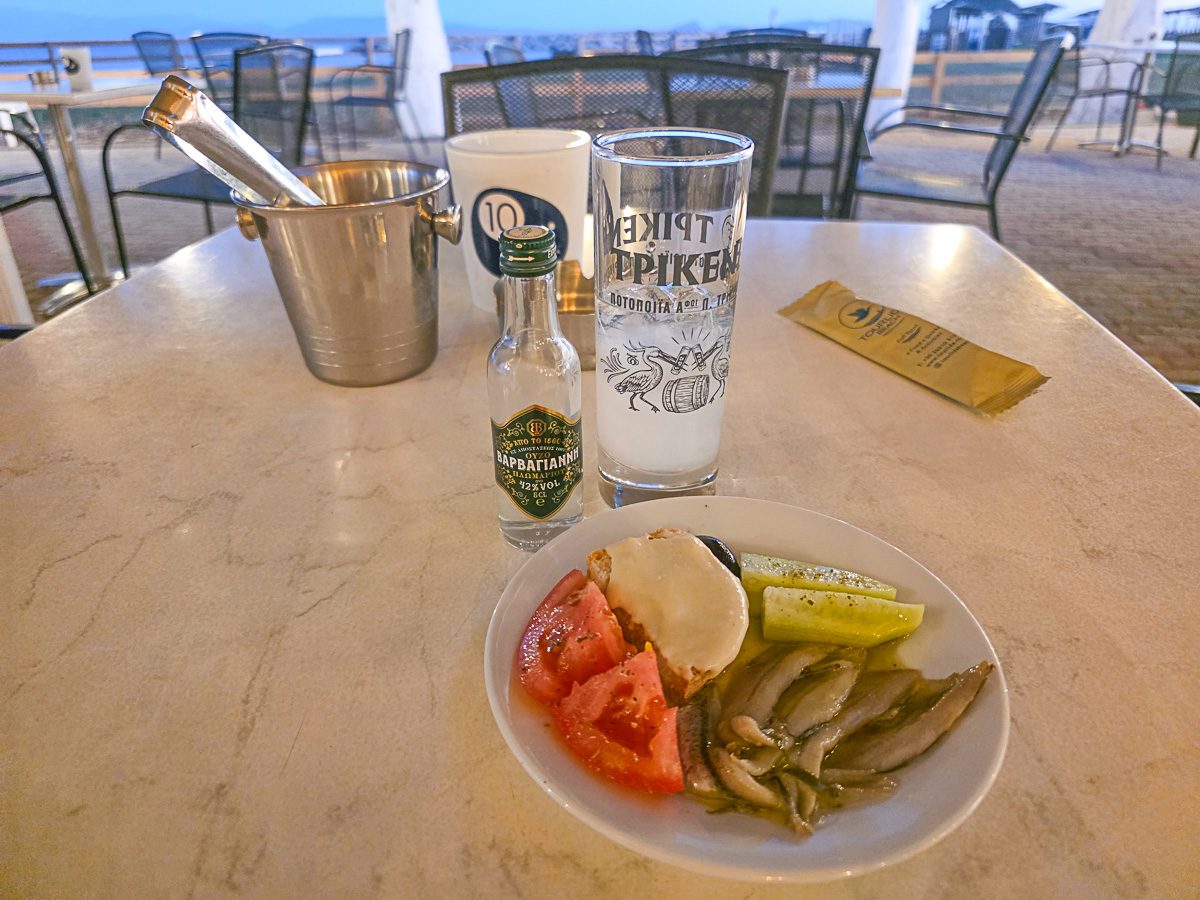
Tourlida Seaside Restaurant and Beach Bar is the other alternative whose footprint is almost as long as its name. The property has a restaurant with a large exterior terrace overlooking the sea, a grassed area with an outdoor beach bar seemingly open only during high season and a small beachfront area with sunbeds.
Although it was always quiet here – at times you could almost mistake it for being closed – it was a good place to come for cold refreshments and a mid-afternoon snack. It was also the only place offering breakfast. It wasn’t an extensive offering at this time of year, but he did manage to rustle me up a cheese and ham toastie and a cup of tea.
They are two very different offerings, which gives the impression of the latter being subject more to seasonality than the former.

Tourlida Beach
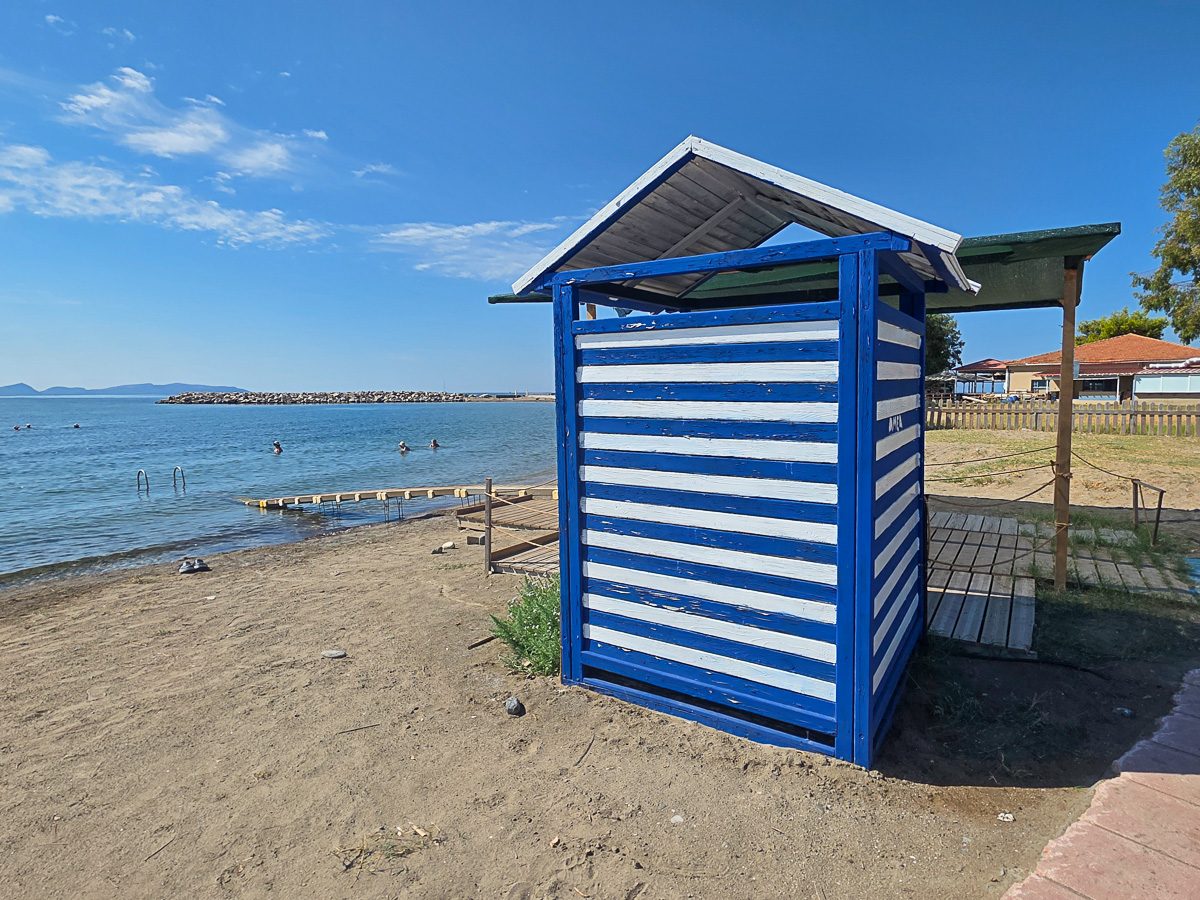
Just beyond Tourlida Seaside Restaurant, Tourlida Beach proper begins, the first sand beach I’ve seen since leaving Zakynthos. It has Blue Flag status, with two manned lifeguard stations and two Seatrac facilities a short distance apart, quite impressive for a beach this size. There are changing rooms, showers, and plenty of sun umbrellas too. At the water’s edge it turns pebbly, so beach shoes, or iron feet, are required.
The water is clear but a little brackish, and there’s a reason for that. The turquoise you get further round in the Ionian comes from deep water over clean limestone. Here, two rivers, the Acheloos and the Evinos, have spent thousands of years dumping silt into this gulf, which is exactly what built the lagoon and made it such a haven for wildlife, but it also keeps the water shallow rather than clear.
I didn’t swim for long. The sea here is home to those annoying fish that like to nip at your legs. After an embarrassing yelp the first time it happened, and a swear word the second, I decided it was time to rescue my dignity and get out.

A Few Things Along the Way
Admiral Andreas Miaoulis played a key role in defending Messolonghi during the War of Independence, and his memorial sits directly opposite my accommodation, a marble bust flanked by two decorative cannons and Greek flags. Looking at tranquil Tourlida today, you can’t imagine that this was a place caught up in some of the most significant battles of the war.
Nafpaktos and its coastline hold plenty of unnamed churches, and this yellow one, with its unusual bell tower, is one of them. It doesn’t appear on Google Maps, odd given it’s not one of those private chapels tucked onto the edge of someone’s property. As I got closer I could see, laid out behind it in a neat oblong, a small salt pan, crystals crusted white right across the surface, exactly like a fresh, heavy fall of snow.


This stretch of Greece has none of the polish of Cycladic island hopping, no turquoise water, little infrastructure built for tourists. What it has instead is something closer to how Greece actually works when nobody’s boutiquified’ it for visitors. Salt flats, stilt houses, a lagoon that rewards you for getting up early and really watching and listening to the environment around you.
Two days on Tourlida had been enough to take in all of it, though I could have stayed longer. However, there was still one more thing left to see before I left Tourlida behind. More in the next post.
Discover more from
Subscribe to get the latest posts sent to your email.
MY BIG FAT GREEK TRAVEL SURVEY
How do you really plan your Greek adventures? I'd love to hear from you.
TAKE THE SURVEY →