Three Days on Trizonia: Adjusting to a Slower Rhythm
Some time after 6am I was woken from my slumber by a gentle rocking. It only lasted for about five seconds but it was enough to wake me up. It was just an earth tremor – a regular occurance in these parts apparently.
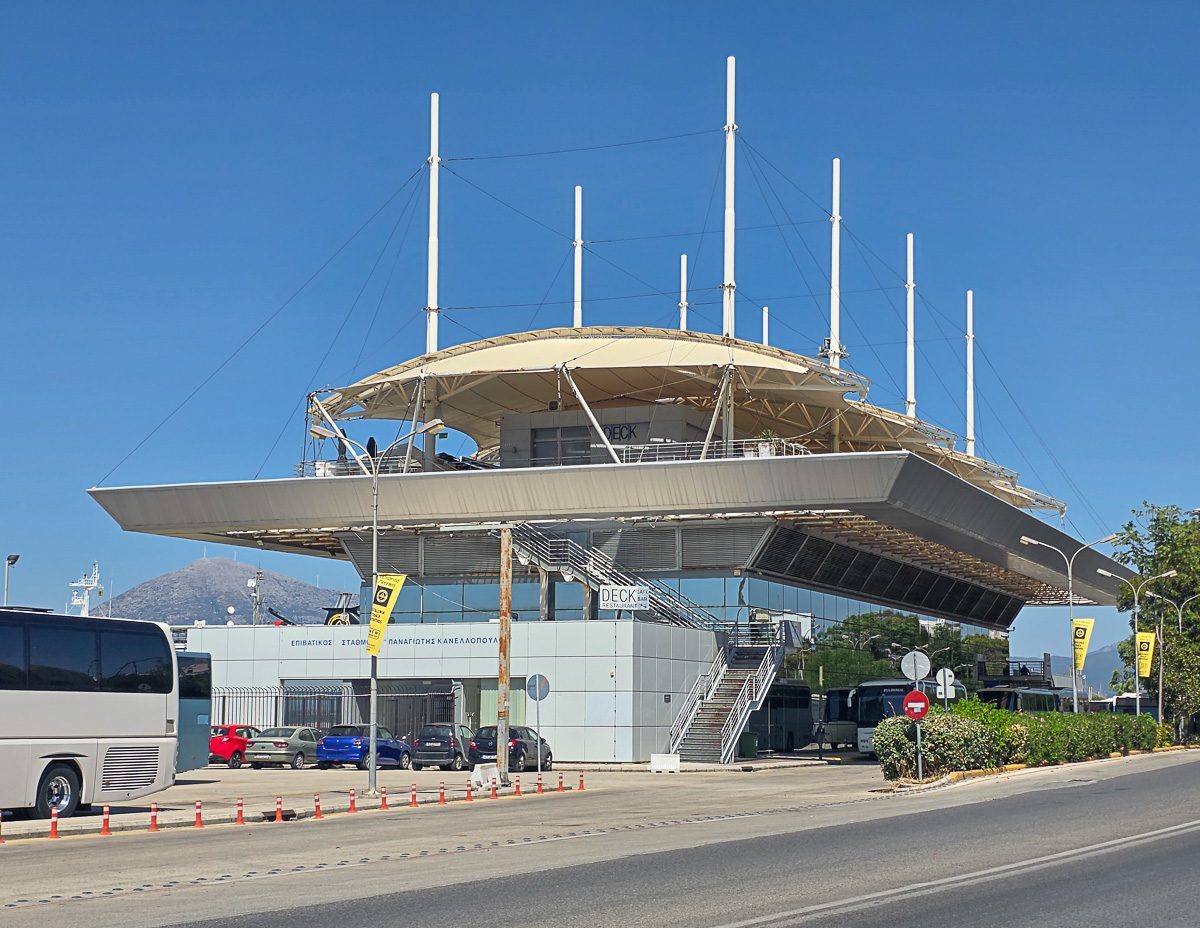
After checking out of my hotel in Patras city, I took a slow amble to the bus station. Not the intercity bus station that I’d arrived at – and this is an important distinction. The Panagiotis Kanellopoulos Passenger Terminal is a striking glass building that also handles Levante Ferries departures to Ithaca and several ports on Kefalonia. It used to be the main ferry passenger terminal but international ferries have since moved to the South Port. It also houses KTEL Aitoloakarnanias, the buses that head north over the Rio-Antirrio bridge to Nafpaktos, Mesolongi and Agrinio, quite separate from the main intercity hub across the street. Somewhere along the way it also picked up a café on the roof, reachable by lift.
There are 6 departures a day from Patras to Nafpaktos running Monday to Friday.
I was leaving Patras with a small pang of regret at how little of it I’d actually managed to see. Some of that is just knowing your limits. Thirty-eight degrees in a city is not exploring weather, it’s survival weather, and there’s no shame in choosing the second over the first.
Whilst waiting for the bus I fell into conversation with a Greek lady called Keri. She was catching the same bus to Nafpaktos and also the connecting bus towards Glyfada. This was quite fortuitous. I hadn’t really researched where to get off – I thought I’d just have the convo with the bus driver but this saved me the trouble. The bus headed out of Patras and eventually a long round about way to the Rio Antirrio Bridge. Even my window seat didn’t give me the best view to video the bridge whilst going over it but I think I’d already had the best view of it from below.
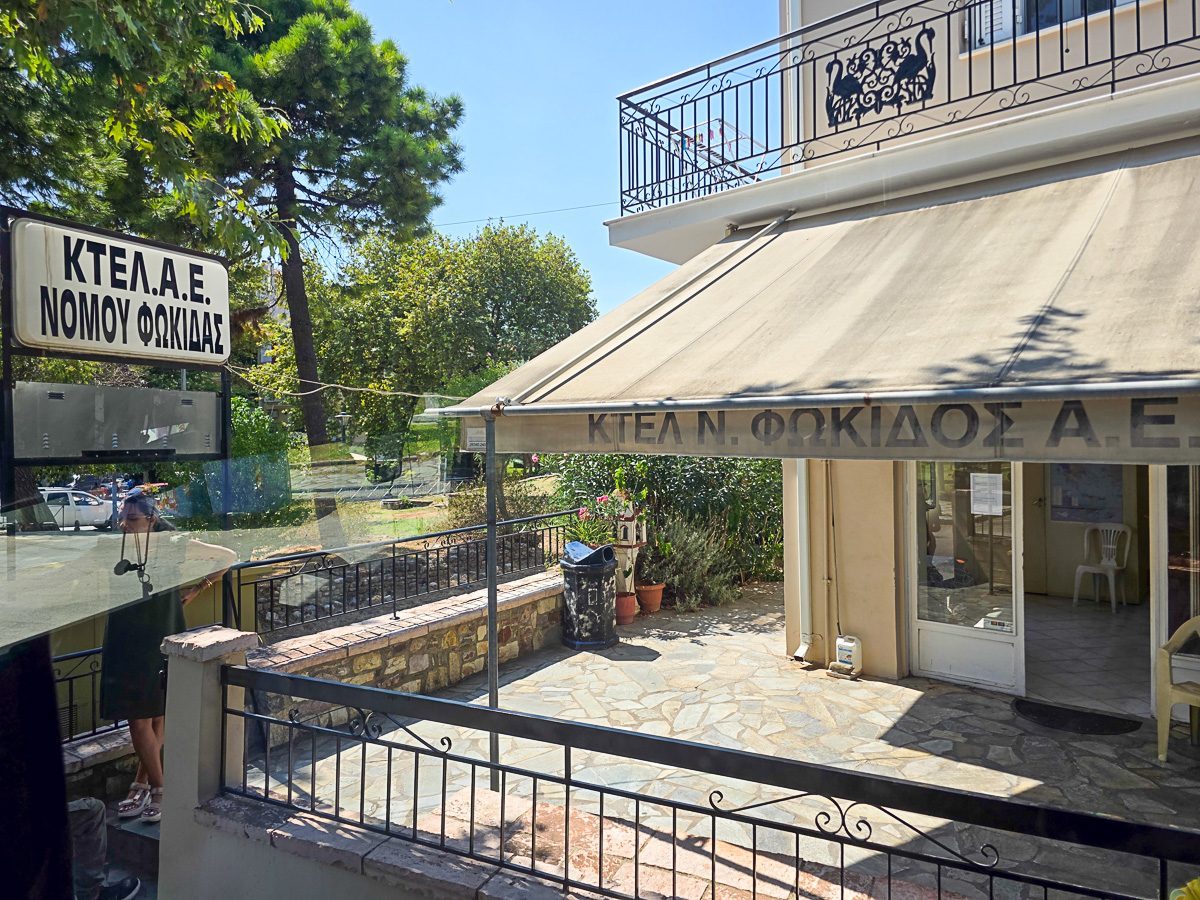
It didn’t take too long to arrive in Nafpaktos, immediately recognisable by the views of the castle set up on the hillside glimpses of which were given between the buildings as we passed. On the other side of the town Keri told me that we’d reaced our stop and then led me across the road to a small bus station of KTEL Fokidas. The bus was waiting to depart but we had plenty of time to purchase our tickets. I’m still impressed by the way buses connect with each other like a well oiled machine.
KTEL Fokidas in Nafpaktos is a satellite station covering the region east of Nafpaktos including local destinations such as Glyfa and Galaxidi and of course to Xania where I will be catching the water taxi to Trizonia. Beyond the service covers Delphi, Lamia, Amfissa and also Athens and Thessaloniki.
Keri suggested that I sit on the right hand side of the bus to get the views of the coastline whilst giving the driver very clear instructions on where I needed to get off as she would be leaving the bus before me.
The bus journey was only about 30 minutes and the final part was along the coastal road providing views of small settlements mainly modern villas separated by swathes of olive trees. The beaches appeared to be mainly pebble which is a feature of the beaches along this coastline. At Monastiraki, Keri bade me farewell – reinforcing the instructions to the driver for me.
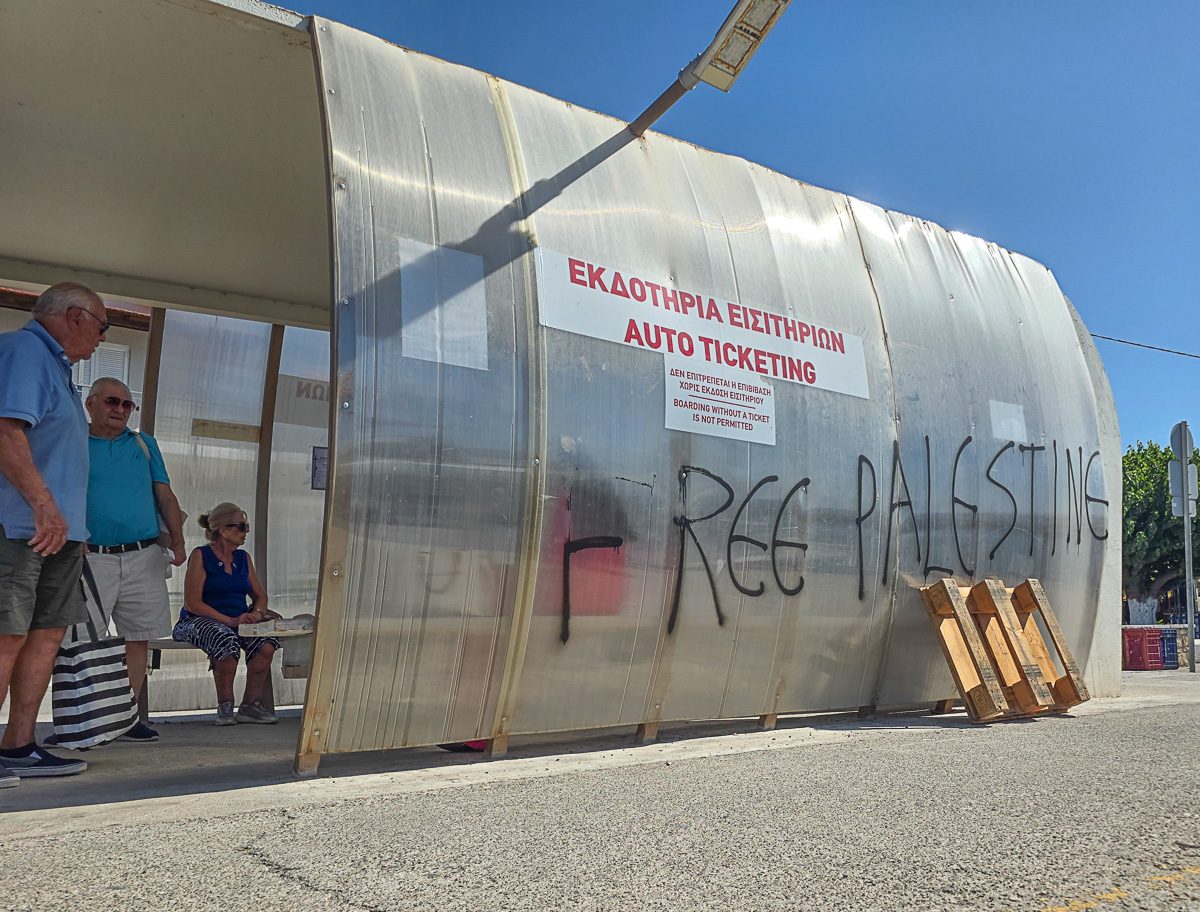
Soon after, the driver pulled over in the small settlement of Xania, right next to a shelter for the water taxi where I would travel over to the tiny island of Trizonia.
I was surprised to see a self-service ticket machine in the shelter – not the cash-in-hand arrangement I’d expected. All very self explanatory as I bought my ticket for 2€ – cash and card accepted.
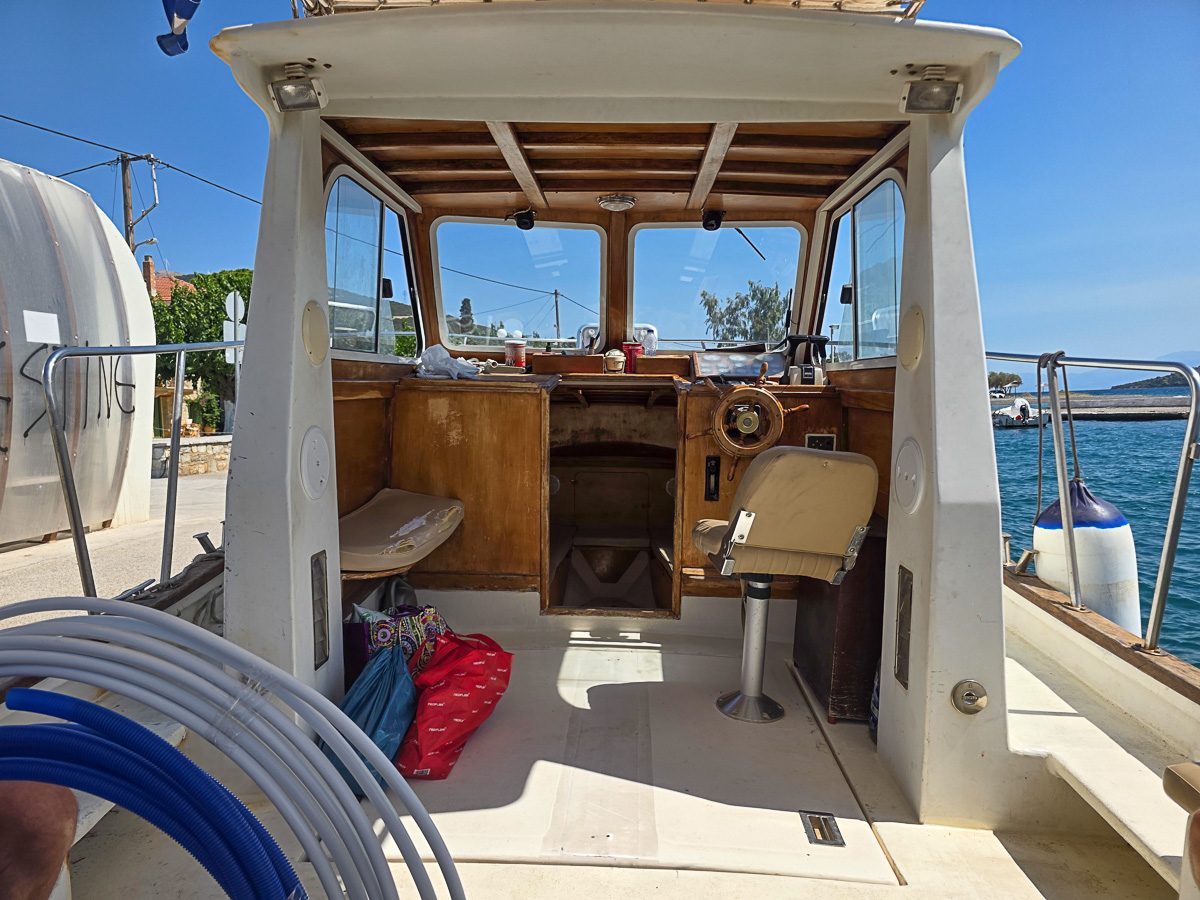
After 15 minutes a small boat arrived, and once moored to the quayside, me and a couple of others boarded. A family with swim things and beach toys and a man carrying coils of piping and a bag of tools. Before we departed a man passed the captain a cool box which I assumed was foodstuff of some kind or other. These little water taxi’s it seems, are not only a tourist shuttle so much as a lifeline, bringing in everything from groceries to building materials.
The crossing itself was brisk, a little choppy, but nothing worth worrying about. I was never blessed with the best pair of legs but at least they’re sea legs!
Trizonia
So Trizonia. It’s the only inhabited island in the Corinthian Gulf, with 55 residents at the last census, a number that’s been sliding for decades, 137 in 1991, down to 55 by 2021. Two and a half square kilometres, its highest point barely scraping 106 metres, with a couple of uninhabited islets for company just offshore.
Nobody seems sure where the name comes from. One version has it from “trizoni,” the Greek word for cricket, after the racket they make on summer nights. Another claims it’s a mangled version of “trionisia,” three islands, referring to the wider group rather than Trizonia alone. To me the latter sounded more plausible.
Under the Ottomans it apparently did a stint as a quarantine station for arriving sailors and during the War of Independence it saw a clash between Greek forces under Andreas Londos and the Ottomans, sometime in 1827 or 1828 depending which account you believe.
Aristotle Onassis is supposed to have looked at buying the island before deciding on Skorpios instead. Whether that’s true or simply the kind of thing that gets said about every good-looking Greek island with a rich man’s name attached to it, I couldn’t tell you.
Once on the other side and disembarked at the harbour, I followed Google Maps to my accommodation, past a couple of tavernas and on through to a marina lined with yachts. I’d booked three nights at Drymna Rooms, the budget end of what’s available, around fifty euros a night. There’s a luxury hotel on the island with a pool, and a couple of boutique places besides, so the range exists.
As I arrived at the Drymna Hotel, I regretted my choice instantly (though I must say my regret was retracted later). A steep concrete path led up to the hotel, the kind that takes everything you’ve got to drag a case up in mid-afternoon heat, and then another flight of steps on top of that to reach reception. I left the case at the bottom and asked the young man checking me in if he’d carry it up for me. He didn’t look thrilled about it, but he did it anyway. I thanked him and told him that I honestly wouldn’t have managed it myself. It wouldn’t have been the first time I’d unpacked my suitcase on the ground floor and carried clothes and then an empty case up the stairs.
The room was spacious, if a little stark. One double bed, one single, a very small bathroom, and a decent-sized terrace. Booking.com had listed a washing machine. What that actually meant was a laundry service aimed mainly at the yachters, which did come in handy during my stay.
3 nights on Trizonia being such a small island seemed the right choice. An opportunity to rest and relax after what had been a pretty full on two weeks on Zakynthos with the fam.
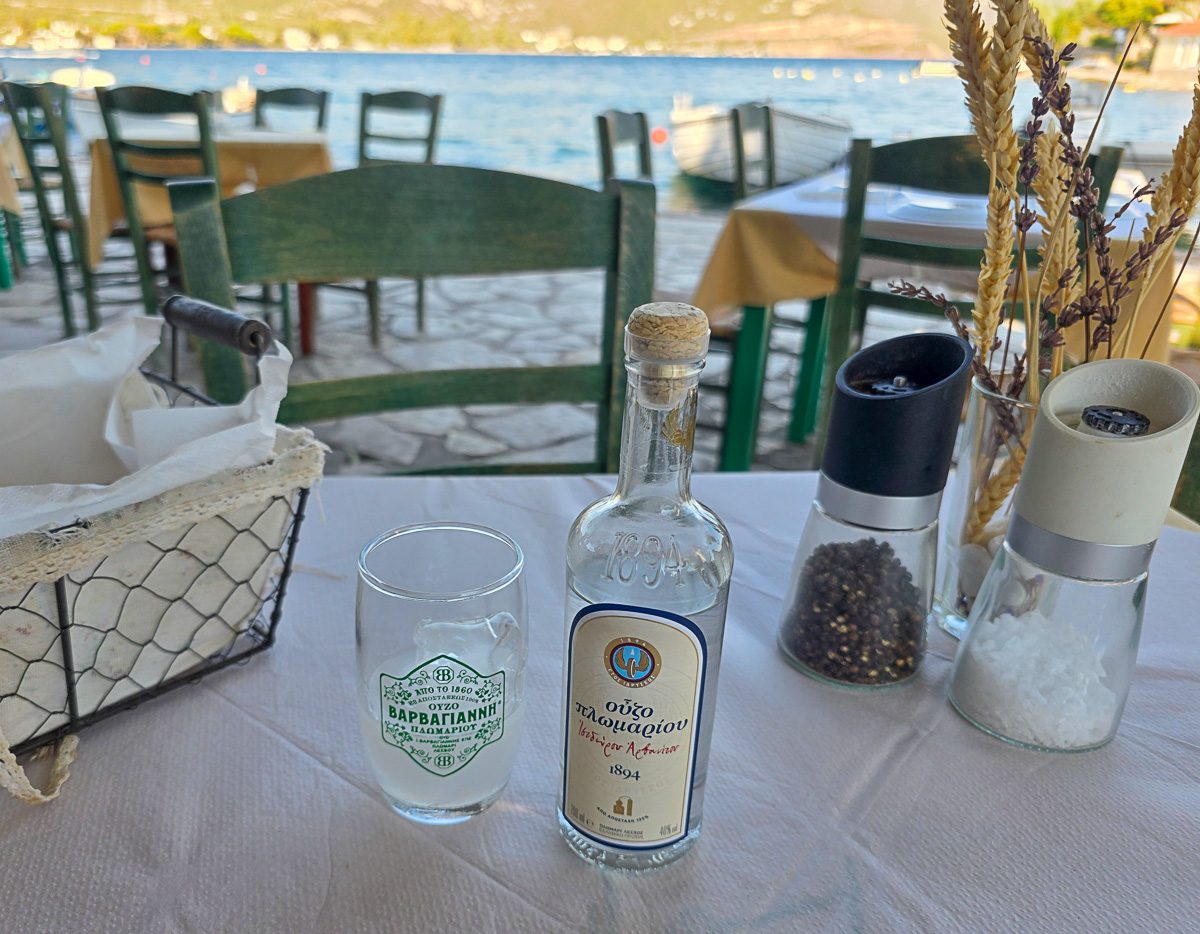
Unpacked, showered and changed, I headed down to the harbour for dinner. There’s a fair bit of choice for such a tiny island. I chose Ostria Taverna – not because it looked any better or had a more extensive menu but because I had to pick one rather than stand staring at them all like an idiot. It was a good choice.
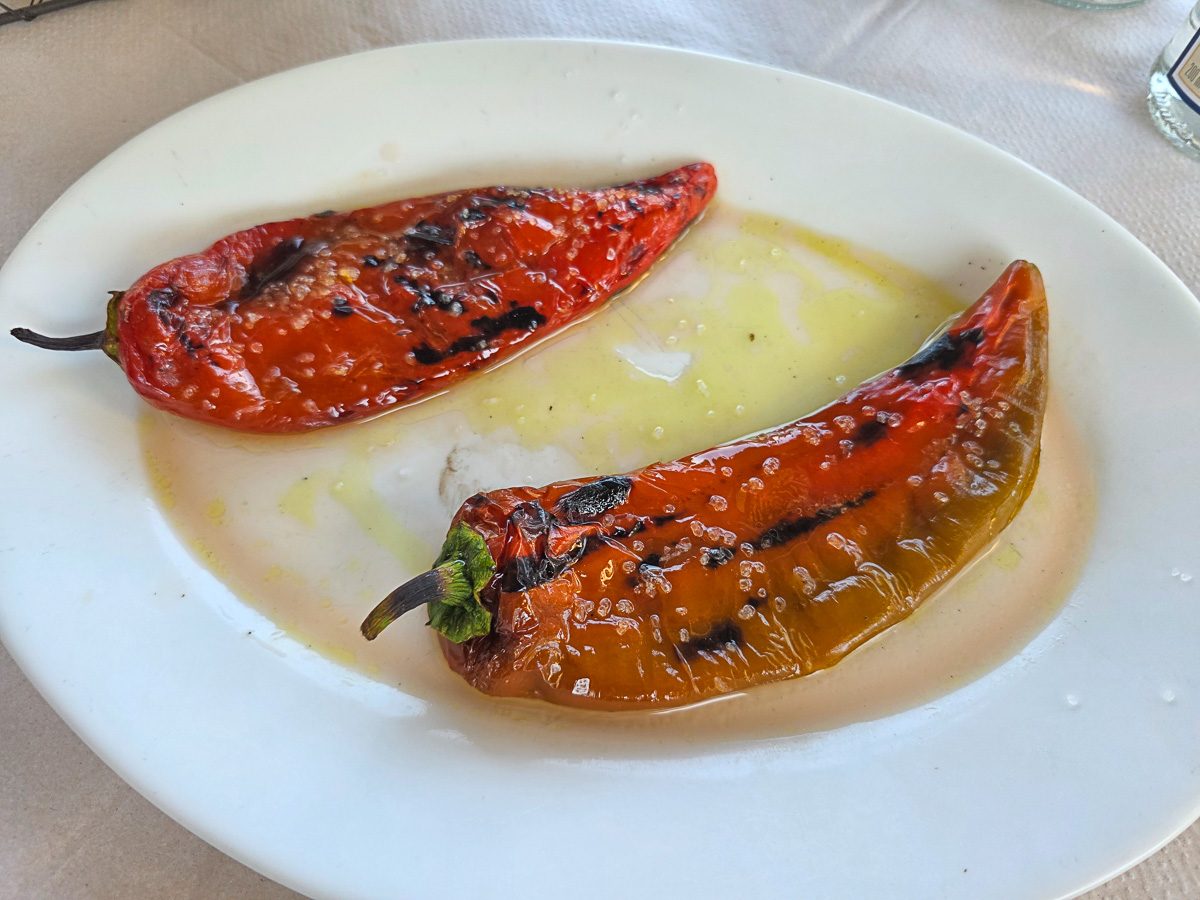
Grilled Florina peppers, skordalia, beef stifado washed down with the usual.
Red Beach
The next day I set out to explore. I’d decided to visit Red Beach also known as Pounda, the furthest away from the centre – only a couple of kilometres away, so doable even in this heat. Getting out on foot I think gives you a real sense of the place, plus did I mention there are no cars or motorbikes on the island? This makes it quite unique. I know islands like Spetses and Hydra claim to be carless but they definitely aren’t motorbikeless which at times feels like being in the middle of the Isle of Man TT race.
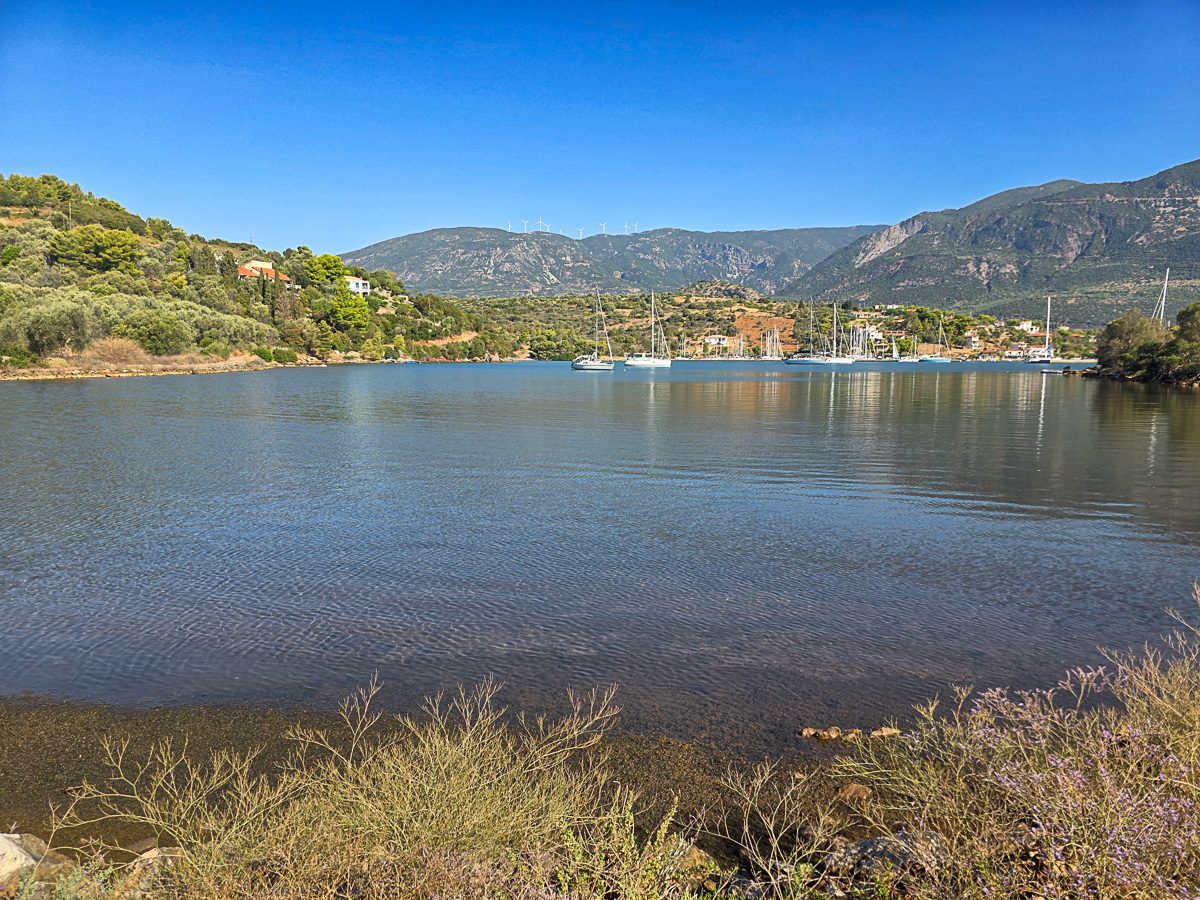
The walk began from my hotel, taking a route around the far side of the marina, following a dirt and gravel track. As the track dropped down again, there was a tiny pebble beach with a single umbrella. The path continued around a lagoon, as still and flat as glass. The water’s edge was lined with clumps of sea lavender which was a haven for bees and a variety of skittish butterflies. The path then tracked inland, climbing gradually. The heat and the humidity began to take its toll but I was determined to complete my mission.
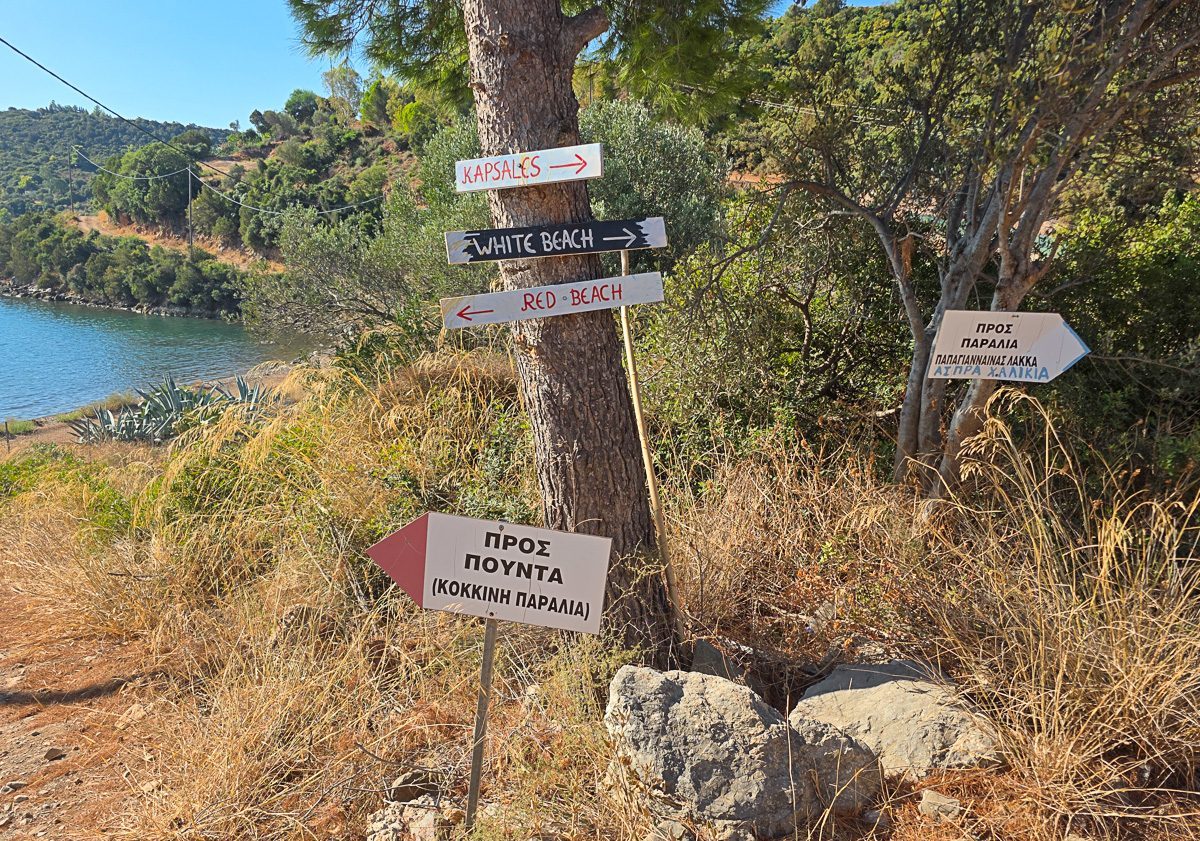
There came a junction if you like, where the track split off in different directions, each leading to another of the island’s beaches – White Beach and Kapsales. I kept Red Beach firmly in my sights.
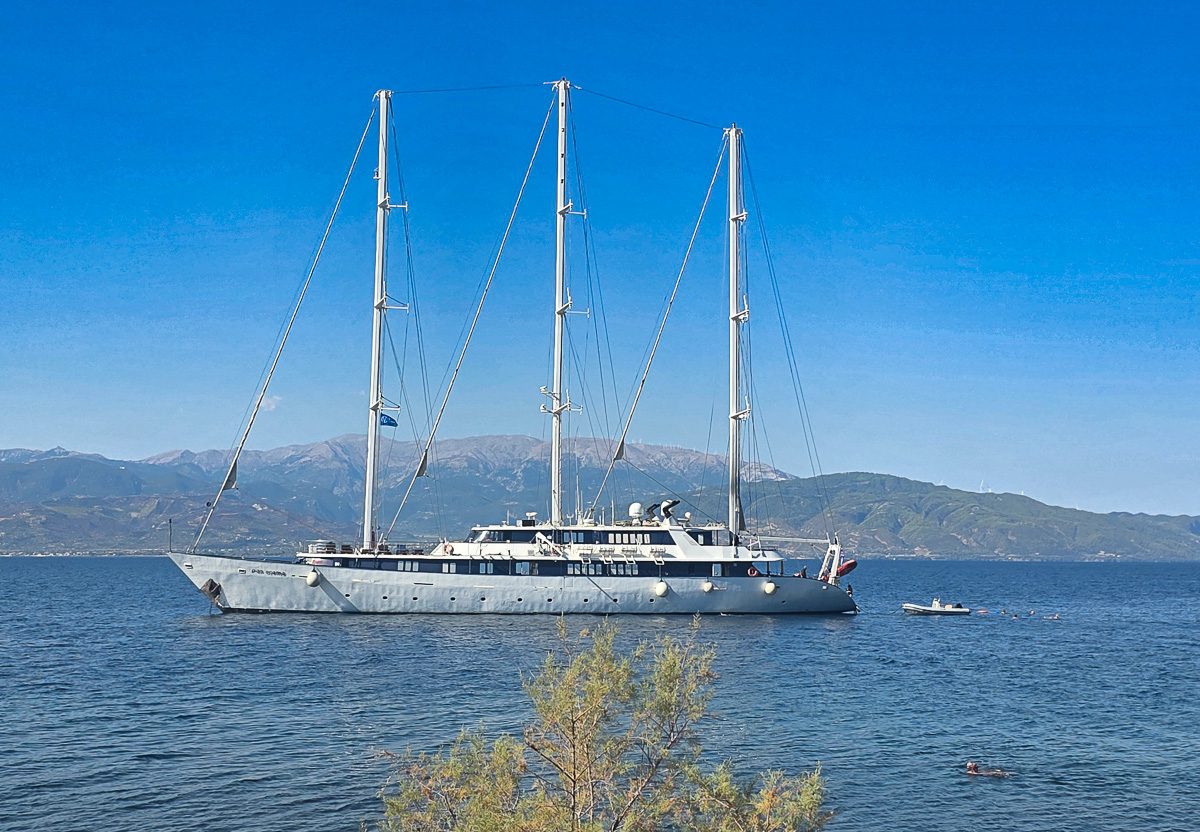
Eventually the track dropped down again, and as it did I could see the coast on the other side. Above the tops of the trees poked several tall masts of a boat. Then as I reached a clearing I could see that Red Beach was not the deserted paradise I had imagined. The boat, Pan Orama, had moored there for its guests. Although they were only about twenty people, they had taken every bit of shade under every tamarisk tree available. I hung around only long enough to take some photographs. The beach wasn’t that spectacular, to be honest, and I don’t think I’d have stayed here very long anyway.
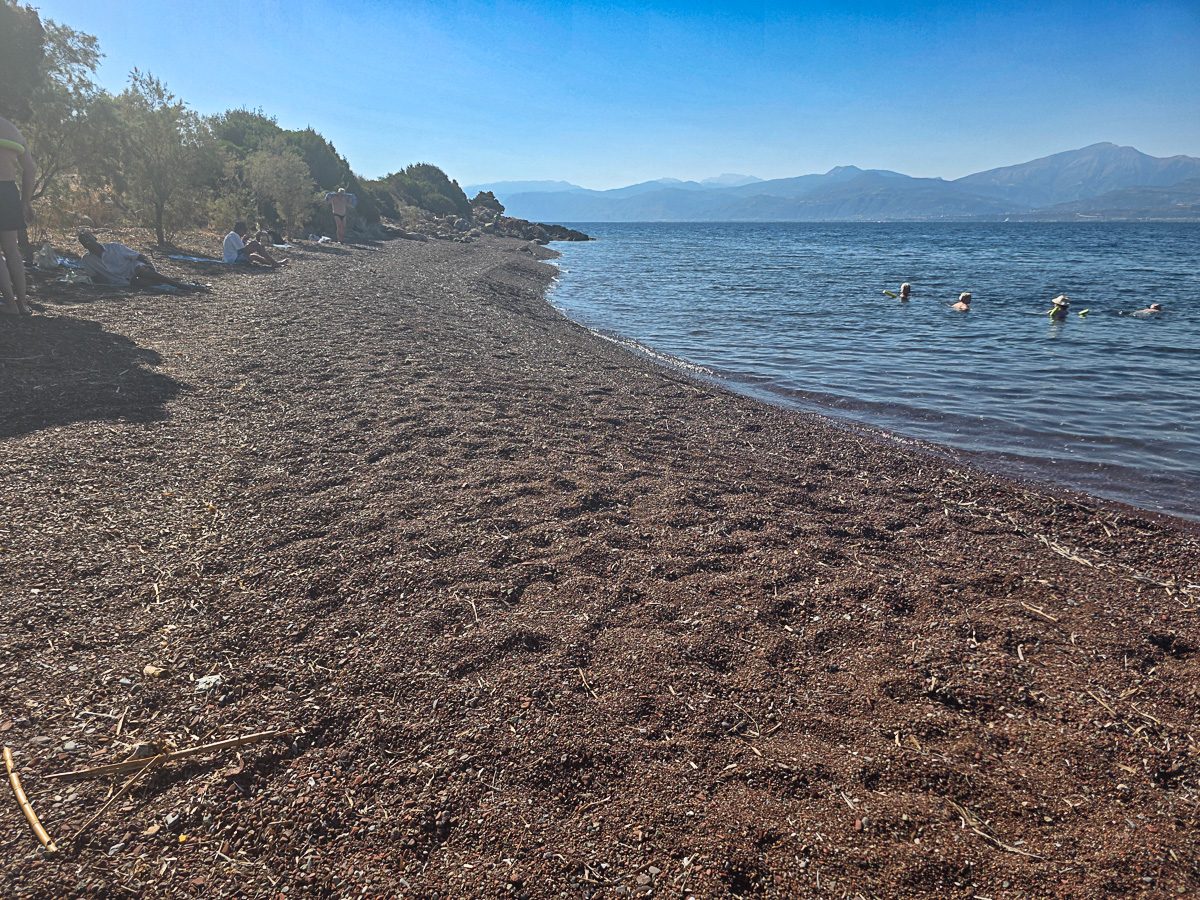
I began to make the trek back, stopping periodically to drink water. Out came the umbrella I’d bought in Zakynthos for 12€ which I thought was very overpriced for something so shoddily made but it actually began to be worth its weight in gold.

The Island Beach Bar
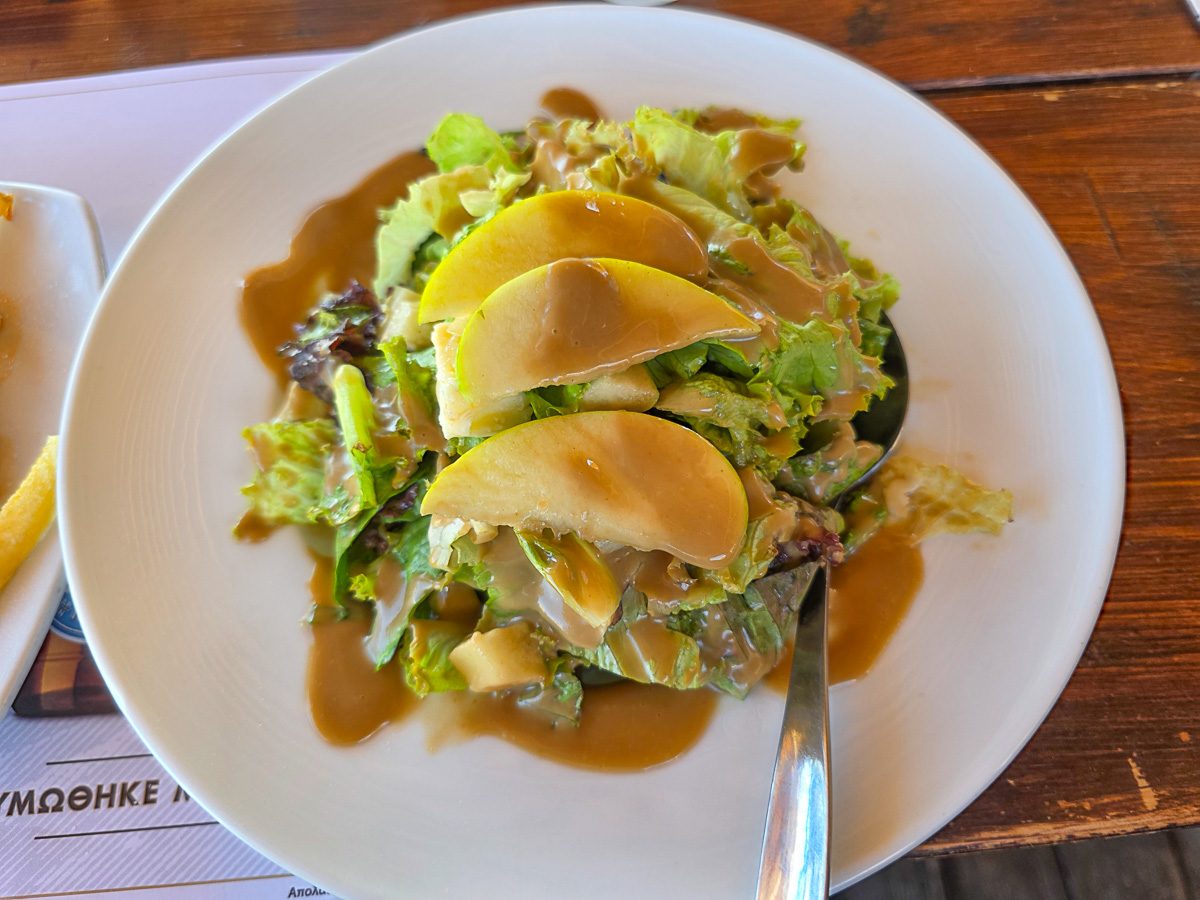
Back at the harbour there’s one small organised beach, run by the Island Beach Bar. I had breakfast there, fruit salad, exactly what the walk had earned me, and then, more or less on a whim, I asked whether I could take a sunbed. Fifteen euros for a set, the young man explained, with the condition that you also have to have lunch there. Fine by me. I stayed for the rest of the day, moving between the two sunbeds chasing the shade and swimming in water clear enough to see every pebble on the bottom. Beach shoes are worth having unless your feet are made of lead. I’m very princess and the pea when it comes to stones underfoot. At the waters edge the pebbles shelve steeply almost as soon as you’re in. Just a few metres out and you’re up to your neck. It’s not my favourite type of beach but swimming in the sea was a crucial means to survival.
The food at the Island Beach Bar earned its keep. With the 15€ charge for the sunbed plus breakfast and a late afternoon lunch it was 65€. and I didn’t begrudge a euro of it for a sunbed and the absolute peace and tranquility. The slow cooked beef in tomato sauce was exceptional. I really didn’t expect it to be so good for a beach bar.
I did notice a few of the yachting fraternity treating the place as a launch pad, swimming straight off the beach bar’s patch without paying for a sunbed or committing to a meal. Where I come from, we call that ‘all fur coat and no knickers’.

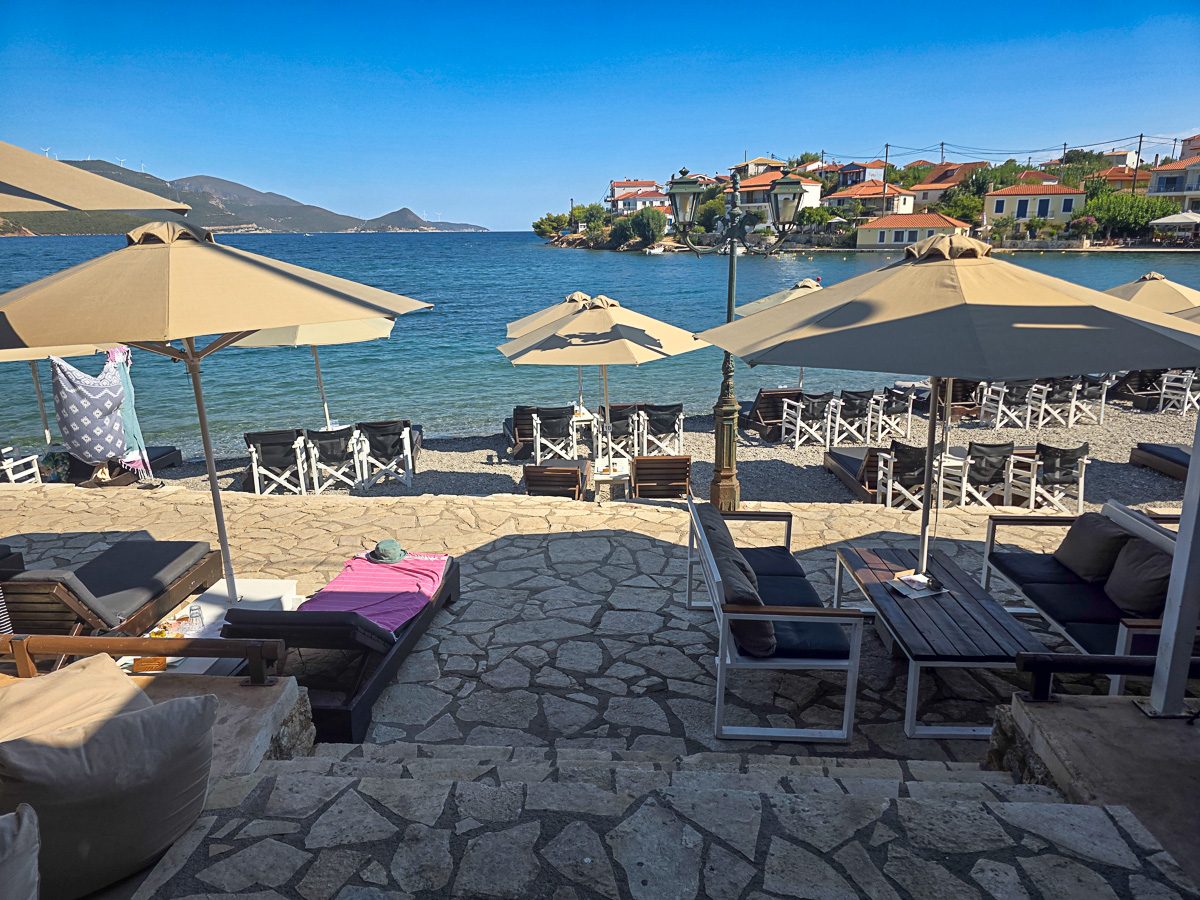


Lying there, you notice how quiet the island actually is, the only traffic being the seafaring kind. I started to get a sense of who else was around: a mix of day-trippers over from the mainland, none of whom seemed to bother with the far flung beaches on the other side of the island. Some headed round the harbour to use the pool facilities at the Trizonia Bay Hotel. The rest were the yachting crowd, German, French and British boats all moored up together.
I hadn’t quite clocked, until I was actually lying there doing nothing, how much of the previous two weeks had been such a whirlwind affair. Family holidays are wonderful and exhausting in roughly equal measure, especially for an introvert who needs a bit of solitude to recalibrate – but they know that about me. Somewhere between the ferry chaos and Mare Mare I’d been running on momentum rather than actually arriving anywhere. Trizonia was the first place I’d stopped moving albeit it only for 3 days. I still had work to do, emails, the odd travel issue for some of my clients. The business doesn’t pause just because I’m on a sunbed, but even that started to feel different done at this pace, laptop open for an hour, then shut again, no particular urgency attached to either.
Day Three: More of the Same, and No Regrets
I liked it at the Island Beach Bar enough to spend my third day exactly the same way. Honestly, there wasn’t much else to do, and for once that felt like the point rather than a failing. I hadn’t properly worked out where the rest of this trip was taking me, not in any real detail, and Trizonia turned out to be a decent place to let that sit unresolved for a while rather than rushing to fill in the gaps. Three days of not much happened to be exactly what I needed before figuring out what happened next.
Trizonia is a place to just be.
A Little More to See
When I said there wasn’t much to do on Trizonia, there are several walking opportunities. For those feeling a bit more intrepid than I, there is a walk that begins at the Church of Agios Giorgios that may be of interest. The church stands on the western side of the harbour, on a rocky rise among the pine trees, overlooking the channel. The road behind it rises steeply and eventually reaches Paleokastro sitting on the highest point of the island – or rather what remains of it.

Rather than an actual kastro, it was more of a medieval defensive tower thought to date from the Byzantine period, although its exact origins remain uncertain. The site is traditionally associated with the Maniote pirate Liberakis Gerakaris, who used Trizonia as a base during the 1690s. Today, there isn’t much left to see beyond fragments of the old fortification, but the elevated position makes it easy to understand why this was chosen as a defensive site. I did attempt this walk but it is steep and I was beaten back by the heat. However, I was rewarded with views over the channel between Trizonia and Xania.
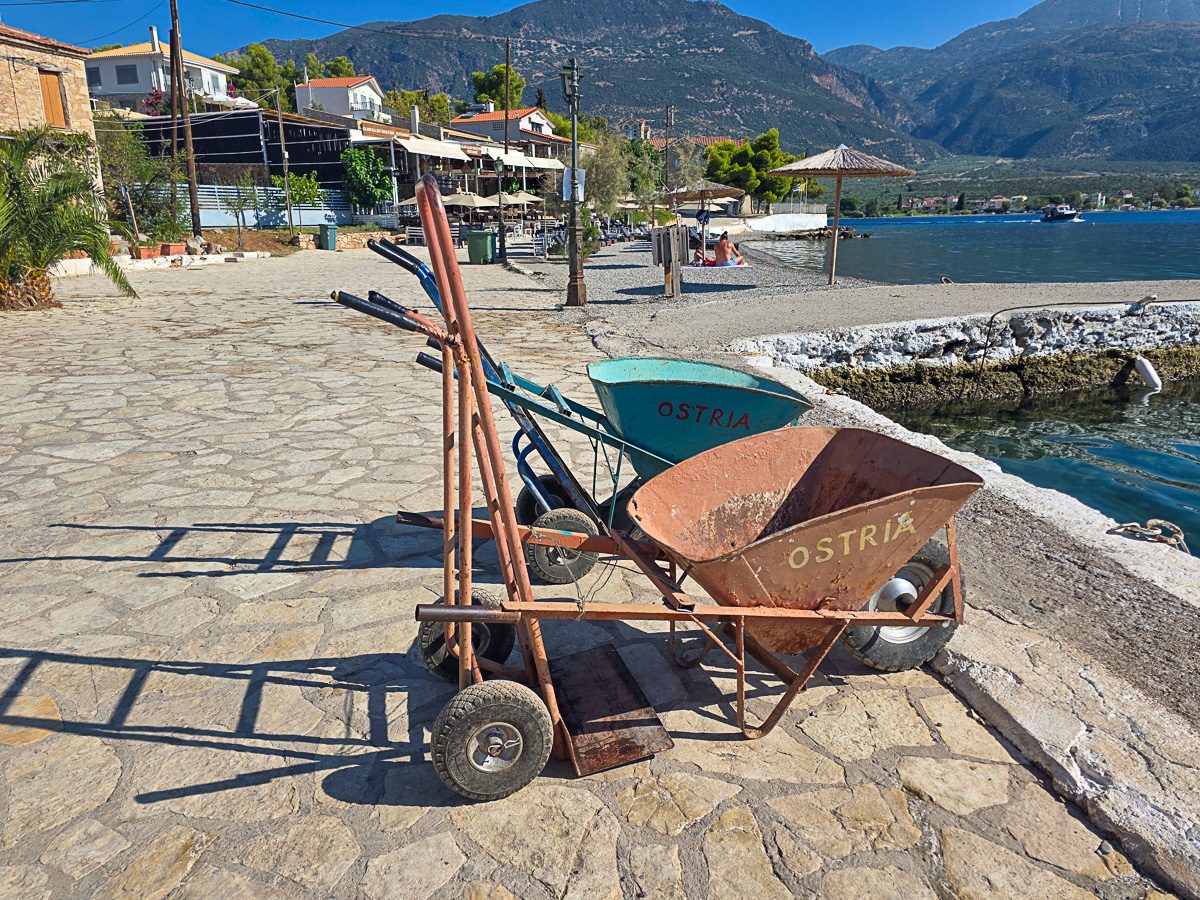
Another thing that interested me was the mechanics of getting goods and materials to the island. I noticed at the other end of the marina was a small car ferry. Parked close to it was a small truck with a grabber on the back. It seemed obvious to me that this was the way large heavy goods and materials are brought onto the island. Smaller, every day goods are brought by water taxi and then transported onwards in wheelbarrows. All very quaint.

Accommodation Options on Trizonia
Before I leave the island, a word on where to stay. Despite its small size there is a fairly good selection of accommodation options on the island for all budgets. Here is a small selection from across the range.
Drymna Hotel
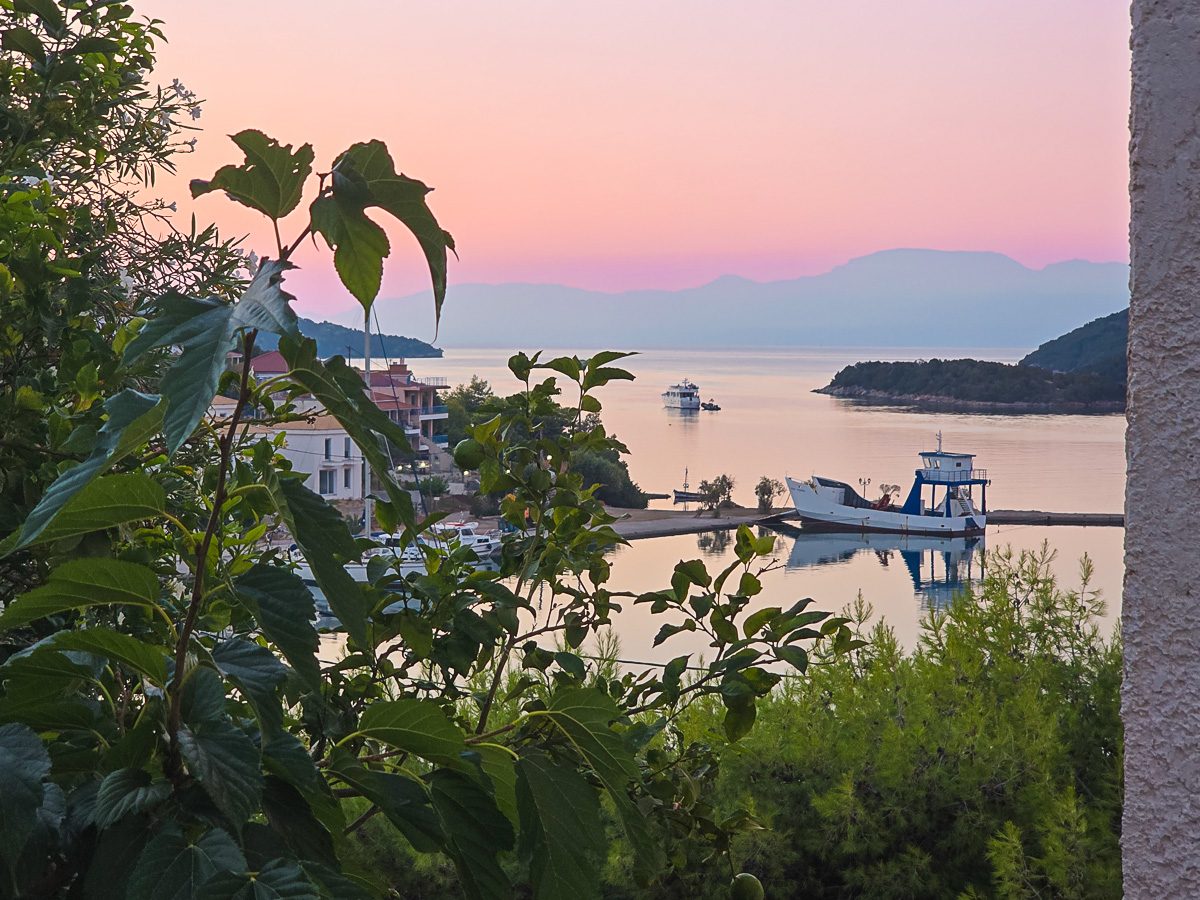
The budget option on the island and on the side of the marina so nice and quiet. As I mentioned earlier the rooms were fairly basic but spacious with a nice large terrace with a slither of a sea view – nice at sunset. It provides laundry services to the guests and yachters and it also advertises breakfast and a bar. I didn’t partake of breakfast here but after a more than substantial meal at the Island Beach Bar I did decide to order a drink on the shared terrace overlooking the marina. The choice was very limited and resembled the drinks cabinet at Abigail’s Party. Tia Maria, Cinzano Bianco, Kahlua, Cointreau, whisky of some description, Metaxa brandy and the remnants of a bottle of Campari. I settled for the latter with lemonade. Cost around 50€ per night

Trizonia Bay Hotel
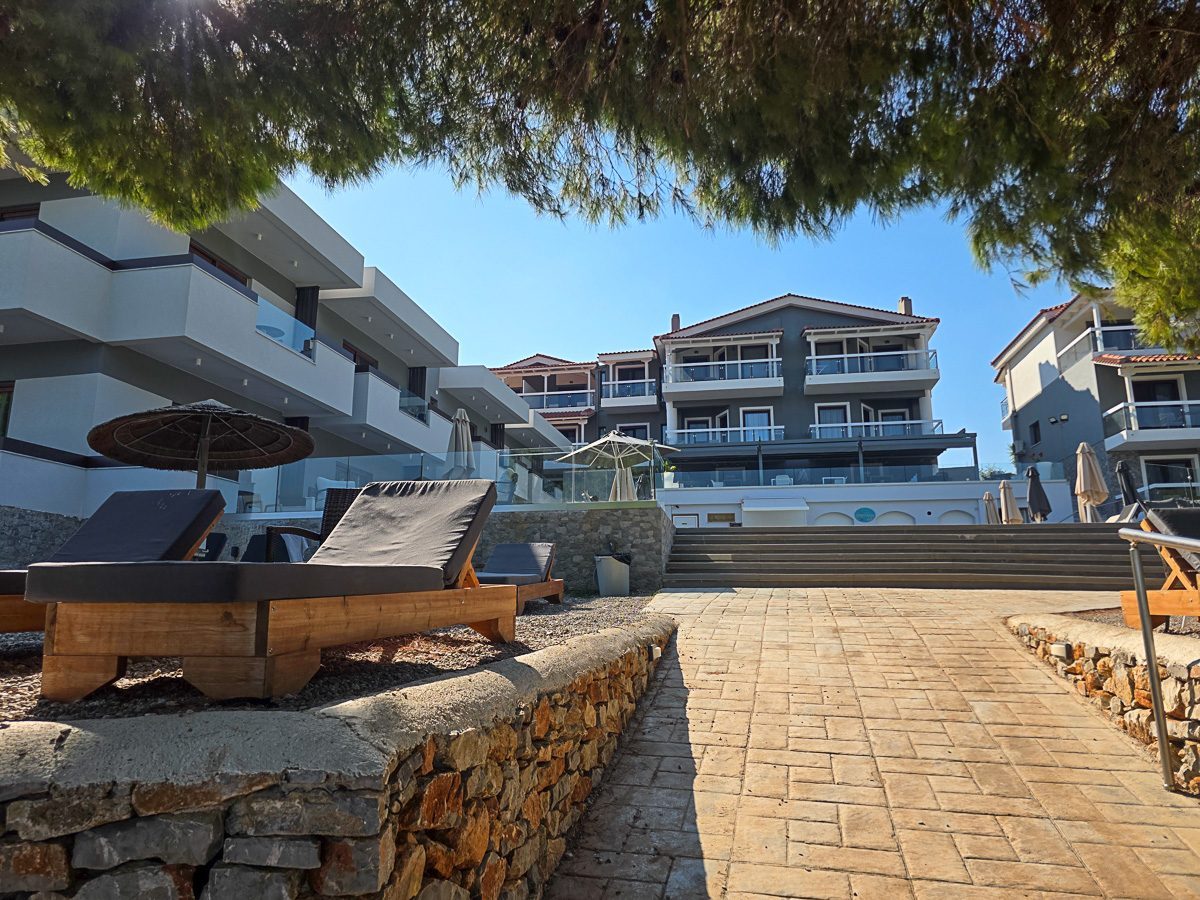
Around the other side of the harbour, Trizonia Bay Hotel is a recently renovated three-star aparthotel sitting directly on the waterfront. The accommodation ranges from double rooms to spacious suites, with many rooms offering sea views and private balconies. Some of the larger units also have their own kitchenette, making them particularly suitable for longer stays.
The hotel has a large outdoor swimming pool surrounded by sun loungers, a garden and a sea-facing terrace, while the poolside snack bar serves drinks and light meals. There is also a small beach directly below the hotel, although it really is tiny, with room for little more than two sunbeds.
Other facilities include free Wi-Fi, air conditioning, daily housekeeping and a tennis court. Massage treatments are also available, provided by a qualified physiotherapist. Breakfast is served on the waterfront terrace and includes a continental buffet with local specialities, pastries and fresh fruit.
The overall feel is considerably more polished than you might expect from a small island hotel, with well-presented rooms, landscaped grounds and plenty of outdoor space. The combination of balconies, sea views, swimming pool and waterfront terrace makes it particularly geared towards guests who want somewhere to linger rather than simply somewhere to sleep. Average cost 100 – 120€ per night.
Boutique Hotel Iasmos
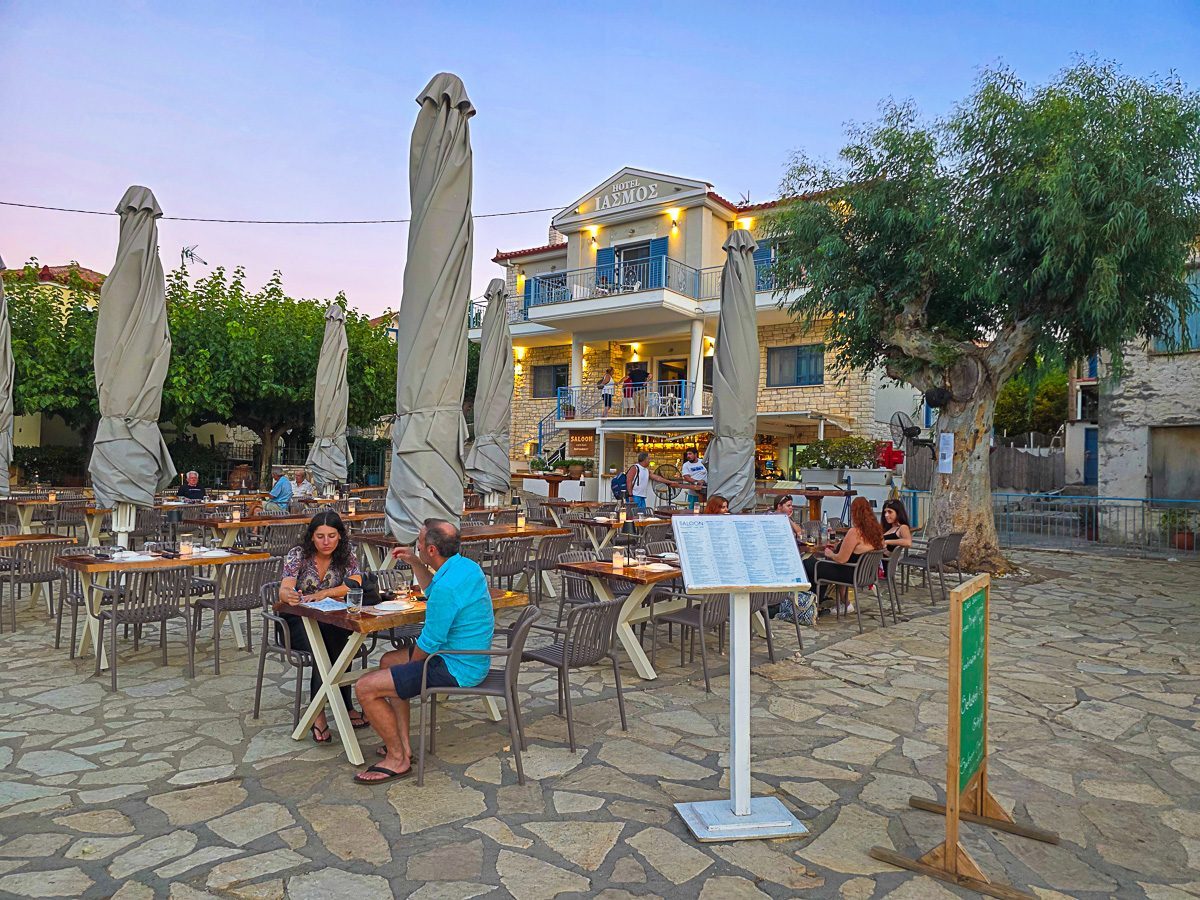
Boutique Hotel Iasmos is a small, intimate three-star hotel right on the waterfront, with rooms and suites overlooking the harbour. Rooms are modern and spacious, with air conditioning, Wi-Fi, tea and coffee-making facilities, and several have private balconies or terraces with water views. The larger suites have separate sitting areas and can accommodate up to four guests.
The hotel’s Saloon restaurant serves breakfast, lunch and dinner, with a terrace overlooking the water, while room service is also available. There is no swimming pool, but the hotel makes up for this with its excellent waterfront position and personal feel. The ferry landing is immediately nearby, making it particularly convenient when arriving with luggage. I can vouch for their breakfast.
Average cost: around €75–€100 per night for two, depending on the room and date.
Book Boutique Hotel Iasmos here

Time to leave this little paradise came soon enough. Getting on to my next destination required a bit more thought. The bus from Xania back to Nafpaktos would arrive at 3.30ish. My host advised me that I would get the 3pm water taxi, walk to the bus stop and wait for around 40 minutes. The maths didn’t add up but I really didn’t fancy just hanging around all that time. Instead I decided to get the 11am water taxi and try and get a road taxi from Xania.
The water taxi back to Xania felt different to the crossing over. Three days is nothing, but it was long enough for Trizonia to have done its work. No cars, no motorbikes, nothing much to do but move between two sunbeds and watch the yachts come and go, and somehow that had been exactly enough.
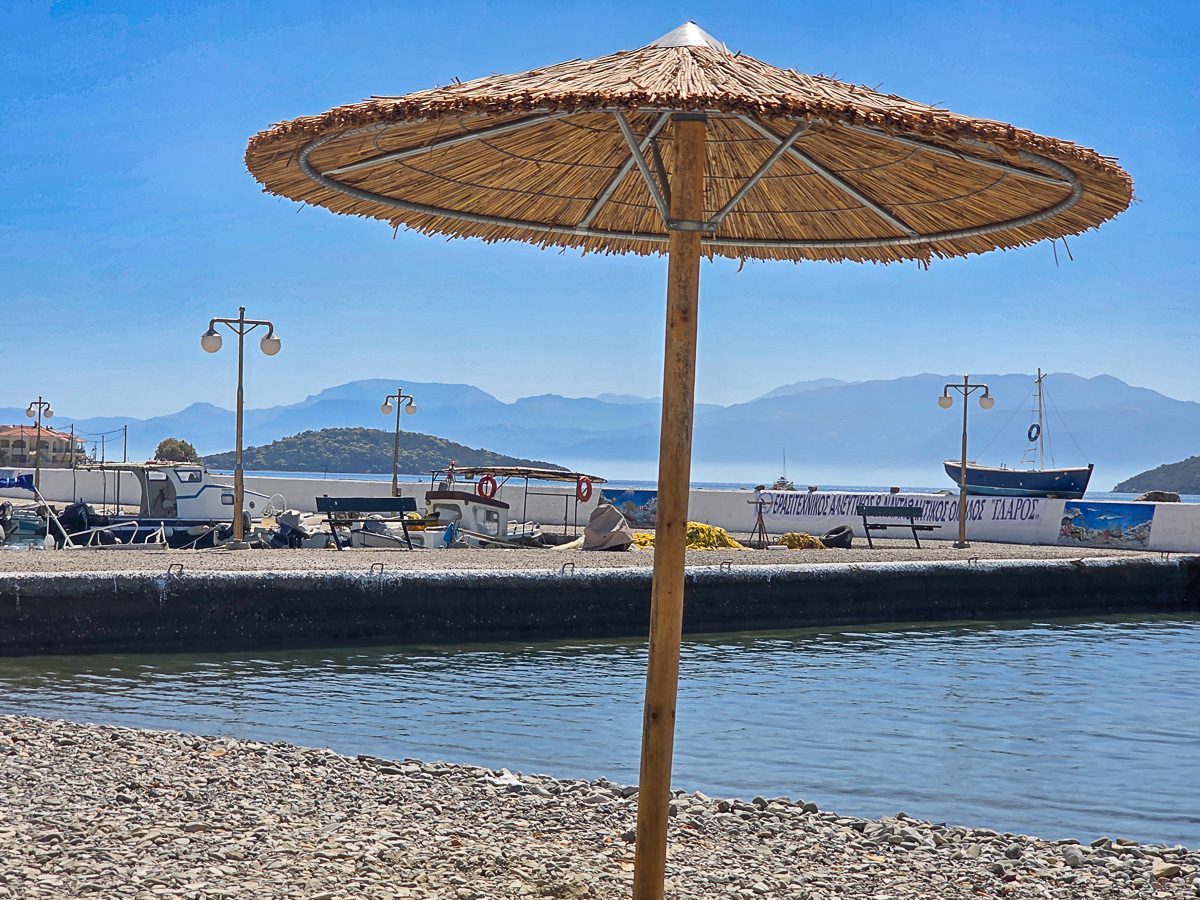
Getting a taxi from Xania itself didn’t materialise, so I ended up dragging my case along to the next village, Glyfa, not through any plan but because I was looking for a café that wasn’t full of old men who just looked me up and down when I walked in. Glyfa delivered. I found a spot on the beach under the trees, ordered a pastry and a cup of tea, and got down to the business of finding transport onward.
The lady in the café gave me a card with three taxi numbers. The first two went unanswered. The third picked up, but the driver was in Athens. I asked the café to try one more number for me, since the driver didn’t speak English and my Greek wasn’t going to stretch to logistics. No joy there either, at first, though the lady who ran the cafe did tell me her sister would be driving to Nafpaktos and would take me in about twenty minutes. Very kind of her.
Ten minutes later, the first taxi driver called back. He’d be there in twenty minutes after all, he said, a nice young man who ran his own small company and also did tours out to Delphi. I relaxed back into the shade with what was left of my pastry and waited. Twenty minutes later, I was in the car, heading for Nafpaktos.
Discover more from
Subscribe to get the latest posts sent to your email.
MY BIG FAT GREEK TRAVEL SURVEY
How do you really plan your Greek adventures? I'd love to hear from you.
TAKE THE SURVEY →